
Going Further: The Incomparable Clarence Thomas
Hardcover
• 336 Pages
• USD 35.00
• English
• 9798217181193
No ratings yet
| Publisher | Sentinel |
|---|---|
| ISBN13 | 9798217181193 |
| ASIN/SKU | B0GXNLZ6W8 |
| Book Format | Hardcover |
| Language | English |
| Pages | 336 |
| List Price | USD 35.00 |
| Publishing Date | 25/08/2026 |
| Dimensions | 6.28 x 1.11 x 9.3 inches |
| Weight | 1.2 pounds |
| Book Code | BD00070244 |
Buy this Book
Amazon Stores
Ebook Stores
Other Stores
Discover Going Further: The Incomparable Clarence Thomas by Ted Cruz. This book is published by Sentinel in Hardcover format, ISBN 9798217181193, ASIN B0GXNLZ6W8, under Law, General Constitutional Law, Law Specialties.
Book Description
From Senator Ted Cruz, a timely, authoritative exploration of Clarence Thomas’s life, ideas, and lasting impact on constitutional law
For over three decades, Clarence Thomas has stood at the center of American law, enduring withering criticism and personal attacks while writing some of the most brilliant, accessible, transformational opinions in the Supreme Court’s history. His insistence that the Constitution, not merely judicial precedent, is the highest authority has reshaped American jurisprudence, and his lasting impact on the trajectory of constitutional law is undeniable.
In this powerful and timely book, Senator Ted Cruz draws on his own Supreme Court clerkship, on his many years as a Supreme Court advocate, and on his now decades-long friendship with Justice Thomas to paint a portrait of one of the most consequential—and misunderstood—Americans in our nation’s history. Drawing on nine hours of exclusive, wide-ranging, and deeply personal one-on-one interviews with the Justice, Cruz reveals how Thomas’s most formative early experiences—like growing up in crushing poverty in segregated Georgia, his early encounters with extreme racism, and his brief stint in radical left-wing politics—forged a lifelong commitment to independence, self-reliance, and truth.
From Thomas's early years studying to be a priest to his role today as the intellectual force behind some of the Court’s most significant decisions, Going Further traces the formation of one of our Constitution’s staunchest defenders and makes a rousing argument about why his life, his ideas, and his courage matter now more than ever.
For over three decades, Clarence Thomas has stood at the center of American law, enduring withering criticism and personal attacks while writing some of the most brilliant, accessible, transformational opinions in the Supreme Court’s history. His insistence that the Constitution, not merely judicial precedent, is the highest authority has reshaped American jurisprudence, and his lasting impact on the trajectory of constitutional law is undeniable.
In this powerful and timely book, Senator Ted Cruz draws on his own Supreme Court clerkship, on his many years as a Supreme Court advocate, and on his now decades-long friendship with Justice Thomas to paint a portrait of one of the most consequential—and misunderstood—Americans in our nation’s history. Drawing on nine hours of exclusive, wide-ranging, and deeply personal one-on-one interviews with the Justice, Cruz reveals how Thomas’s most formative early experiences—like growing up in crushing poverty in segregated Georgia, his early encounters with extreme racism, and his brief stint in radical left-wing politics—forged a lifelong commitment to independence, self-reliance, and truth.
From Thomas's early years studying to be a priest to his role today as the intellectual force behind some of the Court’s most significant decisions, Going Further traces the formation of one of our Constitution’s staunchest defenders and makes a rousing argument about why his life, his ideas, and his courage matter now more than ever.
Author Biography
Sen. Ted Cruz represents 30 million Texans in the U.S. Senate as a passionate fighter for limited government, national security, and economic growth. He has authored dozens of legislative measures that have been signed into law, including expanding 529 college savings accounts to allow parents to save for K–12 public, private, and religious education, repealing Obamacare’s individual mandate, imposing sanctions on terrorists who use civilians as human shields, designating North Korea as a state sponsor of terrorism, targeting Putin’s Nord Stream 2 pipeline through multiple bills that halted construction and kept it stalled, reauthorizing and reforming NASA, holding dictatorships in South America accountable, ensuring the availability of additional records to help solve Civil Rights cold cases, and ending the Department of Defense’s unjust COVID-19 vaccine mandate. He is also leading the fight in the Senate to support Texas jobs, hold Big Tech accountable to the American people, secure the border, fundamentally reassess the U.S.-China relationship and hold the Chinese Communist Party accountable for covering up the coronavirus pandemic, committing human rights atrocities, and engaging in censorship, propaganda, and espionage in the United States.
In addition to serving in the Senate, Sen. Cruz co-hosts the podcast Verdict with Ted Cruz, where he breaks down the most important news stories of the day and what they mean for the American people. He is also the author of three New York Times Bestsellers. A Time for Truth: Reigniting the Promise of America details his journey as the son of a Cuban immigrant who grew up in Texas and was elected to the United States Senate. One Vote Away: How a Single Supreme Court Seat Can Change History explains what happens behind the scenes at the Supreme Court when our constitutional rights are at stake. In the book, Sen. Cruz examines eight constitutional issues and landmark Supreme Court cases that every American should know about, almost all of which he helped litigate. Nearly all of the cases discussed in the book were decided by just one vote. In his book Justice Corrupted: How the Left Weaponized the Legal System, Sen. Cruz lays out how the left has used the mechanisms of government to target their political opponents, especially under Presidents Obama and Biden.
Sen. Cruz is a graduate of Princeton University and Harvard Law School. He is a former law clerk to Chief Justice William Rehnquist, and former solicitor general of Texas. He has argued nine cases before the Supreme Court. In November of 2018, he was re-elected to the Senate by the people of Texas.
Sen. Cruz sits on four committees—the Foreign Relations Committee; Commerce, Science and Transportation Committee; Judiciary Committee; and Rules Committee. He serves as the Ranking Member on the Commerce, Science and Transportation Committee. In the Judiciary Committee, he is the Ranking Member on the Subcommittee on The Constitution.
In addition to serving in the Senate, Sen. Cruz co-hosts the podcast Verdict with Ted Cruz, where he breaks down the most important news stories of the day and what they mean for the American people. He is also the author of three New York Times Bestsellers. A Time for Truth: Reigniting the Promise of America details his journey as the son of a Cuban immigrant who grew up in Texas and was elected to the United States Senate. One Vote Away: How a Single Supreme Court Seat Can Change History explains what happens behind the scenes at the Supreme Court when our constitutional rights are at stake. In the book, Sen. Cruz examines eight constitutional issues and landmark Supreme Court cases that every American should know about, almost all of which he helped litigate. Nearly all of the cases discussed in the book were decided by just one vote. In his book Justice Corrupted: How the Left Weaponized the Legal System, Sen. Cruz lays out how the left has used the mechanisms of government to target their political opponents, especially under Presidents Obama and Biden.
Sen. Cruz is a graduate of Princeton University and Harvard Law School. He is a former law clerk to Chief Justice William Rehnquist, and former solicitor general of Texas. He has argued nine cases before the Supreme Court. In November of 2018, he was re-elected to the Senate by the people of Texas.
Sen. Cruz sits on four committees—the Foreign Relations Committee; Commerce, Science and Transportation Committee; Judiciary Committee; and Rules Committee. He serves as the Ranking Member on the Commerce, Science and Transportation Committee. In the Judiciary Committee, he is the Ranking Member on the Subcommittee on The Constitution.
Editorial Reviews
Editorial Reviews will be added soon…
Book Summary
Ted Cruz’s Going Further: The Incomparable Clarence Thomas is a biography of Supreme Court Justice Clarence Thomas that combines personal history, constitutional philosophy, and political commentary. Published in August 2026, the 336-page book is based not only on Cruz’s long professional relationship with Thomas but also on roughly nine hours of private, one-on-one interviews with the justice. Cruz’s central argument is that Thomas is one of the most consequential and misunderstood figures in modern American law, a man whose unusual independence has allowed him to remain committed to constitutional principles even when those principles have left him isolated.
The book begins with the experiences that Cruz believes made Thomas the person he eventually became. Thomas grew up in Pin Point, Georgia, in circumstances marked by poverty and racial segregation. His childhood was not a comfortable beginning to a life at the highest level of American public service. Instead, it exposed him early to hardship, racial prejudice, discipline, and the importance of self-reliance. Cruz places particular importance on Thomas’s grandfather, whose strong work ethic and faith in personal responsibility became an enduring influence. Rather than presenting Thomas’s later success as simply the result of exceptional education or professional opportunity, Cruz portrays it as the product of character formed under difficult circumstances.
One of the most interesting parts of Going Further is Thomas’s intellectual and political transformation. His early life did not follow the straightforward conservative path that his later judicial career might suggest. Thomas spent time studying for the priesthood and became deeply involved in the political and racial movements of the 1960s. He was, for a period, influenced by radical left-wing ideas. Cruz argues that Thomas’s eventual movement away from radicalism was not a sudden conversion but a long process of questioning. His experiences with racial politics, affirmative action, government institutions, and political ideology gradually convinced him that ideological labels could become another form of conformity.
This idea of independence becomes one of the book’s defining themes. Cruz believes Thomas’s greatest quality is his willingness to think for himself. Thomas, in this account, does not easily accept the assumptions of either political party, intellectual establishment, or legal tradition. His experiences taught him to distrust groupthink. For Cruz, that independence explains why Thomas has sometimes been willing to stand alone on the Supreme Court, even when doing so meant enduring criticism from colleagues, journalists, politicians, and activists.
The title Going Further captures this characteristic. Cruz describes Thomas as a justice who frequently takes an argument further than his colleagues are prepared to take it. Instead of stopping at an incremental legal conclusion, Thomas often asks what the Constitution actually requires if its principles are followed to their logical foundation. Cruz connects this approach to Thomas’s commitment to originalism—the belief that constitutional provisions should be understood according to their original public meaning rather than continually reshaped according to changing political or cultural preferences.
The book therefore moves naturally from biography into constitutional law. Cruz presents Thomas as a justice who regards the Constitution as a limitation on government power rather than simply a collection of judicial precedents. In this philosophy, individual rights do not originate because government decides to grant them. Instead, government exists within boundaries established by constitutional principles and the natural rights tradition associated with the Declaration of Independence. Thomas’s jurisprudence emphasizes federalism, separation of powers, individual liberty, and skepticism toward the expansion of judicial authority.
Cruz also examines Thomas’s controversial confirmation to the Supreme Court in 1991. The confirmation hearings, particularly the allegations made by Anita Hill, became one of the most bitter episodes in modern Senate history. Going Further treats this period as a crucial test of Thomas’s resilience. Cruz argues that the intense scrutiny and personal attacks Thomas experienced helped define his later determination not to allow public hostility to control his judicial decisions. The book places these events within the larger story of Thomas’s career and the political battles surrounding conservative judges in America.
Another important subject is Thomas’s development as a Supreme Court writer. Cruz argues that Thomas’s opinions have become increasingly influential because they are willing to challenge established assumptions rather than merely modify them. The book highlights his readiness to question precedents, reconsider longstanding doctrines, and return to constitutional foundations. One example discussed by reviewers is Thomas’s position in Printz v. United States, where he argued that the Second Amendment protected an individual right years before the Supreme Court’s later decision in District of Columbia v. Heller.
Yet Going Further is not simply a legal biography. At its heart, it is a book about character. Cruz sees Thomas’s life as an example of perseverance in the face of rejection and hostility. The justice’s journey from poverty in segregated Georgia to the Supreme Court is presented as evidence that a person can resist both external expectations and internal doubts. Thomas’s story, in Cruz’s telling, is particularly significant because he repeatedly refused to accept the idea that his racial identity required him to embrace a particular political ideology.
That aspect of the book is especially relevant to Cruz’s broader argument about American freedom. He portrays Thomas as someone who insists on individual judgment rather than collective identity. The result is a portrait of a man who has often been treated as an outsider but has deliberately refused to surrender his convictions merely to gain acceptance. Recent interviews with Thomas similarly emphasize his belief that political expectations should not determine the views of Black Americans or anyone else.
Cruz’s own perspective is impossible to separate from the book. He is not a detached biographer. He is a longtime admirer, former Supreme Court clerk, appellate lawyer, senator, and friend of Thomas. Consequently, the book is openly sympathetic to its subject. It is best understood not as a neutral assessment of every criticism ever directed at Thomas, but as a forceful defense of his character, judicial philosophy, and legacy. Cruz wants readers—especially those unfamiliar with constitutional law—to see Thomas beyond the political controversies that have surrounded him.
Ultimately, Going Further presents Clarence Thomas as a model of intellectual independence and perseverance. Its larger message is that constitutional principles have little meaning if judges abandon them whenever they become unpopular. For Cruz, Thomas’s importance lies precisely in his willingness to stand apart, reconsider conventional wisdom, and follow his understanding of the Constitution to its furthest implications. The book therefore becomes both a biography and an argument: Thomas’s extraordinary journey matters not only because he became a Supreme Court justice, but because he reached that position without allowing poverty, racism, political pressure, ideological expectations, or public criticism to determine who he would become.
The book begins with the experiences that Cruz believes made Thomas the person he eventually became. Thomas grew up in Pin Point, Georgia, in circumstances marked by poverty and racial segregation. His childhood was not a comfortable beginning to a life at the highest level of American public service. Instead, it exposed him early to hardship, racial prejudice, discipline, and the importance of self-reliance. Cruz places particular importance on Thomas’s grandfather, whose strong work ethic and faith in personal responsibility became an enduring influence. Rather than presenting Thomas’s later success as simply the result of exceptional education or professional opportunity, Cruz portrays it as the product of character formed under difficult circumstances.
One of the most interesting parts of Going Further is Thomas’s intellectual and political transformation. His early life did not follow the straightforward conservative path that his later judicial career might suggest. Thomas spent time studying for the priesthood and became deeply involved in the political and racial movements of the 1960s. He was, for a period, influenced by radical left-wing ideas. Cruz argues that Thomas’s eventual movement away from radicalism was not a sudden conversion but a long process of questioning. His experiences with racial politics, affirmative action, government institutions, and political ideology gradually convinced him that ideological labels could become another form of conformity.
This idea of independence becomes one of the book’s defining themes. Cruz believes Thomas’s greatest quality is his willingness to think for himself. Thomas, in this account, does not easily accept the assumptions of either political party, intellectual establishment, or legal tradition. His experiences taught him to distrust groupthink. For Cruz, that independence explains why Thomas has sometimes been willing to stand alone on the Supreme Court, even when doing so meant enduring criticism from colleagues, journalists, politicians, and activists.
The title Going Further captures this characteristic. Cruz describes Thomas as a justice who frequently takes an argument further than his colleagues are prepared to take it. Instead of stopping at an incremental legal conclusion, Thomas often asks what the Constitution actually requires if its principles are followed to their logical foundation. Cruz connects this approach to Thomas’s commitment to originalism—the belief that constitutional provisions should be understood according to their original public meaning rather than continually reshaped according to changing political or cultural preferences.
The book therefore moves naturally from biography into constitutional law. Cruz presents Thomas as a justice who regards the Constitution as a limitation on government power rather than simply a collection of judicial precedents. In this philosophy, individual rights do not originate because government decides to grant them. Instead, government exists within boundaries established by constitutional principles and the natural rights tradition associated with the Declaration of Independence. Thomas’s jurisprudence emphasizes federalism, separation of powers, individual liberty, and skepticism toward the expansion of judicial authority.
Cruz also examines Thomas’s controversial confirmation to the Supreme Court in 1991. The confirmation hearings, particularly the allegations made by Anita Hill, became one of the most bitter episodes in modern Senate history. Going Further treats this period as a crucial test of Thomas’s resilience. Cruz argues that the intense scrutiny and personal attacks Thomas experienced helped define his later determination not to allow public hostility to control his judicial decisions. The book places these events within the larger story of Thomas’s career and the political battles surrounding conservative judges in America.
Another important subject is Thomas’s development as a Supreme Court writer. Cruz argues that Thomas’s opinions have become increasingly influential because they are willing to challenge established assumptions rather than merely modify them. The book highlights his readiness to question precedents, reconsider longstanding doctrines, and return to constitutional foundations. One example discussed by reviewers is Thomas’s position in Printz v. United States, where he argued that the Second Amendment protected an individual right years before the Supreme Court’s later decision in District of Columbia v. Heller.
Yet Going Further is not simply a legal biography. At its heart, it is a book about character. Cruz sees Thomas’s life as an example of perseverance in the face of rejection and hostility. The justice’s journey from poverty in segregated Georgia to the Supreme Court is presented as evidence that a person can resist both external expectations and internal doubts. Thomas’s story, in Cruz’s telling, is particularly significant because he repeatedly refused to accept the idea that his racial identity required him to embrace a particular political ideology.
That aspect of the book is especially relevant to Cruz’s broader argument about American freedom. He portrays Thomas as someone who insists on individual judgment rather than collective identity. The result is a portrait of a man who has often been treated as an outsider but has deliberately refused to surrender his convictions merely to gain acceptance. Recent interviews with Thomas similarly emphasize his belief that political expectations should not determine the views of Black Americans or anyone else.
Cruz’s own perspective is impossible to separate from the book. He is not a detached biographer. He is a longtime admirer, former Supreme Court clerk, appellate lawyer, senator, and friend of Thomas. Consequently, the book is openly sympathetic to its subject. It is best understood not as a neutral assessment of every criticism ever directed at Thomas, but as a forceful defense of his character, judicial philosophy, and legacy. Cruz wants readers—especially those unfamiliar with constitutional law—to see Thomas beyond the political controversies that have surrounded him.
Ultimately, Going Further presents Clarence Thomas as a model of intellectual independence and perseverance. Its larger message is that constitutional principles have little meaning if judges abandon them whenever they become unpopular. For Cruz, Thomas’s importance lies precisely in his willingness to stand apart, reconsider conventional wisdom, and follow his understanding of the Constitution to its furthest implications. The book therefore becomes both a biography and an argument: Thomas’s extraordinary journey matters not only because he became a Supreme Court justice, but because he reached that position without allowing poverty, racism, political pressure, ideological expectations, or public criticism to determine who he would become.
Sample Chapters
Sample Chapters will be added soon…
Reader Reviews
No reviews yet.
Going Further: The Incomparable Clarence Thomas
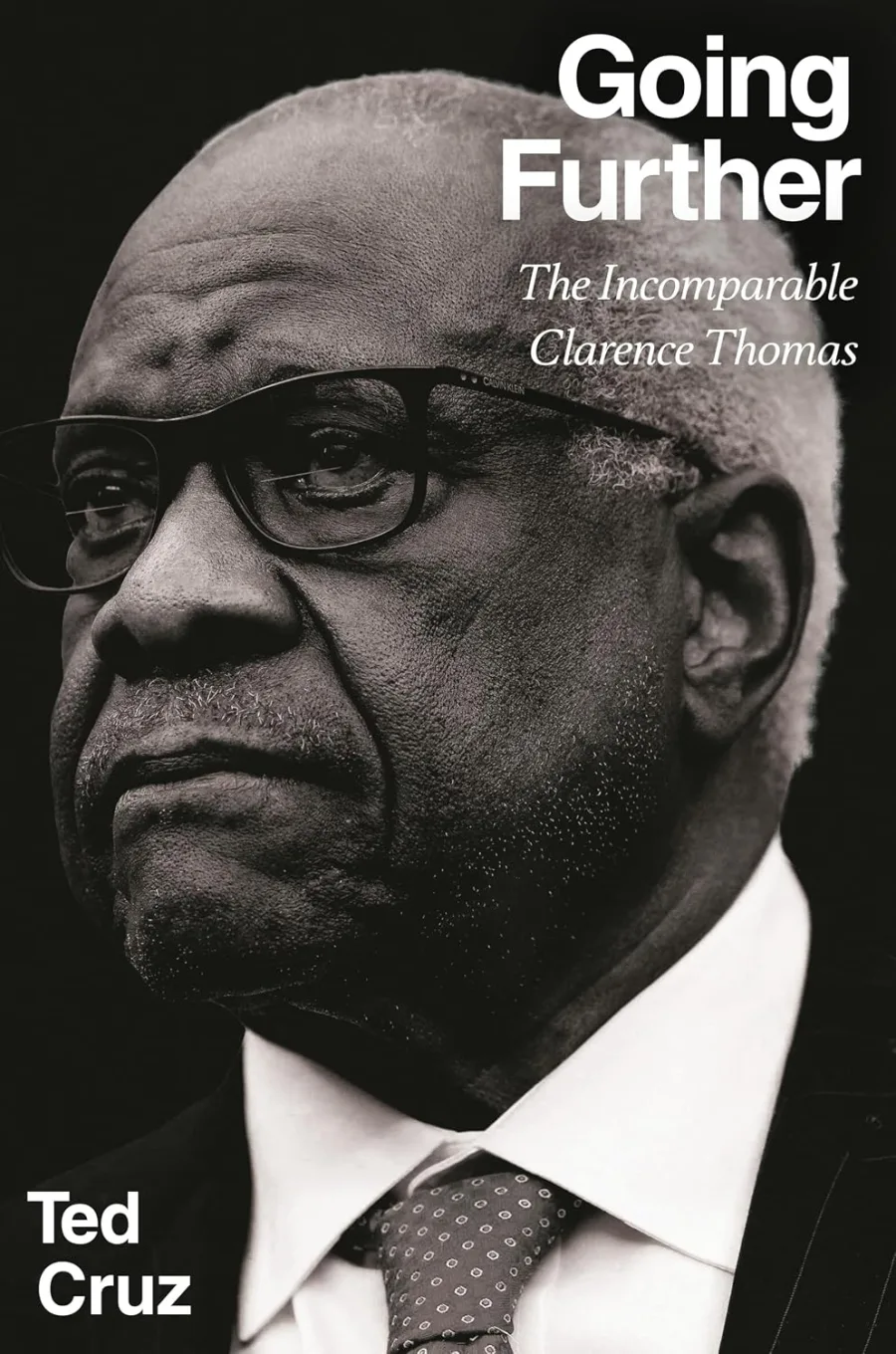
Download Cover Image
Do you want to download the full cover image for Going Further: The Incomparable Clarence Thomas?