
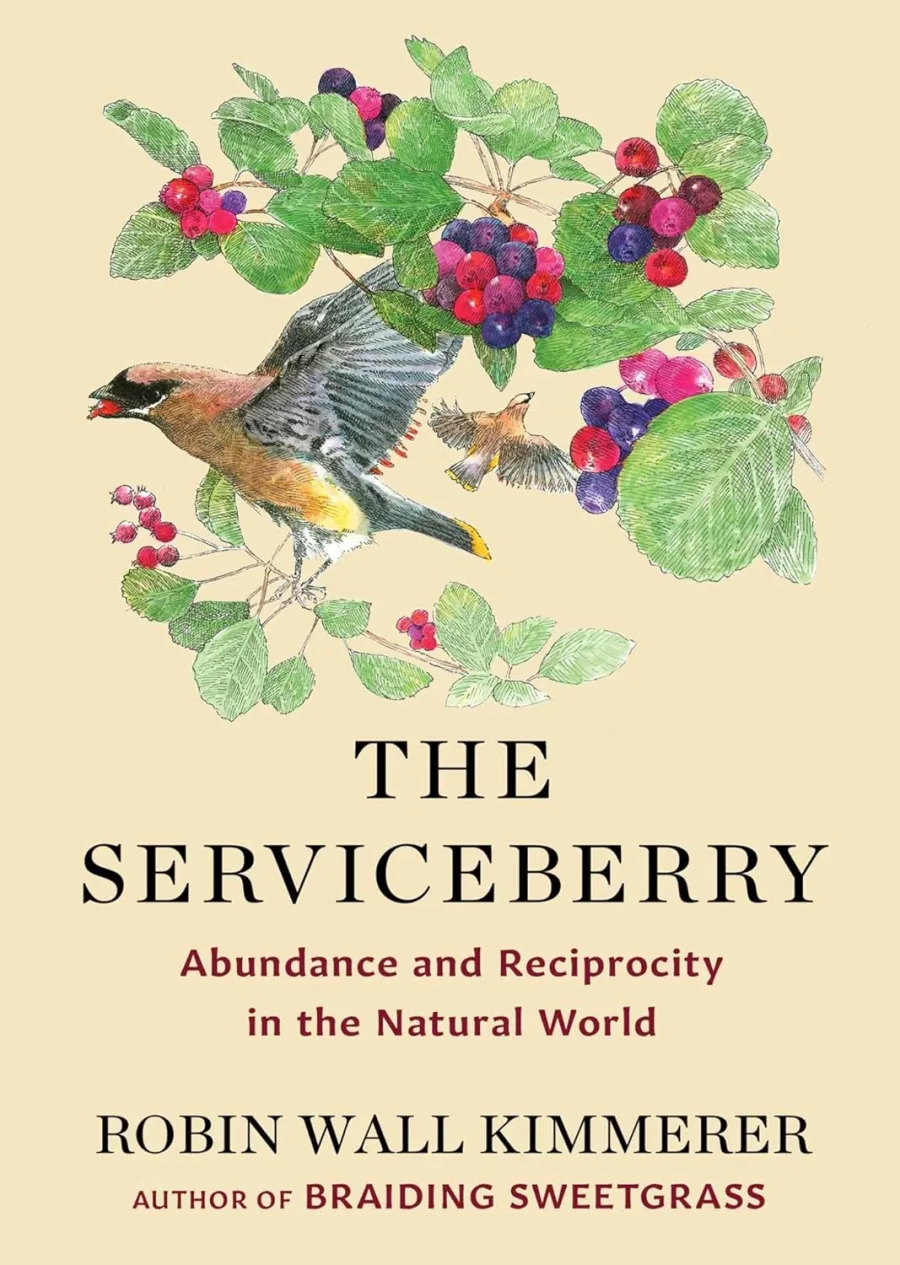
The Serviceberry: Abundance and Reciprocity in the Natural World
Robin Wall Kimmerer, John Burgoyne (Illustrator)
Hardcover
• 128 Pages
• USD 20.00
• English
• 9781668072240
No ratings yet
| Publisher | Scribner |
|---|---|
| ISBN13 | 9781668072240 |
| ASIN/SKU | 1668072246 |
| Book Format | Hardcover |
| Language | English |
| Pages | 128 |
| List Price | USD 20.00 |
| Publishing Date | 19/11/2024 |
| Dimensions | 5 x 0.26 x 7 inches |
| Weight | 7.2 ounces |
| Book Code | BD00070247 |
Buy this Book
Amazon Stores
Ebook Stores
Other Stores
Discover The Serviceberry: Abundance and Reciprocity in the Natural World by Robin Wall Kimmerer. This book is published by Scribner in Hardcover format, ISBN 9781668072240, ASIN 1668072246, under Science and Math, Nature Writing and Essays, Botany.
Book Description
An Instant New York Times Bestseller
From the #1 New York Times bestselling author of Braiding Sweetgrass, a bold and inspiring vision for how to orient our lives around gratitude, reciprocity, and community, based on the lessons of the natural world.
As Indigenous scientist and author of Braiding Sweetgrass Robin Wall Kimmerer harvests serviceberries alongside the birds, she considers the ethic of reciprocity that lies at the heart of the gift economy. How, she asks, can we learn from Indigenous wisdom and the plant world to reimagine what we value most? Our economy is rooted in scarcity, competition, and the hoarding of resources, and we have surrendered our values to a system that actively harms what we love. Meanwhile, the serviceberry’s relationship with the natural world is an embodiment of reciprocity, interconnectedness, and gratitude. The tree distributes its wealth—its abundance of sweet, juicy berries—to meet the needs of its natural community. And this distribution ensures its own survival. As Kimmerer explains, “Serviceberries show us another model, one based upon reciprocity, where wealth comes from the quality of your relationships, not from the illusion of self-sufficiency.”
As Elizabeth Gilbert writes, Robin Wall Kimmerer is “a great teacher, and her words are a hymn of love to the world.” The Serviceberry is an antidote to the broken relationships and misguided goals of our times, and a reminder that “hoarding won’t save us, all flourishing is mutual.”
Robin Wall Kimmerer is donating her advance payments from this book as a reciprocal gift, back to the land, for land protection, restoration, and justice.
From the #1 New York Times bestselling author of Braiding Sweetgrass, a bold and inspiring vision for how to orient our lives around gratitude, reciprocity, and community, based on the lessons of the natural world.
As Indigenous scientist and author of Braiding Sweetgrass Robin Wall Kimmerer harvests serviceberries alongside the birds, she considers the ethic of reciprocity that lies at the heart of the gift economy. How, she asks, can we learn from Indigenous wisdom and the plant world to reimagine what we value most? Our economy is rooted in scarcity, competition, and the hoarding of resources, and we have surrendered our values to a system that actively harms what we love. Meanwhile, the serviceberry’s relationship with the natural world is an embodiment of reciprocity, interconnectedness, and gratitude. The tree distributes its wealth—its abundance of sweet, juicy berries—to meet the needs of its natural community. And this distribution ensures its own survival. As Kimmerer explains, “Serviceberries show us another model, one based upon reciprocity, where wealth comes from the quality of your relationships, not from the illusion of self-sufficiency.”
As Elizabeth Gilbert writes, Robin Wall Kimmerer is “a great teacher, and her words are a hymn of love to the world.” The Serviceberry is an antidote to the broken relationships and misguided goals of our times, and a reminder that “hoarding won’t save us, all flourishing is mutual.”
Robin Wall Kimmerer is donating her advance payments from this book as a reciprocal gift, back to the land, for land protection, restoration, and justice.
Author Biography
Robin Wall Kimmerer is a mother, scientist, decorated professor, and enrolled member of the Citizen Potawatomi Nation. She is the author of the New York Times bestselling collection of essays Braiding Sweetgrass: Indigenous Wisdom, Scientific Knowledge and the Teachings of Plants as well as Gathering Moss: A Natural and Cultural History of Mosses. Kimmerer is a 2022 MacArthur Fellow. She lives in Syracuse, New York, where she is a SUNY Distinguished Teaching Professor of Environmental Biology, and the founder and director of the Center for Native Peoples and the Environment.
Editorial Reviews
“The Serviceberry is a profoundly important book about how we might remodel consumer economies around mutuality, generosity, and bountifulness. The time you’ll spend reading this book will, like the time spent picking wild berries, nourish your soul, heart, and mind. I hope to give this book to everybody.” —Anthony Doerr, author of All the Light We Cannot See and Cloud Cuckoo Land
“A meditation on communing with nature and cultivating connections with one another . . . [a] short, thoughtful book . . . Think of The Serviceberry as a subset of Braiding Sweetgrass, expanding on the gift economy theory… She makes a convincing argument, wrapped in beautiful language and vivid imagery… An optimistic book, one that trusts in the ability of people to do the right thing.” —Washington Post
“A small book with a profound impact.” —Angeline Boulley, Good Morning America, "10 Books to Read this Native American Heritage Month
“The Serviceberry is a gem of a book. it invites us to think again about economics, and imagine another way of relating to one another based on generosity, kindness, interconnectedness, and restraint. The book reminds us that how we think, and the stories we tell, shape how we live—and it’s high time we thought and lived differently, with new stories, about our place in nature.” —James Rebanks
“A moving meditation on what a giving tree can teach us about building a fairer society… A compelling argument for a more ethical economy.” —TIME
"A beautiful meditation on abundance, reciprocity and community, drawing inspiration from indigenous wisdom, and inviting us to reimagine what we value most." —The Guardian
"The Serviceberry picks up where Braiding Sweetgrass left off, once again using the interconnectedness of nature as a guiding light to reimagine a path forward for the future… The message of The Servicceberry is clear: Our individualistic, pro-competition, consumption-focused capitalist economy is inherently flawed and is leading us down a destructive and lonely path…Kimmerer creates a bighearted version of millions of little circular economies in which people learn how to foster kinship, 'recognize enoughness,' and appreciate what Mother Earth provides.” —The San Francisco Chronicle
"The Serviceberry is a psalm for the natural world and a profound exploration of how we can reframe our relationship with nature and with others through gift economies… Kimmerer’s blend of scientific observation, memoir, and philosophical reflection makes The Serviceberry a compelling read that transcends mere ecological treatise. As our planet grapples with environmental challenges, Kimmerer’s vision of a nonextractive, reciprocal relationship with nature offers a necessary alternative." —Sierra Magazine
“The Serviceberry is bound to appeal to the readers who made Braiding Sweetgrass a more-than-2-million-copies-sold phenomenon. Like Braiding Sweetgrass, The Serviceberry draws on traditional Native ways of caring for the land (Kimmerer is an enrolled member of the Citizen Potawatomi Nation). And, like Braiding Sweetgrass, it uses plain language to demonstrate truths about the way all of us live in the world.” —Minnesota Star Tribune
“A novella-length meditation on the abundance that sharing and mutual exchange can create…The Serviceberry continues a long tradition of naturalistic writing about interdependence in the wild…an impassioned call not just to return to the natural webs of exchange that are our birthright‚ but to recapture the fulfillment that stems from interdependence." —Undark Magazine
"Under a hundred pages, The Serviceberry is beautifully written with illustrations by John Burgoyne. Like me, you might pass the afternoon reading the book in one sitting, entranced by the author’s hopeful words for how to combat ecological destruction and the isolation and purposelessness so many people experience in this digitally oriented, self-interested world." —Chicago Review of Books
“Certain to be acclaimed as one of the best books of the year.” —Parade
“Robin Wall Kimmerer, celebrated author of Braiding Sweetgrass, gifts her readers once again with this gorgeous meditation on reciprocity and abundance in nature. . . Beautifully illustrated, brimming and buzzing with plant and animal life, The Serviceberry is a lyrical call to action.” —Oprah Daily
“A delightful new book that reflects on the natural world and how we can derive lessons on gratitude, reciprocity and community to flourish mutually.” —Seattle Times
"Drawing from both Indigenous knowledge and ecological science, Robin Wall Kimmerer, known for her masterwork Braiding Sweetgrass, demonstrates how serviceberries support biodiversity while having historically provided sustenance to Native American communities… Through careful observation of serviceberry ecology, Kimmerer constructs a compelling case for economic systems based on reciprocity." —Forbes
“Kimmerer’s deeply rooted, wise, and inspiring reflections coalesce into a fresh approach to connecting ecology, economics, and ethics… [Readers] will learn a lot about ecological ways of living from Kimmerer's nature-rooted wisdom and beautifully clear writing.” —Booklist, starred review
“An eloquent call to action.” —Publishers Weekly
“Kimmerer, drawing from her Potawatomi heritage, uses the abundant serviceberry to demonstrate the gifts that the natural world provides. This portrait is startling in its simplicity, resulting in a masterful reflection on ecology and culture. The book seamlessly blends science, inherited wisdom, and philosophy . . . [Kimmerer’s] beautiful and hopeful prose leaves readers feeling sated, galvanized, and keenly aware of the world around them. A welcome meditation on living in harmony with the earth and fostering deeper connections with one another.” —Kirkus
“A meditation on communing with nature and cultivating connections with one another . . . [a] short, thoughtful book . . . Think of The Serviceberry as a subset of Braiding Sweetgrass, expanding on the gift economy theory… She makes a convincing argument, wrapped in beautiful language and vivid imagery… An optimistic book, one that trusts in the ability of people to do the right thing.” —Washington Post
“A small book with a profound impact.” —Angeline Boulley, Good Morning America, "10 Books to Read this Native American Heritage Month
“The Serviceberry is a gem of a book. it invites us to think again about economics, and imagine another way of relating to one another based on generosity, kindness, interconnectedness, and restraint. The book reminds us that how we think, and the stories we tell, shape how we live—and it’s high time we thought and lived differently, with new stories, about our place in nature.” —James Rebanks
“A moving meditation on what a giving tree can teach us about building a fairer society… A compelling argument for a more ethical economy.” —TIME
"A beautiful meditation on abundance, reciprocity and community, drawing inspiration from indigenous wisdom, and inviting us to reimagine what we value most." —The Guardian
"The Serviceberry picks up where Braiding Sweetgrass left off, once again using the interconnectedness of nature as a guiding light to reimagine a path forward for the future… The message of The Servicceberry is clear: Our individualistic, pro-competition, consumption-focused capitalist economy is inherently flawed and is leading us down a destructive and lonely path…Kimmerer creates a bighearted version of millions of little circular economies in which people learn how to foster kinship, 'recognize enoughness,' and appreciate what Mother Earth provides.” —The San Francisco Chronicle
"The Serviceberry is a psalm for the natural world and a profound exploration of how we can reframe our relationship with nature and with others through gift economies… Kimmerer’s blend of scientific observation, memoir, and philosophical reflection makes The Serviceberry a compelling read that transcends mere ecological treatise. As our planet grapples with environmental challenges, Kimmerer’s vision of a nonextractive, reciprocal relationship with nature offers a necessary alternative." —Sierra Magazine
“The Serviceberry is bound to appeal to the readers who made Braiding Sweetgrass a more-than-2-million-copies-sold phenomenon. Like Braiding Sweetgrass, The Serviceberry draws on traditional Native ways of caring for the land (Kimmerer is an enrolled member of the Citizen Potawatomi Nation). And, like Braiding Sweetgrass, it uses plain language to demonstrate truths about the way all of us live in the world.” —Minnesota Star Tribune
“A novella-length meditation on the abundance that sharing and mutual exchange can create…The Serviceberry continues a long tradition of naturalistic writing about interdependence in the wild…an impassioned call not just to return to the natural webs of exchange that are our birthright‚ but to recapture the fulfillment that stems from interdependence." —Undark Magazine
"Under a hundred pages, The Serviceberry is beautifully written with illustrations by John Burgoyne. Like me, you might pass the afternoon reading the book in one sitting, entranced by the author’s hopeful words for how to combat ecological destruction and the isolation and purposelessness so many people experience in this digitally oriented, self-interested world." —Chicago Review of Books
“Certain to be acclaimed as one of the best books of the year.” —Parade
“Robin Wall Kimmerer, celebrated author of Braiding Sweetgrass, gifts her readers once again with this gorgeous meditation on reciprocity and abundance in nature. . . Beautifully illustrated, brimming and buzzing with plant and animal life, The Serviceberry is a lyrical call to action.” —Oprah Daily
“A delightful new book that reflects on the natural world and how we can derive lessons on gratitude, reciprocity and community to flourish mutually.” —Seattle Times
"Drawing from both Indigenous knowledge and ecological science, Robin Wall Kimmerer, known for her masterwork Braiding Sweetgrass, demonstrates how serviceberries support biodiversity while having historically provided sustenance to Native American communities… Through careful observation of serviceberry ecology, Kimmerer constructs a compelling case for economic systems based on reciprocity." —Forbes
“Kimmerer’s deeply rooted, wise, and inspiring reflections coalesce into a fresh approach to connecting ecology, economics, and ethics… [Readers] will learn a lot about ecological ways of living from Kimmerer's nature-rooted wisdom and beautifully clear writing.” —Booklist, starred review
“An eloquent call to action.” —Publishers Weekly
“Kimmerer, drawing from her Potawatomi heritage, uses the abundant serviceberry to demonstrate the gifts that the natural world provides. This portrait is startling in its simplicity, resulting in a masterful reflection on ecology and culture. The book seamlessly blends science, inherited wisdom, and philosophy . . . [Kimmerer’s] beautiful and hopeful prose leaves readers feeling sated, galvanized, and keenly aware of the world around them. A welcome meditation on living in harmony with the earth and fostering deeper connections with one another.” —Kirkus
Book Summary
Robin Wall Kimmerer’s The Serviceberry: Abundance and Reciprocity in the Natural World is a gentle but deeply challenging book about how we understand wealth, generosity, community, and our relationship with the natural world. Rather than treating nature simply as a resource from which humans take what they need, Kimmerer asks readers to imagine a different way of living—one based on gratitude, reciprocity, sharing, and abundance. At the center of the book is the serviceberry, a small tree whose berries become a powerful lesson in how the natural world operates. Through this familiar plant, Kimmerer invites us to question some of the basic assumptions of modern economic life and to consider what human society might learn from nature.
Kimmerer, a botanist and member of the Citizen Potawatomi Nation, combines scientific knowledge with Indigenous wisdom and personal observation. Her writing is warm and accessible, but the ideas behind it are profound. She begins with something wonderfully ordinary: picking serviceberries with a friend. The berries do not belong to anyone in the conventional sense. They grow freely, ripen for birds and animals as well as people, and are available to anyone willing to notice and gather them. There is no cashier, price tag, or ownership contract. Yet the berries provide food, pleasure, and nourishment. This simple experience becomes the starting point for a larger question: what if abundance is not something we should accumulate privately, but something we should share?
The serviceberry illustrates an economy that is fundamentally different from the market economy familiar to most modern societies. In nature, Kimmerer observes, abundance tends to generate more abundance. A plant produces fruit, the fruit feeds birds, birds disperse seeds, and new plants emerge. The gift moves through the ecosystem rather than stopping with one owner. Nothing is completely isolated. Every living thing participates in a network of giving and receiving. For Kimmerer, this is not merely an ecological fact; it is also a moral lesson.
The concept of the “gift economy” is therefore central to the book. A gift is different from a commodity. When something is treated as a commodity, its value is usually expressed through a price and ownership. A gift, however, creates a relationship. If someone gives us food, kindness, knowledge, or assistance, we naturally feel connected to that person and may want to give something in return. Reciprocity does not necessarily mean immediate repayment. It means participating in a continuing circle of generosity.
Kimmerer suggests that the natural world is full of gifts. Sunlight, rain, soil, seeds, clean water, and food all arrive before we can claim that we have earned them. Human beings often respond by converting these gifts into commodities, assigning prices to things that once seemed freely available. The result is an economic system that can encourage endless accumulation while weakening our sense of responsibility toward one another and toward the Earth.
This does not mean Kimmerer simply argues that money or markets should disappear. Her deeper point is that markets should not be the only way we understand value. A society becomes impoverished when everything is judged primarily by its financial usefulness. Friendship, care, generosity, ecological health, community knowledge, and time spent helping others may be extremely valuable even though they cannot easily be assigned a price.
The book also challenges the idea of scarcity. Modern economic thinking often begins with the assumption that resources are limited and that people must compete to obtain them. Kimmerer does not deny that the Earth has limits. Instead, she distinguishes between ecological limits and the artificial scarcity created by systems of ownership, inequality, and excessive consumption. A forest can be abundant while individual people remain poor. Food can be plentiful while people go hungry. The problem is sometimes not the absence of resources but the way resources are distributed and valued.
This is where reciprocity becomes an ethical responsibility. If humans receive gifts from the Earth, we should ask what we are giving back. Gratitude, in Kimmerer’s understanding, is not merely an emotion. It should lead to action. We can care for the land, restore damaged ecosystems, share resources, reduce unnecessary consumption, and strengthen the communities on which our lives depend. Receiving and giving are parts of the same relationship.
Kimmerer also draws attention to language and worldview. Indigenous traditions often understand plants and animals not as lifeless objects but as living relatives or beings with whom humans have responsibilities. This perspective changes the question from “What can this land provide for me?” to “How can I live well with this land?” The distinction may sound subtle, but it produces a completely different moral relationship with nature.
The serviceberry itself becomes an ideal teacher because it gives generously without appearing to calculate the transaction. Its fruit feeds birds, animals, and people. The plant participates in an ecological community in which giving is not wasteful. The berry that is eaten may help carry the plant’s seeds elsewhere. What looks like loss from one perspective can become renewal from another.
Kimmerer’s vision extends beyond individual kindness to social transformation. She encourages readers to imagine communities organized around sharing rather than constant accumulation. Libraries, community gardens, seed exchanges, cooperatives, mutual aid networks, and neighborhood food-sharing practices all demonstrate forms of abundance that do not depend entirely on conventional commercial exchange. Such practices can create resilience because they strengthen relationships as well as distribute resources.
At the same time, The Serviceberry never becomes a simplistic celebration of nature. Kimmerer understands that human beings can damage the systems that sustain them. The natural world is not an infinite warehouse. Reciprocity requires limits, attention, and restraint. Taking without giving back eventually destroys the conditions that made abundance possible.
Ultimately, The Serviceberry is a meditation on what it means to live well. Kimmerer asks readers to look again at things they may have learned to overlook: a berry growing beside a path, a neighbor sharing food, a community helping someone in need, or the countless gifts that sustain everyday life. These moments reveal that abundance is not necessarily about possessing more. It can mean recognizing that we already live within networks of generosity.
The book’s most hopeful message is that another way of living is possible because the principles already exist around us. Nature demonstrates cooperation, interdependence, renewal, and reciprocity every day. We do not have to invent these ideas from nothing; we have to learn how to notice them and practice them. In Kimmerer’s vision, true wealth is found not in how much one person can accumulate, but in how richly a community can give, receive, and care for the living world. The Serviceberry ultimately asks us to replace the question “What can I get?” with a more generous one: “What can I give back?” That change in perspective may be small, but Kimmerer suggests it could transform how we understand both prosperity and our place on Earth.
Kimmerer, a botanist and member of the Citizen Potawatomi Nation, combines scientific knowledge with Indigenous wisdom and personal observation. Her writing is warm and accessible, but the ideas behind it are profound. She begins with something wonderfully ordinary: picking serviceberries with a friend. The berries do not belong to anyone in the conventional sense. They grow freely, ripen for birds and animals as well as people, and are available to anyone willing to notice and gather them. There is no cashier, price tag, or ownership contract. Yet the berries provide food, pleasure, and nourishment. This simple experience becomes the starting point for a larger question: what if abundance is not something we should accumulate privately, but something we should share?
The serviceberry illustrates an economy that is fundamentally different from the market economy familiar to most modern societies. In nature, Kimmerer observes, abundance tends to generate more abundance. A plant produces fruit, the fruit feeds birds, birds disperse seeds, and new plants emerge. The gift moves through the ecosystem rather than stopping with one owner. Nothing is completely isolated. Every living thing participates in a network of giving and receiving. For Kimmerer, this is not merely an ecological fact; it is also a moral lesson.
The concept of the “gift economy” is therefore central to the book. A gift is different from a commodity. When something is treated as a commodity, its value is usually expressed through a price and ownership. A gift, however, creates a relationship. If someone gives us food, kindness, knowledge, or assistance, we naturally feel connected to that person and may want to give something in return. Reciprocity does not necessarily mean immediate repayment. It means participating in a continuing circle of generosity.
Kimmerer suggests that the natural world is full of gifts. Sunlight, rain, soil, seeds, clean water, and food all arrive before we can claim that we have earned them. Human beings often respond by converting these gifts into commodities, assigning prices to things that once seemed freely available. The result is an economic system that can encourage endless accumulation while weakening our sense of responsibility toward one another and toward the Earth.
This does not mean Kimmerer simply argues that money or markets should disappear. Her deeper point is that markets should not be the only way we understand value. A society becomes impoverished when everything is judged primarily by its financial usefulness. Friendship, care, generosity, ecological health, community knowledge, and time spent helping others may be extremely valuable even though they cannot easily be assigned a price.
The book also challenges the idea of scarcity. Modern economic thinking often begins with the assumption that resources are limited and that people must compete to obtain them. Kimmerer does not deny that the Earth has limits. Instead, she distinguishes between ecological limits and the artificial scarcity created by systems of ownership, inequality, and excessive consumption. A forest can be abundant while individual people remain poor. Food can be plentiful while people go hungry. The problem is sometimes not the absence of resources but the way resources are distributed and valued.
This is where reciprocity becomes an ethical responsibility. If humans receive gifts from the Earth, we should ask what we are giving back. Gratitude, in Kimmerer’s understanding, is not merely an emotion. It should lead to action. We can care for the land, restore damaged ecosystems, share resources, reduce unnecessary consumption, and strengthen the communities on which our lives depend. Receiving and giving are parts of the same relationship.
Kimmerer also draws attention to language and worldview. Indigenous traditions often understand plants and animals not as lifeless objects but as living relatives or beings with whom humans have responsibilities. This perspective changes the question from “What can this land provide for me?” to “How can I live well with this land?” The distinction may sound subtle, but it produces a completely different moral relationship with nature.
The serviceberry itself becomes an ideal teacher because it gives generously without appearing to calculate the transaction. Its fruit feeds birds, animals, and people. The plant participates in an ecological community in which giving is not wasteful. The berry that is eaten may help carry the plant’s seeds elsewhere. What looks like loss from one perspective can become renewal from another.
Kimmerer’s vision extends beyond individual kindness to social transformation. She encourages readers to imagine communities organized around sharing rather than constant accumulation. Libraries, community gardens, seed exchanges, cooperatives, mutual aid networks, and neighborhood food-sharing practices all demonstrate forms of abundance that do not depend entirely on conventional commercial exchange. Such practices can create resilience because they strengthen relationships as well as distribute resources.
At the same time, The Serviceberry never becomes a simplistic celebration of nature. Kimmerer understands that human beings can damage the systems that sustain them. The natural world is not an infinite warehouse. Reciprocity requires limits, attention, and restraint. Taking without giving back eventually destroys the conditions that made abundance possible.
Ultimately, The Serviceberry is a meditation on what it means to live well. Kimmerer asks readers to look again at things they may have learned to overlook: a berry growing beside a path, a neighbor sharing food, a community helping someone in need, or the countless gifts that sustain everyday life. These moments reveal that abundance is not necessarily about possessing more. It can mean recognizing that we already live within networks of generosity.
The book’s most hopeful message is that another way of living is possible because the principles already exist around us. Nature demonstrates cooperation, interdependence, renewal, and reciprocity every day. We do not have to invent these ideas from nothing; we have to learn how to notice them and practice them. In Kimmerer’s vision, true wealth is found not in how much one person can accumulate, but in how richly a community can give, receive, and care for the living world. The Serviceberry ultimately asks us to replace the question “What can I get?” with a more generous one: “What can I give back?” That change in perspective may be small, but Kimmerer suggests it could transform how we understand both prosperity and our place on Earth.
Sample Chapters
Sample Chapters will be added soon…
Reader Reviews
No reviews yet.
The Serviceberry: Abundance and Reciprocity in the Natural World
Download Cover Image
Do you want to download the full cover image for The Serviceberry: Abundance and Reciprocity in the Natural World?