
Braiding Sweetgrass: Indigenous Wisdom, Scientific Knowledge and the Teachings of Plants
Paperback
• 408 Pages
• USD 7.47
• English
• 9781571313560
No ratings yet
| Publisher | Milkweed Editions |
|---|---|
| ISBN13 | 9781571313560 |
| ASIN/SKU | 1571313567 |
| Book Format | Paperback |
| Language | English |
| Pages | 408 |
| List Price | USD 7.47 |
| Publishing Date | 11/08/2015 |
| Dimensions | 5.5 x 1.1 x 8.4 inches |
| Weight | 1.14 pounds |
| Book Code | BD00070248 |
Buy this Book
Amazon Stores
Ebook Stores
Other Stores
Discover Braiding Sweetgrass: Indigenous Wisdom, Scientific Knowledge and the Teachings of Plants by Robin Wall Kimmerer. This book is published by Milkweed Editions in Paperback format, ISBN 9781571313560, ASIN 1571313567, under Science and Math, Botany, Ecology.
Book Description
A New York Times Bestseller
A Washington Post Bestseller
Named a "Best Essay Collection of the Decade" by Literary Hub
As a botanist, Robin Wall Kimmerer has been trained to ask questions of nature with the tools of science. As a member of the Citizen Potawatomi Nation, she embraces the notion that plants and animals are our oldest teachers. In Braiding Sweetgrass, Kimmerer brings these two lenses of knowledge together to take us on “a journey that is every bit as mythic as it is scientific, as sacred as it is historical, as clever as it is wise” (Elizabeth Gilbert).
Drawing on her life as an indigenous scientist, and as a woman, Kimmerer shows how other living beings―asters and goldenrod, strawberries and squash, salamanders, algae, and sweetgrass―offer us gifts and lessons, even if we've forgotten how to hear their voices. In reflections that range from the creation of Turtle Island to the forces that threaten its flourishing today, she circles toward a central argument: that the awakening of ecological consciousness requires the acknowledgment and celebration of our reciprocal relationship with the rest of the living world. For only when we can hear the languages of other beings will we be capable of understanding the generosity of the earth, and learn to give our own gifts in return.
A Washington Post Bestseller
Named a "Best Essay Collection of the Decade" by Literary Hub
As a botanist, Robin Wall Kimmerer has been trained to ask questions of nature with the tools of science. As a member of the Citizen Potawatomi Nation, she embraces the notion that plants and animals are our oldest teachers. In Braiding Sweetgrass, Kimmerer brings these two lenses of knowledge together to take us on “a journey that is every bit as mythic as it is scientific, as sacred as it is historical, as clever as it is wise” (Elizabeth Gilbert).
Drawing on her life as an indigenous scientist, and as a woman, Kimmerer shows how other living beings―asters and goldenrod, strawberries and squash, salamanders, algae, and sweetgrass―offer us gifts and lessons, even if we've forgotten how to hear their voices. In reflections that range from the creation of Turtle Island to the forces that threaten its flourishing today, she circles toward a central argument: that the awakening of ecological consciousness requires the acknowledgment and celebration of our reciprocal relationship with the rest of the living world. For only when we can hear the languages of other beings will we be capable of understanding the generosity of the earth, and learn to give our own gifts in return.
Author Biography
Robin Wall Kimmerer is a mother, scientist, decorated professor, and enrolled member of the Citizen Potawatomi Nation. She is the author of the New York Times bestselling collection of essays Braiding Sweetgrass: Indigenous Wisdom, Scientific Knowledge and the Teachings of Plants as well as Gathering Moss: A Natural and Cultural History of Mosses. Kimmerer is a 2022 MacArthur Fellow. She lives in Syracuse, New York, where she is a SUNY Distinguished Teaching Professor of Environmental Biology, and the founder and director of the Center for Native Peoples and the Environment.
Editorial Reviews
“Robin Wall Kimmerer is writer of rare grace. She writes about the natural world from a place of such abundant passion that one can never quite see the world the same way after having seen it through Kimmerer’s eyes. In Braiding Sweetgrass, she takes us on a journey that is every bit as mythic as it is scientific, as sacred as it is historical, as clever as it is wise. She is a great teacher, and her words are a hymn of love to the world.”—Elizabeth Gilbert
“Robin Wall Kimmerer has written an extraordinary book, showing how the factual, objective approach of science can be enriched by the ancient knowledge of the indigenous people. It is the way she captures beauty that I love the most—the images of giant cedars and wild strawberries, a forest in the rain and a meadow of fragrant sweetgrass will stay with you long after you read the last page.”—Jane Goodall
"I give daily thanks for Robin Wall Kimmerer for being a font of endless knowledge, both mental and spiritual." —Richard Powers, New York Times
“Robin Wall Kimmerer opens a sense of wonder and humility for the intelligence in all kinds of life we are used to naming and imagining as inanimate.”—Krista Tippett, host of On Being
"In a world where only six percent of mammalian biomass on the planet now comprises of wild animals, I longed for books that pressed me up against the inhuman, that connected me to an inhuman world. Braiding Sweetgrass by Robin Wall Kimmerer moved me to actual tears." —Alexandra Kleeman, The Millions
"In Braiding Sweetgrass, botanist Robin Wall Kimmerer tackles everything from sustainable agriculture to pond scum as a reflection of her Potawatomi heritage, which carries a stewardship 'which could not be taken by history: the knowing that we belonged to the land.' . . . It's a book absorbed with the unfolding of the world to observant eyes—that sense of discovery that draws us in." —NPR
"Professor and botanist Robin Wall Kimmerer knows that the answer to all forms of ecological unbalance have long been hidden in plain sight, told in the language of plants and animals, minerals and elements. She draws on her own heritage . . . pairing science with Indigenous principles and storytelling to advocate for a renewed connection between human beings and nature." —Outside
"Kimmerer eloquently makes the case that by observing and celebrating our reciprocal relationship with the natural world, one can gain greater ecological consciousness." —Sierra Magazine
“With deep compassion and graceful prose, Robin Wall Kimmerer encourages readers to consider the ways that our lives and language weave through the natural world. A mesmerizing storyteller, she shares legends from her Potawatomi ancestors to illustrate the culture of gratitude in which we all should live.”—Publishers Weekly
“The gift of Robin Wall Kimmerer’s book is that she provides readers the ability to see a very common world in uncommon ways, or, rather, in ways that have been commonly held but have recently been largely discarded. She puts forth the notion that we ought to be interacting in such a way that the land should be thankful for the people.”—Minneapolis Star Tribune
“Robin Wall Kimmerer has written an extraordinary book, showing how the factual, objective approach of science can be enriched by the ancient knowledge of the indigenous people. It is the way she captures beauty that I love the most—the images of giant cedars and wild strawberries, a forest in the rain and a meadow of fragrant sweetgrass will stay with you long after you read the last page.”—Jane Goodall
"I give daily thanks for Robin Wall Kimmerer for being a font of endless knowledge, both mental and spiritual." —Richard Powers, New York Times
“Robin Wall Kimmerer opens a sense of wonder and humility for the intelligence in all kinds of life we are used to naming and imagining as inanimate.”—Krista Tippett, host of On Being
"In a world where only six percent of mammalian biomass on the planet now comprises of wild animals, I longed for books that pressed me up against the inhuman, that connected me to an inhuman world. Braiding Sweetgrass by Robin Wall Kimmerer moved me to actual tears." —Alexandra Kleeman, The Millions
"In Braiding Sweetgrass, botanist Robin Wall Kimmerer tackles everything from sustainable agriculture to pond scum as a reflection of her Potawatomi heritage, which carries a stewardship 'which could not be taken by history: the knowing that we belonged to the land.' . . . It's a book absorbed with the unfolding of the world to observant eyes—that sense of discovery that draws us in." —NPR
"Professor and botanist Robin Wall Kimmerer knows that the answer to all forms of ecological unbalance have long been hidden in plain sight, told in the language of plants and animals, minerals and elements. She draws on her own heritage . . . pairing science with Indigenous principles and storytelling to advocate for a renewed connection between human beings and nature." —Outside
"Kimmerer eloquently makes the case that by observing and celebrating our reciprocal relationship with the natural world, one can gain greater ecological consciousness." —Sierra Magazine
“With deep compassion and graceful prose, Robin Wall Kimmerer encourages readers to consider the ways that our lives and language weave through the natural world. A mesmerizing storyteller, she shares legends from her Potawatomi ancestors to illustrate the culture of gratitude in which we all should live.”—Publishers Weekly
“The gift of Robin Wall Kimmerer’s book is that she provides readers the ability to see a very common world in uncommon ways, or, rather, in ways that have been commonly held but have recently been largely discarded. She puts forth the notion that we ought to be interacting in such a way that the land should be thankful for the people.”—Minneapolis Star Tribune
Book Summary
Robin Wall Kimmerer’s Braiding Sweetgrass: Indigenous Wisdom, Scientific Knowledge and the Teachings of Plants is a beautiful and deeply thoughtful book about humanity’s relationship with the natural world. Part memoir, part scientific reflection, part Indigenous teaching, and part meditation on gratitude, the book asks a simple but profound question: What can plants teach us about how to live? Kimmerer, a botanist and a member of the Citizen Potawatomi Nation, brings together two ways of understanding nature that are often treated as opposites: Western scientific knowledge and Indigenous ecological wisdom. Rather than choosing one over the other, she shows how they can complement each other and create a richer understanding of the living world.
The title itself expresses the central idea. Sweetgrass is a sacred plant in many Indigenous traditions, and braiding its long strands becomes a metaphor for bringing different kinds of knowledge together. Kimmerer’s “three strands” can be understood as Indigenous wisdom, scientific knowledge, and the lessons offered by plants and the natural world. Science helps us understand how ecosystems function, while Indigenous knowledge teaches us how to live respectfully within those ecosystems. The third strand is the lived relationship between people and nature—a relationship based not merely on observation, but on responsibility, gratitude, and reciprocity.
Kimmerer begins by challenging the common Western idea that humans are separate from nature. Modern society often treats plants, animals, forests, rivers, and minerals as resources available for human use. In this worldview, nature is frequently valued according to what it can provide economically. Kimmerer offers another perspective. In many Indigenous traditions, the natural world is understood as a community of living beings rather than a collection of objects. Plants are not simply things; they are teachers, relatives, and gifts. This difference in language reflects a deeper difference in worldview.
One of the book’s most important ideas is reciprocity. If the Earth gives human beings food, medicine, beauty, shelter, and countless other gifts, then humans have responsibilities in return. Gratitude should not remain an abstract feeling. It should become an action. We can care for the land, protect species, restore damaged ecosystems, harvest responsibly, and share what we receive. Kimmerer argues that a healthy relationship with nature is based on mutual giving rather than endless taking.
The story of the Three Sisters—corn, beans, and squash beautifully illustrates this principle. These crops have traditionally been grown together because each contributes something to the others. Corn provides a structure for beans to climb, beans contribute nitrogen to the soil, and squash spreads across the ground, helping retain moisture and suppress weeds. The plants thrive together rather than competing for everything separately. For Kimmerer, the Three Sisters represent a broader lesson about cooperation: communities become stronger when different beings contribute their particular gifts.
Another important teaching comes from the gift of strawberries. Wild strawberries can be gathered freely, and their sweetness can inspire gratitude rather than a sense of ownership. Kimmerer uses such experiences to question an economic system that turns almost everything into a commodity. A gift creates a relationship; a commodity creates a transaction. When we think of the Earth only in terms of commodities, we can forget that our lives depend on relationships that cannot be reduced to prices.
The author also explores the meaning of honorable harvest. Taking from nature is not necessarily wrong, because human beings need food and materials to survive. The problem arises when taking becomes excessive or careless. An honorable harvest means receiving nature’s gifts with respect. We should take only what is needed, avoid waste, leave enough for other beings, and help the ecosystem flourish. Harvesting therefore becomes an ethical relationship rather than an act of simple consumption.
Kimmerer’s scientific background gives these teachings an additional dimension. She does not romanticize nature or reject science. Instead, she demonstrates that scientific observation can deepen our appreciation of ecological relationships. Her discussions of mosses, lichens, forests, ponds, and plant communities reveal the extraordinary complexity of life. Science can tell us how a forest functions, but Indigenous knowledge can also ask what obligations humans have toward that forest. The two questions are different, but they do not have to conflict.
The book becomes particularly moving when Kimmerer reflects on damaged landscapes. She discusses the environmental consequences of industrialization, pollution, and human exploitation, but she does not write from a position of hopelessness. Restoration becomes an important form of reciprocity. When people repair wetlands, revive native plants, protect waterways, or restore forests, they are not merely fixing environmental problems. They are rebuilding relationships.
Her reflections on maple trees and maple sugaring provide another example. The seasonal gathering of maple sap is both practical and ceremonial. It connects people to the rhythms of the land and teaches patience. The trees offer something valuable, but the relationship does not end with receiving the sap. Caring for the forest and maintaining the conditions in which future generations can harvest are part of the same cycle.
Kimmerer also explores the emotional consequences of losing contact with nature. When people see the natural world merely as scenery or property, they may become less capable of recognizing its suffering. Developing intimacy with plants and landscapes changes this. A person who knows a particular tree, watches a pond through the seasons, or grows a garden begins to notice changes that an abstract environmental statistic cannot communicate. Love can therefore become a powerful foundation for environmental responsibility.
One of the book’s most memorable themes is gratitude. Kimmerer describes gratitude not simply as saying “thank you,” but as a way of seeing. When we recognize that our food, water, air, shelter, and even our knowledge depend upon countless other beings, our sense of entitlement begins to weaken. Gratitude makes us more attentive. It can also make us more generous because we recognize that we are participants in a larger circle of giving.
The final vision of Braiding Sweetgrass is therefore both ecological and moral. Kimmerer does not suggest that humans must abandon modern life and return to some imagined past. Instead, she asks us to change our relationship with the world around us. We can use scientific knowledge without losing reverence. We can benefit from nature without treating it as property. We can take what we need while accepting responsibility for what we give back.
Ultimately, Braiding Sweetgrass is a book about learning to belong. Its deepest lesson is that humans are not separate observers standing outside the natural world. We are members of a living community that has been giving to us since before we were born. Plants teach cooperation, generosity, patience, resilience, and renewal. By listening to those teachings and braiding them together with scientific understanding, Kimmerer offers a hopeful vision of a more respectful relationship between people and the Earth. The book leaves readers with a simple but powerful realization: the natural world is not merely something we live on; it is something we live with, and our future depends on learning how to give back.
The title itself expresses the central idea. Sweetgrass is a sacred plant in many Indigenous traditions, and braiding its long strands becomes a metaphor for bringing different kinds of knowledge together. Kimmerer’s “three strands” can be understood as Indigenous wisdom, scientific knowledge, and the lessons offered by plants and the natural world. Science helps us understand how ecosystems function, while Indigenous knowledge teaches us how to live respectfully within those ecosystems. The third strand is the lived relationship between people and nature—a relationship based not merely on observation, but on responsibility, gratitude, and reciprocity.
Kimmerer begins by challenging the common Western idea that humans are separate from nature. Modern society often treats plants, animals, forests, rivers, and minerals as resources available for human use. In this worldview, nature is frequently valued according to what it can provide economically. Kimmerer offers another perspective. In many Indigenous traditions, the natural world is understood as a community of living beings rather than a collection of objects. Plants are not simply things; they are teachers, relatives, and gifts. This difference in language reflects a deeper difference in worldview.
One of the book’s most important ideas is reciprocity. If the Earth gives human beings food, medicine, beauty, shelter, and countless other gifts, then humans have responsibilities in return. Gratitude should not remain an abstract feeling. It should become an action. We can care for the land, protect species, restore damaged ecosystems, harvest responsibly, and share what we receive. Kimmerer argues that a healthy relationship with nature is based on mutual giving rather than endless taking.
The story of the Three Sisters—corn, beans, and squash beautifully illustrates this principle. These crops have traditionally been grown together because each contributes something to the others. Corn provides a structure for beans to climb, beans contribute nitrogen to the soil, and squash spreads across the ground, helping retain moisture and suppress weeds. The plants thrive together rather than competing for everything separately. For Kimmerer, the Three Sisters represent a broader lesson about cooperation: communities become stronger when different beings contribute their particular gifts.
Another important teaching comes from the gift of strawberries. Wild strawberries can be gathered freely, and their sweetness can inspire gratitude rather than a sense of ownership. Kimmerer uses such experiences to question an economic system that turns almost everything into a commodity. A gift creates a relationship; a commodity creates a transaction. When we think of the Earth only in terms of commodities, we can forget that our lives depend on relationships that cannot be reduced to prices.
The author also explores the meaning of honorable harvest. Taking from nature is not necessarily wrong, because human beings need food and materials to survive. The problem arises when taking becomes excessive or careless. An honorable harvest means receiving nature’s gifts with respect. We should take only what is needed, avoid waste, leave enough for other beings, and help the ecosystem flourish. Harvesting therefore becomes an ethical relationship rather than an act of simple consumption.
Kimmerer’s scientific background gives these teachings an additional dimension. She does not romanticize nature or reject science. Instead, she demonstrates that scientific observation can deepen our appreciation of ecological relationships. Her discussions of mosses, lichens, forests, ponds, and plant communities reveal the extraordinary complexity of life. Science can tell us how a forest functions, but Indigenous knowledge can also ask what obligations humans have toward that forest. The two questions are different, but they do not have to conflict.
The book becomes particularly moving when Kimmerer reflects on damaged landscapes. She discusses the environmental consequences of industrialization, pollution, and human exploitation, but she does not write from a position of hopelessness. Restoration becomes an important form of reciprocity. When people repair wetlands, revive native plants, protect waterways, or restore forests, they are not merely fixing environmental problems. They are rebuilding relationships.
Her reflections on maple trees and maple sugaring provide another example. The seasonal gathering of maple sap is both practical and ceremonial. It connects people to the rhythms of the land and teaches patience. The trees offer something valuable, but the relationship does not end with receiving the sap. Caring for the forest and maintaining the conditions in which future generations can harvest are part of the same cycle.
Kimmerer also explores the emotional consequences of losing contact with nature. When people see the natural world merely as scenery or property, they may become less capable of recognizing its suffering. Developing intimacy with plants and landscapes changes this. A person who knows a particular tree, watches a pond through the seasons, or grows a garden begins to notice changes that an abstract environmental statistic cannot communicate. Love can therefore become a powerful foundation for environmental responsibility.
One of the book’s most memorable themes is gratitude. Kimmerer describes gratitude not simply as saying “thank you,” but as a way of seeing. When we recognize that our food, water, air, shelter, and even our knowledge depend upon countless other beings, our sense of entitlement begins to weaken. Gratitude makes us more attentive. It can also make us more generous because we recognize that we are participants in a larger circle of giving.
The final vision of Braiding Sweetgrass is therefore both ecological and moral. Kimmerer does not suggest that humans must abandon modern life and return to some imagined past. Instead, she asks us to change our relationship with the world around us. We can use scientific knowledge without losing reverence. We can benefit from nature without treating it as property. We can take what we need while accepting responsibility for what we give back.
Ultimately, Braiding Sweetgrass is a book about learning to belong. Its deepest lesson is that humans are not separate observers standing outside the natural world. We are members of a living community that has been giving to us since before we were born. Plants teach cooperation, generosity, patience, resilience, and renewal. By listening to those teachings and braiding them together with scientific understanding, Kimmerer offers a hopeful vision of a more respectful relationship between people and the Earth. The book leaves readers with a simple but powerful realization: the natural world is not merely something we live on; it is something we live with, and our future depends on learning how to give back.
Sample Chapters
Sample Chapters will be added soon…
Reader Reviews
No reviews yet.
Braiding Sweetgrass: Indigenous Wisdom, Scientific Knowledge and the Teachings of Plants
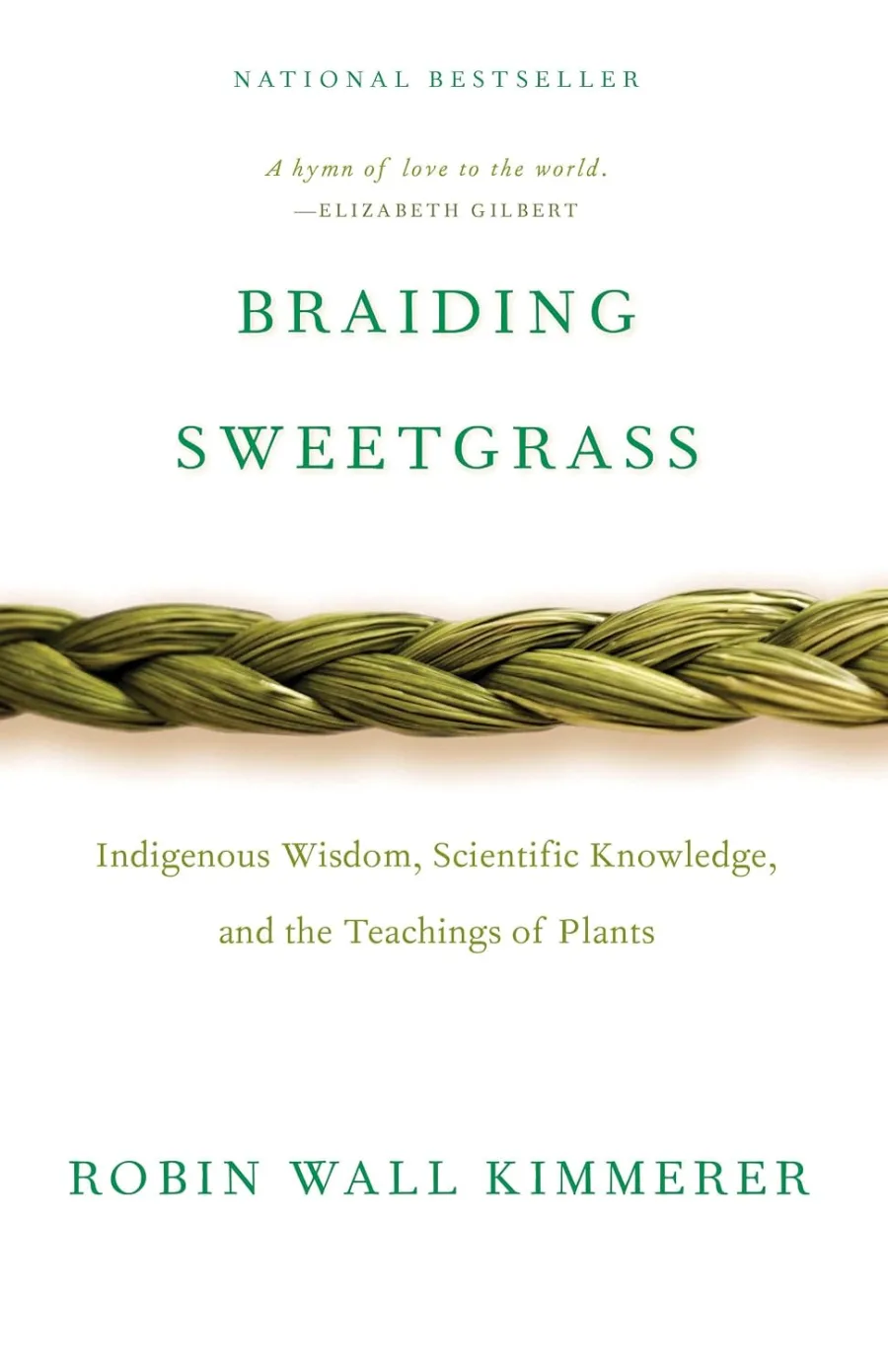
Download Cover Image
Do you want to download the full cover image for Braiding Sweetgrass: Indigenous Wisdom, Scientific Knowledge and the Teachings of Plants?