
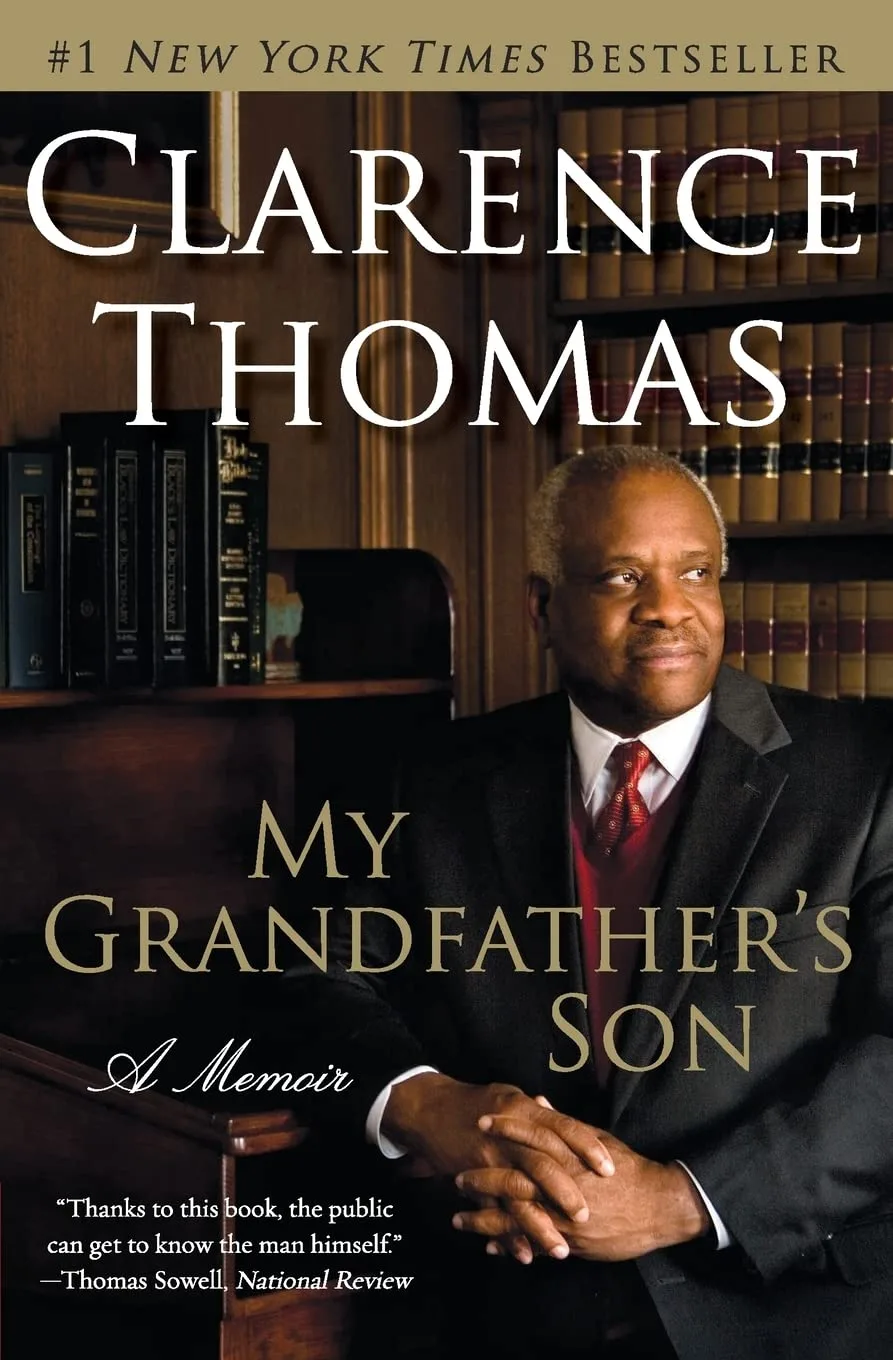
My Grandfather's Son: A Memoir
Paperback
• 289 Pages
• USD 19.99
• English
• 9780060565565
No ratings yet
| Publisher | Harper Perennial |
|---|---|
| ISBN13 | 9780060565565 |
| ASIN/SKU | 006056556X |
| Book Format | Paperback |
| Language | English |
| Pages | 289 |
| List Price | USD 19.99 |
| Publishing Date | 14/10/2008 |
| Dimensions | 5.31 x 0.72 x 8 inches |
| Weight | 2.31 pounds |
| Book Code | BD00070249 |
Buy this Book
Amazon Stores
Ebook Stores
Other Stores
Discover My Grandfather's Son: A Memoir by Clarence Thomas. This book is published by Harper Perennial in Paperback format, ISBN 9780060565565, ASIN 006056556X, under Politics and Social Sciences, African American Demographic Studies, Sociology Reference.
Book Description
Provocative, inspiring, and unflinchingly honest, My Grandfather's Son is the story of one of America's most remarkable and controversial leaders, Supreme Court Justice Clarence Thomas, told in his own words.
Thomas speaks out, revealing the pieces of his life he holds dear, detailing the suffering and injustices he has overcome, including the polarizing Senate hearing involving a former aide, Anita Hill, and the depression and despair it created in his own life and the lives of those closest to him. In this candid and deeply moving memoir, a quintessential American tale of hardship and grit, Clarence Thomas recounts his astonishing journey for the first time.
Thomas speaks out, revealing the pieces of his life he holds dear, detailing the suffering and injustices he has overcome, including the polarizing Senate hearing involving a former aide, Anita Hill, and the depression and despair it created in his own life and the lives of those closest to him. In this candid and deeply moving memoir, a quintessential American tale of hardship and grit, Clarence Thomas recounts his astonishing journey for the first time.
Author Biography
Clarence Thomas is Associate Justice of the Supreme Court of the United States. Born in Pinpoint, Georgia, he is a graduate of the College of the Holy Cross and Yale Law School. He lives with his wife and great nephew in northern Virginia.
Editorial Reviews
“Engrossing.” - Jack & Suzy Welch, Business Week
“A tale of pride, dertermination and independence. . . . A great American story, written by an extraordinary man.” - Rich Lowry, National Review
“Candid. . . . A fascinating glimpse into a tortured, complex, and often perplexing personality.” - The Washington Post Book World
“An original addition to those great black autobiographies of the past. . . . A lesson on how to live in freedom—a lesson that begins with a description of poverty on a par with Richard Wright’s portrait of poverty in Black Boy. . . . Thomas is now an archetype that will inspire others. I can think of no greater achievement.” - Shelby Steele, National Review (cover story)
“Very rewarding reading. . . . While there is anger in the book—justifiable anger, one might argue—there is also tenderness, vulnerability, brutal honesty and overflowing gratitude. . . . There is also unswerving intellectual integrity.” - Mona Charen
“As his memoir shows, Justice Thomas’s views were forged in the crucible of a truly authentic American story.” - John Yoo, The Wall Street Journal
“A transcendent work. . . . My Grandfather’s Son is a coming of age in the fullest sense. . . . A meditation of time and perspective and the shifts in outlook both can bring. . . . A memoir of raw honesty.” - The Oregonian
“The Georgia native writes a telling memoir about his life prior to joining the U.S. Supreme Court. . . . My Grandfather’s Son lays bare the darkest, most painful moments of his life, with candor almost unheard of in public figures, let alone Supreme Court justices.” - The Atlanta Journal-Constitution
“A fascinating and irresistible read.” - The New York Sun
“Justice Thomas describes his intellectual journey, and his struggle to keep body and soul together on meager government pay, in some of the book’s most absorbing and self-critical chapters.” - William Grimes, The New York Times
“Thanks to this book, the public can get to know the man himself.” - Thomas Sowell, National Review
“Gripping. . . . Thomas offers an education in practical wisdom and moral courage. Particularly instructive, and moving, is the portrait of his grandfather. . . . A delightful book—you really can’t put it down—but it’s also a source of moral education for young Americans.” - William Kristol, The Weekly Standard
“Thomas is refreshingly candid about the depths of his suffering, and one comes away with a deep sadness about our broken politics and the ferocious disincentives for anyone to seek high government appointment.” - Newsday
“Absorbing.” - The Economist
“Compelling. . . . An intensely personal account. . . . Thomas writes with unguarded passion. . . . My Grandfather’s Son is not just a tale of challenges overcome; it is also a witness to the evolution of a man’s political and judicial philosophy.” - Michael Steele, The Wall Street Journal
“The book of the year for Americans tired of politics as usual.” - The Denver Post
“Thomas speaks candidly about the mistakes he made that fueled his determination to overcome all odds to be appointed to the nation’s highest court.” - The Oklahoman
“A tale so profoundly moving, and so profoundly true to this nation’s ideals, that every American father ought to read the first two chapters—and then read them aloud to his children.” - The Dallas Morning News
“A tale of pride, dertermination and independence. . . . A great American story, written by an extraordinary man.” - Rich Lowry, National Review
“Candid. . . . A fascinating glimpse into a tortured, complex, and often perplexing personality.” - The Washington Post Book World
“An original addition to those great black autobiographies of the past. . . . A lesson on how to live in freedom—a lesson that begins with a description of poverty on a par with Richard Wright’s portrait of poverty in Black Boy. . . . Thomas is now an archetype that will inspire others. I can think of no greater achievement.” - Shelby Steele, National Review (cover story)
“Very rewarding reading. . . . While there is anger in the book—justifiable anger, one might argue—there is also tenderness, vulnerability, brutal honesty and overflowing gratitude. . . . There is also unswerving intellectual integrity.” - Mona Charen
“As his memoir shows, Justice Thomas’s views were forged in the crucible of a truly authentic American story.” - John Yoo, The Wall Street Journal
“A transcendent work. . . . My Grandfather’s Son is a coming of age in the fullest sense. . . . A meditation of time and perspective and the shifts in outlook both can bring. . . . A memoir of raw honesty.” - The Oregonian
“The Georgia native writes a telling memoir about his life prior to joining the U.S. Supreme Court. . . . My Grandfather’s Son lays bare the darkest, most painful moments of his life, with candor almost unheard of in public figures, let alone Supreme Court justices.” - The Atlanta Journal-Constitution
“A fascinating and irresistible read.” - The New York Sun
“Justice Thomas describes his intellectual journey, and his struggle to keep body and soul together on meager government pay, in some of the book’s most absorbing and self-critical chapters.” - William Grimes, The New York Times
“Thanks to this book, the public can get to know the man himself.” - Thomas Sowell, National Review
“Gripping. . . . Thomas offers an education in practical wisdom and moral courage. Particularly instructive, and moving, is the portrait of his grandfather. . . . A delightful book—you really can’t put it down—but it’s also a source of moral education for young Americans.” - William Kristol, The Weekly Standard
“Thomas is refreshingly candid about the depths of his suffering, and one comes away with a deep sadness about our broken politics and the ferocious disincentives for anyone to seek high government appointment.” - Newsday
“Absorbing.” - The Economist
“Compelling. . . . An intensely personal account. . . . Thomas writes with unguarded passion. . . . My Grandfather’s Son is not just a tale of challenges overcome; it is also a witness to the evolution of a man’s political and judicial philosophy.” - Michael Steele, The Wall Street Journal
“The book of the year for Americans tired of politics as usual.” - The Denver Post
“Thomas speaks candidly about the mistakes he made that fueled his determination to overcome all odds to be appointed to the nation’s highest court.” - The Oklahoman
“A tale so profoundly moving, and so profoundly true to this nation’s ideals, that every American father ought to read the first two chapters—and then read them aloud to his children.” - The Dallas Morning News
Book Summary
Clarence Thomas’s My Grandfather’s Son: A Memoir is a deeply personal account of his childhood, education, political development, career, and controversial journey to the United States Supreme Court. Published in 2007, the memoir is much more than a record of professional achievement. It is Thomas’s attempt to explain how the experiences of poverty, race, family, religion, political idealism, disappointment, and personal resilience shaped the man he eventually became. The title comes from the influence of his grandfather, Myers Anderson, whose strict values and belief in hard work had a lasting impact on Thomas. Throughout the memoir, Thomas returns to the idea that character is built through discipline, responsibility, and perseverance.
Thomas begins with his childhood in Savannah, Georgia, where he grew up in a working-class Black family during an era of segregation. After his parents’ marriage broke down, Thomas and his younger brother were raised largely by their grandparents. His grandfather became the central authority in his early life. Anderson expected discipline, obedience, education, and hard work, and he had little patience for excuses. He worked hard to provide for the family and taught Thomas that dignity did not depend on wealth or social approval. Although Thomas sometimes experienced his grandfather’s methods as severe, he later recognized how profoundly they shaped his sense of responsibility.
Religion was another major influence during Thomas’s youth. He attended Catholic schools and eventually considered becoming a priest. His education exposed him to ideas about morality, service, and social justice. At the same time, Thomas became increasingly aware of racial inequality. The civil rights movement was unfolding around him, and the injustices experienced by Black Americans were impossible to ignore. His early political consciousness therefore developed from a mixture of religious conviction, racial awareness, and a desire to improve society.
During his college years at the College of the Holy Cross and later at Yale Law School, Thomas became deeply interested in politics. Like many young people of his generation, he was attracted to the idealism of the civil rights era and the growing radicalism of the late 1960s. He initially believed strongly in collective political action and government programs designed to address racial and economic inequality. However, his experiences gradually caused him to question some of the assumptions behind the movements and policies he had once supported.
A particularly important turning point was Thomas’s growing skepticism about affirmative action. He had personally experienced racism, yet he became concerned that policies intended to help Black Americans could sometimes create new stereotypes or cause people to doubt whether successful Black individuals had earned their achievements. Thomas wanted to be judged by his abilities and work rather than by racial expectations. This tension between racial identity and individual independence becomes one of the memoir’s most important themes.
After law school, Thomas entered government service and eventually became an assistant attorney general in Missouri. He later worked in Washington, D.C., where he became increasingly involved in conservative political circles. His political transformation was gradual. Thomas did not simply exchange one set of slogans for another; he describes a process in which personal experience made him increasingly distrustful of ideological movements and expansive government. He became more committed to individual responsibility and skeptical of policies that, in his view, treated people primarily as members of racial or economic groups.
Thomas’s career eventually led him to head the Equal Employment Opportunity Commission during the Reagan administration. The position placed him at the center of national debates over discrimination, workplace equality, and affirmative action. He describes the pressure and political hostility surrounding his work, as well as the difficulty of operating within a bureaucracy while maintaining his own convictions. His growing public profile made him a target for critics who believed his political views were inconsistent with the expectations they had for a Black public official.
The most painful portion of the memoir concerns his nomination to the Supreme Court in 1991. President George H. W. Bush nominated Thomas to replace Justice Thurgood Marshall. The nomination was historically significant, but the confirmation process quickly became intensely controversial. After the Senate Judiciary Committee had largely completed its hearings, Anita Hill, a former employee of Thomas, accused him of sexual harassment. Thomas denied the allegations, and the Senate reopened the hearings.
Thomas describes the experience as humiliating, frightening, and deeply damaging. He believed that the process had become a political attack designed to destroy his reputation and prevent his confirmation. His televised testimony, particularly his description of the proceedings as a “high-tech lynching,” became one of the most memorable moments in modern Supreme Court confirmation history. The memoir makes clear that Thomas felt personally betrayed by people and institutions he had previously trusted.
Despite the controversy, Thomas was confirmed by the Senate by a narrow 52–48 vote. He joined the Supreme Court and began a new chapter of his life. The memoir does not present the transition as effortless. Thomas discusses the loneliness of the position, the burden of public expectations, and the criticism he continued to face. He also reflects on his relationship with Justice Antonin Scalia and the development of his own judicial philosophy.
A major theme of the later chapters is Thomas’s commitment to originalism and a restrained understanding of judicial power. He argues that judges should interpret the Constitution according to its text and historical meaning rather than treating the Constitution as an open-ended document that can be changed according to contemporary preferences. His philosophy is closely connected to his personal belief in intellectual independence. He does not want judges to decide cases according to popularity, political pressure, or what he believes society ought to become.
Throughout the memoir, Thomas also emphasizes the importance of perseverance. His life story moves from a difficult childhood in segregated Georgia to an elite education, government leadership, and ultimately the Supreme Court. Yet he does not portray success as the product of talent alone. He repeatedly returns to the lessons of his grandfather: work hard, accept responsibility, develop discipline, and do not allow other people to define your worth.
Ultimately, My Grandfather’s Son is Clarence Thomas’s explanation of himself as much as it is a memoir of events. It is a story about an individual trying to remain independent while moving through institutions that often expect conformity. Thomas acknowledges his mistakes and disappointments but places greater emphasis on the lessons they taught him. The memoir’s deepest message is that identity cannot be reduced to race, politics, social class, or professional position. For Thomas, a meaningful life comes from developing one’s own judgment and accepting responsibility for one’s choices.
The result is a candid, often emotionally intense portrait of a man who believes that personal freedom begins with the ability to think independently. Whether readers agree with Thomas’s politics or judicial philosophy, the memoir offers valuable insight into the experiences that shaped one of the most controversial and influential figures in modern American public life. At its heart, My Grandfather’s Son is a story of family, struggle, transformation, and the enduring power of a grandfather’s lessons.
Thomas begins with his childhood in Savannah, Georgia, where he grew up in a working-class Black family during an era of segregation. After his parents’ marriage broke down, Thomas and his younger brother were raised largely by their grandparents. His grandfather became the central authority in his early life. Anderson expected discipline, obedience, education, and hard work, and he had little patience for excuses. He worked hard to provide for the family and taught Thomas that dignity did not depend on wealth or social approval. Although Thomas sometimes experienced his grandfather’s methods as severe, he later recognized how profoundly they shaped his sense of responsibility.
Religion was another major influence during Thomas’s youth. He attended Catholic schools and eventually considered becoming a priest. His education exposed him to ideas about morality, service, and social justice. At the same time, Thomas became increasingly aware of racial inequality. The civil rights movement was unfolding around him, and the injustices experienced by Black Americans were impossible to ignore. His early political consciousness therefore developed from a mixture of religious conviction, racial awareness, and a desire to improve society.
During his college years at the College of the Holy Cross and later at Yale Law School, Thomas became deeply interested in politics. Like many young people of his generation, he was attracted to the idealism of the civil rights era and the growing radicalism of the late 1960s. He initially believed strongly in collective political action and government programs designed to address racial and economic inequality. However, his experiences gradually caused him to question some of the assumptions behind the movements and policies he had once supported.
A particularly important turning point was Thomas’s growing skepticism about affirmative action. He had personally experienced racism, yet he became concerned that policies intended to help Black Americans could sometimes create new stereotypes or cause people to doubt whether successful Black individuals had earned their achievements. Thomas wanted to be judged by his abilities and work rather than by racial expectations. This tension between racial identity and individual independence becomes one of the memoir’s most important themes.
After law school, Thomas entered government service and eventually became an assistant attorney general in Missouri. He later worked in Washington, D.C., where he became increasingly involved in conservative political circles. His political transformation was gradual. Thomas did not simply exchange one set of slogans for another; he describes a process in which personal experience made him increasingly distrustful of ideological movements and expansive government. He became more committed to individual responsibility and skeptical of policies that, in his view, treated people primarily as members of racial or economic groups.
Thomas’s career eventually led him to head the Equal Employment Opportunity Commission during the Reagan administration. The position placed him at the center of national debates over discrimination, workplace equality, and affirmative action. He describes the pressure and political hostility surrounding his work, as well as the difficulty of operating within a bureaucracy while maintaining his own convictions. His growing public profile made him a target for critics who believed his political views were inconsistent with the expectations they had for a Black public official.
The most painful portion of the memoir concerns his nomination to the Supreme Court in 1991. President George H. W. Bush nominated Thomas to replace Justice Thurgood Marshall. The nomination was historically significant, but the confirmation process quickly became intensely controversial. After the Senate Judiciary Committee had largely completed its hearings, Anita Hill, a former employee of Thomas, accused him of sexual harassment. Thomas denied the allegations, and the Senate reopened the hearings.
Thomas describes the experience as humiliating, frightening, and deeply damaging. He believed that the process had become a political attack designed to destroy his reputation and prevent his confirmation. His televised testimony, particularly his description of the proceedings as a “high-tech lynching,” became one of the most memorable moments in modern Supreme Court confirmation history. The memoir makes clear that Thomas felt personally betrayed by people and institutions he had previously trusted.
Despite the controversy, Thomas was confirmed by the Senate by a narrow 52–48 vote. He joined the Supreme Court and began a new chapter of his life. The memoir does not present the transition as effortless. Thomas discusses the loneliness of the position, the burden of public expectations, and the criticism he continued to face. He also reflects on his relationship with Justice Antonin Scalia and the development of his own judicial philosophy.
A major theme of the later chapters is Thomas’s commitment to originalism and a restrained understanding of judicial power. He argues that judges should interpret the Constitution according to its text and historical meaning rather than treating the Constitution as an open-ended document that can be changed according to contemporary preferences. His philosophy is closely connected to his personal belief in intellectual independence. He does not want judges to decide cases according to popularity, political pressure, or what he believes society ought to become.
Throughout the memoir, Thomas also emphasizes the importance of perseverance. His life story moves from a difficult childhood in segregated Georgia to an elite education, government leadership, and ultimately the Supreme Court. Yet he does not portray success as the product of talent alone. He repeatedly returns to the lessons of his grandfather: work hard, accept responsibility, develop discipline, and do not allow other people to define your worth.
Ultimately, My Grandfather’s Son is Clarence Thomas’s explanation of himself as much as it is a memoir of events. It is a story about an individual trying to remain independent while moving through institutions that often expect conformity. Thomas acknowledges his mistakes and disappointments but places greater emphasis on the lessons they taught him. The memoir’s deepest message is that identity cannot be reduced to race, politics, social class, or professional position. For Thomas, a meaningful life comes from developing one’s own judgment and accepting responsibility for one’s choices.
The result is a candid, often emotionally intense portrait of a man who believes that personal freedom begins with the ability to think independently. Whether readers agree with Thomas’s politics or judicial philosophy, the memoir offers valuable insight into the experiences that shaped one of the most controversial and influential figures in modern American public life. At its heart, My Grandfather’s Son is a story of family, struggle, transformation, and the enduring power of a grandfather’s lessons.
Sample Chapters
Sample Chapters will be added soon…
Reader Reviews
No reviews yet.
My Grandfather's Son: A Memoir
Download Cover Image
Do you want to download the full cover image for My Grandfather's Son: A Memoir?