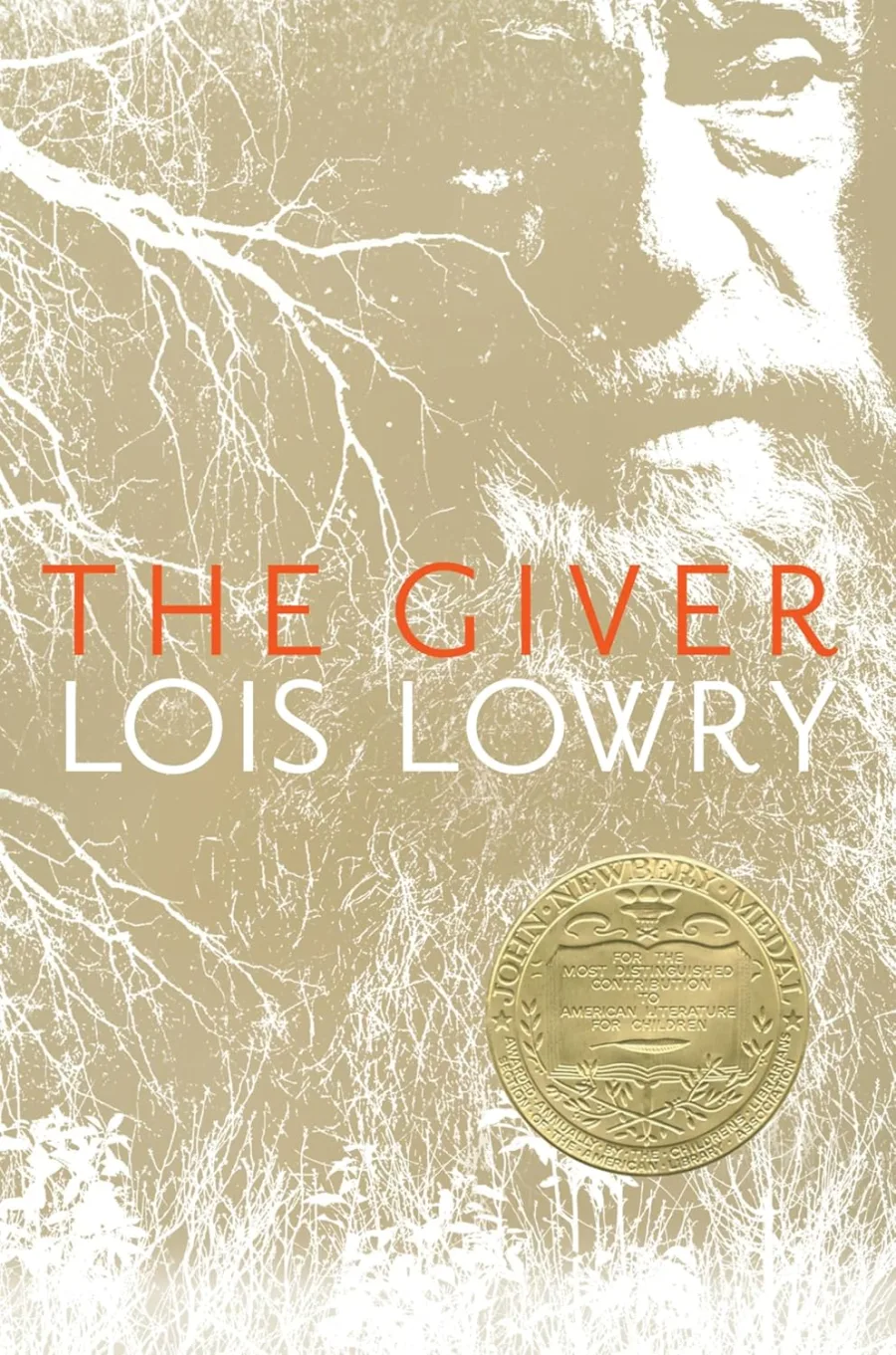
The Giver
Paperback
• 240 Pages
• USD 11.99
• English
• 9780544336261
No ratings yet
Teen & Young Adult
Teen & Young Adult Fiction about Values & Virtues
Teen & Young Adult Fiction about Emotions & Feelings
| Publisher | Clarion Books |
|---|---|
| ISBN13 | 9780544336261 |
| ASIN/SKU | 0544336267 |
| Book Format | Paperback |
| Language | English |
| Pages | 240 |
| List Price | USD 11.99 |
| Publishing Date | 01/07/1993 |
| Dimensions | 5.5 x 0.62 x 8.25 inches |
| Weight | 2.31 pounds |
| Book Code | BD00070250 |
Buy this Book
Amazon Stores
Ebook Stores
Other Stores
Discover The Giver by Lois Lowry. This book is published by Clarion Books in Paperback format, ISBN 9780544336261, ASIN 0544336267, under Teen and Young Adult, Teen and Young Adult Fiction about Values and Virtues, Teen and Young Adult Fiction about Emotions and Feelings.
Book Description
In Lois Lowry’s Newbery Medal–winning classic, twelve-year-old Jonas lives in a seemingly ideal world. Not until he is given his life assignment as the Receiver does he begin to understand the dark secrets behind his fragile community.
Life in the community where Jonas lives is idyllic. Designated birthmothers produce newchildren, who are assigned to appropriate family units. Citizens are assigned their partners and their jobs. No one thinks to ask questions. Everyone obeys. Everyone is the same. Except Jonas.
Not until he is given his life assignment as the Receiver of Memory does he begin to understand the dark, complex secrets behind his fragile community. Gradually Jonas learns that power lies in feelings. But when his own power is put to the test—when he must try to save someone he loves—he may not be ready. Is it too soon? Or too late?
Told with deceptive simplicity, this is the provocative story of a boy who experiences something incredible and undertakes something impossible. In the telling it questions every value we have taken for granted and reexamines our most deeply held beliefs.
The Giver has become one of the most influential novels of our time. Don't miss the powerful companion novels in Lois Lowry's Giver Quartet: Gathering Blue, Messenger, and Son.
Life in the community where Jonas lives is idyllic. Designated birthmothers produce newchildren, who are assigned to appropriate family units. Citizens are assigned their partners and their jobs. No one thinks to ask questions. Everyone obeys. Everyone is the same. Except Jonas.
Not until he is given his life assignment as the Receiver of Memory does he begin to understand the dark, complex secrets behind his fragile community. Gradually Jonas learns that power lies in feelings. But when his own power is put to the test—when he must try to save someone he loves—he may not be ready. Is it too soon? Or too late?
Told with deceptive simplicity, this is the provocative story of a boy who experiences something incredible and undertakes something impossible. In the telling it questions every value we have taken for granted and reexamines our most deeply held beliefs.
The Giver has become one of the most influential novels of our time. Don't miss the powerful companion novels in Lois Lowry's Giver Quartet: Gathering Blue, Messenger, and Son.
Author Biography
Lois Lowry is known for her versatility and invention as a writer. She was born in Hawaii and grew up in New York, Pennsylvania, and Japan. After studying at Brown University, she married, started a family, and turned her attention to writing. She is the author of more than forty books for young adults, including the popular Anastasia Krupnik series. She has received countless honors, among them the Boston Globe-Horn Book Award, the Dorothy Canfield Fisher Award, the California Young Reader's Medal, and the Mark Twain Award. She received Newbery Medals for two of her novels, NUMBER THE STARS and THE GIVER. Her first novel, A SUMMER TO DIE, was awarded the International Reading Association's Children's Book Award. Several books have been adapted to film and stage, and THE GIVER has become an opera. Her newest book, ON THE HORIZON, is a collection of memories and images from Pearl Harbor, Hiroshima, and post-war Japan. A mother and grandmother, Ms. Lowry divides her time between Maine and Florida. To learn more about Lois Lowry, see her website at www.loislowry.com
Editorial Reviews
“A powerful and provocative novel." - New York Times
"Wrought with admirable skill—the emptiness and menace underlying this Utopia emerge step by inexorable step: a richly provocative novel." - Kirkus Reviews (starred review)
“Lowry is once again in top form raising many questions while answering few, and unwinding a tale fit for the most adventurous readers.” - Publishers Weekly (starred review)
“The simplicity and directness of Lowry's writing force readers to grapple with their own thoughts.” - Booklist (starred review)
“Lois Lowry has written a fascinating, thoughtful science-fiction novel. The story is skillfully written; the air of disquiet is delicately insinuated. And the theme of balancing the virtues of freedom and security is beautifully presented." - Horn Book (starred review)
"The Giver has things to say that cannot be said too often, and I hope there will be many, many young people who will be willing to listen. A warning in narrative form." - Washington Post
"Wrought with admirable skill—the emptiness and menace underlying this Utopia emerge step by inexorable step: a richly provocative novel." - Kirkus Reviews (starred review)
“Lowry is once again in top form raising many questions while answering few, and unwinding a tale fit for the most adventurous readers.” - Publishers Weekly (starred review)
“The simplicity and directness of Lowry's writing force readers to grapple with their own thoughts.” - Booklist (starred review)
“Lois Lowry has written a fascinating, thoughtful science-fiction novel. The story is skillfully written; the air of disquiet is delicately insinuated. And the theme of balancing the virtues of freedom and security is beautifully presented." - Horn Book (starred review)
"The Giver has things to say that cannot be said too often, and I hope there will be many, many young people who will be willing to listen. A warning in narrative form." - Washington Post
Book Summary
Lois Lowry’s The Giver is a haunting and thoughtful dystopian novel about memory, freedom, pain, love, and the difficult choices that come with being human. Published in 1993, the novel follows Jonas, a twelve-year-old boy who lives in a seemingly perfect community where suffering, conflict, poverty, and uncertainty have been almost completely eliminated. At first, this world appears peaceful and safe. Everyone has a home, a family, an occupation, and a carefully organized place in society. Yet as Jonas gradually discovers what his community has sacrificed to achieve this stability, he realizes that a life without pain may also be a life without genuine freedom, emotion, or love.
Jonas lives with his parents and his younger sister, Lily. His family appears ordinary, but the community controls almost every aspect of daily life. People follow strict rules governing language, behavior, family relationships, education, and work. Even seemingly harmless choices are limited. Children receive carefully selected clothing and bicycles, families are assigned rather than naturally formed, and every person is expected to fulfill a predetermined social role. The community believes that such control prevents conflict and creates equality.
One of the most striking features of this society is Sameness. The community has deliberately eliminated differences in climate, landscape, appearance, and many aspects of individual experience. There are no extremes of weather, and people do not experience the dramatic variety of nature that exists in the outside world. At first, Jonas sees this uniformity as normal. He has never known anything else. But small changes in his perception gradually make him aware that something is missing.
At the annual Ceremony of Twelve, each twelve-year-old is assigned a lifelong occupation. Jonas is nervous because his future will be determined publicly. When his turn comes, the Chief Elder announces that he has been selected rather than assigned to become the new Receiver of Memory. It is the community’s most honored and unusual position. Jonas is told that he possesses qualities such as intelligence, integrity, courage, and the rare ability to “see beyond.”
His training begins with an elderly man known as the Giver. The Giver holds the memories of the world from before the community adopted Sameness. Through physical contact, he transfers these memories to Jonas. Jonas first experiences something wonderful: he remembers snow, a sled ride, sunshine, and colors. He discovers that the world once contained beauty and variety. He learns that the community’s apparently neutral world has actually been stripped of enormous richness.
As Jonas receives more memories, he also discovers suffering. He experiences hunger, war, physical injury, loneliness, and grief. These memories are painful, but they also give him a depth of understanding that ordinary members of the community do not possess. The Giver explains that someone must carry these memories because society needs protection from the consequences of its own decisions. The Receiver therefore carries the burden of humanity’s past so that everyone else can live without having to confront it.
Jonas gradually realizes that his community has not merely eliminated suffering. It has eliminated genuine choice. People cannot choose their partners, careers, or many aspects of their lives. Even language is carefully controlled. The community has created stability by limiting individual freedom. Jonas begins to understand that meaningful happiness cannot exist without the possibility of sadness, just as love cannot have its full meaning without vulnerability and loss.
One of the most important discoveries comes when Jonas learns the true meaning of “release.” He has always understood release as a peaceful departure from the community. Babies who fail to develop properly, elderly people who have completed their lives, and individuals who break serious rules are sometimes “released.” Jonas eventually watches a recording of his father releasing a newborn twin. To his horror, he discovers that release actually means killing the person through lethal injection.
This revelation destroys Jonas’s trust in his community. His father, whom Jonas loves, does not understand that what he is doing is murder. The society has controlled language so completely that people can participate in terrible acts without recognizing them as terrible. Jonas understands that the absence of emotional depth has made moral responsibility almost impossible.
His relationship with the Giver also becomes deeper. The Giver explains that he once had a daughter, Rosemary, who was selected to become a Receiver before Jonas. She could not bear the painful memories and eventually requested release. When she died, her memories returned to the community, causing temporary suffering among its members. The Giver and Jonas therefore begin discussing the possibility of changing the system and returning memories to everyone.
The turning point comes when Jonas discovers that Gabriel, a baby his family has been temporarily caring for, is scheduled for release because he has not developed quickly enough. Jonas cannot accept this. He decides to rescue Gabriel and escape the community. The Giver remains behind, planning to help the people cope when the memories eventually return to them.
Jonas’s escape becomes both a physical and emotional journey. He rides away with Gabriel, leaving behind the controlled world he once knew. The journey is dangerous. Jonas experiences hunger, cold, exhaustion, and uncertainty—the very conditions his community eliminated. Yet these hardships also represent freedom. For the first time, Jonas is responsible for his own decisions.
Near the end of the novel, Jonas discovers a sled and rides toward what appears to be a warm, illuminated house. He hears music and believes he may have found a place where people celebrate, love, and live freely. The ending is deliberately ambiguous. Jonas may have reached another community, or the scene may represent a final vision as he and Gabriel succumb to the cold. Lowry leaves the interpretation open, allowing the emotional meaning to matter more than a definitive explanation.
The central message of The Giver is that human life cannot be made perfect by eliminating everything difficult. Pain can be terrible, but it also teaches compassion. Choice can lead to mistakes, but it gives life meaning. Love makes people vulnerable, but it is one of the deepest experiences human beings can have. A society that removes suffering by removing freedom may appear peaceful while quietly becoming less human.
Jonas’s journey is therefore a journey from innocence to awareness. He begins as a child who accepts his society without question and ends as someone willing to risk everything for another human being. His greatest transformation is not simply that he learns about pain; it is that he learns to care deeply enough to act.
Ultimately, The Giver asks readers to consider what makes a life truly meaningful. Is safety worth the loss of freedom? Can happiness exist without sadness? Can morality exist without choice? And how much control should society have over individual lives? Through Jonas’s experiences, Lois Lowry suggests that being human means accepting the full range of experience—the beautiful and the painful, the joyful and the tragic. A perfect world may be impossible, but a world in which people can choose, remember, love, and feel may be worth the risks that come with freedom.
Jonas lives with his parents and his younger sister, Lily. His family appears ordinary, but the community controls almost every aspect of daily life. People follow strict rules governing language, behavior, family relationships, education, and work. Even seemingly harmless choices are limited. Children receive carefully selected clothing and bicycles, families are assigned rather than naturally formed, and every person is expected to fulfill a predetermined social role. The community believes that such control prevents conflict and creates equality.
One of the most striking features of this society is Sameness. The community has deliberately eliminated differences in climate, landscape, appearance, and many aspects of individual experience. There are no extremes of weather, and people do not experience the dramatic variety of nature that exists in the outside world. At first, Jonas sees this uniformity as normal. He has never known anything else. But small changes in his perception gradually make him aware that something is missing.
At the annual Ceremony of Twelve, each twelve-year-old is assigned a lifelong occupation. Jonas is nervous because his future will be determined publicly. When his turn comes, the Chief Elder announces that he has been selected rather than assigned to become the new Receiver of Memory. It is the community’s most honored and unusual position. Jonas is told that he possesses qualities such as intelligence, integrity, courage, and the rare ability to “see beyond.”
His training begins with an elderly man known as the Giver. The Giver holds the memories of the world from before the community adopted Sameness. Through physical contact, he transfers these memories to Jonas. Jonas first experiences something wonderful: he remembers snow, a sled ride, sunshine, and colors. He discovers that the world once contained beauty and variety. He learns that the community’s apparently neutral world has actually been stripped of enormous richness.
As Jonas receives more memories, he also discovers suffering. He experiences hunger, war, physical injury, loneliness, and grief. These memories are painful, but they also give him a depth of understanding that ordinary members of the community do not possess. The Giver explains that someone must carry these memories because society needs protection from the consequences of its own decisions. The Receiver therefore carries the burden of humanity’s past so that everyone else can live without having to confront it.
Jonas gradually realizes that his community has not merely eliminated suffering. It has eliminated genuine choice. People cannot choose their partners, careers, or many aspects of their lives. Even language is carefully controlled. The community has created stability by limiting individual freedom. Jonas begins to understand that meaningful happiness cannot exist without the possibility of sadness, just as love cannot have its full meaning without vulnerability and loss.
One of the most important discoveries comes when Jonas learns the true meaning of “release.” He has always understood release as a peaceful departure from the community. Babies who fail to develop properly, elderly people who have completed their lives, and individuals who break serious rules are sometimes “released.” Jonas eventually watches a recording of his father releasing a newborn twin. To his horror, he discovers that release actually means killing the person through lethal injection.
This revelation destroys Jonas’s trust in his community. His father, whom Jonas loves, does not understand that what he is doing is murder. The society has controlled language so completely that people can participate in terrible acts without recognizing them as terrible. Jonas understands that the absence of emotional depth has made moral responsibility almost impossible.
His relationship with the Giver also becomes deeper. The Giver explains that he once had a daughter, Rosemary, who was selected to become a Receiver before Jonas. She could not bear the painful memories and eventually requested release. When she died, her memories returned to the community, causing temporary suffering among its members. The Giver and Jonas therefore begin discussing the possibility of changing the system and returning memories to everyone.
The turning point comes when Jonas discovers that Gabriel, a baby his family has been temporarily caring for, is scheduled for release because he has not developed quickly enough. Jonas cannot accept this. He decides to rescue Gabriel and escape the community. The Giver remains behind, planning to help the people cope when the memories eventually return to them.
Jonas’s escape becomes both a physical and emotional journey. He rides away with Gabriel, leaving behind the controlled world he once knew. The journey is dangerous. Jonas experiences hunger, cold, exhaustion, and uncertainty—the very conditions his community eliminated. Yet these hardships also represent freedom. For the first time, Jonas is responsible for his own decisions.
Near the end of the novel, Jonas discovers a sled and rides toward what appears to be a warm, illuminated house. He hears music and believes he may have found a place where people celebrate, love, and live freely. The ending is deliberately ambiguous. Jonas may have reached another community, or the scene may represent a final vision as he and Gabriel succumb to the cold. Lowry leaves the interpretation open, allowing the emotional meaning to matter more than a definitive explanation.
The central message of The Giver is that human life cannot be made perfect by eliminating everything difficult. Pain can be terrible, but it also teaches compassion. Choice can lead to mistakes, but it gives life meaning. Love makes people vulnerable, but it is one of the deepest experiences human beings can have. A society that removes suffering by removing freedom may appear peaceful while quietly becoming less human.
Jonas’s journey is therefore a journey from innocence to awareness. He begins as a child who accepts his society without question and ends as someone willing to risk everything for another human being. His greatest transformation is not simply that he learns about pain; it is that he learns to care deeply enough to act.
Ultimately, The Giver asks readers to consider what makes a life truly meaningful. Is safety worth the loss of freedom? Can happiness exist without sadness? Can morality exist without choice? And how much control should society have over individual lives? Through Jonas’s experiences, Lois Lowry suggests that being human means accepting the full range of experience—the beautiful and the painful, the joyful and the tragic. A perfect world may be impossible, but a world in which people can choose, remember, love, and feel may be worth the risks that come with freedom.
Sample Chapters
Sample Chapters will be added soon…
Reader Reviews
No reviews yet.
The Giver