
Kitchen Confidential: Adventures in the Culinary Underbelly
Paperback
• 312 Pages
• USD 18.99
• English
• 9780060899226
No ratings yet
| Publisher | Ecco |
|---|---|
| ISBN13 | 9780060899226 |
| ASIN/SKU | 0060899220 |
| Book Format | Paperback |
| Language | English |
| Pages | 312 |
| List Price | USD 18.99 |
| Publishing Date | 09/01/2007 |
| Dimensions | 5.31 x 0.79 x 8 inches |
| Weight | 2.31 pounds |
| Book Code | BD00070252 |
Buy this Book
Amazon Stores
Ebook Stores
Other Stores
Discover Kitchen Confidential: Adventures in the Culinary Underbelly by Anthony Bourdain. This book is published by Ecco in Paperback format, ISBN 9780060899226, ASIN 0060899220, under Arts and Photography, Photography History, Art Encyclopedias.
Book Description
An updated and revised edition of Anthony Bourdain's mega-bestselling Kitchen Confidential
Almost two decades ago, the New Yorker published a now infamous article, “Don’t Eat before You Read This,” by then little-known chef Anthony Bourdain. Bourdain spared no one’s appetite as he revealed what happens behind the kitchen door. The article was a sensation, and the book it spawned, the now classic Kitchen Confidential, became an even bigger sensation, a mega-bestseller with over one million copies in print. Frankly confessional, addictively acerbic, and utterly unsparing, Bourdain pulls no punches in this memoir of his years in the restaurant business.
Fans will love to return to this deliciously funny, delectably shocking banquet of wild-but-true tales of life in the culinary trade from Chef Anthony Bourdain, laying out his more than a quarter-century of drugs, sex, and haute cuisine—this time with never-before-published material.
Almost two decades ago, the New Yorker published a now infamous article, “Don’t Eat before You Read This,” by then little-known chef Anthony Bourdain. Bourdain spared no one’s appetite as he revealed what happens behind the kitchen door. The article was a sensation, and the book it spawned, the now classic Kitchen Confidential, became an even bigger sensation, a mega-bestseller with over one million copies in print. Frankly confessional, addictively acerbic, and utterly unsparing, Bourdain pulls no punches in this memoir of his years in the restaurant business.
Fans will love to return to this deliciously funny, delectably shocking banquet of wild-but-true tales of life in the culinary trade from Chef Anthony Bourdain, laying out his more than a quarter-century of drugs, sex, and haute cuisine—this time with never-before-published material.
Author Biography
Anthony Bourdain was the author of the novels Bone in the Throat and Gone Bamboo, the memoir A Cook’s Tour, and the New York Times bestsellers Kitchen Confidential, Medium Raw, Appetites and World Travel. His work appeared in the New York Times and the New Yorker. He was the host of the popular television shows No Reservations and Parts Unknown. Bourdain died in June 2018.
Editorial Reviews
“The kind of book you read in one sitting, then rush about annoying your coworkers by declaiming whole passages.” - USA Today
“Utterly riveting, swaggering with stylish machismo and precise ear for kitchen patois.” - New York magazine
“You’ll laugh, you’ll cry...you’re gonna love it.” - Denver Post
Bourdain captures the world of restaurants and professionally cooked food in all its theatrical, demented glory. - USA Today
“A gonzo memoir of whats really going on behind those swinging doors.... Kitchen Confidential by Anthony Bourdain is unique.” - Newsweek
“Bourdain’s prose is utterly riveting, swaggering with stylish machismo and a precise ear for kitchen patois.” - New York magazine
“[Bourdain’s] avalanche of colorful stories results in a goodly number of maxims to eat by; namely, never piss off the chef, lest he do the same on your mussels.” - Esquire
“Hysterical... in a style partaking of Hunter S. Thompson, Iggy Pop, and a little Jonathan Swift, Bourdain gleefully rips through the scenery to reveal private backstage horrors.” - New York Times Book Review
“Hysterical.... Bourdain gleefully rips through the scenery to reveal private backstage horrors.” - New York Times Book Review
“Utterly riveting, swaggering with stylish machismo and precise ear for kitchen patois.” - New York magazine
“You’ll laugh, you’ll cry...you’re gonna love it.” - Denver Post
Bourdain captures the world of restaurants and professionally cooked food in all its theatrical, demented glory. - USA Today
“A gonzo memoir of whats really going on behind those swinging doors.... Kitchen Confidential by Anthony Bourdain is unique.” - Newsweek
“Bourdain’s prose is utterly riveting, swaggering with stylish machismo and a precise ear for kitchen patois.” - New York magazine
“[Bourdain’s] avalanche of colorful stories results in a goodly number of maxims to eat by; namely, never piss off the chef, lest he do the same on your mussels.” - Esquire
“Hysterical... in a style partaking of Hunter S. Thompson, Iggy Pop, and a little Jonathan Swift, Bourdain gleefully rips through the scenery to reveal private backstage horrors.” - New York Times Book Review
“Hysterical.... Bourdain gleefully rips through the scenery to reveal private backstage horrors.” - New York Times Book Review
Book Summary
Anthony Bourdain’s Kitchen Confidential: Adventures in the Culinary Underbelly is a memoir about restaurants, chefs, addiction, ambition, friendship, failure, and the strange, exhilarating world that exists behind the doors of professional kitchens. Although the title in the request includes “Spooky Cutie,” that phrase belongs to a different coloring-book title; Bourdain’s book is Kitchen Confidential: Adventures in the Culinary Underbelly. What makes Bourdain’s memoir so memorable is that he does not romanticize restaurant life. Instead, he pulls away the polished image of fine dining and shows readers the sweat, exhaustion, vulgarity, discipline, danger, and camaraderie that make a kitchen function.
The book begins with Bourdain looking back at the experience that first awakened his love of food: a family vacation in France. A simple meal becomes a revelation. Food suddenly seems capable of carrying history, culture, pleasure, and memory in a way that goes far beyond simply satisfying hunger. This moment helps explain why Bourdain eventually becomes a chef, but his path is anything but smooth. His early relationship with professional cooking is shaped by youthful rebellion, impatience, and a fascination with the rough-edged characters who populate restaurant kitchens.
Bourdain openly describes his years of drug use and self-destructive behavior. Addiction becomes one of the darkest threads running through the memoir, particularly because restaurant culture can sometimes normalize excess. His story is not presented as a heroic tale of rebellion. Instead, he shows how easily freedom can turn into recklessness and how destructive habits can threaten work, relationships, and even survival. His honesty gives the book much of its emotional force. He admits his mistakes without pretending that they were glamorous, and his eventual movement away from addiction becomes an important part of his personal growth.
Much of Kitchen Confidential is devoted to explaining how professional kitchens actually work. Bourdain introduces readers to a hidden world governed by hierarchy, speed, repetition, discipline, and an almost military sense of timing. Every person has a role, from the executive chef to the line cooks, sous-chefs, dishwashers, and other workers whose labor keeps the restaurant alive. During service, there is little room for hesitation. Orders arrive rapidly, ingredients must be prepared correctly, and dozens of small decisions have to be made under intense pressure. A successful kitchen depends on coordination, trust, and the ability to remain calm when everything seems to be going wrong.
Bourdain is particularly interested in the personalities found in this environment. His kitchens are populated by people who are talented, difficult, funny, insecure, ambitious, loyal, and sometimes deeply troubled. He does not portray chefs as elegant artists quietly creating beautiful dishes. They are workers operating in a demanding industrial environment, often sacrificing sleep, comfort, relationships, and health for the job. Yet there is genuine pride in what they do. A kitchen can be brutal, but it can also create a powerful sense of belonging. People who might struggle to fit into ordinary social environments can find identity and purpose behind the line.
One of the book’s strongest themes is the difference between the public image of restaurants and the reality behind them. Customers may see polished dining rooms, carefully arranged plates, and attentive servers. They rarely see the frantic preparation happening in the kitchen. Bourdain exposes that hidden machinery with humor and bluntness. He discusses kitchen shortcuts, questionable practices, demanding customers, restaurant politics, and the constant pressure to make food appear effortless. His descriptions can be shocking, but they are also intended to make readers understand that restaurant meals are the product of enormous amounts of labor.
Bourdain also examines the relationship between chefs and food itself. Despite his cynical humor, he clearly believes that ingredients matter and that good cooking requires respect for them. He criticizes pretension and culinary fashion when they become more important than flavor. For him, cooking is fundamentally physical and practical. A chef must understand heat, timing, freshness, texture, seasoning, and technique. Food cannot be rescued indefinitely by presentation or fashionable language. Behind the bravado is a serious craftsman who wants cooking to be treated as real work.
As Bourdain’s career develops, he encounters both failure and opportunity. He works in different kitchens, learns from experienced chefs, makes professional mistakes, and gradually becomes more disciplined. His eventual rise is not presented as the result of one magical breakthrough. Instead, it comes through years of exhausting work and accumulated experience. The memoir therefore becomes a story about learning how to turn raw enthusiasm into professionalism.
Another important dimension of the book is Bourdain’s affection for the people who share his world. Beneath the insults and dark humor, there is often tenderness. He understands that many restaurant workers are outsiders who have found a community in an unconventional workplace. Their shared suffering creates loyalty. They may shout at one another during service, but they also depend on one another completely. This tension between hostility and brotherhood is central to Bourdain’s portrait of kitchen culture.
Ultimately, Kitchen Confidential is more than a memoir about becoming a chef. It is a story about growing up and confronting the consequences of one’s choices. Bourdain begins as a restless young man attracted to food, rebellion, and excess. Over time, he learns that talent without discipline is unreliable and that a life built entirely around pleasure can become destructive. Cooking gives him a structure through which he can transform his energy and anger into something productive.
The book’s lasting appeal comes from its combination of honesty, humor, and humanity. Bourdain does not ask readers to admire the restaurant industry blindly. He shows its ugliness alongside its beauty. The kitchens are exhausting, sometimes cruel, and occasionally dangerous, but they are also places of creativity, friendship, pride, and transformation. His language is direct and often profane, but underneath it lies a deep respect for people who work hard at difficult jobs.
In the end, Kitchen Confidential leaves readers with a richer understanding of what happens behind a restaurant’s swinging doors. It reveals that every polished meal has a human story behind it—one involving pressure, sacrifice, mistakes, skill, and teamwork. Bourdain’s own story is equally human. His journey from reckless outsider to respected chef demonstrates that people can change without erasing their past. His greatest achievement is not simply becoming successful in the culinary world; it is learning to find meaning, discipline, and belonging in a life that once seemed destined for self-destruction.
The book begins with Bourdain looking back at the experience that first awakened his love of food: a family vacation in France. A simple meal becomes a revelation. Food suddenly seems capable of carrying history, culture, pleasure, and memory in a way that goes far beyond simply satisfying hunger. This moment helps explain why Bourdain eventually becomes a chef, but his path is anything but smooth. His early relationship with professional cooking is shaped by youthful rebellion, impatience, and a fascination with the rough-edged characters who populate restaurant kitchens.
Bourdain openly describes his years of drug use and self-destructive behavior. Addiction becomes one of the darkest threads running through the memoir, particularly because restaurant culture can sometimes normalize excess. His story is not presented as a heroic tale of rebellion. Instead, he shows how easily freedom can turn into recklessness and how destructive habits can threaten work, relationships, and even survival. His honesty gives the book much of its emotional force. He admits his mistakes without pretending that they were glamorous, and his eventual movement away from addiction becomes an important part of his personal growth.
Much of Kitchen Confidential is devoted to explaining how professional kitchens actually work. Bourdain introduces readers to a hidden world governed by hierarchy, speed, repetition, discipline, and an almost military sense of timing. Every person has a role, from the executive chef to the line cooks, sous-chefs, dishwashers, and other workers whose labor keeps the restaurant alive. During service, there is little room for hesitation. Orders arrive rapidly, ingredients must be prepared correctly, and dozens of small decisions have to be made under intense pressure. A successful kitchen depends on coordination, trust, and the ability to remain calm when everything seems to be going wrong.
Bourdain is particularly interested in the personalities found in this environment. His kitchens are populated by people who are talented, difficult, funny, insecure, ambitious, loyal, and sometimes deeply troubled. He does not portray chefs as elegant artists quietly creating beautiful dishes. They are workers operating in a demanding industrial environment, often sacrificing sleep, comfort, relationships, and health for the job. Yet there is genuine pride in what they do. A kitchen can be brutal, but it can also create a powerful sense of belonging. People who might struggle to fit into ordinary social environments can find identity and purpose behind the line.
One of the book’s strongest themes is the difference between the public image of restaurants and the reality behind them. Customers may see polished dining rooms, carefully arranged plates, and attentive servers. They rarely see the frantic preparation happening in the kitchen. Bourdain exposes that hidden machinery with humor and bluntness. He discusses kitchen shortcuts, questionable practices, demanding customers, restaurant politics, and the constant pressure to make food appear effortless. His descriptions can be shocking, but they are also intended to make readers understand that restaurant meals are the product of enormous amounts of labor.
Bourdain also examines the relationship between chefs and food itself. Despite his cynical humor, he clearly believes that ingredients matter and that good cooking requires respect for them. He criticizes pretension and culinary fashion when they become more important than flavor. For him, cooking is fundamentally physical and practical. A chef must understand heat, timing, freshness, texture, seasoning, and technique. Food cannot be rescued indefinitely by presentation or fashionable language. Behind the bravado is a serious craftsman who wants cooking to be treated as real work.
As Bourdain’s career develops, he encounters both failure and opportunity. He works in different kitchens, learns from experienced chefs, makes professional mistakes, and gradually becomes more disciplined. His eventual rise is not presented as the result of one magical breakthrough. Instead, it comes through years of exhausting work and accumulated experience. The memoir therefore becomes a story about learning how to turn raw enthusiasm into professionalism.
Another important dimension of the book is Bourdain’s affection for the people who share his world. Beneath the insults and dark humor, there is often tenderness. He understands that many restaurant workers are outsiders who have found a community in an unconventional workplace. Their shared suffering creates loyalty. They may shout at one another during service, but they also depend on one another completely. This tension between hostility and brotherhood is central to Bourdain’s portrait of kitchen culture.
Ultimately, Kitchen Confidential is more than a memoir about becoming a chef. It is a story about growing up and confronting the consequences of one’s choices. Bourdain begins as a restless young man attracted to food, rebellion, and excess. Over time, he learns that talent without discipline is unreliable and that a life built entirely around pleasure can become destructive. Cooking gives him a structure through which he can transform his energy and anger into something productive.
The book’s lasting appeal comes from its combination of honesty, humor, and humanity. Bourdain does not ask readers to admire the restaurant industry blindly. He shows its ugliness alongside its beauty. The kitchens are exhausting, sometimes cruel, and occasionally dangerous, but they are also places of creativity, friendship, pride, and transformation. His language is direct and often profane, but underneath it lies a deep respect for people who work hard at difficult jobs.
In the end, Kitchen Confidential leaves readers with a richer understanding of what happens behind a restaurant’s swinging doors. It reveals that every polished meal has a human story behind it—one involving pressure, sacrifice, mistakes, skill, and teamwork. Bourdain’s own story is equally human. His journey from reckless outsider to respected chef demonstrates that people can change without erasing their past. His greatest achievement is not simply becoming successful in the culinary world; it is learning to find meaning, discipline, and belonging in a life that once seemed destined for self-destruction.
Sample Chapters
Sample Chapters will be added soon…
Reader Reviews
No reviews yet.
Kitchen Confidential: Adventures in the Culinary Underbelly
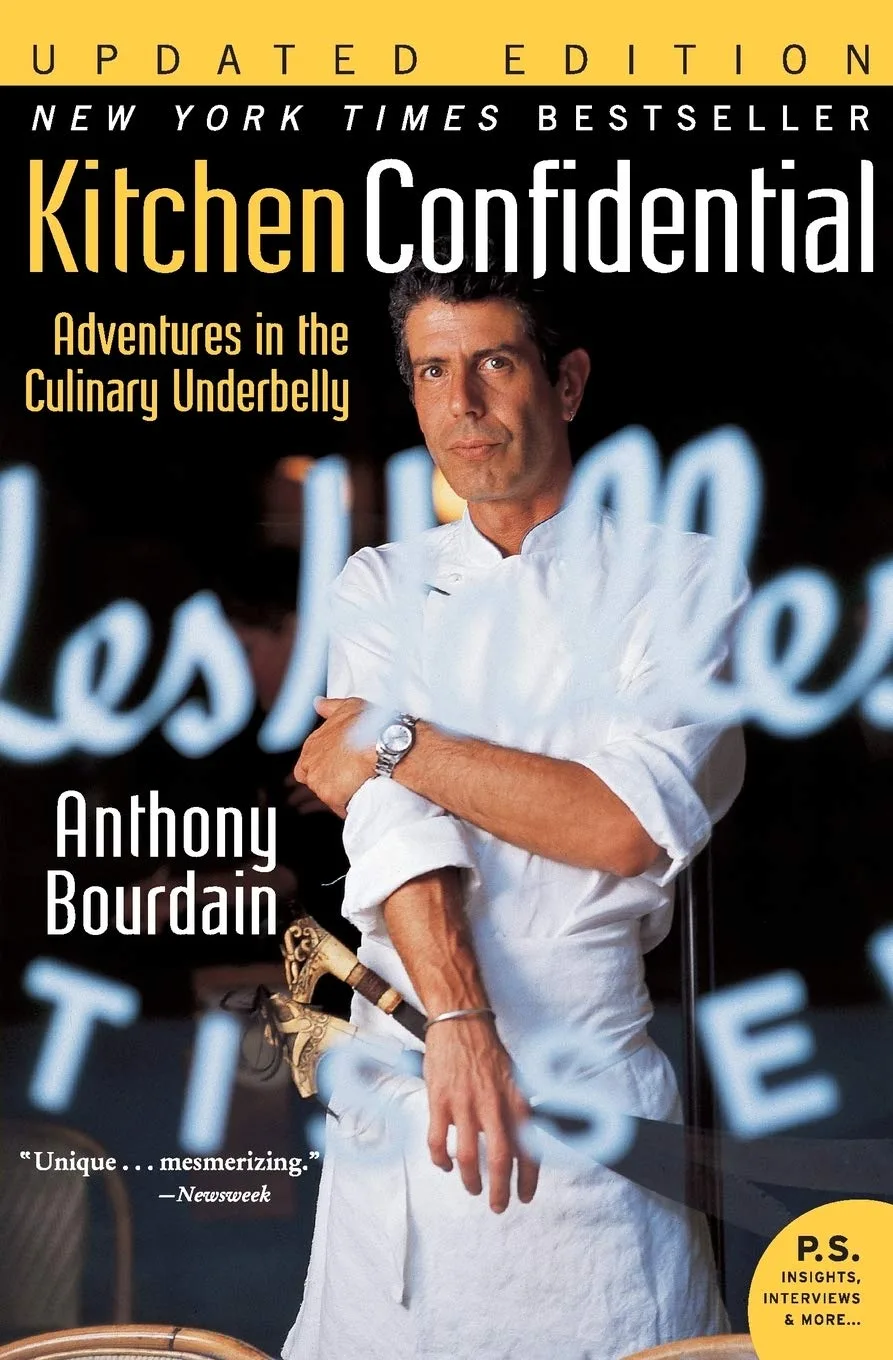
Download Cover Image
Do you want to download the full cover image for Kitchen Confidential: Adventures in the Culinary Underbelly?