
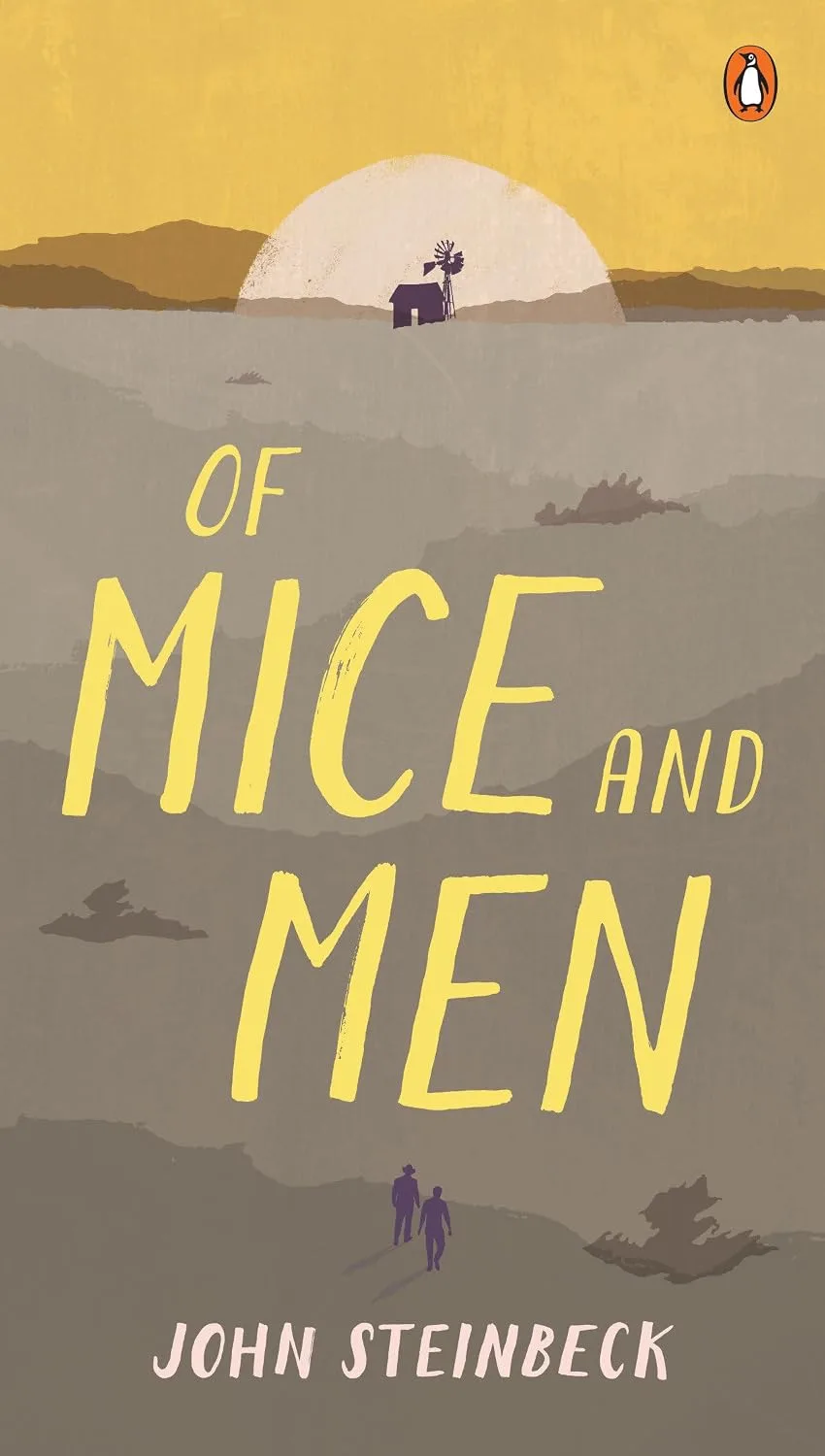
Of Mice and Men
Mass Market Paperback
• 107 Pages
• USD 14.00
• English
• 9780140177398
No ratings yet
| Publisher | Penguin Books |
|---|---|
| ISBN13 | 9780140177398 |
| ASIN/SKU | 0140177396 |
| Book Format | Mass Market Paperback |
| Language | English |
| Pages | 107 |
| List Price | USD 14.00 |
| Publishing Date | 01/09/1993 |
| Dimensions | 7.4 x 4.2 x 0.4 inches |
| Weight | 2.19 ounces |
| Book Code | BD00070253 |
Buy this Book
Amazon Stores
Ebook Stores
Other Stores
Discover Of Mice and Men by John Steinbeck. This book is published by Penguin Books in Mass Market Paperback format, ISBN 9780140177398, ASIN 0140177396, under Literature and Fiction, Contemporary Literature and Fiction, Small Town and Rural Fiction.
Book Description
A controversial tale of friendship and tragedy during the Great Depression
"A thriller, a gripping tale . . . that you will not set down until it is finished. Steinbeck has touched the quick." —The New York Times
John Steinbeck's classic novella follows an unlikely pair: George is "small and quick and dark of face"; Lennie, a man of tremendous size, has the mind of a young child. Yet together they have formed a family, clinging to each other in the face of loneliness, and alienation, and hardship.
Laborers in California's dusty vegetable fields, they hustle work when they can, living a hand-to-mouth existence. For George and Lennie have a plan: to own an acre of land and a shack they can call their own. When they land jobs on a ranch in the Salinas Valley, the fulfillment of their dream seems to be within their grasp. But even George cannot guard Lennie from the provocations of a flirtatious woman, nor predict the consequences of Lennie's unswerving obedience to the things George taught him.
"A thriller, a gripping tale . . . that you will not set down until it is finished. Steinbeck has touched the quick." —The New York Times
John Steinbeck's classic novella follows an unlikely pair: George is "small and quick and dark of face"; Lennie, a man of tremendous size, has the mind of a young child. Yet together they have formed a family, clinging to each other in the face of loneliness, and alienation, and hardship.
Laborers in California's dusty vegetable fields, they hustle work when they can, living a hand-to-mouth existence. For George and Lennie have a plan: to own an acre of land and a shack they can call their own. When they land jobs on a ranch in the Salinas Valley, the fulfillment of their dream seems to be within their grasp. But even George cannot guard Lennie from the provocations of a flirtatious woman, nor predict the consequences of Lennie's unswerving obedience to the things George taught him.
Author Biography
John Steinbeck (1902-1968), winner of the Nobel Prize in Literature, achieved popular success in 1935 when he published Tortilla Flat. He went on to write more than twenty-five novels, including The Grapes of Wrath and Of Mice and Men.
Photo by JohnSteinbeck.JPG: US Government derivative work: Homonihilis (JohnSteinbeck.JPG) [Public domain], via Wikimedia Commons
Photo by JohnSteinbeck.JPG: US Government derivative work: Homonihilis (JohnSteinbeck.JPG) [Public domain], via Wikimedia Commons
Editorial Reviews
Editorial Reviews will be added soon…
Book Summary
John Steinbeck’s Of Mice and Men is a short but deeply moving novella about friendship, loneliness, dreams, poverty, and the painful limits placed on human beings by society and circumstance. Published in 1937 and set during the Great Depression, the story follows two migrant ranch workers, George Milton and Lennie Small, as they move from one temporary job to another in California. George is intelligent, practical, and physically small, while Lennie is enormously strong but has an intellectual disability that makes it difficult for him to understand consequences or control his physical power. Together, the two men share an unusual bond and a simple dream: to own a small piece of land where they can live independently, grow their own food, and, most importantly for Lennie, raise rabbits. The dream gives their difficult lives meaning, but Steinbeck gradually reveals how fragile such dreams can be in a world shaped by poverty, prejudice, loneliness, and violence.
The story begins beside the Salinas River, where George and Lennie stop to rest before reporting to a new ranch job. Their relationship becomes clear immediately. Lennie is dependent on George and constantly seeks his reassurance, while George acts as his protector and guide. Lennie has a fascination with soft things because he loves touching and stroking them, but he does not understand his own strength. He has been carrying a dead mouse in his pocket because he enjoys its softness. George takes the mouse away from him and reminds him that his actions can cause trouble. The incident also recalls the reason the two men had to flee their previous workplace in Weed. Lennie had grabbed a woman’s dress because he liked the feel of it and, frightened when she resisted, held on even more tightly. The woman’s screams attracted attention, and George and Lennie were forced to escape. George knows that Lennie is not intentionally cruel, but he also knows that Lennie’s inability to understand his strength can have dangerous consequences.
At the river, George repeatedly tells Lennie that if anything goes wrong at the new ranch, he must return to this exact place and hide until George comes for him. This instruction seems simple at first, but it becomes one of the most important details in the entire story. George also tells Lennie about their dream of owning a small farm. They imagine a place where they will no longer have to work for other people. They will grow vegetables, keep animals, and live according to their own wishes. Lennie is especially excited about tending the rabbits. George has told the story so many times that it has become almost like a comforting ritual between them. The farm represents much more than property. It symbolizes independence, security, dignity, and the possibility that their lives might someday become their own.
The next day, George and Lennie arrive at the ranch and meet the other workers. George is careful to speak for Lennie because he fears that the boss will reject them if he discovers how dependent Lennie is. The ranch quickly emerges as a harsh social environment in which everyone has a position and everyone is vulnerable in some way. Candy is an aging ranch worker who has lost one hand. Crooks, the Black stable hand, is isolated from the other workers because of racism. Slim is a highly respected mule driver whose calm intelligence gives him unusual authority among the men. Carlson is practical and insensitive, while Curley, the boss’s son, is aggressive, insecure, and constantly looking for opportunities to prove his strength. Curley’s unnamed wife is also isolated, although her loneliness takes a different form. She wanders around the ranch seeking attention and conversation. Steinbeck introduces these characters not simply as individuals but as different examples of loneliness and social exclusion.
Curley immediately dislikes Lennie because Lennie is physically much larger than he is. Curley is insecure about his size and seems determined to establish his authority by challenging bigger men. George recognizes the danger and tells Lennie to avoid him. Meanwhile, Curley’s wife becomes another source of tension. She is attractive and flirtatious, but Steinbeck gradually shows that her behavior is rooted in deep dissatisfaction. She had once dreamed of becoming a movie actress, but instead she married Curley and now lives an unhappy and isolated life. Because she is never given a personal name, she is largely identified through her relationship with her husband. This emphasizes her lack of independent identity and also reflects the limited choices available to women in the world Steinbeck portrays.
One of the novella’s most important episodes concerns Candy’s old dog. The dog is extremely old, weak, and suffering, and Carlson argues that it should be killed. Candy desperately wants to keep the animal because it is his companion and represents the last meaningful connection to his past. Eventually, however, he allows Carlson to take the dog outside and shoot it. The incident is painful because Candy realizes that he has surrendered something he loves simply because others have decided that it is no longer useful. The old dog becomes an important symbol of vulnerability, aging, and the harsh belief that those who are weak or no longer productive have little value. Candy later recognizes a similar threat to himself: he fears that once he is too old to work, he too will be discarded.
After Candy hears George and Lennie discussing their dream farm, he asks if he can join them. Candy has money saved, and his contribution suddenly makes the dream appear possible. For the first time, the fantasy becomes something that could actually happen. George, Lennie, and Candy make plans to buy the land. Their excitement is profound because each man has something different to gain. George wants independence, Lennie wants a safe place where he can care for rabbits, and Candy wants somewhere he will not be treated as useless because of his age. For a brief moment, the men believe they have escaped the cycle of temporary labor and poverty. Their dream becomes a shared human hope rather than merely George and Lennie’s private fantasy.
That hope is threatened when Curley attacks Lennie. Curley initially sees Lennie as an easy target, but when Lennie finally defends himself, his enormous strength becomes terrifying. George tells him to fight back, and Lennie crushes Curley’s hand. Slim then pressures Curley to claim that the injury happened in an accident. This scene reveals one of the central contradictions in Lennie’s character. He is gentle and childlike in intention, but his physical strength is enormous. He can cause devastating harm without wanting to hurt anyone. Steinbeck uses this contradiction to create much of the novella’s tragedy: Lennie’s innocence does not protect the people around him from the consequences of his actions.
Another major scene occurs when Lennie meets Crooks in the stable. Crooks lives separately from the other workers because of racial discrimination. At first he is bitter and defensive, but Lennie’s innocent conversation encourages him to talk about his loneliness. Crooks explains that a person can become so isolated that even the company of another human being becomes essential. He briefly challenges Lennie’s belief that George will always return, asking what would happen if George abandoned him. Lennie becomes frightened, showing how deeply his sense of security depends on George. When Lennie tells Crooks about the farm, Crooks momentarily becomes interested in joining them. Yet he quickly withdraws after Curley’s wife enters and reminds him of the social hierarchy that keeps him powerless. This scene demonstrates how desperately almost everyone in the novella wants the same basic things: companionship, dignity, security, and a place where they belong.
The tragedy accelerates when Lennie accidentally kills the puppy Slim gave him. Lennie is devastated because he loves soft animals but cannot control his strength. Curley’s wife finds him in the barn and begins talking to him. She tells Lennie about her own failed dreams and admits that she once believed she could become a movie star. Her conversation reveals that she is not simply a villainous or flirtatious woman; she is another lonely person trapped in circumstances she dislikes. She allows Lennie to touch her hair because he loves soft things. When Lennie becomes frightened by her reaction and refuses to let go, she screams. Trying to silence her, Lennie shakes her violently and accidentally breaks her neck. He immediately realizes that something terrible has happened and runs away to the river, exactly as George had instructed him earlier.
Curley discovers his wife’s body and becomes determined to hunt Lennie down. The other men join him, turning the search into a violent pursuit. At this point, George understands that the dream of the farm has ended. Candy is particularly devastated because he had believed that the farm might give him a secure future. The death of Curley’s wife has destroyed that possibility, while Lennie’s actions have made his own survival almost impossible. George knows that if Curley’s group finds Lennie first, Lennie will be killed violently. He therefore leaves the ranch and goes to the river, knowing that Lennie will be waiting there.
The final scene is the emotional heart of Of Mice and Men. Lennie is frightened and confused, but George finds him and does not immediately express anger. Instead, George asks Lennie to look across the river and imagine the farm one more time. He describes the land, the animals, and the rabbits. Lennie becomes happy again, listening to the dream he has trusted throughout the story. As the pursuing men approach, George takes Carlson’s gun and shoots Lennie in the back of the head. He kills his friend before the others can capture and torture him. The act is both horrifying and deeply compassionate. George destroys the person he loves in order to spare him from a more brutal death.
After Lennie’s death, Slim understands what George has done and quietly comforts him. Curley and Carlson, however, fail to understand the emotional reality of the moment. Their confusion at George and Lennie’s relationship highlights what made the friendship so unusual. In the world of the ranch, men are generally isolated, competing for work, money, status, and survival. George and Lennie were different because they belonged to each other. George complained about Lennie and sometimes imagined how much easier his life would be without him, but he never truly abandoned him. Lennie, meanwhile, trusted George completely. Their friendship gave both men something that money could not buy: a sense of belonging.
The title Of Mice and Men points toward the novella’s central idea that human plans are fragile. The title alludes to Robert Burns’s poem “To a Mouse,” in which a carefully constructed plan is destroyed unexpectedly. Steinbeck applies the same idea to George, Lennie, Candy, Crooks, and Curley’s wife. Almost every character has a dream, but almost every dream is broken by forces beyond individual control. The farm is destroyed by tragedy; Crooks’s hope for companionship is crushed by racism; Candy’s security disappears with Lennie’s death; Curley’s wife’s dream of Hollywood has already collapsed; and Lennie’s innocent desire for rabbits ends in violence.
Ultimately, Of Mice and Men is a tragedy about the distance between what people dream of and what life allows them to have. The novella’s most powerful theme is perhaps loneliness. Almost every major character is lonely, even when surrounded by other people. George has Lennie, Lennie has George, and their relationship is exceptional precisely because genuine companionship is so rare on the ranch. Steinbeck also explores the American Dream and asks whether hard work really guarantees independence and happiness. For people living through poverty, discrimination, disability, aging, or social isolation, the promise of a better future may be almost impossible to achieve.
What makes Of Mice and Men so enduring is that Steinbeck does not present the characters simply as good or bad. George can be impatient, Curley can be cruel, Curley’s wife can be manipulative, and Lennie can be dangerous, yet each is also human and vulnerable. Their weaknesses are shaped by loneliness, fear, social pressure, and circumstances. The ending therefore does not feel like a simple punishment for Lennie’s actions. Instead, it feels like the final collapse of a world in which vulnerable people have very few choices.
In the end, George and Lennie’s dream of a small farm becomes the symbol of everything they wanted but could never possess: freedom, safety, companionship, and control over their own lives. The dream gives them happiness while it lasts, even though the reader gradually understands that it may never become reality. George’s final act destroys that dream along with Lennie, leaving him alive but emotionally broken. Of Mice and Men therefore becomes much more than a story about two migrant workers during the Great Depression. It is a deeply human exploration of friendship, mercy, loneliness, prejudice, powerlessness, and the heartbreaking truth that sometimes people can love one another deeply and still be unable to save each other.
The story begins beside the Salinas River, where George and Lennie stop to rest before reporting to a new ranch job. Their relationship becomes clear immediately. Lennie is dependent on George and constantly seeks his reassurance, while George acts as his protector and guide. Lennie has a fascination with soft things because he loves touching and stroking them, but he does not understand his own strength. He has been carrying a dead mouse in his pocket because he enjoys its softness. George takes the mouse away from him and reminds him that his actions can cause trouble. The incident also recalls the reason the two men had to flee their previous workplace in Weed. Lennie had grabbed a woman’s dress because he liked the feel of it and, frightened when she resisted, held on even more tightly. The woman’s screams attracted attention, and George and Lennie were forced to escape. George knows that Lennie is not intentionally cruel, but he also knows that Lennie’s inability to understand his strength can have dangerous consequences.
At the river, George repeatedly tells Lennie that if anything goes wrong at the new ranch, he must return to this exact place and hide until George comes for him. This instruction seems simple at first, but it becomes one of the most important details in the entire story. George also tells Lennie about their dream of owning a small farm. They imagine a place where they will no longer have to work for other people. They will grow vegetables, keep animals, and live according to their own wishes. Lennie is especially excited about tending the rabbits. George has told the story so many times that it has become almost like a comforting ritual between them. The farm represents much more than property. It symbolizes independence, security, dignity, and the possibility that their lives might someday become their own.
The next day, George and Lennie arrive at the ranch and meet the other workers. George is careful to speak for Lennie because he fears that the boss will reject them if he discovers how dependent Lennie is. The ranch quickly emerges as a harsh social environment in which everyone has a position and everyone is vulnerable in some way. Candy is an aging ranch worker who has lost one hand. Crooks, the Black stable hand, is isolated from the other workers because of racism. Slim is a highly respected mule driver whose calm intelligence gives him unusual authority among the men. Carlson is practical and insensitive, while Curley, the boss’s son, is aggressive, insecure, and constantly looking for opportunities to prove his strength. Curley’s unnamed wife is also isolated, although her loneliness takes a different form. She wanders around the ranch seeking attention and conversation. Steinbeck introduces these characters not simply as individuals but as different examples of loneliness and social exclusion.
Curley immediately dislikes Lennie because Lennie is physically much larger than he is. Curley is insecure about his size and seems determined to establish his authority by challenging bigger men. George recognizes the danger and tells Lennie to avoid him. Meanwhile, Curley’s wife becomes another source of tension. She is attractive and flirtatious, but Steinbeck gradually shows that her behavior is rooted in deep dissatisfaction. She had once dreamed of becoming a movie actress, but instead she married Curley and now lives an unhappy and isolated life. Because she is never given a personal name, she is largely identified through her relationship with her husband. This emphasizes her lack of independent identity and also reflects the limited choices available to women in the world Steinbeck portrays.
One of the novella’s most important episodes concerns Candy’s old dog. The dog is extremely old, weak, and suffering, and Carlson argues that it should be killed. Candy desperately wants to keep the animal because it is his companion and represents the last meaningful connection to his past. Eventually, however, he allows Carlson to take the dog outside and shoot it. The incident is painful because Candy realizes that he has surrendered something he loves simply because others have decided that it is no longer useful. The old dog becomes an important symbol of vulnerability, aging, and the harsh belief that those who are weak or no longer productive have little value. Candy later recognizes a similar threat to himself: he fears that once he is too old to work, he too will be discarded.
After Candy hears George and Lennie discussing their dream farm, he asks if he can join them. Candy has money saved, and his contribution suddenly makes the dream appear possible. For the first time, the fantasy becomes something that could actually happen. George, Lennie, and Candy make plans to buy the land. Their excitement is profound because each man has something different to gain. George wants independence, Lennie wants a safe place where he can care for rabbits, and Candy wants somewhere he will not be treated as useless because of his age. For a brief moment, the men believe they have escaped the cycle of temporary labor and poverty. Their dream becomes a shared human hope rather than merely George and Lennie’s private fantasy.
That hope is threatened when Curley attacks Lennie. Curley initially sees Lennie as an easy target, but when Lennie finally defends himself, his enormous strength becomes terrifying. George tells him to fight back, and Lennie crushes Curley’s hand. Slim then pressures Curley to claim that the injury happened in an accident. This scene reveals one of the central contradictions in Lennie’s character. He is gentle and childlike in intention, but his physical strength is enormous. He can cause devastating harm without wanting to hurt anyone. Steinbeck uses this contradiction to create much of the novella’s tragedy: Lennie’s innocence does not protect the people around him from the consequences of his actions.
Another major scene occurs when Lennie meets Crooks in the stable. Crooks lives separately from the other workers because of racial discrimination. At first he is bitter and defensive, but Lennie’s innocent conversation encourages him to talk about his loneliness. Crooks explains that a person can become so isolated that even the company of another human being becomes essential. He briefly challenges Lennie’s belief that George will always return, asking what would happen if George abandoned him. Lennie becomes frightened, showing how deeply his sense of security depends on George. When Lennie tells Crooks about the farm, Crooks momentarily becomes interested in joining them. Yet he quickly withdraws after Curley’s wife enters and reminds him of the social hierarchy that keeps him powerless. This scene demonstrates how desperately almost everyone in the novella wants the same basic things: companionship, dignity, security, and a place where they belong.
The tragedy accelerates when Lennie accidentally kills the puppy Slim gave him. Lennie is devastated because he loves soft animals but cannot control his strength. Curley’s wife finds him in the barn and begins talking to him. She tells Lennie about her own failed dreams and admits that she once believed she could become a movie star. Her conversation reveals that she is not simply a villainous or flirtatious woman; she is another lonely person trapped in circumstances she dislikes. She allows Lennie to touch her hair because he loves soft things. When Lennie becomes frightened by her reaction and refuses to let go, she screams. Trying to silence her, Lennie shakes her violently and accidentally breaks her neck. He immediately realizes that something terrible has happened and runs away to the river, exactly as George had instructed him earlier.
Curley discovers his wife’s body and becomes determined to hunt Lennie down. The other men join him, turning the search into a violent pursuit. At this point, George understands that the dream of the farm has ended. Candy is particularly devastated because he had believed that the farm might give him a secure future. The death of Curley’s wife has destroyed that possibility, while Lennie’s actions have made his own survival almost impossible. George knows that if Curley’s group finds Lennie first, Lennie will be killed violently. He therefore leaves the ranch and goes to the river, knowing that Lennie will be waiting there.
The final scene is the emotional heart of Of Mice and Men. Lennie is frightened and confused, but George finds him and does not immediately express anger. Instead, George asks Lennie to look across the river and imagine the farm one more time. He describes the land, the animals, and the rabbits. Lennie becomes happy again, listening to the dream he has trusted throughout the story. As the pursuing men approach, George takes Carlson’s gun and shoots Lennie in the back of the head. He kills his friend before the others can capture and torture him. The act is both horrifying and deeply compassionate. George destroys the person he loves in order to spare him from a more brutal death.
After Lennie’s death, Slim understands what George has done and quietly comforts him. Curley and Carlson, however, fail to understand the emotional reality of the moment. Their confusion at George and Lennie’s relationship highlights what made the friendship so unusual. In the world of the ranch, men are generally isolated, competing for work, money, status, and survival. George and Lennie were different because they belonged to each other. George complained about Lennie and sometimes imagined how much easier his life would be without him, but he never truly abandoned him. Lennie, meanwhile, trusted George completely. Their friendship gave both men something that money could not buy: a sense of belonging.
The title Of Mice and Men points toward the novella’s central idea that human plans are fragile. The title alludes to Robert Burns’s poem “To a Mouse,” in which a carefully constructed plan is destroyed unexpectedly. Steinbeck applies the same idea to George, Lennie, Candy, Crooks, and Curley’s wife. Almost every character has a dream, but almost every dream is broken by forces beyond individual control. The farm is destroyed by tragedy; Crooks’s hope for companionship is crushed by racism; Candy’s security disappears with Lennie’s death; Curley’s wife’s dream of Hollywood has already collapsed; and Lennie’s innocent desire for rabbits ends in violence.
Ultimately, Of Mice and Men is a tragedy about the distance between what people dream of and what life allows them to have. The novella’s most powerful theme is perhaps loneliness. Almost every major character is lonely, even when surrounded by other people. George has Lennie, Lennie has George, and their relationship is exceptional precisely because genuine companionship is so rare on the ranch. Steinbeck also explores the American Dream and asks whether hard work really guarantees independence and happiness. For people living through poverty, discrimination, disability, aging, or social isolation, the promise of a better future may be almost impossible to achieve.
What makes Of Mice and Men so enduring is that Steinbeck does not present the characters simply as good or bad. George can be impatient, Curley can be cruel, Curley’s wife can be manipulative, and Lennie can be dangerous, yet each is also human and vulnerable. Their weaknesses are shaped by loneliness, fear, social pressure, and circumstances. The ending therefore does not feel like a simple punishment for Lennie’s actions. Instead, it feels like the final collapse of a world in which vulnerable people have very few choices.
In the end, George and Lennie’s dream of a small farm becomes the symbol of everything they wanted but could never possess: freedom, safety, companionship, and control over their own lives. The dream gives them happiness while it lasts, even though the reader gradually understands that it may never become reality. George’s final act destroys that dream along with Lennie, leaving him alive but emotionally broken. Of Mice and Men therefore becomes much more than a story about two migrant workers during the Great Depression. It is a deeply human exploration of friendship, mercy, loneliness, prejudice, powerlessness, and the heartbreaking truth that sometimes people can love one another deeply and still be unable to save each other.
Sample Chapters
Sample Chapters will be added soon…
Reader Reviews
No reviews yet.
Of Mice and Men
Download Cover Image
Do you want to download the full cover image for Of Mice and Men?