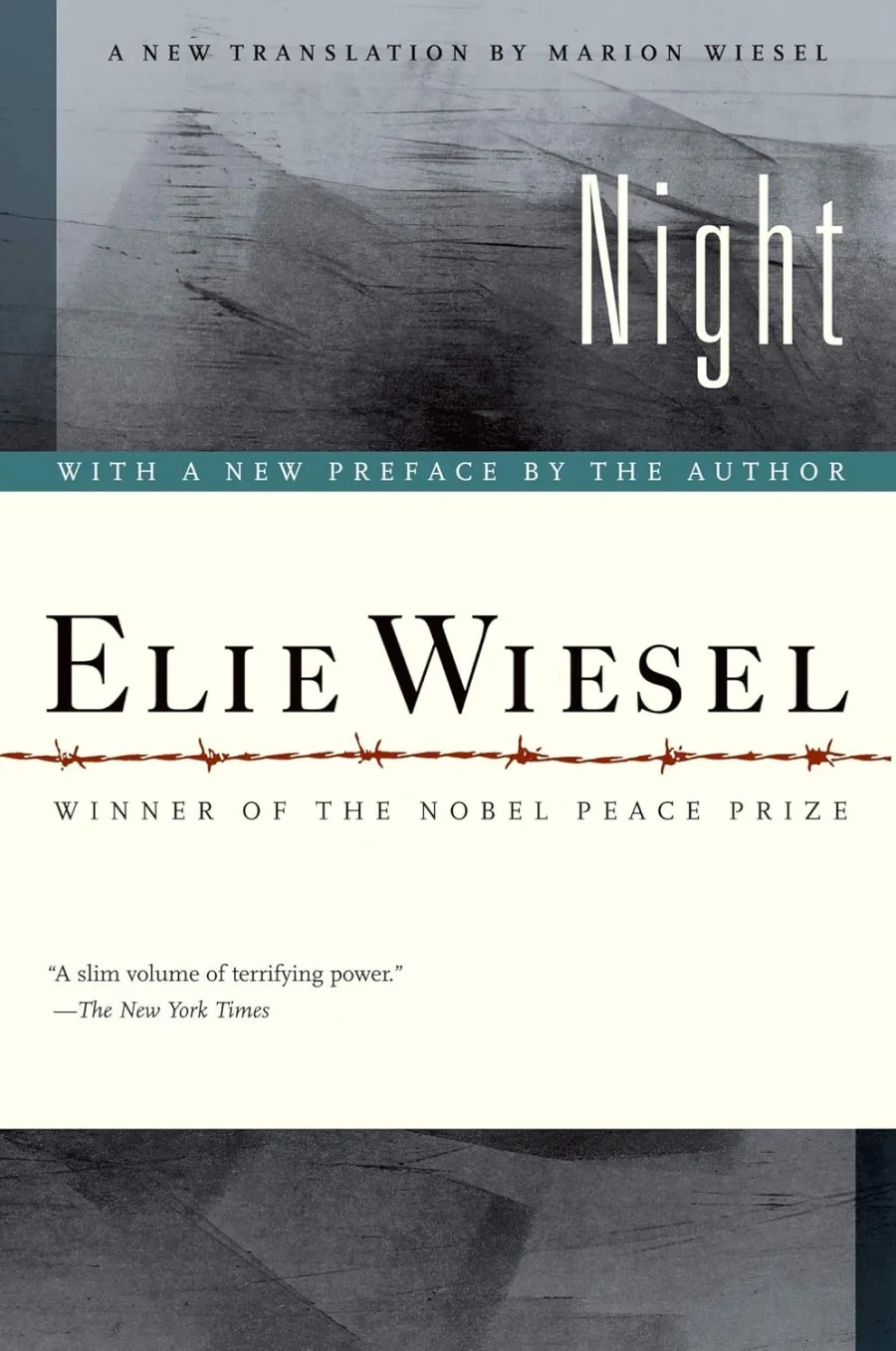
Night
Paperback
• 120 Pages
• USD 2.61
• English
• 9780374500016
No ratings yet
| Publisher | Hill and Wang |
|---|---|
| ISBN13 | 9780374500016 |
| ASIN/SKU | 0374500010 |
| Book Format | Paperback |
| Language | English |
| Pages | 120 |
| List Price | USD 2.61 |
| Publishing Date | 16/01/2006 |
| Dimensions | 5.5 x 0.39 x 8.26 inches |
| Weight | 4.8 ounces |
| Book Code | BD00070254 |
Buy this Book
Amazon Stores
Ebook Stores
Other Stores
Discover Night by Elie Wiesel. This book is published by Hill and Wang in Paperback format, ISBN 9780374500016, ASIN 0374500010, under Biographies and Memoirs, Historical European Biographies, Jewish Biographies.
Book Description
Alert: This product may be shipped with or without the inclusion of the Oprah Book Club sticker. Please note that regardless of the cover, the books are identical. Night is Elie Wiesel's masterpiece, a candid, horrific, and deeply poignant autobiographical account of his survival as a teenager in the Nazi death camps. This new translation by Marion Wiesel, Elie's wife and frequent translator, presents this seminal memoir in the language and spirit truest to the author's original intent. And in a substantive new preface, Elie reflects on the enduring importance of Night and his lifelong, passionate dedication to ensuring that the world never forgets man's capacity for inhumanity to man.
Night offers much more than a litany of the daily terrors, everyday perversions, and rampant sadism at Auschwitz and Buchenwald; it also eloquently addresses many of the philosophical as well as personal questions implicit in any serious consideration of what the Holocaust was, what it meant, and what its legacy is and will be.
Night offers much more than a litany of the daily terrors, everyday perversions, and rampant sadism at Auschwitz and Buchenwald; it also eloquently addresses many of the philosophical as well as personal questions implicit in any serious consideration of what the Holocaust was, what it meant, and what its legacy is and will be.
Author Biography
ELIE WIESEL was awarded the Nobel Peace Prize in 1986. The author of more than fifty internationally acclaimed works of fiction and nonfiction, he was Andrew W. Mellon Professor in the Humanities and University Professor at Boston University for forty years. Wiesel died in 2016.
Editorial Reviews
Editorial Reviews will be added soon…
Book Summary
Night is one of the most powerful and painful memoirs ever written about the Holocaust. First published as La Nuit in 1958, the book recounts Elie Wiesel’s experiences as a Jewish teenager imprisoned by the Nazis during World War II. The memoir follows his journey from an ordinary religious childhood in Sighet, Transylvania, through deportation, Auschwitz, forced labor, a death march, and finally liberation at Buchenwald. More than a historical account, Night is a deeply personal exploration of faith, suffering, family, survival, guilt, and the destruction of human dignity. The United States Holocaust Memorial Museum notes that Wiesel’s narrative describes the deportation of his family, his separation from his mother and younger sister, his imprisonment and forced labor, and the death march that ultimately brought him to Buchenwald.
At the beginning of Night, Eliezer is a deeply religious Jewish boy living with his parents and sisters in Sighet. His life revolves around Jewish tradition and religious study. He is particularly interested in mystical teachings and wants to understand the deeper meaning of his faith. His father, a respected member of the community, is less interested in mystical questions and initially believes that his son is too young to become so absorbed in them. Eliezer's early life is therefore presented as safe, familiar, and spiritually meaningful. He believes in God with the uncomplicated confidence of a young person who has not yet been forced to confront extreme suffering. His world has rules, traditions, family bonds, and a sense of moral order. This peaceful beginning is important because the rest of the memoir shows how completely that world is destroyed.
One of the first warnings comes from Moishe the Beadle, a poor Jewish man who has been deported with other foreign Jews. Moishe eventually returns to Sighet and tells the townspeople that the deported Jews were murdered. He desperately tries to warn everyone about what is coming. Yet the people refuse to believe him. They assume that he has become mentally disturbed and that his terrible story cannot possibly be true. This episode introduces one of the most important ideas in Night: the danger of disbelief and silence. The residents of Sighet cannot imagine that the world could become as evil as Moishe describes. Their inability to accept the truth makes them vulnerable when the Nazis eventually arrive.
In 1944, the situation changes rapidly. The Germans occupy Hungary, and anti-Jewish measures become increasingly severe. Jewish people are forced to wear identifying symbols, their property is taken, and they are eventually confined to ghettos. At first, these developments seem frightening but temporary. Even when the Jews of Sighet are forced from their homes, many still hope that the worst will soon be over. Wiesel carefully shows how persecution can develop gradually. People are repeatedly given reasons to believe that the next restriction will be the last one. Instead, each new restriction prepares the way for something even more terrible.
Eventually, Eliezer and his family are forced onto cattle cars bound for Auschwitz. The journey itself becomes an ordeal. The prisoners are crowded together without adequate food, water, space, or ventilation. Fear and exhaustion spread throughout the train. One woman, Madame Schächter, repeatedly screams that she sees fire. The other prisoners cannot understand her terror and eventually beat her into silence. Later, when they arrive at Birkenau, Eliezer realizes that her terrible vision was not madness. The flames and crematoria are real. Her episode becomes a grim symbol of the truth that people refuse to see until it is too late.
Arrival at Auschwitz marks the destruction of Eliezer's old life. He is separated from his mother and younger sister, whom he never sees again. He and his father survive the initial selection and are chosen for forced labor. From this point onward, survival becomes uncertain from moment to moment. Prisoners are stripped of their clothing and possessions, shaved, disinfected, numbered, and reduced to bodies that can either work or be killed. Their identities as sons, daughters, teachers, merchants, students, parents, and religious people are deliberately erased. Wiesel's description of this process is central to understanding Night: the Nazis do not merely seek to kill their prisoners physically; they create a system designed to destroy their sense of themselves as human beings.
The first night in the camp becomes a turning point for Eliezer. He witnesses the burning of children and understands that the world he knew has disappeared. His faith, once the foundation of his identity, begins to collapse. He has been taught to believe in a powerful and compassionate God, yet he now sees innocent people being murdered without mercy. His questions are not abstract theological problems anymore. They are questions born from immediate suffering: How can God allow this? Where is justice? What meaning can prayer have in a place where innocent children are being killed?
This spiritual crisis becomes one of the central themes of Night. Eliezer's relationship with God changes as his experiences become more horrific. He does not simply stop believing overnight. Instead, faith becomes an agonizing struggle. He argues internally with God, feels anger toward Him, questions religious traditions, and eventually refuses to participate sincerely in certain religious observances. His crisis is particularly visible during Jewish holidays such as Rosh Hashanah and Yom Kippur. The very rituals that once gave his life meaning now seem impossible to reconcile with what he sees around him. Scholars and critics frequently identify this conflict between faith and suffering as one of the memoir's defining concerns.
Eliezer and his father are eventually transferred to Buna, a labor camp within the Auschwitz complex. Their existence becomes a repetitive struggle involving hunger, exhaustion, forced labor, beatings, selections, and the constant possibility of death. Eliezer is assigned to work in an electrical-fittings factory. His gold tooth is forcibly removed by a brutal foreman, illustrating how even the smallest possession becomes valuable when prisoners have almost nothing left. Violence is arbitrary and often meaningless. A prisoner can be beaten because a guard is angry, because work is slow, or simply because the person has become an object upon which power can be exercised.
Yet Night does not portray every prisoner as completely passive or every relationship as destroyed. Small acts of companionship remain enormously important. Most importantly, Eliezer's relationship with his father becomes one of the major emotional centers of the memoir. His father becomes both a source of strength and a responsibility. Eliezer repeatedly tells himself that he must survive because his father needs him. Their relationship gives him a reason to continue when his own desire to live is nearly gone. The father-son bond therefore becomes an important counterforce to the camp's attempt to turn everyone into an isolated individual concerned only with survival.
At the same time, Wiesel shows the terrible moral consequences of extreme hunger and fear. Prisoners sometimes turn against one another. One of the most disturbing episodes occurs when an elderly man receives bread and is attacked by other prisoners desperate for food. In another scene, Eliezer witnesses a son turn violently against his father during the struggle for a piece of bread. These episodes are horrifying precisely because they show how systematic starvation can destroy ordinary moral instincts. Wiesel does not condemn the victims simplistically. Instead, he asks what happens to human morality when people are deliberately pushed beyond the limits of endurance. The Holocaust becomes, in Night, not only a story of physical destruction but also a study of how oppression can manipulate people into losing their connections with one another.
Another unforgettable episode is the hanging of a young child, referred to as the pipel. The prisoners are forced to watch. Because the child is too light to die quickly, his death becomes prolonged and agonizing. Afterward, a prisoner asks where God is. For Eliezer, the question becomes almost unbearable. The suffering of a child represents everything he can no longer reconcile with his earlier understanding of a just and compassionate God. This moment deepens his spiritual rebellion and reinforces the memoir's recurring image of silence: people cry out, but there seems to be no answer.
As the war turns against Nazi Germany and Soviet forces approach, the prisoners are evacuated from Buna. Eliezer has recently undergone an operation on his injured foot, but he chooses to leave the infirmary with his father rather than risk being separated from him. They join a brutal death march through snow and freezing conditions. Prisoners who cannot keep running are shot or left behind. The march is not simply transportation; it is another mechanism of mass death.
At Gleiwitz, the surviving prisoners are forced into a crowded barracks. Eliezer becomes separated from his father for a moment and fears that he has lost him. Eventually they find each other again. Their survival depends partly upon their determination not to abandon one another. They are then loaded into open cattle cars bound for Buchenwald. The journey is catastrophic. Prisoners die from cold, starvation, exhaustion, and violence. When bread is thrown into the cars by people watching from outside, desperate prisoners fight one another for scraps. The scene demonstrates how completely the camp system has reduced human life to the struggle for food and survival.
Buchenwald becomes the final stage of Eliezer's journey with his father. His father's health deteriorates rapidly. He suffers from dysentery and is too weak to care for himself. Eliezer tries to help him but is increasingly exhausted and frightened. His father calls for water, yet helping him can expose Eliezer to punishment. Eventually, his father dies. Perhaps one of the most painful aspects of this moment is Eliezer's reaction. He feels grief, but he also experiences relief because his responsibility has ended. He is ashamed of that relief. Wiesel therefore presents survival as morally complicated. Being alive does not necessarily mean feeling heroic or grateful. Sometimes survival leaves the survivor carrying guilt over thoughts and actions that arose under unimaginable circumstances.
Soon afterward, Buchenwald is liberated. Liberation should represent the happy conclusion to the story, but Wiesel deliberately refuses to give the reader a conventional ending. Eliezer has survived, yet the boy who entered the camps no longer exists in the same form. When he looks into a mirror after liberation, he sees a corpse-like figure staring back at him. The image suggests that although his body has survived, his innocence and former identity have been profoundly destroyed. Physical freedom cannot immediately undo psychological trauma.
This ending is essential to understanding why Night remains such a significant Holocaust memoir. It is not simply a story about escaping a concentration camp. It is a story about what happens to a human being when an entire system is organized around humiliation, starvation, violence, fear, and murder. Wiesel shows how such a system attacks everything that normally gives life meaning: family, religion, community, dignity, trust, and hope.
The title Night itself carries several meanings. Literally, the narrative contains many nights during which Eliezer experiences fear, uncertainty, and death. Symbolically, however, night represents spiritual darkness and the disappearance of moral certainty. Light traditionally suggests knowledge, hope, and goodness; darkness suggests confusion, fear, and despair. As Eliezer moves deeper into the concentration-camp system, his world becomes metaphorically darker. The title therefore captures not only the historical darkness of the Holocaust but also the darkness that enters Eliezer's inner life.
Another major theme is silence. At the beginning, people remain silent because they refuse to believe Moishe. Later, prisoners are silenced by terror. God appears silent when Eliezer desperately needs an answer. The world outside the camps is also largely absent from his experience. Wiesel's decision to write the memoir can consequently be understood as an answer to silence. His testimony gives language to an experience that many people would rather avoid confronting. The memoir itself becomes an act of remembrance.
Ultimately, the central message of Night is not that suffering automatically makes a person stronger. Wiesel offers no easy lesson of that kind. Instead, he shows that suffering can break people, distort relationships, destroy faith, and leave wounds that do not disappear when the physical danger ends. At the same time, the memoir demonstrates the importance of remembering what happened. Wiesel transformed his personal experience into testimony so that the victims would not simply disappear into statistics. The United States Holocaust Memorial Museum records that Night has been translated into numerous languages and read by millions since its publication, reflecting its lasting importance as both literature and Holocaust testimony.
In the end, Night is a profoundly human book because it refuses to simplify its characters or its suffering. Eliezer is at once a son, a believer, a prisoner, a frightened child, and eventually a survivor burdened by memories. His greatest struggle is not merely to stay alive but to understand what survival means after witnessing the destruction of so many innocent lives. His relationship with his father gives him a reason to endure, while the loss of his family and faith reveals the terrible cost of that endurance. The memoir leaves readers with difficult questions rather than comfortable answers: What happens to morality under extreme oppression? Can faith survive unbearable suffering? What responsibilities do survivors have to remember? And what responsibility does the rest of humanity have to listen?
That is why Night remains more than a Holocaust book or a required school reading. It is a warning about what happens when prejudice becomes policy, when human beings are reduced to categories, and when silence allows cruelty to grow. Wiesel's restrained, direct narrative makes the story even more powerful because he does not need exaggerated language to communicate horror. His testimony asks readers to remember the individual human beings behind historical numbers and to understand that the destruction of humanity begins long before the final act of violence. In this sense, Night is ultimately a book about memory: the memory of a boy who lost his family, his childhood, and much of his faith, but who survived to tell the world what happened.
At the beginning of Night, Eliezer is a deeply religious Jewish boy living with his parents and sisters in Sighet. His life revolves around Jewish tradition and religious study. He is particularly interested in mystical teachings and wants to understand the deeper meaning of his faith. His father, a respected member of the community, is less interested in mystical questions and initially believes that his son is too young to become so absorbed in them. Eliezer's early life is therefore presented as safe, familiar, and spiritually meaningful. He believes in God with the uncomplicated confidence of a young person who has not yet been forced to confront extreme suffering. His world has rules, traditions, family bonds, and a sense of moral order. This peaceful beginning is important because the rest of the memoir shows how completely that world is destroyed.
One of the first warnings comes from Moishe the Beadle, a poor Jewish man who has been deported with other foreign Jews. Moishe eventually returns to Sighet and tells the townspeople that the deported Jews were murdered. He desperately tries to warn everyone about what is coming. Yet the people refuse to believe him. They assume that he has become mentally disturbed and that his terrible story cannot possibly be true. This episode introduces one of the most important ideas in Night: the danger of disbelief and silence. The residents of Sighet cannot imagine that the world could become as evil as Moishe describes. Their inability to accept the truth makes them vulnerable when the Nazis eventually arrive.
In 1944, the situation changes rapidly. The Germans occupy Hungary, and anti-Jewish measures become increasingly severe. Jewish people are forced to wear identifying symbols, their property is taken, and they are eventually confined to ghettos. At first, these developments seem frightening but temporary. Even when the Jews of Sighet are forced from their homes, many still hope that the worst will soon be over. Wiesel carefully shows how persecution can develop gradually. People are repeatedly given reasons to believe that the next restriction will be the last one. Instead, each new restriction prepares the way for something even more terrible.
Eventually, Eliezer and his family are forced onto cattle cars bound for Auschwitz. The journey itself becomes an ordeal. The prisoners are crowded together without adequate food, water, space, or ventilation. Fear and exhaustion spread throughout the train. One woman, Madame Schächter, repeatedly screams that she sees fire. The other prisoners cannot understand her terror and eventually beat her into silence. Later, when they arrive at Birkenau, Eliezer realizes that her terrible vision was not madness. The flames and crematoria are real. Her episode becomes a grim symbol of the truth that people refuse to see until it is too late.
Arrival at Auschwitz marks the destruction of Eliezer's old life. He is separated from his mother and younger sister, whom he never sees again. He and his father survive the initial selection and are chosen for forced labor. From this point onward, survival becomes uncertain from moment to moment. Prisoners are stripped of their clothing and possessions, shaved, disinfected, numbered, and reduced to bodies that can either work or be killed. Their identities as sons, daughters, teachers, merchants, students, parents, and religious people are deliberately erased. Wiesel's description of this process is central to understanding Night: the Nazis do not merely seek to kill their prisoners physically; they create a system designed to destroy their sense of themselves as human beings.
The first night in the camp becomes a turning point for Eliezer. He witnesses the burning of children and understands that the world he knew has disappeared. His faith, once the foundation of his identity, begins to collapse. He has been taught to believe in a powerful and compassionate God, yet he now sees innocent people being murdered without mercy. His questions are not abstract theological problems anymore. They are questions born from immediate suffering: How can God allow this? Where is justice? What meaning can prayer have in a place where innocent children are being killed?
This spiritual crisis becomes one of the central themes of Night. Eliezer's relationship with God changes as his experiences become more horrific. He does not simply stop believing overnight. Instead, faith becomes an agonizing struggle. He argues internally with God, feels anger toward Him, questions religious traditions, and eventually refuses to participate sincerely in certain religious observances. His crisis is particularly visible during Jewish holidays such as Rosh Hashanah and Yom Kippur. The very rituals that once gave his life meaning now seem impossible to reconcile with what he sees around him. Scholars and critics frequently identify this conflict between faith and suffering as one of the memoir's defining concerns.
Eliezer and his father are eventually transferred to Buna, a labor camp within the Auschwitz complex. Their existence becomes a repetitive struggle involving hunger, exhaustion, forced labor, beatings, selections, and the constant possibility of death. Eliezer is assigned to work in an electrical-fittings factory. His gold tooth is forcibly removed by a brutal foreman, illustrating how even the smallest possession becomes valuable when prisoners have almost nothing left. Violence is arbitrary and often meaningless. A prisoner can be beaten because a guard is angry, because work is slow, or simply because the person has become an object upon which power can be exercised.
Yet Night does not portray every prisoner as completely passive or every relationship as destroyed. Small acts of companionship remain enormously important. Most importantly, Eliezer's relationship with his father becomes one of the major emotional centers of the memoir. His father becomes both a source of strength and a responsibility. Eliezer repeatedly tells himself that he must survive because his father needs him. Their relationship gives him a reason to continue when his own desire to live is nearly gone. The father-son bond therefore becomes an important counterforce to the camp's attempt to turn everyone into an isolated individual concerned only with survival.
At the same time, Wiesel shows the terrible moral consequences of extreme hunger and fear. Prisoners sometimes turn against one another. One of the most disturbing episodes occurs when an elderly man receives bread and is attacked by other prisoners desperate for food. In another scene, Eliezer witnesses a son turn violently against his father during the struggle for a piece of bread. These episodes are horrifying precisely because they show how systematic starvation can destroy ordinary moral instincts. Wiesel does not condemn the victims simplistically. Instead, he asks what happens to human morality when people are deliberately pushed beyond the limits of endurance. The Holocaust becomes, in Night, not only a story of physical destruction but also a study of how oppression can manipulate people into losing their connections with one another.
Another unforgettable episode is the hanging of a young child, referred to as the pipel. The prisoners are forced to watch. Because the child is too light to die quickly, his death becomes prolonged and agonizing. Afterward, a prisoner asks where God is. For Eliezer, the question becomes almost unbearable. The suffering of a child represents everything he can no longer reconcile with his earlier understanding of a just and compassionate God. This moment deepens his spiritual rebellion and reinforces the memoir's recurring image of silence: people cry out, but there seems to be no answer.
As the war turns against Nazi Germany and Soviet forces approach, the prisoners are evacuated from Buna. Eliezer has recently undergone an operation on his injured foot, but he chooses to leave the infirmary with his father rather than risk being separated from him. They join a brutal death march through snow and freezing conditions. Prisoners who cannot keep running are shot or left behind. The march is not simply transportation; it is another mechanism of mass death.
At Gleiwitz, the surviving prisoners are forced into a crowded barracks. Eliezer becomes separated from his father for a moment and fears that he has lost him. Eventually they find each other again. Their survival depends partly upon their determination not to abandon one another. They are then loaded into open cattle cars bound for Buchenwald. The journey is catastrophic. Prisoners die from cold, starvation, exhaustion, and violence. When bread is thrown into the cars by people watching from outside, desperate prisoners fight one another for scraps. The scene demonstrates how completely the camp system has reduced human life to the struggle for food and survival.
Buchenwald becomes the final stage of Eliezer's journey with his father. His father's health deteriorates rapidly. He suffers from dysentery and is too weak to care for himself. Eliezer tries to help him but is increasingly exhausted and frightened. His father calls for water, yet helping him can expose Eliezer to punishment. Eventually, his father dies. Perhaps one of the most painful aspects of this moment is Eliezer's reaction. He feels grief, but he also experiences relief because his responsibility has ended. He is ashamed of that relief. Wiesel therefore presents survival as morally complicated. Being alive does not necessarily mean feeling heroic or grateful. Sometimes survival leaves the survivor carrying guilt over thoughts and actions that arose under unimaginable circumstances.
Soon afterward, Buchenwald is liberated. Liberation should represent the happy conclusion to the story, but Wiesel deliberately refuses to give the reader a conventional ending. Eliezer has survived, yet the boy who entered the camps no longer exists in the same form. When he looks into a mirror after liberation, he sees a corpse-like figure staring back at him. The image suggests that although his body has survived, his innocence and former identity have been profoundly destroyed. Physical freedom cannot immediately undo psychological trauma.
This ending is essential to understanding why Night remains such a significant Holocaust memoir. It is not simply a story about escaping a concentration camp. It is a story about what happens to a human being when an entire system is organized around humiliation, starvation, violence, fear, and murder. Wiesel shows how such a system attacks everything that normally gives life meaning: family, religion, community, dignity, trust, and hope.
The title Night itself carries several meanings. Literally, the narrative contains many nights during which Eliezer experiences fear, uncertainty, and death. Symbolically, however, night represents spiritual darkness and the disappearance of moral certainty. Light traditionally suggests knowledge, hope, and goodness; darkness suggests confusion, fear, and despair. As Eliezer moves deeper into the concentration-camp system, his world becomes metaphorically darker. The title therefore captures not only the historical darkness of the Holocaust but also the darkness that enters Eliezer's inner life.
Another major theme is silence. At the beginning, people remain silent because they refuse to believe Moishe. Later, prisoners are silenced by terror. God appears silent when Eliezer desperately needs an answer. The world outside the camps is also largely absent from his experience. Wiesel's decision to write the memoir can consequently be understood as an answer to silence. His testimony gives language to an experience that many people would rather avoid confronting. The memoir itself becomes an act of remembrance.
Ultimately, the central message of Night is not that suffering automatically makes a person stronger. Wiesel offers no easy lesson of that kind. Instead, he shows that suffering can break people, distort relationships, destroy faith, and leave wounds that do not disappear when the physical danger ends. At the same time, the memoir demonstrates the importance of remembering what happened. Wiesel transformed his personal experience into testimony so that the victims would not simply disappear into statistics. The United States Holocaust Memorial Museum records that Night has been translated into numerous languages and read by millions since its publication, reflecting its lasting importance as both literature and Holocaust testimony.
In the end, Night is a profoundly human book because it refuses to simplify its characters or its suffering. Eliezer is at once a son, a believer, a prisoner, a frightened child, and eventually a survivor burdened by memories. His greatest struggle is not merely to stay alive but to understand what survival means after witnessing the destruction of so many innocent lives. His relationship with his father gives him a reason to endure, while the loss of his family and faith reveals the terrible cost of that endurance. The memoir leaves readers with difficult questions rather than comfortable answers: What happens to morality under extreme oppression? Can faith survive unbearable suffering? What responsibilities do survivors have to remember? And what responsibility does the rest of humanity have to listen?
That is why Night remains more than a Holocaust book or a required school reading. It is a warning about what happens when prejudice becomes policy, when human beings are reduced to categories, and when silence allows cruelty to grow. Wiesel's restrained, direct narrative makes the story even more powerful because he does not need exaggerated language to communicate horror. His testimony asks readers to remember the individual human beings behind historical numbers and to understand that the destruction of humanity begins long before the final act of violence. In this sense, Night is ultimately a book about memory: the memory of a boy who lost his family, his childhood, and much of his faith, but who survived to tell the world what happened.
Sample Chapters
Sample Chapters will be added soon…
Reader Reviews
No reviews yet.
Night