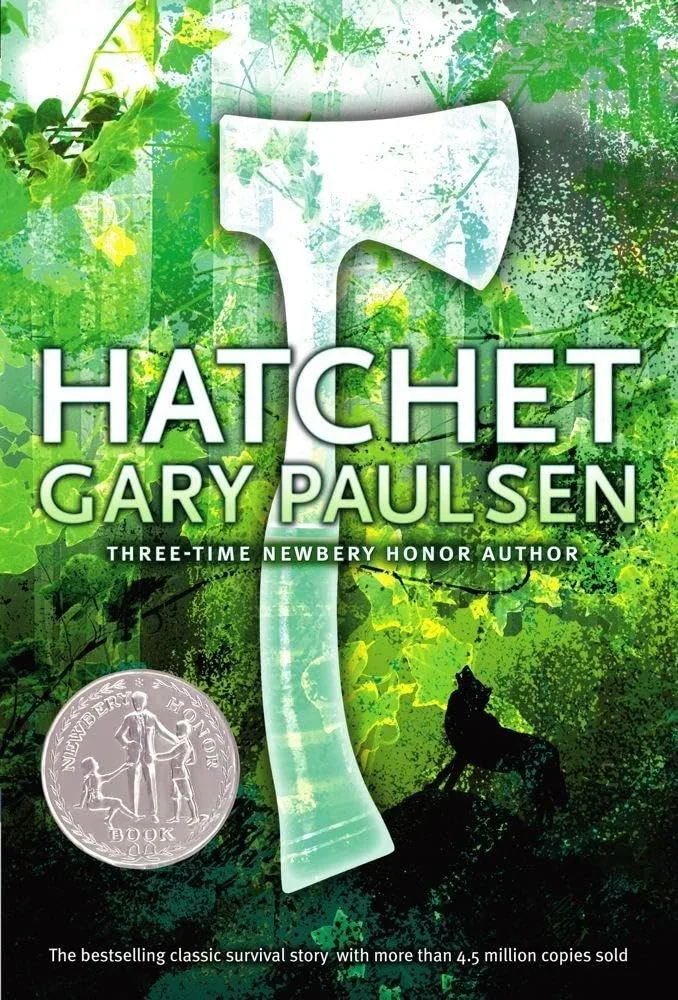
Hatchet
Paperback
• 192 Pages
• USD 8.99
• English
• 9781416936473
No ratings yet
| Publisher | S&S Books for Young Readers |
|---|---|
| ISBN13 | 9781416936473 |
| ASIN/SKU | 1416936475 |
| Book Format | Paperback |
| Language | English |
| Pages | 192 |
| List Price | USD 8.99 |
| Publishing Date | 26/12/2006 |
| Dimensions | 5.12 x 0.48 x 7.62 inches |
| Weight | 2.31 pounds |
| Book Code | BD00070255 |
Buy this Book
Amazon Stores
Ebook Stores
Other Stores
Discover Hatchet by Gary Paulsen. This book is published by SandS Books for Young Readers in Paperback format, ISBN 9781416936473, ASIN 1416936475, under Teen and Young Adult, Teen and Young Adult Fiction about Being a Teen, Teen and Young Adult Parents Fiction.
Book Description
This award-winning contemporary classic is the survival story with which all others are compared—and a page-turning, heart-stopping adventure, recipient of the Newbery Honor. Hatchet has also been nominated as one of America’s best-loved novels by PBS’s The Great American Read.
Thirteen-year-old Brian Robeson, haunted by his secret knowledge of his mother’s infidelity, is traveling by single-engine plane to visit his father for the first time since the divorce. When the plane crashes, killing the pilot, the sole survivor is Brian. He is alone in the Canadian wilderness with nothing but his clothing, a tattered windbreaker, and the hatchet his mother had given him as a present.
At first consumed by despair and self-pity, Brian slowly learns survival skills—how to make a shelter for himself, how to hunt and fish and forage for food, how to make a fire—and even finds the courage to start over from scratch when a tornado ravages his campsite. When Brian is finally rescued after fifty-four days in the wild, he emerges from his ordeal with new patience and maturity, and a greater understanding of himself and his parents.
Thirteen-year-old Brian Robeson, haunted by his secret knowledge of his mother’s infidelity, is traveling by single-engine plane to visit his father for the first time since the divorce. When the plane crashes, killing the pilot, the sole survivor is Brian. He is alone in the Canadian wilderness with nothing but his clothing, a tattered windbreaker, and the hatchet his mother had given him as a present.
At first consumed by despair and self-pity, Brian slowly learns survival skills—how to make a shelter for himself, how to hunt and fish and forage for food, how to make a fire—and even finds the courage to start over from scratch when a tornado ravages his campsite. When Brian is finally rescued after fifty-four days in the wild, he emerges from his ordeal with new patience and maturity, and a greater understanding of himself and his parents.
Author Biography
Gary Paulsen is one of the most honored writers of contemporary literature for young readers. He has written more than one hundred book for adults and young readers, and is the author of three Newberry Honor titles: Dogsong, Hatchet, and The Winter Room. He divides his time among Alaska, New Mexico, Minnesota, and the Pacific.
Editorial Reviews
"This is a spellbinding account...a winner."
-- Kirkus Reviews, starred review
"Riveting."
-- Booklist, starred review
-- Kirkus Reviews, starred review
"Riveting."
-- Booklist, starred review
Book Summary
Hatchet by Gary Paulsen is a gripping survival novel about a thirteen-year-old boy who is forced to depend on his own courage, intelligence, and determination after a plane crash leaves him alone in the Canadian wilderness. First published in 1987, the novel follows Brian Robeson as he learns how to survive without the comforts of modern life. What begins as a frightening story about a stranded child gradually becomes a powerful coming-of-age story about resilience, independence, observation, and hope. The central question of Hatchet is simple but profound: what happens when a young person who has always depended on adults suddenly has to depend entirely on himself? Through Brian's struggle, Paulsen shows that survival is not about being fearless or naturally heroic. It is about learning from mistakes, adapting to circumstances, and refusing to give up.
At the beginning of Hatchet, Brian is traveling in a small bush plane to visit his father in the Canadian wilderness. Brian's parents have recently divorced, and he is carrying the emotional burden of their separation. The most painful part of the situation is what he privately calls "the Secret." Brian knows that his mother has been involved with another man, and he is struggling with the knowledge that this relationship played a role in the breakup of his family. He has not fully processed his anger, sadness, and confusion. During the flight, his thoughts repeatedly return to his parents and the changes in his family. His emotional problems may seem ordinary compared with what is about to happen, but they are important because Paulsen establishes Brian as a vulnerable teenager before placing him in an extraordinary situation.
The pilot initially tries to teach Brian a little about flying, but the journey suddenly becomes a nightmare. The pilot suffers a massive heart attack and dies while flying the plane. Brian is now completely alone. He has no experience flying an aircraft, no radio that he can use successfully, and no adult to tell him what to do. He is terrified as the plane continues through the sky. In a desperate attempt to survive, Brian tries to control the plane and eventually manages to guide it toward a large lake. The aircraft crashes into the water, and Brian escapes before it sinks.
The crash is a dramatic turning point in the novel because Brian goes from being an ordinary teenager to being completely responsible for his own survival. He is injured, exhausted, frightened, and isolated. When he reaches the shore, he has almost nothing. The one useful object he possesses is a hatchet that his mother gave him as a gift before his trip. At first, the hatchet seems insignificant compared with the enormous challenges facing him. Soon, however, it becomes the most important tool in his possession. It allows him to cut branches, make fires, construct shelter, and eventually obtain food. The title Hatchet therefore refers not simply to an object but to Brian's first connection with practical survival.
Brian's first days in the wilderness are filled with mistakes. He does not immediately become an expert survivor. He cries, panics, becomes hungry, and makes poor decisions. This is one of the most realistic and appealing aspects of the novel. Paulsen does not portray Brian as an unrealistic child who suddenly knows everything about wilderness survival. Instead, Brian learns through observation and failure. He gradually realizes that survival depends on paying attention to his surroundings rather than allowing fear to control him.
One of Brian's earliest achievements is learning how to make fire. He remembers the sparks created when the hatchet strikes stone and experiments until he discovers how to produce a flame. Fire becomes enormously important. It provides warmth, allows him to cook food, protects him psychologically from the darkness, and gives him a sense of control. Brian begins to understand that small discoveries can have enormous consequences. He also learns that survival requires preparation. He cannot simply react to every problem as it appears; he has to think ahead.
Food becomes another major challenge. Brian is initially unfamiliar with the plants, berries, and animals around him. He experiments cautiously and learns which berries are safe to eat. Eventually, he discovers turtle eggs and begins to understand how the natural environment can provide food if he observes carefully. Later, he learns to hunt fish and birds. Each success gives him confidence, but the process also teaches him patience. In the city, food is something that simply appears on a table or in a store. In the wilderness, every meal requires knowledge, effort, and risk.
Brian's shelter is equally important. At first, he finds a place near the lake and gradually builds a more secure shelter. He uses branches and natural materials to create protection from the weather and animals. The shelter is imperfect, but every improvement represents another step toward independence. Brian is slowly changing from a frightened boy waiting to be rescued into someone who understands that he must actively create the conditions necessary for his survival.
A particularly important part of Brian's development is his changing relationship with fear. At first, fear overwhelms him. He is frightened of the dark, animals, hunger, loneliness, and the possibility that nobody knows where he is. But he gradually learns that fear can be managed. He begins to distinguish between things that are genuinely dangerous and things that merely frighten him. This is one of the novel's most important lessons: courage does not mean having no fear. Courage means continuing to think and act even while afraid.
The wilderness also teaches Brian to observe. Before the crash, he often moved through life without paying close attention to his surroundings. Now observation becomes a survival skill. He notices animal tracks, changes in weather, the behavior of birds, the movement of fish, and the signs that indicate danger. He begins to understand that the forest is not simply a hostile place. It is a complex environment governed by patterns. If he learns those patterns, he has a better chance of surviving.
One of the novel's memorable turning points occurs when Brian encounters a skunk. The animal approaches his shelter and eventually sprays him. The experience is unpleasant, but Brian learns from it. He begins to understand that many of his problems can be solved if he observes animal behavior rather than reacting impulsively. The wilderness becomes Brian's teacher. Instead of receiving lessons from parents or teachers, he learns directly from experience.
Brian also encounters more serious dangers. A tornado tears through the area, destroying much of what he has built and forcing him to confront how fragile his survival system really is. The storm leaves him devastated, but it also creates an unexpected opportunity. The crash site, previously hidden beneath the water, becomes accessible after the changing conditions. Brian remembers that the plane contains an emergency survival pack. This realization gives him a new goal: he must somehow reach the wreckage and retrieve it.
Getting to the submerged plane is extremely difficult. Brian must overcome fear and physical exhaustion as he dives into the water and enters the aircraft. The experience is terrifying, particularly because he encounters the remains of the dead pilot. Nevertheless, he manages to retrieve the survival pack. This discovery dramatically changes his situation. The pack contains useful supplies, including food, tools, and equipment that he could never have produced on his own.
However, Paulsen does not allow the discovery to erase Brian's growth. The survival pack helps him, but Brian has already learned the most important lesson: he cannot depend entirely on luck or equipment. The tools are valuable because he now understands how to use them. Before the crash, a simple tool would have seemed ordinary. After his experience in the wilderness, Brian understands the value of every resource.
One of the most important emotional changes in Brian is the way he thinks about his parents. At the beginning, his thoughts are dominated by the pain of the divorce and the Secret. He feels anger and confusion, especially toward his mother. But as he struggles to survive, his perspective gradually changes. His immediate circumstances force him to think beyond his personal anger. He begins to understand that adults are complicated human beings who make mistakes and experience conflicting emotions. His understanding of his family becomes less simplistic.
This emotional growth parallels Brian's physical transformation. He becomes stronger, thinner, more alert, and more capable. He learns to make tools, catch food, build shelter, and protect himself. But the most significant transformation occurs inside his mind. Brian develops what he calls a different way of thinking. Instead of becoming overwhelmed by a problem, he learns to break it into smaller parts. If he is hungry, he asks what food is available. If his shelter is damaged, he considers how to repair it. If he is afraid, he identifies the source of the fear and determines whether he can do something about it.
The idea of "thinking" is central to Hatchet. Brian's greatest survival tool is not actually the hatchet; it is his ability to learn. Every failure provides information. Every mistake becomes a lesson. Paulsen shows that intelligence in difficult circumstances is not simply about knowing facts. It is about being observant, flexible, patient, and willing to change one's approach.
Eventually, Brian realizes that the emergency transmitter from the survival pack may allow him to contact rescuers. He initially does not understand how significant this possibility is. When he manages to activate the device, he receives an unexpected response. A pilot is able to hear him and comes to investigate. Brian is finally rescued.
The rescue is powerful precisely because Brian has changed so much by the time it happens. At the beginning of the novel, he is dependent on adults and emotionally overwhelmed by his parents' divorce. At the end, he is still a thirteen-year-old boy, but he has developed a level of self-reliance and confidence that he did not possess before. The wilderness has forced him to grow up quickly. He has learned that he can survive frightening circumstances and solve problems that initially seem impossible.
The ending of Hatchet is therefore not simply about Brian returning to civilization. It is about the person who returns. He has experienced hunger, fear, loneliness, injury, and loss, but he has also discovered his own strength. His experience changes how he sees ordinary life. Things that once seemed unimportant—food, shelter, warmth, family, and safety—now carry enormous meaning.
The major theme of Hatchet is survival, but the novel is equally concerned with personal growth. Brian's physical survival reflects an internal transformation. He begins as a boy who feels powerless because his family has fallen apart. The wilderness initially seems like another situation in which he has no control. Gradually, however, he learns that while he cannot control everything around him, he can control how he responds. That realization gives him a sense of independence.
Another major theme is resilience. Brian fails many times, but failure never becomes the final word. He learns from each mistake and tries again. His survival demonstrates that resilience is not one dramatic act of bravery. It is the repeated decision to continue. Paulsen presents this process in a very humane way because Brian often feels exhausted, frightened, and discouraged. His strength comes not from being fearless but from continuing despite those feelings.
Nature is also an important force in the novel. The wilderness is neither completely good nor completely evil. It can provide food and shelter, but it can also produce storms, dangerous animals, injuries, and extreme isolation. Brian learns to respect nature rather than imagining that he can dominate it. The wilderness becomes a place of danger, education, and transformation.
Ultimately, Hatchet by Gary Paulsen is a compelling story about a boy discovering that he is far more capable than he imagined. Its survival adventure makes the novel exciting, but its deeper appeal comes from Brian's emotional and psychological growth. The hatchet symbolizes the practical tools Brian needs, while his developing ability to observe, think, adapt, and persevere becomes the true source of his survival. The novel reminds readers that difficult experiences can reveal strengths that remain hidden during comfortable times. Brian does not survive because he is exceptionally powerful or because everything goes according to plan. He survives because he learns, adapts, and refuses to surrender. That message makes Hatchet an enduring coming-of-age and survival story, especially for young readers, while giving adult readers a moving reminder of the resilience of the human spirit.
At the beginning of Hatchet, Brian is traveling in a small bush plane to visit his father in the Canadian wilderness. Brian's parents have recently divorced, and he is carrying the emotional burden of their separation. The most painful part of the situation is what he privately calls "the Secret." Brian knows that his mother has been involved with another man, and he is struggling with the knowledge that this relationship played a role in the breakup of his family. He has not fully processed his anger, sadness, and confusion. During the flight, his thoughts repeatedly return to his parents and the changes in his family. His emotional problems may seem ordinary compared with what is about to happen, but they are important because Paulsen establishes Brian as a vulnerable teenager before placing him in an extraordinary situation.
The pilot initially tries to teach Brian a little about flying, but the journey suddenly becomes a nightmare. The pilot suffers a massive heart attack and dies while flying the plane. Brian is now completely alone. He has no experience flying an aircraft, no radio that he can use successfully, and no adult to tell him what to do. He is terrified as the plane continues through the sky. In a desperate attempt to survive, Brian tries to control the plane and eventually manages to guide it toward a large lake. The aircraft crashes into the water, and Brian escapes before it sinks.
The crash is a dramatic turning point in the novel because Brian goes from being an ordinary teenager to being completely responsible for his own survival. He is injured, exhausted, frightened, and isolated. When he reaches the shore, he has almost nothing. The one useful object he possesses is a hatchet that his mother gave him as a gift before his trip. At first, the hatchet seems insignificant compared with the enormous challenges facing him. Soon, however, it becomes the most important tool in his possession. It allows him to cut branches, make fires, construct shelter, and eventually obtain food. The title Hatchet therefore refers not simply to an object but to Brian's first connection with practical survival.
Brian's first days in the wilderness are filled with mistakes. He does not immediately become an expert survivor. He cries, panics, becomes hungry, and makes poor decisions. This is one of the most realistic and appealing aspects of the novel. Paulsen does not portray Brian as an unrealistic child who suddenly knows everything about wilderness survival. Instead, Brian learns through observation and failure. He gradually realizes that survival depends on paying attention to his surroundings rather than allowing fear to control him.
One of Brian's earliest achievements is learning how to make fire. He remembers the sparks created when the hatchet strikes stone and experiments until he discovers how to produce a flame. Fire becomes enormously important. It provides warmth, allows him to cook food, protects him psychologically from the darkness, and gives him a sense of control. Brian begins to understand that small discoveries can have enormous consequences. He also learns that survival requires preparation. He cannot simply react to every problem as it appears; he has to think ahead.
Food becomes another major challenge. Brian is initially unfamiliar with the plants, berries, and animals around him. He experiments cautiously and learns which berries are safe to eat. Eventually, he discovers turtle eggs and begins to understand how the natural environment can provide food if he observes carefully. Later, he learns to hunt fish and birds. Each success gives him confidence, but the process also teaches him patience. In the city, food is something that simply appears on a table or in a store. In the wilderness, every meal requires knowledge, effort, and risk.
Brian's shelter is equally important. At first, he finds a place near the lake and gradually builds a more secure shelter. He uses branches and natural materials to create protection from the weather and animals. The shelter is imperfect, but every improvement represents another step toward independence. Brian is slowly changing from a frightened boy waiting to be rescued into someone who understands that he must actively create the conditions necessary for his survival.
A particularly important part of Brian's development is his changing relationship with fear. At first, fear overwhelms him. He is frightened of the dark, animals, hunger, loneliness, and the possibility that nobody knows where he is. But he gradually learns that fear can be managed. He begins to distinguish between things that are genuinely dangerous and things that merely frighten him. This is one of the novel's most important lessons: courage does not mean having no fear. Courage means continuing to think and act even while afraid.
The wilderness also teaches Brian to observe. Before the crash, he often moved through life without paying close attention to his surroundings. Now observation becomes a survival skill. He notices animal tracks, changes in weather, the behavior of birds, the movement of fish, and the signs that indicate danger. He begins to understand that the forest is not simply a hostile place. It is a complex environment governed by patterns. If he learns those patterns, he has a better chance of surviving.
One of the novel's memorable turning points occurs when Brian encounters a skunk. The animal approaches his shelter and eventually sprays him. The experience is unpleasant, but Brian learns from it. He begins to understand that many of his problems can be solved if he observes animal behavior rather than reacting impulsively. The wilderness becomes Brian's teacher. Instead of receiving lessons from parents or teachers, he learns directly from experience.
Brian also encounters more serious dangers. A tornado tears through the area, destroying much of what he has built and forcing him to confront how fragile his survival system really is. The storm leaves him devastated, but it also creates an unexpected opportunity. The crash site, previously hidden beneath the water, becomes accessible after the changing conditions. Brian remembers that the plane contains an emergency survival pack. This realization gives him a new goal: he must somehow reach the wreckage and retrieve it.
Getting to the submerged plane is extremely difficult. Brian must overcome fear and physical exhaustion as he dives into the water and enters the aircraft. The experience is terrifying, particularly because he encounters the remains of the dead pilot. Nevertheless, he manages to retrieve the survival pack. This discovery dramatically changes his situation. The pack contains useful supplies, including food, tools, and equipment that he could never have produced on his own.
However, Paulsen does not allow the discovery to erase Brian's growth. The survival pack helps him, but Brian has already learned the most important lesson: he cannot depend entirely on luck or equipment. The tools are valuable because he now understands how to use them. Before the crash, a simple tool would have seemed ordinary. After his experience in the wilderness, Brian understands the value of every resource.
One of the most important emotional changes in Brian is the way he thinks about his parents. At the beginning, his thoughts are dominated by the pain of the divorce and the Secret. He feels anger and confusion, especially toward his mother. But as he struggles to survive, his perspective gradually changes. His immediate circumstances force him to think beyond his personal anger. He begins to understand that adults are complicated human beings who make mistakes and experience conflicting emotions. His understanding of his family becomes less simplistic.
This emotional growth parallels Brian's physical transformation. He becomes stronger, thinner, more alert, and more capable. He learns to make tools, catch food, build shelter, and protect himself. But the most significant transformation occurs inside his mind. Brian develops what he calls a different way of thinking. Instead of becoming overwhelmed by a problem, he learns to break it into smaller parts. If he is hungry, he asks what food is available. If his shelter is damaged, he considers how to repair it. If he is afraid, he identifies the source of the fear and determines whether he can do something about it.
The idea of "thinking" is central to Hatchet. Brian's greatest survival tool is not actually the hatchet; it is his ability to learn. Every failure provides information. Every mistake becomes a lesson. Paulsen shows that intelligence in difficult circumstances is not simply about knowing facts. It is about being observant, flexible, patient, and willing to change one's approach.
Eventually, Brian realizes that the emergency transmitter from the survival pack may allow him to contact rescuers. He initially does not understand how significant this possibility is. When he manages to activate the device, he receives an unexpected response. A pilot is able to hear him and comes to investigate. Brian is finally rescued.
The rescue is powerful precisely because Brian has changed so much by the time it happens. At the beginning of the novel, he is dependent on adults and emotionally overwhelmed by his parents' divorce. At the end, he is still a thirteen-year-old boy, but he has developed a level of self-reliance and confidence that he did not possess before. The wilderness has forced him to grow up quickly. He has learned that he can survive frightening circumstances and solve problems that initially seem impossible.
The ending of Hatchet is therefore not simply about Brian returning to civilization. It is about the person who returns. He has experienced hunger, fear, loneliness, injury, and loss, but he has also discovered his own strength. His experience changes how he sees ordinary life. Things that once seemed unimportant—food, shelter, warmth, family, and safety—now carry enormous meaning.
The major theme of Hatchet is survival, but the novel is equally concerned with personal growth. Brian's physical survival reflects an internal transformation. He begins as a boy who feels powerless because his family has fallen apart. The wilderness initially seems like another situation in which he has no control. Gradually, however, he learns that while he cannot control everything around him, he can control how he responds. That realization gives him a sense of independence.
Another major theme is resilience. Brian fails many times, but failure never becomes the final word. He learns from each mistake and tries again. His survival demonstrates that resilience is not one dramatic act of bravery. It is the repeated decision to continue. Paulsen presents this process in a very humane way because Brian often feels exhausted, frightened, and discouraged. His strength comes not from being fearless but from continuing despite those feelings.
Nature is also an important force in the novel. The wilderness is neither completely good nor completely evil. It can provide food and shelter, but it can also produce storms, dangerous animals, injuries, and extreme isolation. Brian learns to respect nature rather than imagining that he can dominate it. The wilderness becomes a place of danger, education, and transformation.
Ultimately, Hatchet by Gary Paulsen is a compelling story about a boy discovering that he is far more capable than he imagined. Its survival adventure makes the novel exciting, but its deeper appeal comes from Brian's emotional and psychological growth. The hatchet symbolizes the practical tools Brian needs, while his developing ability to observe, think, adapt, and persevere becomes the true source of his survival. The novel reminds readers that difficult experiences can reveal strengths that remain hidden during comfortable times. Brian does not survive because he is exceptionally powerful or because everything goes according to plan. He survives because he learns, adapts, and refuses to surrender. That message makes Hatchet an enduring coming-of-age and survival story, especially for young readers, while giving adult readers a moving reminder of the resilience of the human spirit.
Sample Chapters
Sample Chapters will be added soon…
Reader Reviews
No reviews yet.
Hatchet