
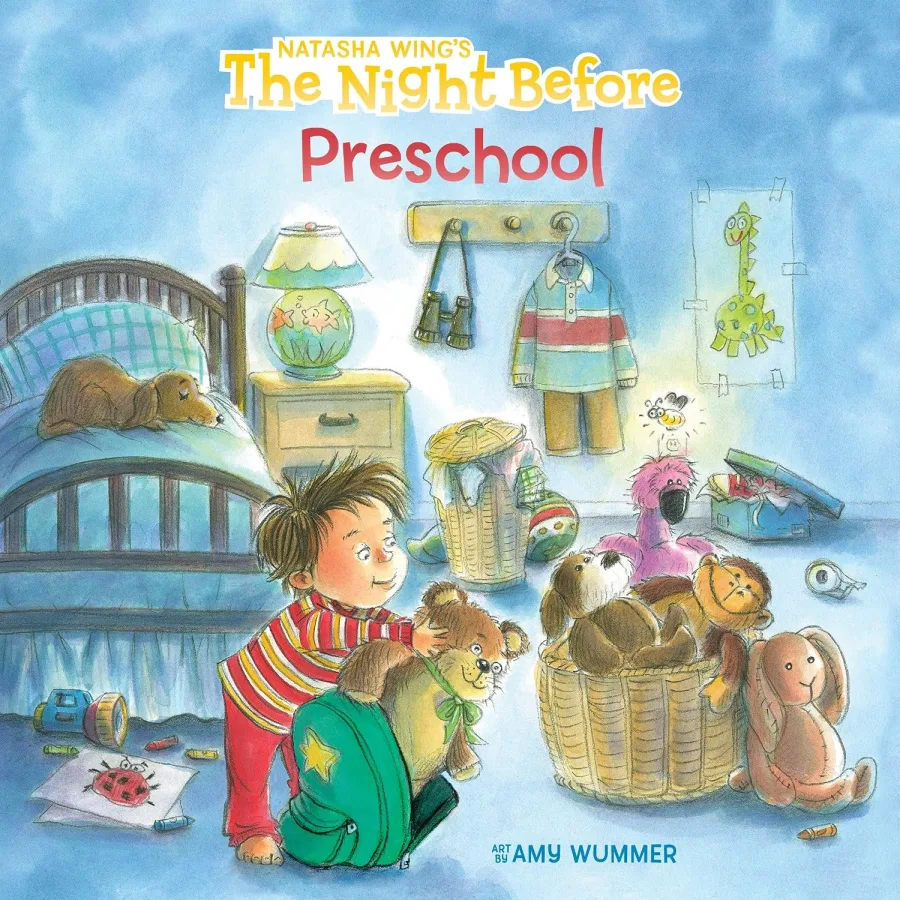
The Night Before Preschool
Natasha Wing, Amy Wummer (Illustrator)
Paperback
• 32 Pages
• USD 5.99
• English
• 9780448454511
No ratings yet
| Publisher | Grosset & Dunlap |
|---|---|
| ISBN13 | 9780448454511 |
| ASIN/SKU | 0448454513 |
| Book Format | Paperback |
| Language | English |
| Pages | 32 |
| List Price | USD 5.99 |
| Publishing Date | 12/05/2011 |
| Dimensions | 7.99 x 0.08 x 7.99 inches |
| Weight | 3 ounces |
| Book Code | BD00070256 |
Buy this Book
Amazon Stores
Ebook Stores
Other Stores
Discover The Night Before Preschool by Natasha Wing. This book is published by Grosset and Dunlap in Paperback format, ISBN 9780448454511, ASIN 0448454513, under Children's Books, Children's New Experiences Books, Poetry for Early Learning.
Book Description
NEW YORK TIMES BESTSELLING SERIES • Putting an uplifting spin on a classic poem, this charmingly illustrated and lyrical picture book prepares kids—and their parents!—for all that preschool has to offer.
It's the night before preschool, and a little boy named Billy is so nervous he can't fall asleep. The friends he makes the next day at school give him a reason not to sleep the next night, either: he's too excited about going back! The book's simple rhyming text and sweet illustrations will soothe any child's fears about the first day of school.
The Night Before series helps young readers—and their parents!—explore big milestones in an encouraging, uplifting way.
It's the night before preschool, and a little boy named Billy is so nervous he can't fall asleep. The friends he makes the next day at school give him a reason not to sleep the next night, either: he's too excited about going back! The book's simple rhyming text and sweet illustrations will soothe any child's fears about the first day of school.
The Night Before series helps young readers—and their parents!—explore big milestones in an encouraging, uplifting way.
Author Biography
Natasha Wing was born in Connecticut and now lives in Colorado. After graduating from Arizona State University, she worked in advertising for a number of years. It wasn't until 1991 that she decided to write children's books. Luckily she sold her first book within six months and has been writing children's books and articles ever since. Some of her books have even ended up on bestseller lists, including the wildly popular The Night Before series.
"I'm curious about many things - people, holidays, underdogs, little known historic figures - and translate my excitement for a topic into books for kids to enjoy. Story ideas are popping into my head all the time, so you never know what my next book will be. But that's what's so fun about writing."
To find out more about Natasha Wing go to www.natashawing.com. Natasha also writes under the pen name Hester Applebee.
Favorite Children's Books: The Polar Express (I have a signed copy!), Charlie and the Chocolate Factory, The Cat in the Hat, The Golden Compass, Harry Potter; Favorite Season: Fall; Favorite Tree: Maple; Favorite Colors: Cranberry red and fuschia pink; Pet: Purrsia the lynx point kitty Professional: Member of Society of Children's Book Writers & Illustrators, Children's Book Insider.
"I'm curious about many things - people, holidays, underdogs, little known historic figures - and translate my excitement for a topic into books for kids to enjoy. Story ideas are popping into my head all the time, so you never know what my next book will be. But that's what's so fun about writing."
To find out more about Natasha Wing go to www.natashawing.com. Natasha also writes under the pen name Hester Applebee.
Favorite Children's Books: The Polar Express (I have a signed copy!), Charlie and the Chocolate Factory, The Cat in the Hat, The Golden Compass, Harry Potter; Favorite Season: Fall; Favorite Tree: Maple; Favorite Colors: Cranberry red and fuschia pink; Pet: Purrsia the lynx point kitty Professional: Member of Society of Children's Book Writers & Illustrators, Children's Book Insider.
Editorial Reviews
Editorial Reviews will be added soon…
Book Summary
The Night Before Preschool by Natasha Wing, illustrated by Amy Wummer, is a warm and reassuring picture book about the excitement, nervousness, and emotional uncertainty that can accompany a child's first experience with preschool. Part of Natasha Wing's popular The Night Before series, the book uses simple rhyming language inspired by the rhythm and structure of the classic The Night Before Christmas. First published in 2011, the 32-page picture book is aimed primarily at children ages three to five and focuses on the familiar childhood experience of starting school for the first time. At the heart of the story is Billy, a young boy who is excited about the idea of preschool but is also so nervous that he cannot sleep. His first day ultimately shows him that unfamiliar places can become comfortable when children are given kindness, patience, friendship, and the chance to discover things at their own pace.
The story begins on the night before preschool, when children and their families are preparing for the important day ahead. The atmosphere is filled with anticipation. Clothes are prepared, alarms are set, and children settle into bed with their favorite stuffed animals. Everything about the scene communicates that something new and important is about to happen. For many children, the night before starting school can feel enormous. A child may wonder what the classroom will look like, who the teacher will be, whether the other children will be friendly, and whether a parent will come back at the end of the day. Wing understands these very ordinary fears and turns them into the central emotional experience of her story.
Billy is the child who has the hardest time settling down. While the other children are preparing to sleep, he remains awake because he is worried about preschool and the possibility of making new friends. His nervousness is physical as well as emotional. He has that uncomfortable feeling in his stomach that many children experience when facing something unfamiliar. He is shy and unsure of himself, and instead of looking forward to school without reservation, he imagines all the things that might go wrong. This is an important beginning because Billy is not presented as a child who simply needs to "stop being scared." His anxiety is treated as a natural response to a major new experience. The book's official description similarly emphasizes that Billy is so nervous about preschool that he cannot fall asleep.
This opening makes The Night Before Preschool especially effective as a first-day-of-school story. Preschool is often one of a child's earliest experiences with spending substantial time away from home. Even children who are generally confident can feel uncertain about it. They may have never been in a classroom without their parents or caregivers nearby. Billy therefore represents the child who has plenty of questions but does not yet have the words to explain all of them. His nervousness is understandable, and the story gives young readers permission to recognize similar feelings in themselves.
When morning arrives, Billy goes to preschool and meets his teacher. The classroom immediately introduces him to a world that is different from home. There are other children, activities, routines, toys, songs, stories, and opportunities to play. Rather than presenting preschool as a place dominated by formal learning, Wing portrays it as a welcoming environment where young children learn through participation, play, imagination, and social interaction. This is one of the book's strengths: it helps children understand what preschool can actually feel like without turning the story into an instructional manual.
Billy initially remains quiet and watches the other children. He is not instantly transformed into an outgoing child simply because he has entered the classroom. Instead, he needs time to become comfortable. He stays somewhat apart from the group and observes what everyone else is doing. This detail is important because children adjust to new environments at different speeds. Some children immediately join a group, while others need to watch for a while before they feel safe enough to participate. Billy's behavior reassures shy readers that they do not have to become confident immediately. Being quiet on the first day does not mean that something is wrong.
His teacher plays an important role in making the classroom feel safe. The teacher greets the children warmly and involves them in activities, helping establish a sense of routine and belonging. The children participate in songs, circle time, stories, and imaginative play. The classroom becomes a place where there are things to do and people to meet, rather than the mysterious and intimidating place Billy had imagined the previous night. By giving readers glimpses of ordinary preschool activities, the story answers some of the questions that can make a first day frightening: What will we do? Where will I sit? What happens during the day? Who will help me?
One of the charming features of the story is the emphasis on play. The children can use their imaginations, interact with toys, participate in creative activities, and explore the classroom. Preschool is presented as a place where learning and fun are closely connected. Billy does not have to prove that he is smart or perform perfectly. He simply has to take part. This makes the book particularly useful for parents and teachers looking for a gentle story about preschool readiness and first-day anxiety.
Billy slowly begins to engage with the classroom. Although he is still shy, he finds a way to participate through drawing. His artwork gives him something familiar and manageable to focus on while he is surrounded by unfamiliar people. This is another subtle message in the story: children do not always enter a new social situation by immediately talking to everyone. Sometimes they begin by doing an activity they enjoy, and that activity becomes a bridge toward connection.
As the day continues, the children move through familiar preschool routines, including snack time, outdoor play, and quiet time. These routines help make the day predictable. For a nervous child, predictability can be comforting. The unknown becomes less frightening when it is divided into small, understandable parts: play, eat, explore, rest, and then eventually go home. In this way, The Night Before Preschool gives young readers a basic mental picture of how a school day might unfold.
Outdoor play provides another opportunity for Billy to see that preschool can be enjoyable. The children have opportunities to ride, explore, and play together. The emphasis remains on movement and discovery rather than academic pressure. Billy is gradually surrounded by activities that make school feel less like a place where he has been separated from home and more like a place where interesting things can happen.
The most emotionally significant part of the story comes during nap or quiet time. Billy discovers that one of the things making him uncomfortable is the absence of his teddy bear, Jerome. At home, his teddy bear is a familiar source of comfort, but he has left it behind. Now, when the classroom becomes quiet and everyone is expected to rest, Billy misses his familiar companion. His homesickness and nervousness return, showing that adjusting to a new environment is not always a straight line. A child may seem comfortable one moment and become upset again when something reminds them of home.
Then comes the small act of kindness that changes Billy's experience. A little girl offers him her soft stuffed bunny to help him settle down. This is a simple gesture, but for Billy it makes a significant difference. The story's emotional power comes partly from the fact that nobody gives Billy a complicated solution. He does not need a lecture about courage. He simply needs another child to notice that he is having a difficult moment and respond with kindness. The friendship begins with sharing something comforting.
The stuffed bunny becomes more than a toy. It represents empathy and the power of small gestures. The little girl does not know Billy very well, yet she is willing to share something that belongs to her. Her kindness gives him a sense of security at precisely the moment when he needs it. This episode demonstrates one of the book's central ideas: starting school becomes easier when children realize that they are not alone. A friendly classmate can transform an unfamiliar environment into a welcoming one.
After the nap, Billy's mood has changed. He is more comfortable and begins interacting with the other children. He eventually plays with a new friend named Charlie. The change is significant because Billy has moved from standing apart and observing to participating in the social world of the classroom. He has not suddenly become a completely different child. Rather, his nervousness has eased because he has discovered that the other children can be friendly and that the classroom can be enjoyable.
The arrival of the parents at the end of the day brings another important moment. Billy is reunited with his mother and gets his own teddy bear back. The familiar comfort of home is restored, but now he has something new to look forward to as well. Preschool is no longer simply a place he feared. It is a place where he has met people, played games, participated in activities, and made a friend. The first day that seemed frightening before it began has turned into an experience he wants to repeat.
This leads to the delightful reversal at the end of the story. On the first night, Billy cannot sleep because he is nervous about preschool. After experiencing his first day, he has a completely different reason for being unable to sleep: he is excited about going back. The publisher's description highlights exactly this transformation, explaining that the friends Billy makes at school give him a reason to stay awake the following night because he is eager to return. The emotional movement from anxiety to excitement provides the story with a satisfying and reassuring conclusion.
The central theme of The Night Before Preschool is overcoming fear through experience. Billy's fears do not disappear because someone tells him that preschool will be fine. They disappear gradually as he experiences the reality of school for himself. Before the first day, preschool exists only in his imagination, and imagination makes room for frightening possibilities. Once he enters the classroom, however, he discovers concrete realities: a welcoming teacher, other children, enjoyable activities, playtime, and opportunities for friendship. The story therefore communicates an important lesson for young children: sometimes the things we fear most are simply things we have not experienced yet.
Another major theme is friendship. Billy's first meaningful connection at school begins with an act of compassion. The little girl's willingness to share her bunny helps him feel safe, and that feeling of safety makes it easier for him to participate. Later, he plays with Charlie and becomes part of the group. The book shows that friendship does not always begin with a dramatic conversation. It can begin with sharing a toy, offering comfort, sitting beside someone, or inviting a shy child into an activity.
The story also explores the importance of familiar objects in helping children manage transitions. Billy's teddy bear represents home and emotional security. When he does not have it, he feels vulnerable. The borrowed bunny temporarily fills that emotional role and helps him cope. This is especially relatable for preschoolers, many of whom use favorite blankets, stuffed animals, or other comfort objects when facing unfamiliar situations. Wing treats this attachment with affection rather than embarrassment.
The book's rhyming structure is another important part of its appeal. The Night Before Preschool follows the recognizable pattern of the classic "night before" storytelling tradition, making the story easy and enjoyable to read aloud. TeachingBooks categorizes the book as both a picture book and poetry/story in rhyme and identifies its themes as school, new experiences, nursery school, and the first day of school. The predictable rhythm makes the book particularly suitable for young listeners, while the illustrations by Amy Wummer add visual warmth and humor to the story.
The illustrations are important because preschool-age children often understand stories through a combination of words and pictures. Wummer's artwork helps show the emotional contrast between Billy's nervousness and the fun happening around him. The classroom becomes visually lively and inviting, reinforcing the idea that school is not an abstract or frightening institution but a place filled with familiar childhood activities. The combination of Wing's accessible rhymes and Wummer's expressive illustrations makes the story especially suitable for bedtime reading before a child's first day of preschool.
Ultimately, The Night Before Preschool is much more than a simple story about going to school. It is a gentle lesson in emotional adjustment. Billy begins the story frightened by the unknown and ends it excited about returning to the very place he feared. His transformation is believable because it happens through small experiences rather than through a sudden change in personality. He observes, hesitates, becomes homesick, receives kindness, makes connections, and discovers that school can be fun. That sequence mirrors the way many young children actually adjust to new environments.
For parents searching for a book about preschool anxiety, first-day-of-school fears, starting preschool, or books to prepare a child for preschool, The Night Before Preschool is especially relevant because it validates nervous feelings while ending on an encouraging note. It does not promise that every child will love school immediately or that nobody will feel homesick. Instead, it shows that nervousness and excitement can exist together and that a difficult first moment does not determine the entire experience. The book is officially positioned for children around ages three to five and up to kindergarten, making it particularly well suited to children approaching their first preschool experience.
In the end, Natasha Wing's The Night Before Preschool offers a simple but meaningful message: new experiences can be scary because they are unknown, but they can also become wonderful once we give them a chance. Billy's story reassures children that it is perfectly normal to feel nervous before preschool. It also reminds them that teachers can help, friends can appear in unexpected ways, and familiar comforts can make difficult moments easier. Most importantly, the book shows that confidence often comes after the first step, not before it. Billy does not need to stop being shy before entering preschool. He simply needs to enter, observe, participate, and allow himself to discover what is there. By the time his first day ends, the unknown has become familiar, loneliness has become friendship, and nervous anticipation has turned into genuine excitement. That gentle emotional journey is what makes The Night Before Preschool such a comforting and enduring first-day-of-school story for young children and their families.
The story begins on the night before preschool, when children and their families are preparing for the important day ahead. The atmosphere is filled with anticipation. Clothes are prepared, alarms are set, and children settle into bed with their favorite stuffed animals. Everything about the scene communicates that something new and important is about to happen. For many children, the night before starting school can feel enormous. A child may wonder what the classroom will look like, who the teacher will be, whether the other children will be friendly, and whether a parent will come back at the end of the day. Wing understands these very ordinary fears and turns them into the central emotional experience of her story.
Billy is the child who has the hardest time settling down. While the other children are preparing to sleep, he remains awake because he is worried about preschool and the possibility of making new friends. His nervousness is physical as well as emotional. He has that uncomfortable feeling in his stomach that many children experience when facing something unfamiliar. He is shy and unsure of himself, and instead of looking forward to school without reservation, he imagines all the things that might go wrong. This is an important beginning because Billy is not presented as a child who simply needs to "stop being scared." His anxiety is treated as a natural response to a major new experience. The book's official description similarly emphasizes that Billy is so nervous about preschool that he cannot fall asleep.
This opening makes The Night Before Preschool especially effective as a first-day-of-school story. Preschool is often one of a child's earliest experiences with spending substantial time away from home. Even children who are generally confident can feel uncertain about it. They may have never been in a classroom without their parents or caregivers nearby. Billy therefore represents the child who has plenty of questions but does not yet have the words to explain all of them. His nervousness is understandable, and the story gives young readers permission to recognize similar feelings in themselves.
When morning arrives, Billy goes to preschool and meets his teacher. The classroom immediately introduces him to a world that is different from home. There are other children, activities, routines, toys, songs, stories, and opportunities to play. Rather than presenting preschool as a place dominated by formal learning, Wing portrays it as a welcoming environment where young children learn through participation, play, imagination, and social interaction. This is one of the book's strengths: it helps children understand what preschool can actually feel like without turning the story into an instructional manual.
Billy initially remains quiet and watches the other children. He is not instantly transformed into an outgoing child simply because he has entered the classroom. Instead, he needs time to become comfortable. He stays somewhat apart from the group and observes what everyone else is doing. This detail is important because children adjust to new environments at different speeds. Some children immediately join a group, while others need to watch for a while before they feel safe enough to participate. Billy's behavior reassures shy readers that they do not have to become confident immediately. Being quiet on the first day does not mean that something is wrong.
His teacher plays an important role in making the classroom feel safe. The teacher greets the children warmly and involves them in activities, helping establish a sense of routine and belonging. The children participate in songs, circle time, stories, and imaginative play. The classroom becomes a place where there are things to do and people to meet, rather than the mysterious and intimidating place Billy had imagined the previous night. By giving readers glimpses of ordinary preschool activities, the story answers some of the questions that can make a first day frightening: What will we do? Where will I sit? What happens during the day? Who will help me?
One of the charming features of the story is the emphasis on play. The children can use their imaginations, interact with toys, participate in creative activities, and explore the classroom. Preschool is presented as a place where learning and fun are closely connected. Billy does not have to prove that he is smart or perform perfectly. He simply has to take part. This makes the book particularly useful for parents and teachers looking for a gentle story about preschool readiness and first-day anxiety.
Billy slowly begins to engage with the classroom. Although he is still shy, he finds a way to participate through drawing. His artwork gives him something familiar and manageable to focus on while he is surrounded by unfamiliar people. This is another subtle message in the story: children do not always enter a new social situation by immediately talking to everyone. Sometimes they begin by doing an activity they enjoy, and that activity becomes a bridge toward connection.
As the day continues, the children move through familiar preschool routines, including snack time, outdoor play, and quiet time. These routines help make the day predictable. For a nervous child, predictability can be comforting. The unknown becomes less frightening when it is divided into small, understandable parts: play, eat, explore, rest, and then eventually go home. In this way, The Night Before Preschool gives young readers a basic mental picture of how a school day might unfold.
Outdoor play provides another opportunity for Billy to see that preschool can be enjoyable. The children have opportunities to ride, explore, and play together. The emphasis remains on movement and discovery rather than academic pressure. Billy is gradually surrounded by activities that make school feel less like a place where he has been separated from home and more like a place where interesting things can happen.
The most emotionally significant part of the story comes during nap or quiet time. Billy discovers that one of the things making him uncomfortable is the absence of his teddy bear, Jerome. At home, his teddy bear is a familiar source of comfort, but he has left it behind. Now, when the classroom becomes quiet and everyone is expected to rest, Billy misses his familiar companion. His homesickness and nervousness return, showing that adjusting to a new environment is not always a straight line. A child may seem comfortable one moment and become upset again when something reminds them of home.
Then comes the small act of kindness that changes Billy's experience. A little girl offers him her soft stuffed bunny to help him settle down. This is a simple gesture, but for Billy it makes a significant difference. The story's emotional power comes partly from the fact that nobody gives Billy a complicated solution. He does not need a lecture about courage. He simply needs another child to notice that he is having a difficult moment and respond with kindness. The friendship begins with sharing something comforting.
The stuffed bunny becomes more than a toy. It represents empathy and the power of small gestures. The little girl does not know Billy very well, yet she is willing to share something that belongs to her. Her kindness gives him a sense of security at precisely the moment when he needs it. This episode demonstrates one of the book's central ideas: starting school becomes easier when children realize that they are not alone. A friendly classmate can transform an unfamiliar environment into a welcoming one.
After the nap, Billy's mood has changed. He is more comfortable and begins interacting with the other children. He eventually plays with a new friend named Charlie. The change is significant because Billy has moved from standing apart and observing to participating in the social world of the classroom. He has not suddenly become a completely different child. Rather, his nervousness has eased because he has discovered that the other children can be friendly and that the classroom can be enjoyable.
The arrival of the parents at the end of the day brings another important moment. Billy is reunited with his mother and gets his own teddy bear back. The familiar comfort of home is restored, but now he has something new to look forward to as well. Preschool is no longer simply a place he feared. It is a place where he has met people, played games, participated in activities, and made a friend. The first day that seemed frightening before it began has turned into an experience he wants to repeat.
This leads to the delightful reversal at the end of the story. On the first night, Billy cannot sleep because he is nervous about preschool. After experiencing his first day, he has a completely different reason for being unable to sleep: he is excited about going back. The publisher's description highlights exactly this transformation, explaining that the friends Billy makes at school give him a reason to stay awake the following night because he is eager to return. The emotional movement from anxiety to excitement provides the story with a satisfying and reassuring conclusion.
The central theme of The Night Before Preschool is overcoming fear through experience. Billy's fears do not disappear because someone tells him that preschool will be fine. They disappear gradually as he experiences the reality of school for himself. Before the first day, preschool exists only in his imagination, and imagination makes room for frightening possibilities. Once he enters the classroom, however, he discovers concrete realities: a welcoming teacher, other children, enjoyable activities, playtime, and opportunities for friendship. The story therefore communicates an important lesson for young children: sometimes the things we fear most are simply things we have not experienced yet.
Another major theme is friendship. Billy's first meaningful connection at school begins with an act of compassion. The little girl's willingness to share her bunny helps him feel safe, and that feeling of safety makes it easier for him to participate. Later, he plays with Charlie and becomes part of the group. The book shows that friendship does not always begin with a dramatic conversation. It can begin with sharing a toy, offering comfort, sitting beside someone, or inviting a shy child into an activity.
The story also explores the importance of familiar objects in helping children manage transitions. Billy's teddy bear represents home and emotional security. When he does not have it, he feels vulnerable. The borrowed bunny temporarily fills that emotional role and helps him cope. This is especially relatable for preschoolers, many of whom use favorite blankets, stuffed animals, or other comfort objects when facing unfamiliar situations. Wing treats this attachment with affection rather than embarrassment.
The book's rhyming structure is another important part of its appeal. The Night Before Preschool follows the recognizable pattern of the classic "night before" storytelling tradition, making the story easy and enjoyable to read aloud. TeachingBooks categorizes the book as both a picture book and poetry/story in rhyme and identifies its themes as school, new experiences, nursery school, and the first day of school. The predictable rhythm makes the book particularly suitable for young listeners, while the illustrations by Amy Wummer add visual warmth and humor to the story.
The illustrations are important because preschool-age children often understand stories through a combination of words and pictures. Wummer's artwork helps show the emotional contrast between Billy's nervousness and the fun happening around him. The classroom becomes visually lively and inviting, reinforcing the idea that school is not an abstract or frightening institution but a place filled with familiar childhood activities. The combination of Wing's accessible rhymes and Wummer's expressive illustrations makes the story especially suitable for bedtime reading before a child's first day of preschool.
Ultimately, The Night Before Preschool is much more than a simple story about going to school. It is a gentle lesson in emotional adjustment. Billy begins the story frightened by the unknown and ends it excited about returning to the very place he feared. His transformation is believable because it happens through small experiences rather than through a sudden change in personality. He observes, hesitates, becomes homesick, receives kindness, makes connections, and discovers that school can be fun. That sequence mirrors the way many young children actually adjust to new environments.
For parents searching for a book about preschool anxiety, first-day-of-school fears, starting preschool, or books to prepare a child for preschool, The Night Before Preschool is especially relevant because it validates nervous feelings while ending on an encouraging note. It does not promise that every child will love school immediately or that nobody will feel homesick. Instead, it shows that nervousness and excitement can exist together and that a difficult first moment does not determine the entire experience. The book is officially positioned for children around ages three to five and up to kindergarten, making it particularly well suited to children approaching their first preschool experience.
In the end, Natasha Wing's The Night Before Preschool offers a simple but meaningful message: new experiences can be scary because they are unknown, but they can also become wonderful once we give them a chance. Billy's story reassures children that it is perfectly normal to feel nervous before preschool. It also reminds them that teachers can help, friends can appear in unexpected ways, and familiar comforts can make difficult moments easier. Most importantly, the book shows that confidence often comes after the first step, not before it. Billy does not need to stop being shy before entering preschool. He simply needs to enter, observe, participate, and allow himself to discover what is there. By the time his first day ends, the unknown has become familiar, loneliness has become friendship, and nervous anticipation has turned into genuine excitement. That gentle emotional journey is what makes The Night Before Preschool such a comforting and enduring first-day-of-school story for young children and their families.
Sample Chapters
Sample Chapters will be added soon…
Reader Reviews
No reviews yet.
The Night Before Preschool
Download Cover Image
Do you want to download the full cover image for The Night Before Preschool?