
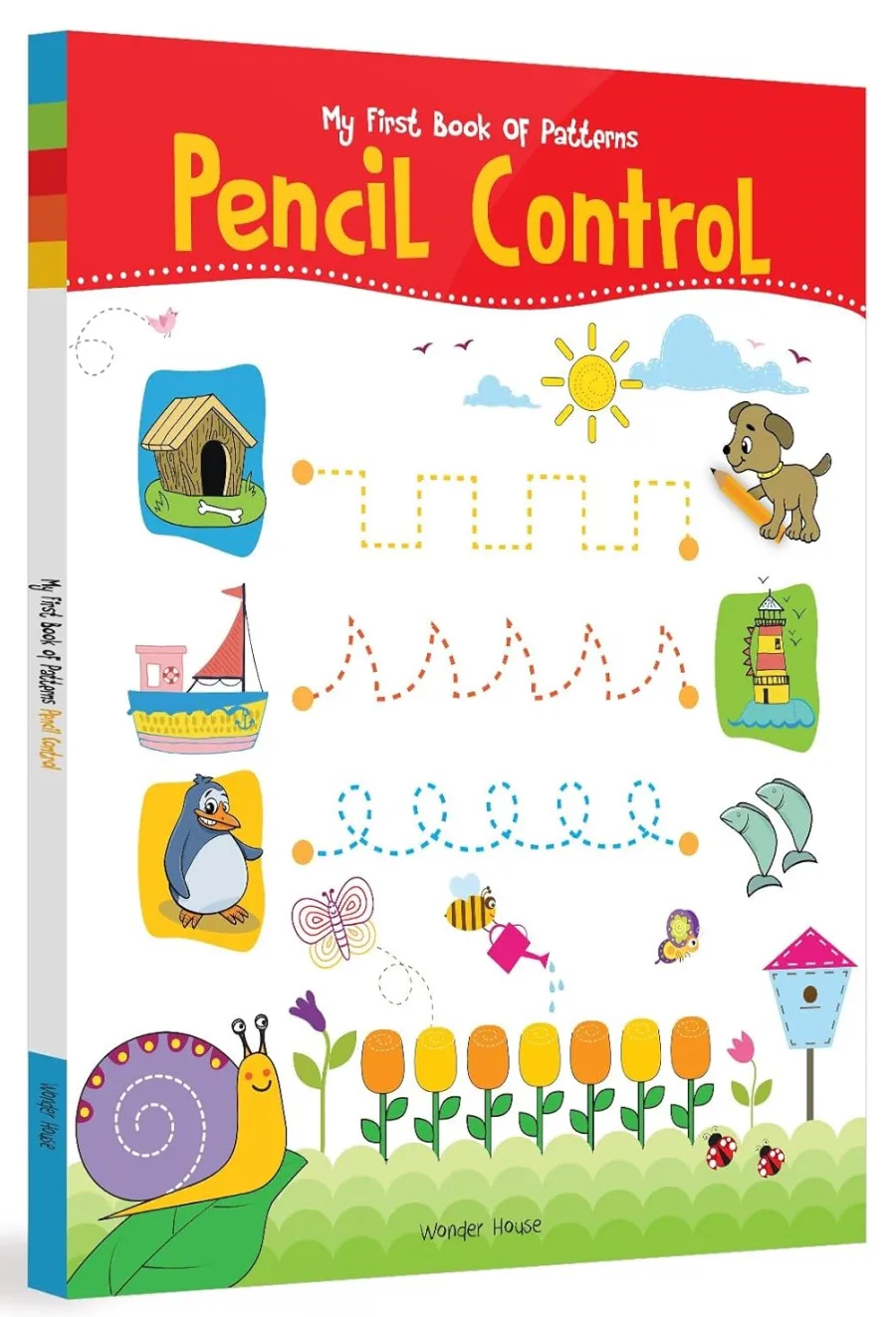
My First Book of Patterns Pencil Control: Patterns Practice book for kids
Paperback
• 48 Pages
• USD 5.99
• English
• 9789387779310
No ratings yet
| Publisher | Wonder House Books |
|---|---|
| ISBN13 | 9789387779310 |
| ASIN/SKU | 9387779319 |
| Book Format | Paperback |
| Language | English |
| Pages | 48 |
| List Price | USD 5.99 |
| Publishing Date | 25/04/2018 |
| Dimensions | 0.59 x 8.5 x 11.02 inches |
| Weight | 5.4 ounces |
| Book Code | BD00070257 |
Buy this Book
Amazon Stores
Ebook Stores
Other Stores
Discover My First Book of Patterns Pencil Control: Patterns Practice book for kids by Wonder House Books. This book is published by Wonder House Books in Paperback format, ISBN 9789387779310, ASIN 9387779319, under Children's Books, Children's Handwriting Books, Children's Composition and Creative Writing Books.
Book Description
A perfect activity book designed for early learners to develop pencil control and motor skills. By following the arrows and tracing the dotted lines, little scholars can complete tracing exercises and creative activities that lay the foundation for early writing. Children will learn to identify straight, curvy, zig-zag lines, and multiple patterns. This book is an excellent first step to prepare for school.
Shaping Bright Futures, One Pattern at a Time!
Why Children Will Love It:
Offers beautiful illustrations and fun activities
Features large, easy-to-follow pattern outlines
Encourages creative expression through tracing
Why Parents Will Love It:
Instills foundational skills like pencil control and pattern recognition
Introduces skill-building exercises for cognitive development
Inculcates hand-eye coordination and muscle memory
Perfect For:
Preschoolers and early learners
At-home learning and kindergarten readiness
Building confidence before starting to write letters and numbers
Shaping Bright Futures, One Pattern at a Time!
Why Children Will Love It:
Offers beautiful illustrations and fun activities
Features large, easy-to-follow pattern outlines
Encourages creative expression through tracing
Why Parents Will Love It:
Instills foundational skills like pencil control and pattern recognition
Introduces skill-building exercises for cognitive development
Inculcates hand-eye coordination and muscle memory
Perfect For:
Preschoolers and early learners
At-home learning and kindergarten readiness
Building confidence before starting to write letters and numbers
Author Biography
Wonder House has a dedicated team of editors and designers involved in the development of magnificent and enriching children books. The team pays special attention to develop age appropriate content and does extensive research on every topic included in the book. Our mission is to develop highly informative content which will help the children to master different skills. At Wonder House, we strive to make learning a joy.
Editorial Reviews
Editorial Reviews will be added soon…
Book Summary
My First Book of Patterns Pencil Control: Patterns Practice Book for Kids by Wonder House Books is a preschool activity and handwriting-readiness book designed to help young children develop the basic skills they need before they begin writing letters and numbers. Unlike a conventional storybook, this is a practical learning workbook built around tracing, pattern recognition, pencil movement, and repeated practice. Published by Wonder House Books, the book is 48 pages long and is primarily intended for children around three to five years old, with kindergarten readiness as one of its central purposes. The book's central idea is simple but important: before a child can confidently form letters, numbers, and words, the child needs to learn how to control a pencil, follow a direction, coordinate hand and eye movements, and reproduce basic lines and shapes. Through large patterns, arrows, dotted paths, illustrations, and creative exercises, the book turns these foundational skills into an accessible and enjoyable activity.
At first glance, My First Book of Patterns Pencil Control may appear to be a simple tracing workbook, but its educational purpose is more significant than that. Early writing is not something that begins when a child is first asked to copy the alphabet. It develops through a series of smaller physical and visual abilities. A young child has to learn how to hold and move a pencil, control the direction of the hand, judge distance, stay within a pathway, coordinate what the eyes see with what the hand does, and gradually reproduce increasingly complex movements. This workbook is designed around that progression. Its publisher describes it as an activity book for early learners that develops pencil control and motor skills while introducing straight lines, curvy lines, zigzag lines, and multiple patterns.
The book therefore does not tell a traditional narrative with characters, conflict, and resolution. Instead, its "story" is the child's journey from uncontrolled marks toward purposeful writing movements. Each page provides another small opportunity to practice. A child follows an arrow, traces a dotted line, repeats a shape, or completes a pattern. What may seem like a very small accomplishment to an adult can be an important developmental step for a preschooler. The book understands that learning to write is built from repetition. Rather than expecting a child to master handwriting immediately, it provides manageable exercises that allow confidence to develop gradually.
One of the first major skills emphasized by the book is pencil control. For a young child, holding a pencil and moving it accurately is not as easy as it looks. Adults often take these movements for granted because they have performed them thousands of times. A preschool child, however, is still developing the fine-motor strength and coordination necessary for controlled writing. The tracing exercises give the child a visual route to follow. Arrows indicate direction, while dotted lines provide a physical target for the pencil. The child therefore has both a visual instruction and an actual path to practice. According to the official Wonder House description, following arrows and tracing dotted lines is intended to help develop early writing skills.
The use of straight lines is an important foundation. Straight-line patterns may look extremely simple, but they introduce children to directional control. The child learns that a pencil can move from one point to another deliberately rather than wandering randomly across the page. Horizontal and vertical movements help establish the basic idea of starting at one point and finishing at another. These movements later become useful when children begin writing letters that contain straight strokes. The repeated practice also helps children become more comfortable with the physical sensation of controlling a writing instrument.
The workbook then expands beyond simple straight movements into curved patterns. Curved lines require a different kind of control because the child's hand must change direction smoothly rather than simply moving along a single axis. This prepares children for the rounded and looping movements found in many letters and numbers. More importantly, curved tracing teaches children to maintain continuity. They have to watch the line carefully and adjust their pencil movement as the shape changes. In this way, the exercise develops not only hand control but also attention and visual tracking.
Zigzag patterns add another layer of difficulty. Unlike a straight line or gentle curve, a zigzag requires repeated changes in direction. The child must stop or redirect the hand at the appropriate points while continuing to follow the overall pattern. This strengthens coordination and introduces the idea of rhythm in writing movements. The publisher specifically identifies straight, curvy, and zigzag lines among the patterns children learn to identify, write, and revise. These exercises are valuable because early handwriting depends upon the ability to combine several different movements rather than relying on one repetitive stroke.
The book also introduces multiple patterns, allowing children to move beyond individual lines toward repeated visual sequences. Pattern practice has an important cognitive component because the child is not merely moving a pencil mechanically. The child must notice what comes next, understand repetition, and reproduce the visual sequence. Pattern recognition is closely connected with early learning more broadly. Children encounter patterns in language, mathematics, shapes, sounds, and everyday routines. Practicing visual patterns therefore gives them an early opportunity to recognize order and repetition while simultaneously developing motor skills.
The arrows in the exercises are particularly helpful for preschool learners because they make direction visible. A young child may understand that a line needs to be traced without knowing exactly where or how to begin. An arrow removes some of that uncertainty. It tells the child where the movement starts and which way it should go. This transforms the page from an abstract collection of lines into a guided activity. Over time, children can internalize these directional movements and become increasingly independent.
The dotted lines serve a similar purpose. They provide structure without requiring the child to reproduce the entire pattern from memory. This is important because a preschooler may not yet possess enough motor control to copy a shape independently. Tracing reduces the difficulty while still requiring active participation. The child has to keep the pencil moving along the intended route. With repeated practice, the distance between tracing and independent writing can gradually become smaller. The book therefore functions as a bridge between free drawing and formal handwriting.
Another major strength of My First Book of Patterns Pencil Control is its emphasis on hand-eye coordination. Writing requires constant communication between vision and movement. The eyes identify where the pencil should go, while the hand and fingers attempt to carry out that movement. When children trace patterns, they repeatedly practice this connection. The book's product information specifically identifies hand-eye coordination and muscle memory among the skills it aims to cultivate. The repeated movements can help children become more comfortable with the physical demands of early writing.
The concept of muscle memory is also relevant. Children do not become proficient at writing simply by understanding what a letter looks like. They need repeated physical practice so that certain movements become increasingly familiar. Pattern tracing gives them that repetition before they are asked to form recognizable letters. A child who has practiced lines, curves, loops, and directional changes has already developed some of the movement vocabulary needed for handwriting. The book's purpose is therefore preparatory: it helps children build the physical foundation on which later writing can develop.
The illustrations and visual elements make the activities more approachable. For preschool children, a page filled only with abstract lines could quickly become boring. Bright imagery and playful activities can make practice feel more like exploration than formal work. Wonder House Books describes the book as offering beautiful illustrations, fun activities, and large, easy-to-follow pattern outlines. This matters because motivation is a major part of early learning. Children are more likely to practice repeatedly when the activity feels engaging and achievable.
The book also encourages creative expression. Although tracing has a structured purpose, it does not have to feel rigid. Children can interact with the illustrations and patterns in ways that make the learning experience personal. This balance between structure and creativity is useful for preschoolers. They receive enough guidance to develop a specific skill while still experiencing the pleasure of drawing and making marks on a page.
One of the most important educational ideas behind the workbook is that confidence develops through small successes. A preschooler who is repeatedly told to write letters before having adequate pencil control may become frustrated. By contrast, a child who successfully traces a line, completes a curve, follows a zigzag, and reproduces a pattern can experience a series of manageable achievements. Each completed activity communicates a simple message: "I can do this." That sense of competence can become extremely valuable when the child later encounters more difficult handwriting tasks.
This is why the book can be understood as a kindergarten-readiness workbook. Its goal is not merely to keep children occupied. It helps introduce several abilities that become useful when children enter formal schooling. The publisher and booksellers position it for preschoolers and early learners and specifically describe it as an excellent first step toward school preparation and confidence before children begin writing letters and numbers. The book is listed for children ages three to five and through kindergarten level, although individual children's readiness will naturally vary.
For parents, one of the practical advantages of the book is that it provides structured practice at home. Instead of having to invent handwriting-preparation activities, parents can give children a clearly organized page and allow them to work through the patterns. The large format and straightforward exercises make the book accessible for young children who are still developing their ability to work independently. It can be used during short practice sessions rather than requiring long periods of formal study.
The book is also useful for parents who are searching for a pencil control book for preschoolers, a pattern tracing workbook for kids, a pre-writing activity book, or a handwriting practice book for kindergarten readiness. These search terms describe the book's actual educational purpose quite well. It is not primarily intended to teach reading or mathematics. Instead, it occupies the important stage between drawing and formal writing. Children learn to control marks before they are expected to turn those marks into letters, numbers, and words.
An especially humane aspect of this kind of activity book is that it recognizes that children develop at different speeds. One child may trace a pattern confidently while another may need several attempts. The purpose of the exercises is practice rather than perfection. Adults using the book can support children by encouraging them to follow the path carefully without turning every page into a test. A child who goes outside the dotted line is still learning. The process matters more than producing perfectly neat pages.
The book can therefore be approached as a gradual learning journey. At the beginning, the child is learning to understand the page and control basic movements. As the patterns become more varied, the child must pay closer attention to direction, shape, rhythm, and repetition. Eventually, the child has a larger collection of practiced movements that can support the transition to letters and numbers. The progression may look simple on paper, but it represents an important developmental sequence.
The physical format also supports its purpose. The book has 48 pages and is approximately 21.6 by 28 centimeters in the Wonder House listing, giving children substantial room to work on the patterns rather than forcing them into tiny spaces. For preschoolers, generous writing space can make a difference because their fine-motor control is still developing. Larger patterns allow them to practice broad movements before gradually moving toward the smaller and more precise movements required for handwriting.
Ultimately, My First Book of Patterns Pencil Control is best understood not as a conventional book to be read from beginning to end but as a guided practice experience for early learners. Its value comes from repetition, visual guidance, simple challenges, and the gradual strengthening of foundational abilities. The book takes something as ordinary as drawing a line and reveals the many skills hidden inside that action: concentration, direction, visual tracking, hand control, coordination, patience, and repetition.
In conclusion, My First Book of Patterns Pencil Control: Patterns Practice Book for Kids by Wonder House Books is a practical and child-friendly introduction to pre-writing skills. Through straight lines, curves, zigzags, repeated patterns, arrows, dotted paths, illustrations, and creative exercises, it helps young children become more comfortable with the physical and visual demands of early writing. Its 48 pages are designed for preschool-age learners, particularly children around three to five years old, and its stated goals include pencil control, motor development, pattern recognition, hand-eye coordination, and preparation for school.
The most important lesson of the book is that writing does not begin with the alphabet. It begins much earlier, with the simple ability to make a controlled mark and intentionally guide that mark across a page. My First Book of Patterns Pencil Control gives children an opportunity to practice those movements in a playful and accessible setting. By turning foundational handwriting exercises into colorful pattern activities, Wonder House Books makes an important developmental process feel less like a lesson and more like an enjoyable accomplishment. For young children preparing for preschool or kindergarten, and for parents looking for a simple at-home pre-writing workbook, the book offers a useful bridge between early drawing and the more structured world of letters, numbers, and handwriting.
At first glance, My First Book of Patterns Pencil Control may appear to be a simple tracing workbook, but its educational purpose is more significant than that. Early writing is not something that begins when a child is first asked to copy the alphabet. It develops through a series of smaller physical and visual abilities. A young child has to learn how to hold and move a pencil, control the direction of the hand, judge distance, stay within a pathway, coordinate what the eyes see with what the hand does, and gradually reproduce increasingly complex movements. This workbook is designed around that progression. Its publisher describes it as an activity book for early learners that develops pencil control and motor skills while introducing straight lines, curvy lines, zigzag lines, and multiple patterns.
The book therefore does not tell a traditional narrative with characters, conflict, and resolution. Instead, its "story" is the child's journey from uncontrolled marks toward purposeful writing movements. Each page provides another small opportunity to practice. A child follows an arrow, traces a dotted line, repeats a shape, or completes a pattern. What may seem like a very small accomplishment to an adult can be an important developmental step for a preschooler. The book understands that learning to write is built from repetition. Rather than expecting a child to master handwriting immediately, it provides manageable exercises that allow confidence to develop gradually.
One of the first major skills emphasized by the book is pencil control. For a young child, holding a pencil and moving it accurately is not as easy as it looks. Adults often take these movements for granted because they have performed them thousands of times. A preschool child, however, is still developing the fine-motor strength and coordination necessary for controlled writing. The tracing exercises give the child a visual route to follow. Arrows indicate direction, while dotted lines provide a physical target for the pencil. The child therefore has both a visual instruction and an actual path to practice. According to the official Wonder House description, following arrows and tracing dotted lines is intended to help develop early writing skills.
The use of straight lines is an important foundation. Straight-line patterns may look extremely simple, but they introduce children to directional control. The child learns that a pencil can move from one point to another deliberately rather than wandering randomly across the page. Horizontal and vertical movements help establish the basic idea of starting at one point and finishing at another. These movements later become useful when children begin writing letters that contain straight strokes. The repeated practice also helps children become more comfortable with the physical sensation of controlling a writing instrument.
The workbook then expands beyond simple straight movements into curved patterns. Curved lines require a different kind of control because the child's hand must change direction smoothly rather than simply moving along a single axis. This prepares children for the rounded and looping movements found in many letters and numbers. More importantly, curved tracing teaches children to maintain continuity. They have to watch the line carefully and adjust their pencil movement as the shape changes. In this way, the exercise develops not only hand control but also attention and visual tracking.
Zigzag patterns add another layer of difficulty. Unlike a straight line or gentle curve, a zigzag requires repeated changes in direction. The child must stop or redirect the hand at the appropriate points while continuing to follow the overall pattern. This strengthens coordination and introduces the idea of rhythm in writing movements. The publisher specifically identifies straight, curvy, and zigzag lines among the patterns children learn to identify, write, and revise. These exercises are valuable because early handwriting depends upon the ability to combine several different movements rather than relying on one repetitive stroke.
The book also introduces multiple patterns, allowing children to move beyond individual lines toward repeated visual sequences. Pattern practice has an important cognitive component because the child is not merely moving a pencil mechanically. The child must notice what comes next, understand repetition, and reproduce the visual sequence. Pattern recognition is closely connected with early learning more broadly. Children encounter patterns in language, mathematics, shapes, sounds, and everyday routines. Practicing visual patterns therefore gives them an early opportunity to recognize order and repetition while simultaneously developing motor skills.
The arrows in the exercises are particularly helpful for preschool learners because they make direction visible. A young child may understand that a line needs to be traced without knowing exactly where or how to begin. An arrow removes some of that uncertainty. It tells the child where the movement starts and which way it should go. This transforms the page from an abstract collection of lines into a guided activity. Over time, children can internalize these directional movements and become increasingly independent.
The dotted lines serve a similar purpose. They provide structure without requiring the child to reproduce the entire pattern from memory. This is important because a preschooler may not yet possess enough motor control to copy a shape independently. Tracing reduces the difficulty while still requiring active participation. The child has to keep the pencil moving along the intended route. With repeated practice, the distance between tracing and independent writing can gradually become smaller. The book therefore functions as a bridge between free drawing and formal handwriting.
Another major strength of My First Book of Patterns Pencil Control is its emphasis on hand-eye coordination. Writing requires constant communication between vision and movement. The eyes identify where the pencil should go, while the hand and fingers attempt to carry out that movement. When children trace patterns, they repeatedly practice this connection. The book's product information specifically identifies hand-eye coordination and muscle memory among the skills it aims to cultivate. The repeated movements can help children become more comfortable with the physical demands of early writing.
The concept of muscle memory is also relevant. Children do not become proficient at writing simply by understanding what a letter looks like. They need repeated physical practice so that certain movements become increasingly familiar. Pattern tracing gives them that repetition before they are asked to form recognizable letters. A child who has practiced lines, curves, loops, and directional changes has already developed some of the movement vocabulary needed for handwriting. The book's purpose is therefore preparatory: it helps children build the physical foundation on which later writing can develop.
The illustrations and visual elements make the activities more approachable. For preschool children, a page filled only with abstract lines could quickly become boring. Bright imagery and playful activities can make practice feel more like exploration than formal work. Wonder House Books describes the book as offering beautiful illustrations, fun activities, and large, easy-to-follow pattern outlines. This matters because motivation is a major part of early learning. Children are more likely to practice repeatedly when the activity feels engaging and achievable.
The book also encourages creative expression. Although tracing has a structured purpose, it does not have to feel rigid. Children can interact with the illustrations and patterns in ways that make the learning experience personal. This balance between structure and creativity is useful for preschoolers. They receive enough guidance to develop a specific skill while still experiencing the pleasure of drawing and making marks on a page.
One of the most important educational ideas behind the workbook is that confidence develops through small successes. A preschooler who is repeatedly told to write letters before having adequate pencil control may become frustrated. By contrast, a child who successfully traces a line, completes a curve, follows a zigzag, and reproduces a pattern can experience a series of manageable achievements. Each completed activity communicates a simple message: "I can do this." That sense of competence can become extremely valuable when the child later encounters more difficult handwriting tasks.
This is why the book can be understood as a kindergarten-readiness workbook. Its goal is not merely to keep children occupied. It helps introduce several abilities that become useful when children enter formal schooling. The publisher and booksellers position it for preschoolers and early learners and specifically describe it as an excellent first step toward school preparation and confidence before children begin writing letters and numbers. The book is listed for children ages three to five and through kindergarten level, although individual children's readiness will naturally vary.
For parents, one of the practical advantages of the book is that it provides structured practice at home. Instead of having to invent handwriting-preparation activities, parents can give children a clearly organized page and allow them to work through the patterns. The large format and straightforward exercises make the book accessible for young children who are still developing their ability to work independently. It can be used during short practice sessions rather than requiring long periods of formal study.
The book is also useful for parents who are searching for a pencil control book for preschoolers, a pattern tracing workbook for kids, a pre-writing activity book, or a handwriting practice book for kindergarten readiness. These search terms describe the book's actual educational purpose quite well. It is not primarily intended to teach reading or mathematics. Instead, it occupies the important stage between drawing and formal writing. Children learn to control marks before they are expected to turn those marks into letters, numbers, and words.
An especially humane aspect of this kind of activity book is that it recognizes that children develop at different speeds. One child may trace a pattern confidently while another may need several attempts. The purpose of the exercises is practice rather than perfection. Adults using the book can support children by encouraging them to follow the path carefully without turning every page into a test. A child who goes outside the dotted line is still learning. The process matters more than producing perfectly neat pages.
The book can therefore be approached as a gradual learning journey. At the beginning, the child is learning to understand the page and control basic movements. As the patterns become more varied, the child must pay closer attention to direction, shape, rhythm, and repetition. Eventually, the child has a larger collection of practiced movements that can support the transition to letters and numbers. The progression may look simple on paper, but it represents an important developmental sequence.
The physical format also supports its purpose. The book has 48 pages and is approximately 21.6 by 28 centimeters in the Wonder House listing, giving children substantial room to work on the patterns rather than forcing them into tiny spaces. For preschoolers, generous writing space can make a difference because their fine-motor control is still developing. Larger patterns allow them to practice broad movements before gradually moving toward the smaller and more precise movements required for handwriting.
Ultimately, My First Book of Patterns Pencil Control is best understood not as a conventional book to be read from beginning to end but as a guided practice experience for early learners. Its value comes from repetition, visual guidance, simple challenges, and the gradual strengthening of foundational abilities. The book takes something as ordinary as drawing a line and reveals the many skills hidden inside that action: concentration, direction, visual tracking, hand control, coordination, patience, and repetition.
In conclusion, My First Book of Patterns Pencil Control: Patterns Practice Book for Kids by Wonder House Books is a practical and child-friendly introduction to pre-writing skills. Through straight lines, curves, zigzags, repeated patterns, arrows, dotted paths, illustrations, and creative exercises, it helps young children become more comfortable with the physical and visual demands of early writing. Its 48 pages are designed for preschool-age learners, particularly children around three to five years old, and its stated goals include pencil control, motor development, pattern recognition, hand-eye coordination, and preparation for school.
The most important lesson of the book is that writing does not begin with the alphabet. It begins much earlier, with the simple ability to make a controlled mark and intentionally guide that mark across a page. My First Book of Patterns Pencil Control gives children an opportunity to practice those movements in a playful and accessible setting. By turning foundational handwriting exercises into colorful pattern activities, Wonder House Books makes an important developmental process feel less like a lesson and more like an enjoyable accomplishment. For young children preparing for preschool or kindergarten, and for parents looking for a simple at-home pre-writing workbook, the book offers a useful bridge between early drawing and the more structured world of letters, numbers, and handwriting.
Sample Chapters
Sample Chapters will be added soon…
Reader Reviews
No reviews yet.
My First Book of Patterns Pencil Control: Patterns Practice book for kids
Download Cover Image
Do you want to download the full cover image for My First Book of Patterns Pencil Control: Patterns Practice book for kids?