
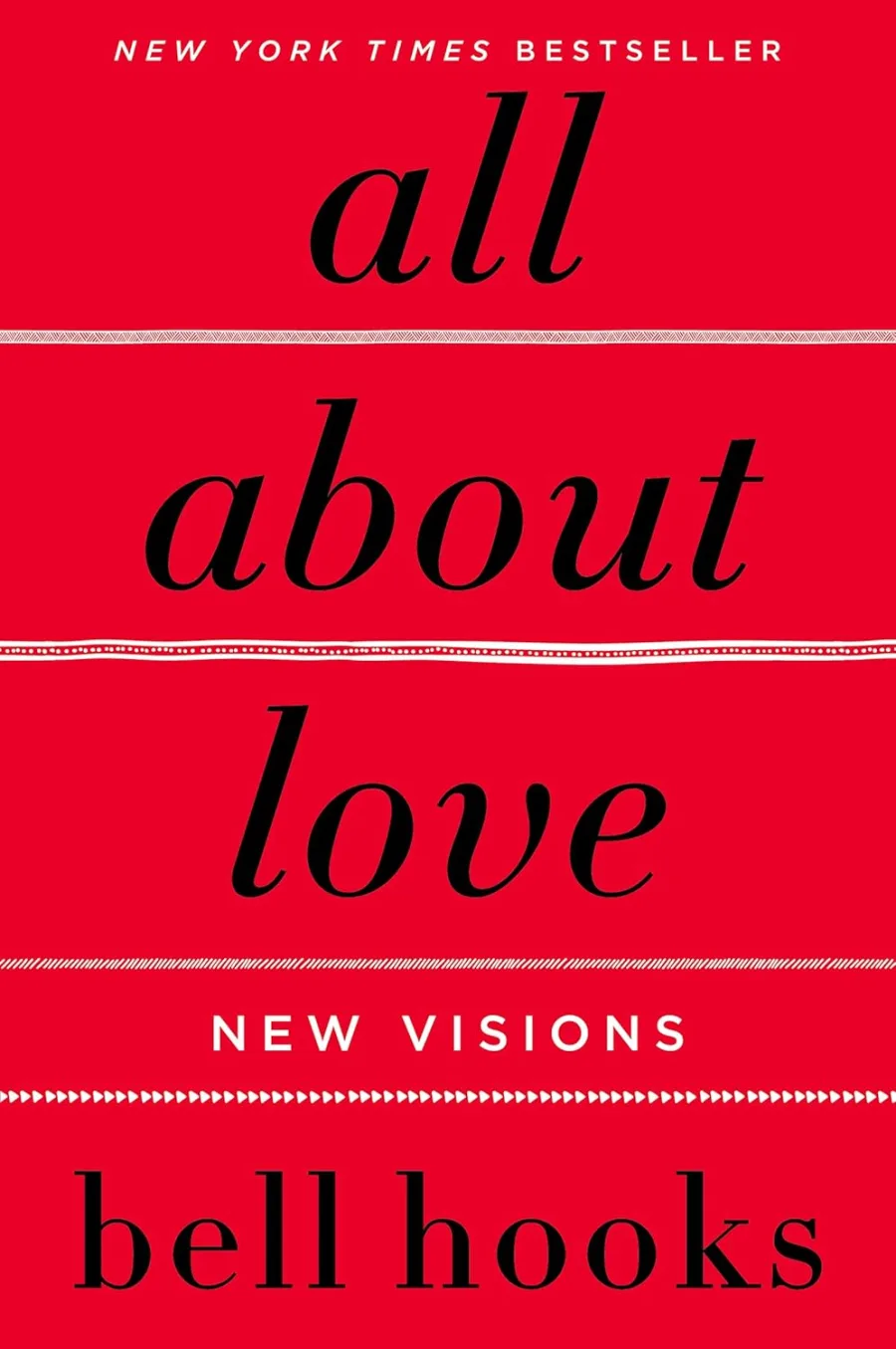
All About Love: New Visions
Paperback
• 272 Pages
• USD 17.99
• English
• 9780060959470
No ratings yet
| Publisher | William Morrow Paperbacks |
|---|---|
| ISBN13 | 9780060959470 |
| ASIN/SKU | 0060959479 |
| Book Format | Paperback |
| Language | English |
| Pages | 272 |
| List Price | USD 17.99 |
| Publishing Date | 09/01/2009 |
| Dimensions | 8 x 5.3 x 0.7 inches |
| Weight | 10.4 ounces |
| Book Code | BD00070259 |
Buy this Book
Amazon Stores
Ebook Stores
Other Stores
Discover All About Love: New Visions by bell hooks. This book is published by William Morrow Paperbacks in Paperback format, ISBN 9780060959470, ASIN 0060959479, under Politics and Social Sciences, Cultural Anthropology, General Gender Studies.
Book Description
A New York Times bestseller and enduring classic, All About Love is the acclaimed first volume in feminist icon bell hooks' "Love Song to the Nation" trilogy. All About Love reveals what causes a polarized society, and how to heal the divisions that cause suffering. Here is the truth about love, and inspiration to help us instill caring, compassion, and strength in our homes, schools, and workplaces.
“The word ‘love’ is most often defined as a noun, yet we would all love better if we used it as a verb,” writes bell hooks as she comes out fighting and on fire in All About Love. Provocative and intensely personal, renowned scholar, cultural critic and feminist bell hooks speaks to society stricken with lovelessness—not the lack of romance, but the lack of care, compassion, and unity. People are divided, she declares, by society’s failure to provide a model for learning to love.
In this landmark book, bell hooks explores the question “What is love?” Disputing that the ideal love is infused with sex and desire, she provides a new path to love that is sacred, redemptive, and healing for individuals and for a nation. All About Love is a powerful, timely affirmation of just how profoundly love and community can change hearts and minds for the better.
Part of the groundbreaking "Love Song to the Nation" trilogy that includes Communion and Salvation
On the New York Times bestseller list for over a year.
Speaks to the mind and the heart about the transformational power of love to heal society.
“The word ‘love’ is most often defined as a noun, yet we would all love better if we used it as a verb,” writes bell hooks as she comes out fighting and on fire in All About Love. Provocative and intensely personal, renowned scholar, cultural critic and feminist bell hooks speaks to society stricken with lovelessness—not the lack of romance, but the lack of care, compassion, and unity. People are divided, she declares, by society’s failure to provide a model for learning to love.
In this landmark book, bell hooks explores the question “What is love?” Disputing that the ideal love is infused with sex and desire, she provides a new path to love that is sacred, redemptive, and healing for individuals and for a nation. All About Love is a powerful, timely affirmation of just how profoundly love and community can change hearts and minds for the better.
Part of the groundbreaking "Love Song to the Nation" trilogy that includes Communion and Salvation
On the New York Times bestseller list for over a year.
Speaks to the mind and the heart about the transformational power of love to heal society.
Author Biography
bell hooks is a cultural critic, feminist theorist, and writer. Celebrated as one of our nation's leading public intellectual by The Atlantic Monthly, as well as one of Utne Reader's 100 Visionaries Who Could Change Your Life, she is a charismatic speaker who divides her time among teaching, writing, and lecturing around the world. Previously a professor in the English departments at Yale University and Oberlin College, hooks is now a Distinguished Professor of English at City College and the Graduate Center of the City University of New York. She is the author of more than seventeen books, including All About Love: New Visions; Remembered Rapture: The Writer at Work; Wounds of Passion: A Writing Life; Bone Black: Memories of Girlhood; Killing Rage: Ending Racism; Art on My Mind: Visual Politics; and Breaking Bread: Insurgent Black Intellectual Life. She lives in New York City.
Photo by Alex Lozupone (Tduk) (Own work) [CC BY-SA 4.0 (http://creativecommons.org/licenses/by-sa/4.0)], via Wikimedia Commons.
Photo by Alex Lozupone (Tduk) (Own work) [CC BY-SA 4.0 (http://creativecommons.org/licenses/by-sa/4.0)], via Wikimedia Commons.
Editorial Reviews
“Each offering from bell hooks is a major event, as she has so much to give us.” - Maya Angelou
“Like love, this book is worth the commitment.” - Toronto Sun
“She provides a refreshing spiritual treatise that steps outside the confines of the intellect and into the wilds of the heart.” - Seattle Weekly
“Like love, this book is worth the commitment.” - Toronto Sun
“She provides a refreshing spiritual treatise that steps outside the confines of the intellect and into the wilds of the heart.” - Seattle Weekly
Book Summary
All About Love: New Visions by bell hooks is a thoughtful, challenging, and deeply humane exploration of one of the most familiar yet least clearly understood words in everyday life: love. First published in 2000, the book asks readers to reconsider what they mean when they say they love someone, what they expect from love, and why so many people experience loneliness and emotional disconnection even while living in a culture that constantly talks about romance and relationships. Rather than treating love as a private feeling between romantic partners, hooks presents it as an active practice involving care, commitment, honesty, responsibility, respect, trust, and mutual growth. The book contains thirteen chapters that move between childhood, family, romance, spirituality, community, justice, loss, healing, and social life.
At the heart of All About Love is a deceptively simple argument: people cannot create loving lives if they do not have a clear understanding of what love actually is. hooks observes that love is used constantly in popular culture, yet people often use the word to describe very different things. Desire, sexual attraction, attachment, possession, dependency, affection, control, and even abuse can be confused with love. When people say "I love you," their behavior may not necessarily demonstrate care or respect. hooks therefore believes that love needs to be understood through what people do, not merely through what they claim to feel. Her definition draws heavily on the idea that love involves the will to nurture one's own or another person's spiritual growth. In this understanding, love is a choice and a practice rather than an uncontrollable emotion.
The book begins with a personal reflection on the author's childhood experience of love and abandonment. hooks remembers an early period when she felt surrounded by love and belonging, followed by an experience in which that sense of security seemed to disappear. The wound affected her understanding of relationships for years. She came to recognize that some of her longing for love was also a longing to recover what she believed she had lost. Her personal story establishes one of the book's most important ideas: our earliest experiences of love shape the expectations we carry into adulthood. When children receive confusing messages about love, they may grow up believing that love and pain naturally belong together.
From this starting point, hooks challenges the common belief that love is simply something that happens to us. Popular ideas about romantic love often portray people as powerless before attraction: we "fall" in love, lose control, become consumed by another person, and assume that intense emotion proves the relationship is meaningful. hooks questions this model. Strong feelings may be part of love, but feelings alone cannot sustain a healthy relationship. Love requires behavior. A person who claims to love someone but repeatedly humiliates, manipulates, deceives, or controls them cannot use the feeling of love as an excuse for harmful actions. For hooks, genuine love must be visible in conduct.
This leads to the book's emphasis on clarity. hooks argues that giving love clear language is essential because vague definitions make it difficult to recognize either healthy or unhealthy relationships. If love means care, respect, responsibility, trust, knowledge, and commitment, then people have standards by which they can evaluate their relationships. A relationship based primarily on jealousy, fear, domination, or possession may be emotionally intense, but intensity does not automatically make it loving. The distinction is liberating because it allows people to separate love from behaviors that society has sometimes taught them to accept as normal parts of intimacy.
One of the book's most important discussions concerns childhood and parenting. hooks argues that children learn about love primarily through what adults do to them and around them. Telling a child "I love you" does not erase the impact of cruelty, humiliation, neglect, or physical punishment. When children are simultaneously told that they are loved and subjected to harmful treatment, they can become confused about what love means. They may learn that love includes domination or that someone can hurt them while still claiming to care about them. For hooks, this confusion can continue into adulthood, affecting romantic and family relationships.
This discussion is particularly important because hooks refuses to treat children merely as recipients of love. She sees children as people deserving of respect and emotional honesty. Loving children means recognizing their humanity, listening to them, establishing boundaries without cruelty, and creating environments in which they can develop confidence and emotional security. The lessons learned in childhood become a foundation for the adult capacity to trust, communicate, and care for others.
The theme of honesty follows naturally from this argument. hooks insists that genuine love cannot flourish without truth. People often hide their real feelings because they are afraid of rejection, conflict, or abandonment. They create false versions of themselves to become more acceptable to partners or family members. But a relationship built around a false self cannot provide genuine intimacy. To be truly known, a person must eventually become honest about what they think, feel, want, and fear. Likewise, loving another person requires being willing to hear their truth rather than demanding that they tell us what we want to hear.
hooks connects this problem of emotional dishonesty to gender roles and patriarchy. Traditional gender expectations often teach women and men different lessons about love. Women may be encouraged to please, accommodate, and sacrifice themselves, while men may be taught to suppress vulnerability and demonstrate power. These expectations make genuine intimacy difficult. If women are trained to erase themselves for others and men are trained to hide their emotions, neither person is fully free to participate honestly in a relationship. hooks therefore argues that learning to love requires challenging the social structures that teach people to perform gender rather than express their humanity.
Her discussion of masculinity is especially significant. hooks does not portray men simply as perpetrators of emotional harm; she also examines how patriarchal culture harms men's ability to experience and express love. Boys may learn early that crying, tenderness, fear, and vulnerability are signs of weakness. They may be rewarded for emotional distance and aggression. As adults, some men struggle to communicate affection because they were never given healthy models for doing so. hooks argues that dismantling these patterns can benefit everyone. Men need freedom to be emotionally present, and women need freedom from the expectation that they must provide all the emotional care in relationships.
The book then expands from personal relationships to spirituality. hooks sees love as having a spiritual dimension because it encourages people to move beyond selfishness and recognize the value of other human beings. This does not mean that love must be tied to a particular religious tradition. Instead, spirituality in the book represents a deeper commitment to connection, compassion, meaning, and the recognition that human beings are interdependent. Love becomes a way of living rather than merely a feeling experienced in moments of romance.
This broader understanding of love leads hooks to develop what can be called a love ethic. If love is genuinely transformative, it should not stop at the boundaries of the household. The same values that make relationships healthy—care, respect, responsibility, honesty, trust, and mutuality—can also shape communities and public life. hooks challenges the idea that politics and love belong to completely separate worlds. A society organized around domination, exploitation, racism, sexism, greed, and violence cannot easily be described as loving. If people genuinely want a more compassionate society, they must practice values that resist these systems.
This is where All About Love becomes more than a relationship book. hooks argues that love and justice are connected. Justice without compassion can become cold and punitive, while claims of love without justice can become empty. To love people means taking seriously the conditions in which they live. If a society allows people to be systematically devalued or harmed, individual declarations of love are not enough. Love must involve a willingness to confront structures that produce suffering.
The book also examines self-love, but hooks makes an important distinction between self-love and narcissism. Genuine self-love is not selfishness or an inflated sense of superiority. It involves caring for oneself, recognizing one's own worth, establishing healthy boundaries, and refusing to accept relationships that repeatedly cause harm. A person who does not value themselves may become vulnerable to relationships based on exploitation or dependency. Healthy self-love, by contrast, creates the emotional foundation from which people can offer love without completely losing themselves. Google Books describes hooks's approach as a rethinking of self-love that rejects narcissism while connecting it to peace and compassion in personal and professional life.
Another important subject is romantic love. hooks does not reject romance, sexuality, or desire. Instead, she challenges the cultural tendency to treat romantic love as the highest or most important form of love. Romantic relationships receive enormous attention in films, music, advertising, and popular literature, while friendships, family bonds, community relationships, and love of self often receive much less attention. This imbalance can make people believe that finding a romantic partner is the ultimate solution to loneliness. hooks argues for a wider understanding in which romantic love becomes one meaningful form of connection rather than the measure of whether a person's life is complete.
Her discussion of mutuality is crucial here. Healthy love cannot be based entirely on one person giving while the other takes. Both people need to be recognized as full human beings with needs, boundaries, desires, and responsibilities. Mutual love does not mean that everything is always equal in a mechanical sense. Instead, it means that both people matter. Each person should have space to grow, speak honestly, make choices, and receive care. This principle also distinguishes love from possession. To love another person is not to own them.
hooks also addresses commitment. In a culture that often treats relationships as disposable, commitment can seem old-fashioned or restrictive. For hooks, however, commitment does not mean remaining trapped in a harmful relationship. Rather, it means making a conscious choice to participate in the ongoing work of love. Because love is an action, it requires attention. People have to communicate, repair mistakes, learn about each other, and make room for change. Commitment is therefore not merely staying; it is actively participating in the relationship.
The theme of forgiveness and healing becomes especially important as the book moves toward loss. hooks understands that people carry wounds from childhood, family relationships, failed romances, betrayal, and disappointment. Healing does not require pretending that harm never happened. Instead, it involves recognizing the wound and refusing to let it permanently determine one's capacity for love. Forgiveness, in this context, can become a way of releasing oneself from the emotional power of past injury. It does not necessarily mean excusing wrongdoing or returning to an unsafe relationship. Rather, it can mean choosing not to build one's entire future around resentment.
Loss is another unavoidable part of love. hooks recognizes that loving someone creates vulnerability because everything we love can eventually change or disappear. People die, relationships end, children grow up, friendships change, and circumstances shift. The fear of loss can therefore lead people to avoid intimacy altogether. Yet hooks suggests that avoiding love to avoid grief also means avoiding one of life's deepest sources of meaning. Love makes loss painful, but that does not make love a mistake. The experience of loving can give life richness even when it cannot prevent mortality.
The book's final movement toward healing and redemptive love is ultimately hopeful. hooks does not claim that love can magically solve every problem. Instead, she believes love gives people a way to respond to suffering without reproducing it. A person who has been hurt can choose to become more conscious rather than more destructive. A family can learn healthier ways of communicating. A community can replace domination with mutual care. A society can move toward justice by treating human beings as worthy of dignity. Love, in this sense, is not passive comfort but a practice of transformation.
The lasting power of All About Love: New Visions comes from its insistence that love should be taken seriously. hooks refuses to reduce love to sentimentality, romance, or private emotion. She treats it as an ethical and social practice that affects how people raise children, conduct friendships, build romantic relationships, understand themselves, respond to suffering, and participate in communities. The book's original publisher description similarly emphasizes its movement from private life to public life and its challenge to the belief that romantic love is more important than every other bond.
For readers searching for an All About Love book summary, an explanation of bell hooks's definition of love, or a discussion of the book's major themes, the central lesson can be expressed simply: love is something we practice. It requires more than attraction or good intentions. It asks us to tell the truth, listen carefully, respect boundaries, accept responsibility, nurture growth, reject domination, and care for ourselves as well as others. It also asks us to examine the cultural beliefs that have taught us to confuse love with control, sacrifice, dependency, or possession.
Ultimately, All About Love: New Visions is a hopeful book precisely because it does not assume that people already know how to love. hooks treats loving as something that can be learned. If destructive patterns are learned in childhood and reinforced by culture, healthier patterns can also be consciously developed. The book invites readers to imagine relationships in which tenderness is not weakness, honesty is not threatening, vulnerability is not shameful, and care is not a one-sided obligation. It also invites us to imagine communities in which justice and compassion reinforce one another rather than being treated as opposites.
The deepest message of All About Love is therefore that love is both intimate and revolutionary. It begins with how we treat ourselves and the people closest to us, but its implications extend much further. When people learn to distinguish love from control, when parents treat children with respect, when men are allowed to be vulnerable, when women are freed from compulsory self-sacrifice, when partners practice honesty and mutuality, and when communities value care and justice, love becomes more than a private emotion. It becomes a way of changing how human beings live together. That is what makes bell hooks's book enduring: it does not simply ask us whether we have found love. It asks a much harder and more meaningful question—Are we actually learning how to love?
At the heart of All About Love is a deceptively simple argument: people cannot create loving lives if they do not have a clear understanding of what love actually is. hooks observes that love is used constantly in popular culture, yet people often use the word to describe very different things. Desire, sexual attraction, attachment, possession, dependency, affection, control, and even abuse can be confused with love. When people say "I love you," their behavior may not necessarily demonstrate care or respect. hooks therefore believes that love needs to be understood through what people do, not merely through what they claim to feel. Her definition draws heavily on the idea that love involves the will to nurture one's own or another person's spiritual growth. In this understanding, love is a choice and a practice rather than an uncontrollable emotion.
The book begins with a personal reflection on the author's childhood experience of love and abandonment. hooks remembers an early period when she felt surrounded by love and belonging, followed by an experience in which that sense of security seemed to disappear. The wound affected her understanding of relationships for years. She came to recognize that some of her longing for love was also a longing to recover what she believed she had lost. Her personal story establishes one of the book's most important ideas: our earliest experiences of love shape the expectations we carry into adulthood. When children receive confusing messages about love, they may grow up believing that love and pain naturally belong together.
From this starting point, hooks challenges the common belief that love is simply something that happens to us. Popular ideas about romantic love often portray people as powerless before attraction: we "fall" in love, lose control, become consumed by another person, and assume that intense emotion proves the relationship is meaningful. hooks questions this model. Strong feelings may be part of love, but feelings alone cannot sustain a healthy relationship. Love requires behavior. A person who claims to love someone but repeatedly humiliates, manipulates, deceives, or controls them cannot use the feeling of love as an excuse for harmful actions. For hooks, genuine love must be visible in conduct.
This leads to the book's emphasis on clarity. hooks argues that giving love clear language is essential because vague definitions make it difficult to recognize either healthy or unhealthy relationships. If love means care, respect, responsibility, trust, knowledge, and commitment, then people have standards by which they can evaluate their relationships. A relationship based primarily on jealousy, fear, domination, or possession may be emotionally intense, but intensity does not automatically make it loving. The distinction is liberating because it allows people to separate love from behaviors that society has sometimes taught them to accept as normal parts of intimacy.
One of the book's most important discussions concerns childhood and parenting. hooks argues that children learn about love primarily through what adults do to them and around them. Telling a child "I love you" does not erase the impact of cruelty, humiliation, neglect, or physical punishment. When children are simultaneously told that they are loved and subjected to harmful treatment, they can become confused about what love means. They may learn that love includes domination or that someone can hurt them while still claiming to care about them. For hooks, this confusion can continue into adulthood, affecting romantic and family relationships.
This discussion is particularly important because hooks refuses to treat children merely as recipients of love. She sees children as people deserving of respect and emotional honesty. Loving children means recognizing their humanity, listening to them, establishing boundaries without cruelty, and creating environments in which they can develop confidence and emotional security. The lessons learned in childhood become a foundation for the adult capacity to trust, communicate, and care for others.
The theme of honesty follows naturally from this argument. hooks insists that genuine love cannot flourish without truth. People often hide their real feelings because they are afraid of rejection, conflict, or abandonment. They create false versions of themselves to become more acceptable to partners or family members. But a relationship built around a false self cannot provide genuine intimacy. To be truly known, a person must eventually become honest about what they think, feel, want, and fear. Likewise, loving another person requires being willing to hear their truth rather than demanding that they tell us what we want to hear.
hooks connects this problem of emotional dishonesty to gender roles and patriarchy. Traditional gender expectations often teach women and men different lessons about love. Women may be encouraged to please, accommodate, and sacrifice themselves, while men may be taught to suppress vulnerability and demonstrate power. These expectations make genuine intimacy difficult. If women are trained to erase themselves for others and men are trained to hide their emotions, neither person is fully free to participate honestly in a relationship. hooks therefore argues that learning to love requires challenging the social structures that teach people to perform gender rather than express their humanity.
Her discussion of masculinity is especially significant. hooks does not portray men simply as perpetrators of emotional harm; she also examines how patriarchal culture harms men's ability to experience and express love. Boys may learn early that crying, tenderness, fear, and vulnerability are signs of weakness. They may be rewarded for emotional distance and aggression. As adults, some men struggle to communicate affection because they were never given healthy models for doing so. hooks argues that dismantling these patterns can benefit everyone. Men need freedom to be emotionally present, and women need freedom from the expectation that they must provide all the emotional care in relationships.
The book then expands from personal relationships to spirituality. hooks sees love as having a spiritual dimension because it encourages people to move beyond selfishness and recognize the value of other human beings. This does not mean that love must be tied to a particular religious tradition. Instead, spirituality in the book represents a deeper commitment to connection, compassion, meaning, and the recognition that human beings are interdependent. Love becomes a way of living rather than merely a feeling experienced in moments of romance.
This broader understanding of love leads hooks to develop what can be called a love ethic. If love is genuinely transformative, it should not stop at the boundaries of the household. The same values that make relationships healthy—care, respect, responsibility, honesty, trust, and mutuality—can also shape communities and public life. hooks challenges the idea that politics and love belong to completely separate worlds. A society organized around domination, exploitation, racism, sexism, greed, and violence cannot easily be described as loving. If people genuinely want a more compassionate society, they must practice values that resist these systems.
This is where All About Love becomes more than a relationship book. hooks argues that love and justice are connected. Justice without compassion can become cold and punitive, while claims of love without justice can become empty. To love people means taking seriously the conditions in which they live. If a society allows people to be systematically devalued or harmed, individual declarations of love are not enough. Love must involve a willingness to confront structures that produce suffering.
The book also examines self-love, but hooks makes an important distinction between self-love and narcissism. Genuine self-love is not selfishness or an inflated sense of superiority. It involves caring for oneself, recognizing one's own worth, establishing healthy boundaries, and refusing to accept relationships that repeatedly cause harm. A person who does not value themselves may become vulnerable to relationships based on exploitation or dependency. Healthy self-love, by contrast, creates the emotional foundation from which people can offer love without completely losing themselves. Google Books describes hooks's approach as a rethinking of self-love that rejects narcissism while connecting it to peace and compassion in personal and professional life.
Another important subject is romantic love. hooks does not reject romance, sexuality, or desire. Instead, she challenges the cultural tendency to treat romantic love as the highest or most important form of love. Romantic relationships receive enormous attention in films, music, advertising, and popular literature, while friendships, family bonds, community relationships, and love of self often receive much less attention. This imbalance can make people believe that finding a romantic partner is the ultimate solution to loneliness. hooks argues for a wider understanding in which romantic love becomes one meaningful form of connection rather than the measure of whether a person's life is complete.
Her discussion of mutuality is crucial here. Healthy love cannot be based entirely on one person giving while the other takes. Both people need to be recognized as full human beings with needs, boundaries, desires, and responsibilities. Mutual love does not mean that everything is always equal in a mechanical sense. Instead, it means that both people matter. Each person should have space to grow, speak honestly, make choices, and receive care. This principle also distinguishes love from possession. To love another person is not to own them.
hooks also addresses commitment. In a culture that often treats relationships as disposable, commitment can seem old-fashioned or restrictive. For hooks, however, commitment does not mean remaining trapped in a harmful relationship. Rather, it means making a conscious choice to participate in the ongoing work of love. Because love is an action, it requires attention. People have to communicate, repair mistakes, learn about each other, and make room for change. Commitment is therefore not merely staying; it is actively participating in the relationship.
The theme of forgiveness and healing becomes especially important as the book moves toward loss. hooks understands that people carry wounds from childhood, family relationships, failed romances, betrayal, and disappointment. Healing does not require pretending that harm never happened. Instead, it involves recognizing the wound and refusing to let it permanently determine one's capacity for love. Forgiveness, in this context, can become a way of releasing oneself from the emotional power of past injury. It does not necessarily mean excusing wrongdoing or returning to an unsafe relationship. Rather, it can mean choosing not to build one's entire future around resentment.
Loss is another unavoidable part of love. hooks recognizes that loving someone creates vulnerability because everything we love can eventually change or disappear. People die, relationships end, children grow up, friendships change, and circumstances shift. The fear of loss can therefore lead people to avoid intimacy altogether. Yet hooks suggests that avoiding love to avoid grief also means avoiding one of life's deepest sources of meaning. Love makes loss painful, but that does not make love a mistake. The experience of loving can give life richness even when it cannot prevent mortality.
The book's final movement toward healing and redemptive love is ultimately hopeful. hooks does not claim that love can magically solve every problem. Instead, she believes love gives people a way to respond to suffering without reproducing it. A person who has been hurt can choose to become more conscious rather than more destructive. A family can learn healthier ways of communicating. A community can replace domination with mutual care. A society can move toward justice by treating human beings as worthy of dignity. Love, in this sense, is not passive comfort but a practice of transformation.
The lasting power of All About Love: New Visions comes from its insistence that love should be taken seriously. hooks refuses to reduce love to sentimentality, romance, or private emotion. She treats it as an ethical and social practice that affects how people raise children, conduct friendships, build romantic relationships, understand themselves, respond to suffering, and participate in communities. The book's original publisher description similarly emphasizes its movement from private life to public life and its challenge to the belief that romantic love is more important than every other bond.
For readers searching for an All About Love book summary, an explanation of bell hooks's definition of love, or a discussion of the book's major themes, the central lesson can be expressed simply: love is something we practice. It requires more than attraction or good intentions. It asks us to tell the truth, listen carefully, respect boundaries, accept responsibility, nurture growth, reject domination, and care for ourselves as well as others. It also asks us to examine the cultural beliefs that have taught us to confuse love with control, sacrifice, dependency, or possession.
Ultimately, All About Love: New Visions is a hopeful book precisely because it does not assume that people already know how to love. hooks treats loving as something that can be learned. If destructive patterns are learned in childhood and reinforced by culture, healthier patterns can also be consciously developed. The book invites readers to imagine relationships in which tenderness is not weakness, honesty is not threatening, vulnerability is not shameful, and care is not a one-sided obligation. It also invites us to imagine communities in which justice and compassion reinforce one another rather than being treated as opposites.
The deepest message of All About Love is therefore that love is both intimate and revolutionary. It begins with how we treat ourselves and the people closest to us, but its implications extend much further. When people learn to distinguish love from control, when parents treat children with respect, when men are allowed to be vulnerable, when women are freed from compulsory self-sacrifice, when partners practice honesty and mutuality, and when communities value care and justice, love becomes more than a private emotion. It becomes a way of changing how human beings live together. That is what makes bell hooks's book enduring: it does not simply ask us whether we have found love. It asks a much harder and more meaningful question—Are we actually learning how to love?
Sample Chapters
Sample Chapters will be added soon…
Reader Reviews
No reviews yet.
All About Love: New Visions
Download Cover Image
Do you want to download the full cover image for All About Love: New Visions?