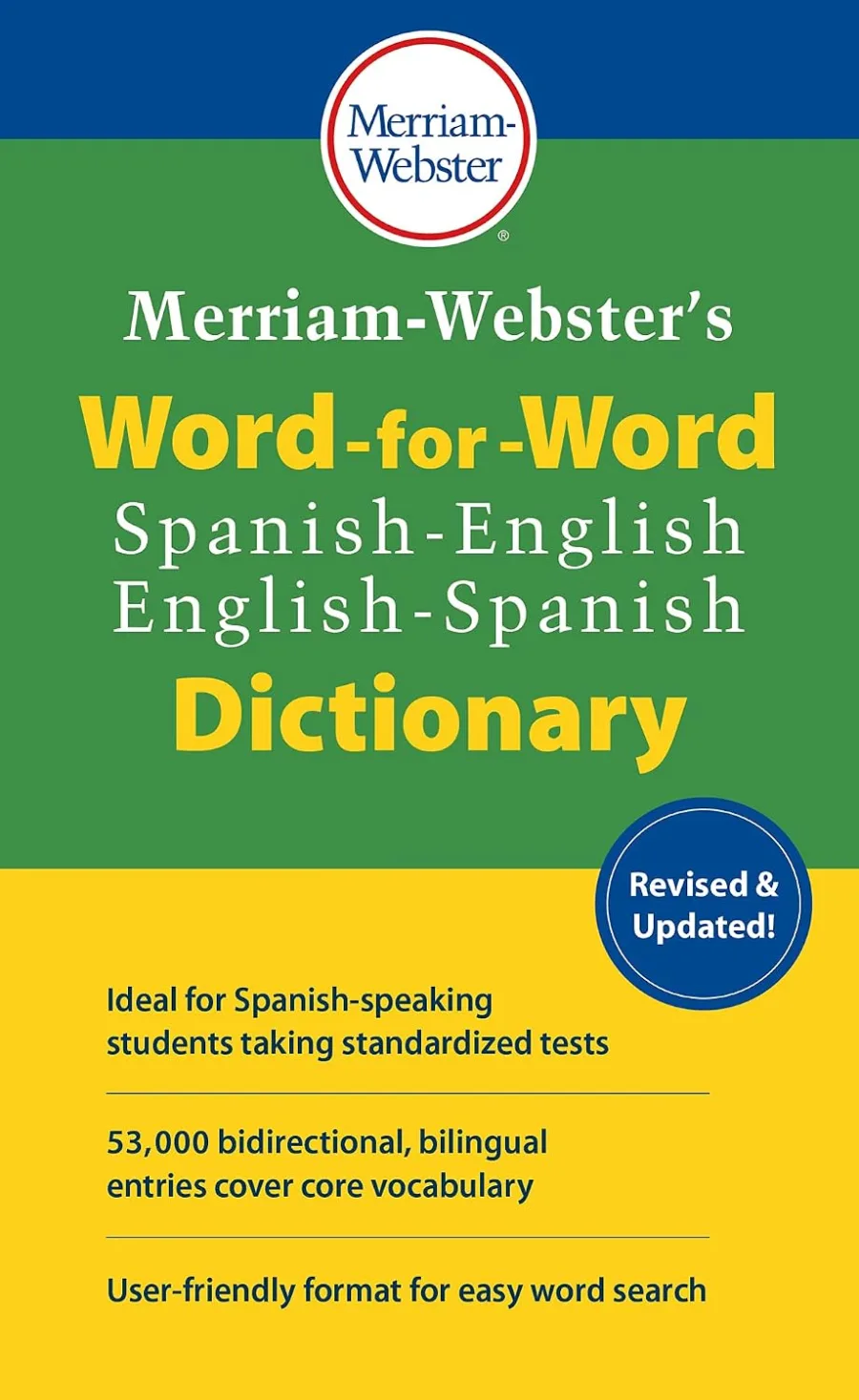
Merriam-Webster's Word-for-Word Spanish-English Dictionary
Mass Market Paperback
• 672 Pages
• USD 8.50
• English
• 9780877792994
No ratings yet
| Publisher | Merriam-Webster, Inc. |
|---|---|
| ISBN13 | 9780877792994 |
| ASIN/SKU | 0877792992 |
| Book Format | Mass Market Paperback |
| Language | English |
| Pages | 672 |
| List Price | USD 8.50 |
| Publishing Date | 19/08/2021 |
| Dimensions | 4.13 x 1.2 x 6.75 inches |
| Weight | 10.4 ounces |
| Book Code | BD00070261 |
Buy this Book
Amazon Stores
Ebook Stores
Other Stores
Discover Merriam-Webster's Word-for-Word Spanish-English Dictionary by Merriam-Webster. This book is published by Merriam-Webster, Inc. in Mass Market Paperback format, ISBN 9780877792994, ASIN 0877792992, under Reference, Translation Reference, Foreign Dictionaries and Thesauruses.
Book Description
This dictionary is especially designed to be used as an accommodation during state standardized tests by Spanish-speaking students.
It features word-to-word equivalents for 53,000 entries covering core vocabulary in Spanish and English, and a user-friendly format for easy word search. Includes more than 2,000 new words from areas such as science, medicine, technology, and popular culture. New words include: augmented reality, bestie, Bitcoin, cisgender, glamping, hashtag, ransomware, self-care, and slider.
This dictionary is appropriate for grades 3 and up.
It features word-to-word equivalents for 53,000 entries covering core vocabulary in Spanish and English, and a user-friendly format for easy word search. Includes more than 2,000 new words from areas such as science, medicine, technology, and popular culture. New words include: augmented reality, bestie, Bitcoin, cisgender, glamping, hashtag, ransomware, self-care, and slider.
This dictionary is appropriate for grades 3 and up.
Author Biography
At Merriam-Webster, we consider it our mission both to propagate our irrational love of the English language and to help people better understand and use language, so they can better understand and communicate with the world around them.
To that end, we develop products that clarify meaning and usage, and help users communicate more clearly and powerfully.
In fact, we’ve been America’s leading and most-trusted provider of language information for nearly 200 years. And all Merriam-Webster products and services are backed by the largest team of professional dictionary editors and writers in America.
To that end, we develop products that clarify meaning and usage, and help users communicate more clearly and powerfully.
In fact, we’ve been America’s leading and most-trusted provider of language information for nearly 200 years. And all Merriam-Webster products and services are backed by the largest team of professional dictionary editors and writers in America.
Editorial Reviews
Editorial Reviews will be added soon…
Book Summary
Merriam-Webster's Word-for-Word Spanish-English Dictionary is not a conventional book with a storyline, characters, or a beginning-to-end narrative. It is a practical bilingual reference designed to help Spanish-speaking students understand English vocabulary quickly and directly, while also allowing English speakers to find Spanish equivalents. Its greatest strength is its simplicity: instead of overwhelming learners with long definitions, grammatical explanations, or multiple layers of linguistic detail, it provides word-for-word equivalents in both directions. The 2021 revised edition contains approximately 53,000 bidirectional bilingual entries covering core vocabulary and more than 2,000 newer terms from areas such as science, medicine, technology, and popular culture. Merriam-Webster specifically describes it as a resource designed especially for Spanish-speaking students who may use a translation-only dictionary as an accommodation during state standardized tests.
The best way to understand this dictionary is to see it as a bridge between two languages. A student reading an English textbook may encounter an unfamiliar word and need to understand it without having enough English vocabulary to consult a lengthy English-language dictionary. Instead of requiring the student to understand an English definition of an unfamiliar English word, the dictionary provides a Spanish equivalent. Likewise, someone working from Spanish toward English can search for the Spanish word and find its English counterpart. This two-way design is reflected in the dictionary's organization as an English-to-Spanish and Spanish-to-English resource. The publisher emphasizes that its entries focus on core vocabulary likely to appear in classrooms and standardized tests.
The phrase "word-for-word" is central to the book's purpose. Unlike a comprehensive learner's dictionary that may explain shades of meaning, idiomatic usage, pronunciation, grammar, register, and examples, this resource is intentionally more direct. Its objective is to give the user a usable equivalent rather than a lengthy linguistic lesson. This makes it particularly valuable in situations where speed and clarity matter. A student encountering an unfamiliar word during reading does not necessarily need a paragraph explaining the history or nuances of that word. The immediate need may simply be to know what it means in Spanish. The dictionary meets that need by minimizing unnecessary complexity.
The dictionary is therefore especially suited to students learning English as a second language. For a bilingual learner, vocabulary can be one of the biggest barriers to understanding academic material. A student may understand the general subject being taught but become stuck because several words in an assignment are unfamiliar. Looking up each word in a conventional English dictionary can sometimes create another problem: the definition itself may contain words the student does not understand. A word-for-word bilingual dictionary removes much of that extra difficulty. The learner can move directly from the unfamiliar English term to a familiar Spanish equivalent.
This direct approach is also useful for reading comprehension. Suppose a student is reading a science lesson, a history chapter, or a school assignment in English. The student may know enough English to understand most sentences but encounter a handful of difficult words. Instead of abandoning the reading or asking for help each time, the student can consult the dictionary and continue. In this sense, the dictionary encourages independence. It gives learners a tool they can use whenever vocabulary becomes a barrier.
The 2021 edition contains 53,000 bidirectional entries, making it considerably broader than a tiny pocket glossary. The entries cover core vocabulary in both English and Spanish, while the revised edition adds more than 2,000 newer words. Merriam-Webster identifies areas such as science, medicine, technology, and popular culture as sources for this updated vocabulary. This updating is important because language is constantly changing. A bilingual dictionary that included only traditional classroom vocabulary would eventually become less useful for students living in a modern world.
The newer vocabulary illustrates this point particularly well. Terms such as augmented reality, Bitcoin, hashtag, livestream, ransomware, self-care, glamping, bestie, cisgender, and slider appear in the updated edition. These words come from very different parts of contemporary life. Some belong to technology, some to popular culture, some to social discussions, and others to everyday informal communication. Their inclusion demonstrates that the dictionary is not restricted to an old-fashioned school vocabulary. It recognizes that students encounter English through the internet, social media, entertainment, technology, and modern public life as well as through textbooks.
The book's user-friendly format is another important part of its educational value. A reference book is only useful when people can find information quickly. The publisher specifically describes the format as easy to search, which is especially important for students who may already be struggling with unfamiliar English. The dictionary is arranged so that the user can approach it from either language direction. This means that an English-speaking learner of Spanish can use it differently from a Spanish-speaking learner of English, yet both can rely on the same volume.
The dictionary's two-way structure also makes it useful beyond schoolwork. A learner who knows a Spanish word but cannot remember its English equivalent can search from Spanish to English. Someone who encounters an English word in conversation, on a website, or in a book can move in the opposite direction. This makes the dictionary a flexible resource rather than a one-purpose translation list.
Its compact physical design reinforces that practical purpose. The 2021 mass-market paperback edition is listed at approximately 4⅛ by 6¾ inches and 672 pages in Merriam-Webster's catalog, while another official product listing describes the same edition's copyright year as 2021 and gives ISBN 9780877792994. The relatively small format allows the dictionary to function as a portable reference. A student can keep it beside a textbook, carry it in a backpack, or bring it into settings where a permitted translation-only dictionary is required.
One of the dictionary's most distinctive purposes is its use as an educational accommodation during standardized testing. Merriam-Webster specifically says that the book is designed especially for Spanish-speaking students preparing for or participating in state standardized tests where a translation-only dictionary is allowed. This explains why the dictionary is deliberately different from a full explanatory bilingual dictionary. In a testing environment, the student may need a quick translation of a word without receiving additional information that could go beyond the permitted accommodation. A concise word-to-word format is therefore particularly appropriate.
This feature also explains why the dictionary emphasizes core vocabulary. The goal is not to provide an encyclopedia of every possible word in Spanish and English. Instead, it focuses on the vocabulary students are most likely to encounter in academic settings and standardized assessments. This creates a balance between breadth and usability. The dictionary is large enough to cover a substantial range of words but focused enough to remain practical for quick consultation.
For students, the dictionary can therefore become a kind of confidence tool. Encountering an unknown word can create a moment of uncertainty. A learner may wonder whether they have misunderstood the sentence or whether they can complete the assignment at all. Having a bilingual reference nearby changes that experience. Instead of feeling completely stuck, the student has a clear next step: find the word, identify its Spanish equivalent, and return to the material. That small act of independence can gradually make academic work less intimidating.
The book is also useful for teachers and educators working with bilingual or multilingual students. A teacher can recommend it as a straightforward vocabulary resource without requiring students to navigate complicated dictionary entries. Because the dictionary works in both directions, it can support different classroom situations. Students may use it when reading English, while teachers or classmates who are learning Spanish can use the reverse direction.
For English learners, one of the dictionary's major advantages is that it does not demand complete English proficiency before it becomes useful. This is an important distinction. A monolingual English dictionary is most helpful when a learner already has enough English to understand definitions. A bilingual dictionary, by contrast, uses the learner's existing Spanish knowledge as a foundation for acquiring English. The learner can gradually expand English vocabulary without having to understand an English explanation of every new word.
At the same time, the dictionary should not be mistaken for a complete language-learning course. Its word-for-word design is a strength when direct translation is needed, but it also means that it is not primarily designed to teach all the complexities of Spanish-English usage. Language rarely operates through perfect one-to-one substitutions. A single Spanish word can have several English equivalents depending on context, and an English word can likewise require different Spanish translations. A concise dictionary of equivalents cannot explain every cultural nuance, idiom, grammatical distinction, or contextual variation. The value of this book lies in its specific purpose: fast, practical vocabulary assistance.
That limitation is actually part of the reason the dictionary works well as a translation-only reference. It does not try to become everything at once. Instead, it concentrates on one important job and performs it efficiently. Students who need deeper explanations of grammar, pronunciation, verb conjugation, or usage may need a more comprehensive bilingual dictionary or language-learning resource. Merriam-Webster itself distinguishes this word-for-word title from its larger Spanish-English Dictionary, which contains 80,000 entries and 130,000 translations, pronunciation information, grammar material, verb conjugations, and other reference sections.
This comparison helps clarify the intended audience. The full Merriam-Webster's Spanish-English Dictionary is designed for students, teachers, travelers, and language learners of various levels and includes substantially more explanatory material. The Word-for-Word Spanish-English Dictionary, on the other hand, prioritizes direct equivalents and quick searching. For someone looking for a compact test-appropriate translation reference, this narrower focus can actually be an advantage.
The dictionary's educational philosophy is therefore based on accessibility rather than complexity. A learner does not need to become a linguist to use it. The basic process is straightforward: identify the unknown word, locate it alphabetically, find its equivalent, and return to the original task. Repeated use can also expose learners to vocabulary from multiple subject areas. Words encountered in science, medicine, technology, school subjects, or everyday communication can gradually become familiar through repeated reading and translation.
The book also reflects the increasingly bilingual nature of modern education and communication. Spanish and English are widely used together in schools, workplaces, families, communities, and online spaces. A resource that allows users to move comfortably between the two languages can help reduce the feeling that switching languages is a barrier. Instead, the dictionary treats bilingual ability as a practical resource. Spanish becomes a bridge through which English vocabulary can be understood.
For readers searching for a Merriam-Webster Word-for-Word Spanish-English Dictionary summary, review, or explanation of what the book is used for, the most important point is that this is a functional reference tool rather than a conventional book. Its "plot" is essentially the process of solving vocabulary problems. A student encounters an unfamiliar word, searches for it, discovers the equivalent in the other language, and continues learning. The value is found in thousands of these small moments of understanding.
Ultimately, Merriam-Webster's Word-for-Word Spanish-English Dictionary succeeds because it understands that language learners do not always need more information; sometimes they simply need the right information quickly. Its approximately 53,000 bidirectional entries, updated vocabulary, compact format, and straightforward organization make it particularly useful for Spanish-speaking students learning English and for situations in which a translation-only dictionary is permitted. The 2021 edition expands its usefulness by adding thousands of contemporary terms from science, medicine, technology, popular culture, and everyday life.
In the end, the dictionary's greatest contribution is not literary but practical. It helps turn an unfamiliar English word into something understandable and usable. For a student struggling with a textbook, a learner preparing for an exam, a Spanish speaker navigating an English-speaking classroom, or anyone who needs a quick Spanish-English or English-Spanish equivalent, that simple function can make a meaningful difference. The book demonstrates that a good reference work does not need to be complicated to be valuable. By concentrating on clear word-for-word equivalents and making them easy to locate, Merriam-Webster's Word-for-Word Spanish-English Dictionary provides a direct bridge between Spanish and English and gives learners a practical tool for reading, studying, testing, and communicating with greater confidence.
The best way to understand this dictionary is to see it as a bridge between two languages. A student reading an English textbook may encounter an unfamiliar word and need to understand it without having enough English vocabulary to consult a lengthy English-language dictionary. Instead of requiring the student to understand an English definition of an unfamiliar English word, the dictionary provides a Spanish equivalent. Likewise, someone working from Spanish toward English can search for the Spanish word and find its English counterpart. This two-way design is reflected in the dictionary's organization as an English-to-Spanish and Spanish-to-English resource. The publisher emphasizes that its entries focus on core vocabulary likely to appear in classrooms and standardized tests.
The phrase "word-for-word" is central to the book's purpose. Unlike a comprehensive learner's dictionary that may explain shades of meaning, idiomatic usage, pronunciation, grammar, register, and examples, this resource is intentionally more direct. Its objective is to give the user a usable equivalent rather than a lengthy linguistic lesson. This makes it particularly valuable in situations where speed and clarity matter. A student encountering an unfamiliar word during reading does not necessarily need a paragraph explaining the history or nuances of that word. The immediate need may simply be to know what it means in Spanish. The dictionary meets that need by minimizing unnecessary complexity.
The dictionary is therefore especially suited to students learning English as a second language. For a bilingual learner, vocabulary can be one of the biggest barriers to understanding academic material. A student may understand the general subject being taught but become stuck because several words in an assignment are unfamiliar. Looking up each word in a conventional English dictionary can sometimes create another problem: the definition itself may contain words the student does not understand. A word-for-word bilingual dictionary removes much of that extra difficulty. The learner can move directly from the unfamiliar English term to a familiar Spanish equivalent.
This direct approach is also useful for reading comprehension. Suppose a student is reading a science lesson, a history chapter, or a school assignment in English. The student may know enough English to understand most sentences but encounter a handful of difficult words. Instead of abandoning the reading or asking for help each time, the student can consult the dictionary and continue. In this sense, the dictionary encourages independence. It gives learners a tool they can use whenever vocabulary becomes a barrier.
The 2021 edition contains 53,000 bidirectional entries, making it considerably broader than a tiny pocket glossary. The entries cover core vocabulary in both English and Spanish, while the revised edition adds more than 2,000 newer words. Merriam-Webster identifies areas such as science, medicine, technology, and popular culture as sources for this updated vocabulary. This updating is important because language is constantly changing. A bilingual dictionary that included only traditional classroom vocabulary would eventually become less useful for students living in a modern world.
The newer vocabulary illustrates this point particularly well. Terms such as augmented reality, Bitcoin, hashtag, livestream, ransomware, self-care, glamping, bestie, cisgender, and slider appear in the updated edition. These words come from very different parts of contemporary life. Some belong to technology, some to popular culture, some to social discussions, and others to everyday informal communication. Their inclusion demonstrates that the dictionary is not restricted to an old-fashioned school vocabulary. It recognizes that students encounter English through the internet, social media, entertainment, technology, and modern public life as well as through textbooks.
The book's user-friendly format is another important part of its educational value. A reference book is only useful when people can find information quickly. The publisher specifically describes the format as easy to search, which is especially important for students who may already be struggling with unfamiliar English. The dictionary is arranged so that the user can approach it from either language direction. This means that an English-speaking learner of Spanish can use it differently from a Spanish-speaking learner of English, yet both can rely on the same volume.
The dictionary's two-way structure also makes it useful beyond schoolwork. A learner who knows a Spanish word but cannot remember its English equivalent can search from Spanish to English. Someone who encounters an English word in conversation, on a website, or in a book can move in the opposite direction. This makes the dictionary a flexible resource rather than a one-purpose translation list.
Its compact physical design reinforces that practical purpose. The 2021 mass-market paperback edition is listed at approximately 4⅛ by 6¾ inches and 672 pages in Merriam-Webster's catalog, while another official product listing describes the same edition's copyright year as 2021 and gives ISBN 9780877792994. The relatively small format allows the dictionary to function as a portable reference. A student can keep it beside a textbook, carry it in a backpack, or bring it into settings where a permitted translation-only dictionary is required.
One of the dictionary's most distinctive purposes is its use as an educational accommodation during standardized testing. Merriam-Webster specifically says that the book is designed especially for Spanish-speaking students preparing for or participating in state standardized tests where a translation-only dictionary is allowed. This explains why the dictionary is deliberately different from a full explanatory bilingual dictionary. In a testing environment, the student may need a quick translation of a word without receiving additional information that could go beyond the permitted accommodation. A concise word-to-word format is therefore particularly appropriate.
This feature also explains why the dictionary emphasizes core vocabulary. The goal is not to provide an encyclopedia of every possible word in Spanish and English. Instead, it focuses on the vocabulary students are most likely to encounter in academic settings and standardized assessments. This creates a balance between breadth and usability. The dictionary is large enough to cover a substantial range of words but focused enough to remain practical for quick consultation.
For students, the dictionary can therefore become a kind of confidence tool. Encountering an unknown word can create a moment of uncertainty. A learner may wonder whether they have misunderstood the sentence or whether they can complete the assignment at all. Having a bilingual reference nearby changes that experience. Instead of feeling completely stuck, the student has a clear next step: find the word, identify its Spanish equivalent, and return to the material. That small act of independence can gradually make academic work less intimidating.
The book is also useful for teachers and educators working with bilingual or multilingual students. A teacher can recommend it as a straightforward vocabulary resource without requiring students to navigate complicated dictionary entries. Because the dictionary works in both directions, it can support different classroom situations. Students may use it when reading English, while teachers or classmates who are learning Spanish can use the reverse direction.
For English learners, one of the dictionary's major advantages is that it does not demand complete English proficiency before it becomes useful. This is an important distinction. A monolingual English dictionary is most helpful when a learner already has enough English to understand definitions. A bilingual dictionary, by contrast, uses the learner's existing Spanish knowledge as a foundation for acquiring English. The learner can gradually expand English vocabulary without having to understand an English explanation of every new word.
At the same time, the dictionary should not be mistaken for a complete language-learning course. Its word-for-word design is a strength when direct translation is needed, but it also means that it is not primarily designed to teach all the complexities of Spanish-English usage. Language rarely operates through perfect one-to-one substitutions. A single Spanish word can have several English equivalents depending on context, and an English word can likewise require different Spanish translations. A concise dictionary of equivalents cannot explain every cultural nuance, idiom, grammatical distinction, or contextual variation. The value of this book lies in its specific purpose: fast, practical vocabulary assistance.
That limitation is actually part of the reason the dictionary works well as a translation-only reference. It does not try to become everything at once. Instead, it concentrates on one important job and performs it efficiently. Students who need deeper explanations of grammar, pronunciation, verb conjugation, or usage may need a more comprehensive bilingual dictionary or language-learning resource. Merriam-Webster itself distinguishes this word-for-word title from its larger Spanish-English Dictionary, which contains 80,000 entries and 130,000 translations, pronunciation information, grammar material, verb conjugations, and other reference sections.
This comparison helps clarify the intended audience. The full Merriam-Webster's Spanish-English Dictionary is designed for students, teachers, travelers, and language learners of various levels and includes substantially more explanatory material. The Word-for-Word Spanish-English Dictionary, on the other hand, prioritizes direct equivalents and quick searching. For someone looking for a compact test-appropriate translation reference, this narrower focus can actually be an advantage.
The dictionary's educational philosophy is therefore based on accessibility rather than complexity. A learner does not need to become a linguist to use it. The basic process is straightforward: identify the unknown word, locate it alphabetically, find its equivalent, and return to the original task. Repeated use can also expose learners to vocabulary from multiple subject areas. Words encountered in science, medicine, technology, school subjects, or everyday communication can gradually become familiar through repeated reading and translation.
The book also reflects the increasingly bilingual nature of modern education and communication. Spanish and English are widely used together in schools, workplaces, families, communities, and online spaces. A resource that allows users to move comfortably between the two languages can help reduce the feeling that switching languages is a barrier. Instead, the dictionary treats bilingual ability as a practical resource. Spanish becomes a bridge through which English vocabulary can be understood.
For readers searching for a Merriam-Webster Word-for-Word Spanish-English Dictionary summary, review, or explanation of what the book is used for, the most important point is that this is a functional reference tool rather than a conventional book. Its "plot" is essentially the process of solving vocabulary problems. A student encounters an unfamiliar word, searches for it, discovers the equivalent in the other language, and continues learning. The value is found in thousands of these small moments of understanding.
Ultimately, Merriam-Webster's Word-for-Word Spanish-English Dictionary succeeds because it understands that language learners do not always need more information; sometimes they simply need the right information quickly. Its approximately 53,000 bidirectional entries, updated vocabulary, compact format, and straightforward organization make it particularly useful for Spanish-speaking students learning English and for situations in which a translation-only dictionary is permitted. The 2021 edition expands its usefulness by adding thousands of contemporary terms from science, medicine, technology, popular culture, and everyday life.
In the end, the dictionary's greatest contribution is not literary but practical. It helps turn an unfamiliar English word into something understandable and usable. For a student struggling with a textbook, a learner preparing for an exam, a Spanish speaker navigating an English-speaking classroom, or anyone who needs a quick Spanish-English or English-Spanish equivalent, that simple function can make a meaningful difference. The book demonstrates that a good reference work does not need to be complicated to be valuable. By concentrating on clear word-for-word equivalents and making them easy to locate, Merriam-Webster's Word-for-Word Spanish-English Dictionary provides a direct bridge between Spanish and English and gives learners a practical tool for reading, studying, testing, and communicating with greater confidence.
Sample Chapters
Sample Chapters will be added soon…
Reader Reviews
No reviews yet.
Merriam-Webster's Word-for-Word Spanish-English Dictionary
Download Cover Image
Do you want to download the full cover image for Merriam-Webster's Word-for-Word Spanish-English Dictionary?