
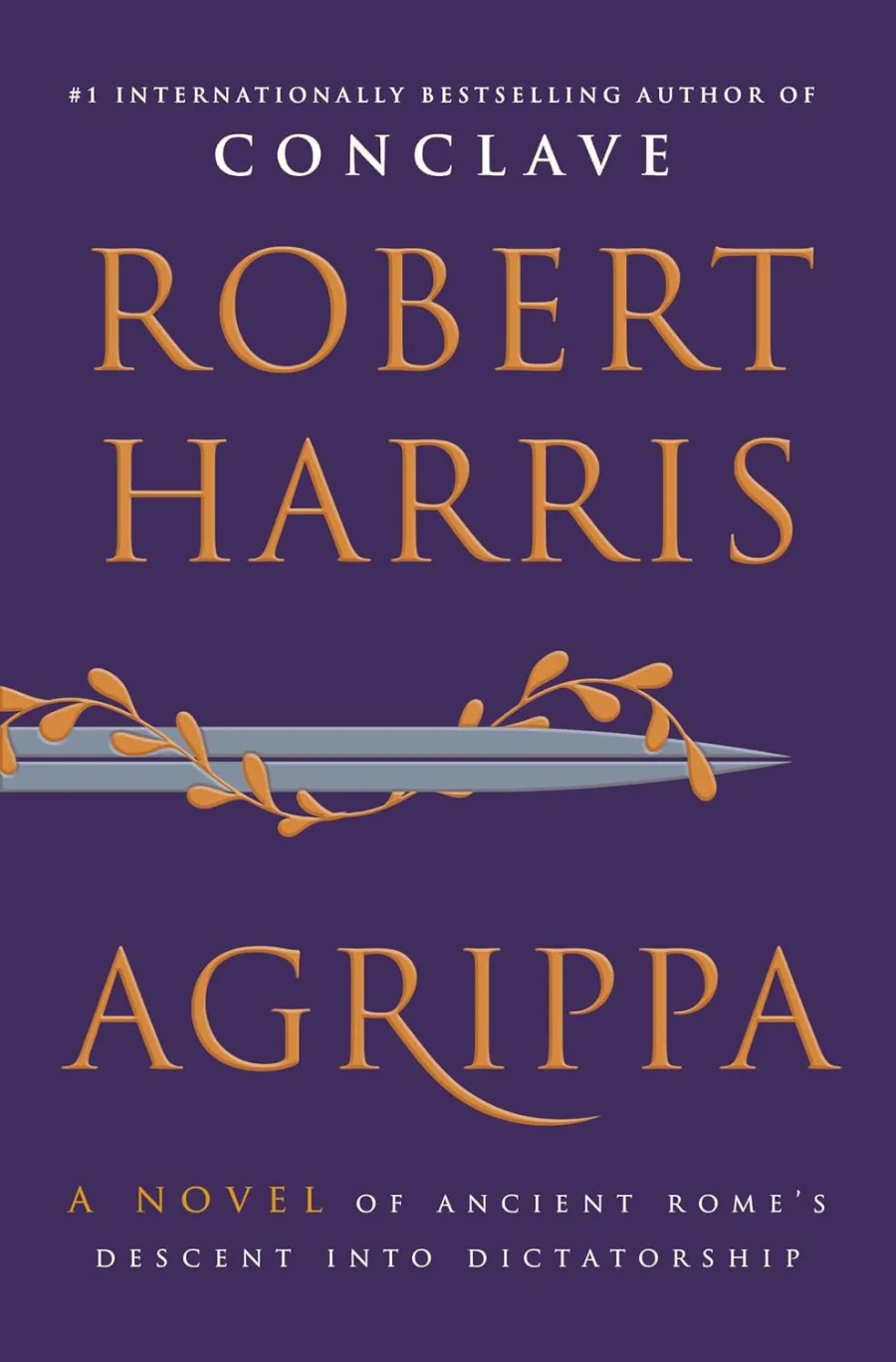
Agrippa: A Novel of Ancient Rome's Descent into Dictatorship
Hardcover
• 384 Pages
• USD 32.00
• English
• 9780385552387
No ratings yet
| Publisher | Doubleday |
|---|---|
| ISBN13 | 9780385552387 |
| ASIN/SKU | 0385552386 |
| Book Format | Hardcover |
| Language | English |
| Pages | 384 |
| List Price | USD 32.00 |
| Publishing Date | 01/09/2026 |
| Dimensions | 6.4 x 1.29 x 9.51 inches |
| Weight | 1.35 pounds |
| Book Code | BD00070305 |
Buy this Book
Amazon Stores
Ebook Stores
Other Stores
Discover Agrippa: A Novel of Ancient Rome's Descent into Dictatorship by Robert Harris. This book is published by Doubleday in Hardcover format, ISBN 9780385552387, ASIN 0385552386, under Mystery, Thriller and Suspense, Historical Thrillers, Political Thrillers.
Book Description
From the #1 internationally bestselling author of Conclave and Dictator, a gripping tale of ancient Rome’s descent into dictatorship
“Thrilling. . . . Agrippa is a swift-paced romp. . . . Politics may be ‘a filthy business,’ as Agrippa observes, but in the hands of Mr. Harris, it is a drama of endless interest.” —The Wall Street Journal
He was born feet first, a dangerous way to enter the world. His mother did not survive, and the nickname, Agrippa—mother killer—stuck. But the schoolyard taunting only served to harden his resolve and hone his predilection for aggression. In time, the name lost its sting and became instead a mark of his invincibility. It came to shape his destiny.
Agrippa was a mere commoner, a plebeian, his father a humble Stoic, but he earned the respect and fear of his peers. He defended a bullied young boy, Octavius, who turned out to be the nephew of Caesar himself, a chance encounter that would change the trajectory of his life. He eventually joined the ranks of the legionnaires and marched against their enemies. His prowess on the battlefield spoke for itself, and Caesar relied on him to protect his favored nephew. When Caesar was murdered in the Senate, Octavius inherited the empire in name only. To assume the mantle he would have to fight for it, and Agrippa, forever by his side, would be his closest advisor and the merciless agent of his military will.
As gripping and full of intrigue as his bestselling novel Conclave, Agrippa is Robert Harris’s monumental return to the world of ancient Rome on the precipice of dictatorship, a novel for our times.
“Thrilling. . . . Agrippa is a swift-paced romp. . . . Politics may be ‘a filthy business,’ as Agrippa observes, but in the hands of Mr. Harris, it is a drama of endless interest.” —The Wall Street Journal
He was born feet first, a dangerous way to enter the world. His mother did not survive, and the nickname, Agrippa—mother killer—stuck. But the schoolyard taunting only served to harden his resolve and hone his predilection for aggression. In time, the name lost its sting and became instead a mark of his invincibility. It came to shape his destiny.
Agrippa was a mere commoner, a plebeian, his father a humble Stoic, but he earned the respect and fear of his peers. He defended a bullied young boy, Octavius, who turned out to be the nephew of Caesar himself, a chance encounter that would change the trajectory of his life. He eventually joined the ranks of the legionnaires and marched against their enemies. His prowess on the battlefield spoke for itself, and Caesar relied on him to protect his favored nephew. When Caesar was murdered in the Senate, Octavius inherited the empire in name only. To assume the mantle he would have to fight for it, and Agrippa, forever by his side, would be his closest advisor and the merciless agent of his military will.
As gripping and full of intrigue as his bestselling novel Conclave, Agrippa is Robert Harris’s monumental return to the world of ancient Rome on the precipice of dictatorship, a novel for our times.
Author Biography
Robert Harris is the author of eleven bestselling novels: the Cicero Trilogy - Imperium, Lustrum and Dictator - Fatherland, Enigma, Archangel, Pompeii, The Ghost, The Fear Index, An Officer and a Spy, which won four prizes including the Walter Scott Prize for Historical Fiction, and Conclave. His forthcoming book, Munich, coming out in September 2017, is set over the four days of the Munich Conference, and is filled with the real-life characters and events of the time. Several of his books have been filmed, including The Ghost, which was directed by Roman Polanski. His work has been translated into thirty-seven languages and he is a Fellow of the Royal Society of Literature. He lives in West Berkshire with his wife, Gill Hornby.
Editorial Reviews
“In his new novel, Harris employs that same propulsive prose and whip-smart dialogue to imagine what Agrippa’s lost memoir might have revealed about his career as Rome’s great survivor. . . . Agrippa offers a forensically accurate account of Roman politics in the Late Republic spliced with an imaginative portrait of one of the period’s great, if flawed, heroes. The result is more than just a thrilling read; it is also a call to moral arms. Agrippa has multiple chances to resist Rome’s slide toward political absolutism yet, for the sake of convenience, fails to act. Harris, who started his career as a political journalist, clearly wants us to consider whether, in our own dark times, we might be in danger of doing the same.”
—The New York Times Book Review
“A persuasive portrait of a Rome exhausted by civil strife, and of the serpentine manoeuvrings of its rulers. Everyone is betraying everyone else, raising armies, marrying each other’s children, forming and breaking alliances.”
—The Guardian
“Although Agrippa was responsible for all kinds of slaughter and skulduggery, I found myself rooting for him. That is due in no small part to a delicious fictional twist Harris introduces at the centre of Agrippa’s life. . . . The novel comes alive. You’re transported into the period, the room and the intrigue. I gobbled up its nearly 400 pages in no time.”
—Irish Independent
“A compelling mix of history and imagination. . . . Harris weaves a strong story that honors history and imagines vivid details. There are great naval battles, disastrous storms at sea, and the threat posed by Antony and Cleopatra. . . . And through it all, Rome descends into dictatorship.”
—Kirkus Reviews (starred review)
“This crisply written novel has manifest appeal for fans of Roman history, military history, political intrigue, and biographical fiction.”
—Booklist
“Intimate, tense and rich with historical detail, Agrippa is perhaps the ultimate story of the power behind the throne, mapping Rome’s dictatorial turn under Caesar Augustus in a clear-eyed and nuanced narrative. . . . Compelling. . . . The prose is rich and driving, the characters layered and memorable even outside of their historical context, and the lessons of Agrippa’s story both apparent and thoroughly entertaining. This is vintage Harris, great for longtime fans and new readers alike.”
—BookPage
—The New York Times Book Review
“A persuasive portrait of a Rome exhausted by civil strife, and of the serpentine manoeuvrings of its rulers. Everyone is betraying everyone else, raising armies, marrying each other’s children, forming and breaking alliances.”
—The Guardian
“Although Agrippa was responsible for all kinds of slaughter and skulduggery, I found myself rooting for him. That is due in no small part to a delicious fictional twist Harris introduces at the centre of Agrippa’s life. . . . The novel comes alive. You’re transported into the period, the room and the intrigue. I gobbled up its nearly 400 pages in no time.”
—Irish Independent
“A compelling mix of history and imagination. . . . Harris weaves a strong story that honors history and imagines vivid details. There are great naval battles, disastrous storms at sea, and the threat posed by Antony and Cleopatra. . . . And through it all, Rome descends into dictatorship.”
—Kirkus Reviews (starred review)
“This crisply written novel has manifest appeal for fans of Roman history, military history, political intrigue, and biographical fiction.”
—Booklist
“Intimate, tense and rich with historical detail, Agrippa is perhaps the ultimate story of the power behind the throne, mapping Rome’s dictatorial turn under Caesar Augustus in a clear-eyed and nuanced narrative. . . . Compelling. . . . The prose is rich and driving, the characters layered and memorable even outside of their historical context, and the lessons of Agrippa’s story both apparent and thoroughly entertaining. This is vintage Harris, great for longtime fans and new readers alike.”
—BookPage
Book Summary
Robert Harris’s Agrippa: A Novel of Ancient Rome’s Descent into Dictatorship is a sweeping historical thriller about friendship, political ambition, military power, betrayal, and the gradual destruction of republican government. Set during one of the most consequential periods in Roman history, the novel follows Marcus Vipsanius Agrippa, the soldier, statesman, strategist, and lifelong companion of Octavius, the young heir of Julius Caesar who eventually becomes Caesar Augustus, Rome’s first emperor. Rather than telling the story from the perspective of the man who ultimately sits on the throne, Harris places the extraordinary but less celebrated Agrippa at the center. The result is a story about the person standing beside power—the man who helps create an empire without becoming its supreme ruler himself.
At the heart of Agrippa is an unlikely friendship. Agrippa is born a commoner, a plebeian, and his childhood begins under an ominous shadow. He is born feet first, and his mother dies during childbirth. From this comes the cruel nickname “Agrippa,” associated with a mother-killer. Instead of allowing the insult to define him, Agrippa develops the toughness, aggression, and determination that will eventually make him an exceptional soldier and commander. His background is important because Harris contrasts him with the aristocratic world around him. Agrippa does not inherit power. He has to earn it. His abilities in war, his loyalty, and his practical intelligence become the foundations of his influence.
Agrippa’s life changes when he encounters the young Octavius. The future Augustus is not yet the commanding political figure history remembers. He is a young boy who can be vulnerable, calculating, and physically unimposing. Agrippa defends him from bullying, beginning a relationship that will become one of the most consequential partnerships in Roman history. The two boys are radically different, yet their differences make them effective together. Octavius possesses political intelligence, patience, and an instinct for manipulation, while Agrippa has courage, military ability, practicality, and a willingness to act. Their friendship therefore becomes much more than a personal bond: it becomes a partnership through which an entirely new Roman political order is created.
The story becomes dramatically more dangerous after the assassination of Julius Caesar. Caesar’s death creates a political vacuum in which competing factions fight for control of Rome. Octavius discovers that being Caesar’s chosen heir gives him enormous symbolic power, but it does not automatically give him armies, authority, or security. He must fight to establish his inheritance. Agrippa becomes the man who helps turn Octavius’s claim into reality. The novel consequently transforms the familiar history of Augustus into a tense political and military struggle, in which alliances are temporary, enemies can become partners, and political survival depends as much on calculation as on battlefield strength.
One of the novel’s most interesting ideas is that empires are rarely created by one person alone. Augustus may eventually receive the titles and public glory, but Agrippa is indispensable to the process. He becomes the military instrument of Octavius’s ambitions, helping him confront the powerful men who stand between him and supremacy. Harris uses this relationship to explore the complicated meaning of loyalty. Agrippa is loyal to Octavius because of friendship, shared history, personal affection, and a belief that their cause can bring stability to Rome. But as Octavius becomes more powerful, the same loyalty becomes increasingly difficult to distinguish from obedience.
The military campaigns provide much of the novel’s momentum. Agrippa emerges as an exceptionally capable commander, and his victories become essential to Octavius’s political survival. The conflict culminates in the struggle against Mark Antony and Cleopatra, two of the most famous figures of the ancient world. The Battle of Actium is particularly important. It is not simply a spectacular military confrontation; it represents the destruction of the last major challenge to Octavius’s dominance. With Antony and Cleopatra defeated, Octavius can consolidate his position and eventually become Augustus.
Yet Harris is less interested in presenting victory as a simple triumph than in examining its cost. Rome’s descent into dictatorship is gradual. The republic does not simply disappear overnight. Instead, institutions are weakened, political compromises are made, enemies are eliminated or absorbed, and extraordinary powers become increasingly normal. This is one of the central ideas of Agrippa: authoritarian government can emerge through a series of decisions that seem individually defensible. A leader promises stability after years of civil war. Citizens accept stronger authority because they are exhausted by political chaos. Military power becomes necessary for security. Political opponents become threats. Eventually, the exceptional becomes permanent.
Agrippa occupies a particularly fascinating moral position within this transformation. He is not the dictator, but he helps build the system that makes dictatorship possible. He has opportunities to question what Octavius is becoming, yet loyalty repeatedly wins over resistance. This gives the novel much of its moral tension. Agrippa is neither a straightforward hero nor a simple accomplice. He is a man who believes in his friend, serves his country, wins wars, and helps establish peace, while simultaneously participating in the destruction of the political system that existed before them. A major strength of Harris’s approach is therefore the refusal to make the historical transition completely black and white.
The novel’s later perspective makes this conflict even more poignant. Agrippa is older, physically diminished, and increasingly isolated. He has spent decades helping Octavius become Augustus, yet he does not enjoy the uncomplicated rewards that one might expect from being the emperor’s closest ally. His marriage has suffered from infidelity, his political position becomes uncertain, and eventually he finds himself away from the center of imperial power. From his house on the Bay of Naples, he begins looking back over the life he has shared with Augustus.
This retrospective structure gives Agrippa an important second dimension. The novel is not merely about what happened; it is about how a person remembers what happened after the consequences have become impossible to ignore. Agrippa’s memoir-like perspective encourages readers to reconsider the events of his youth and military career. What did he believe he was building when he first followed Octavius? Did he understand that the Republic was disappearing? At what point could he have acted differently? And when does loyalty to a friend become complicity in that friend’s abuses of power?
The relationship between Agrippa and Augustus consequently becomes the emotional center of the book. Their friendship begins innocently, almost accidentally, but history transforms it into something much more complicated. Agrippa becomes Augustus’s trusted general and adviser, while Augustus becomes the political force around which Agrippa’s entire existence revolves. Their partnership demonstrates how friendship can survive ambition—but also how ambition can eventually reshape friendship itself. The question running underneath the story is whether genuine friendship can exist when one person possesses almost unlimited political power. The British publisher’s description captures this central tension by asking whether friendship can survive when it is intertwined with the pursuit of power.
Harris also uses Agrippa to examine the relationship between military success and political authority. Rome’s transformation cannot be understood without understanding its armies. The men who control legions possess extraordinary leverage over the state. Agrippa’s victories therefore have political consequences far beyond the battlefield. Every military success strengthens Octavius. Every defeated rival removes another obstacle. War becomes a mechanism through which political legitimacy is manufactured.
At the same time, the book is concerned with the enormous contradiction at the heart of Augustus’s achievement. Rome needs peace after years of civil conflict, and Augustus ultimately provides it. The empire becomes more stable and powerful. Yet the stability is purchased through the concentration of authority in one man. This makes Harris’s depiction more sophisticated than a simple “Republic good, Empire bad” argument. The Republic has already been damaged by decades of political violence, civil war, factionalism, and personal ambition. Augustus does not destroy a perfectly functioning system; he takes control of a political order that is already deeply broken. The uncomfortable question is whether Rome’s citizens willingly accept authoritarianism because the alternative appears even worse.
Agrippa’s character embodies this contradiction. He is a builder as well as a destroyer, a soldier as well as a statesman. His achievements are not confined to warfare; historical Agrippa was also deeply associated with the development and improvement of Rome’s infrastructure and public works. Harris therefore presents him as one of the essential architects of the new Roman order, even though he remains in the shadow of Augustus.
The political thriller elements are strengthened by Harris’s attention to historical detail. The novel moves through assassinations, shifting alliances, military campaigns, political marriages, rivalries, and struggles for succession. Its historical framework includes figures such as Julius Caesar, Mark Antony, Cleopatra, Lepidus, Cicero, and other major personalities of the late Roman Republic. Rather than treating ancient history as a distant museum piece, Harris makes the political world feel immediate and recognizable: ambitious politicians manipulate public opinion, powerful men use institutions when convenient, alliances are made for strategic reasons, and ordinary people suffer when elite competition turns violent.
This contemporary relevance is one reason the novel’s subtitle—A Novel of Ancient Rome’s Descent into Dictatorship—is so significant. Harris is not merely recreating ancient history. He is asking readers to think about how democratic systems can weaken. The novel suggests that dictatorship is not always imposed suddenly from outside. Sometimes it develops from within existing institutions, helped by people who believe they are making necessary compromises. Political exhaustion, fear, ambition, and the desire for stability can gradually make extraordinary power seem reasonable.
Ultimately, Agrippa is a story about the price of helping someone else become powerful. Agrippa gets what many soldiers and politicians dream of: victory, influence, wealth, prestige, and a place beside the most powerful man in the world. But he also discovers that proximity to power is not the same as possessing it. The person who builds the throne may still find himself excluded from it. His relationship with Augustus therefore becomes increasingly tragic. Agrippa helped create the political order that ultimately limits his own freedom and independence.
The deepest lesson of Robert Harris’s Agrippa is consequently not simply that Augustus became emperor. It is that Rome’s transformation happened through thousands of human decisions—decisions made by people who loved, feared, trusted, betrayed, negotiated, fought, and compromised. Agrippa’s tragedy is that he repeatedly chooses loyalty and practical necessity over moral resistance. By the time he can look back and understand the full consequences, the transformation is complete.
For readers searching for a summary of Agrippa by Robert Harris, the novel can therefore be understood as both an ancient Roman political thriller and a character study of the man behind Augustus’s rise. It combines military history, historical fiction, political intrigue, friendship, betrayal, and moral ambiguity. Fans of Harris’s Dictator and his earlier Cicero trilogy will recognize his fascination with the political machinery of Rome, while readers of Conclave may appreciate his ability to turn institutional politics into gripping drama. The book is ultimately about more than one Roman general or one emperor: it is about how political systems collapse, how power accumulates, and how people can participate in the creation of something they later realize they can no longer control.
In that sense, Agrippa is a particularly compelling historical novel because its greatest conflict is not simply between armies. It is between friendship and ambition, loyalty and conscience, stability and freedom, and the desire to preserve a political order versus the temptation to replace it with something seemingly more efficient. Agrippa may stand beside Augustus throughout the creation of the Roman Empire, but the novel ultimately asks whether standing beside power for too long means becoming responsible for what power eventually becomes.
At the heart of Agrippa is an unlikely friendship. Agrippa is born a commoner, a plebeian, and his childhood begins under an ominous shadow. He is born feet first, and his mother dies during childbirth. From this comes the cruel nickname “Agrippa,” associated with a mother-killer. Instead of allowing the insult to define him, Agrippa develops the toughness, aggression, and determination that will eventually make him an exceptional soldier and commander. His background is important because Harris contrasts him with the aristocratic world around him. Agrippa does not inherit power. He has to earn it. His abilities in war, his loyalty, and his practical intelligence become the foundations of his influence.
Agrippa’s life changes when he encounters the young Octavius. The future Augustus is not yet the commanding political figure history remembers. He is a young boy who can be vulnerable, calculating, and physically unimposing. Agrippa defends him from bullying, beginning a relationship that will become one of the most consequential partnerships in Roman history. The two boys are radically different, yet their differences make them effective together. Octavius possesses political intelligence, patience, and an instinct for manipulation, while Agrippa has courage, military ability, practicality, and a willingness to act. Their friendship therefore becomes much more than a personal bond: it becomes a partnership through which an entirely new Roman political order is created.
The story becomes dramatically more dangerous after the assassination of Julius Caesar. Caesar’s death creates a political vacuum in which competing factions fight for control of Rome. Octavius discovers that being Caesar’s chosen heir gives him enormous symbolic power, but it does not automatically give him armies, authority, or security. He must fight to establish his inheritance. Agrippa becomes the man who helps turn Octavius’s claim into reality. The novel consequently transforms the familiar history of Augustus into a tense political and military struggle, in which alliances are temporary, enemies can become partners, and political survival depends as much on calculation as on battlefield strength.
One of the novel’s most interesting ideas is that empires are rarely created by one person alone. Augustus may eventually receive the titles and public glory, but Agrippa is indispensable to the process. He becomes the military instrument of Octavius’s ambitions, helping him confront the powerful men who stand between him and supremacy. Harris uses this relationship to explore the complicated meaning of loyalty. Agrippa is loyal to Octavius because of friendship, shared history, personal affection, and a belief that their cause can bring stability to Rome. But as Octavius becomes more powerful, the same loyalty becomes increasingly difficult to distinguish from obedience.
The military campaigns provide much of the novel’s momentum. Agrippa emerges as an exceptionally capable commander, and his victories become essential to Octavius’s political survival. The conflict culminates in the struggle against Mark Antony and Cleopatra, two of the most famous figures of the ancient world. The Battle of Actium is particularly important. It is not simply a spectacular military confrontation; it represents the destruction of the last major challenge to Octavius’s dominance. With Antony and Cleopatra defeated, Octavius can consolidate his position and eventually become Augustus.
Yet Harris is less interested in presenting victory as a simple triumph than in examining its cost. Rome’s descent into dictatorship is gradual. The republic does not simply disappear overnight. Instead, institutions are weakened, political compromises are made, enemies are eliminated or absorbed, and extraordinary powers become increasingly normal. This is one of the central ideas of Agrippa: authoritarian government can emerge through a series of decisions that seem individually defensible. A leader promises stability after years of civil war. Citizens accept stronger authority because they are exhausted by political chaos. Military power becomes necessary for security. Political opponents become threats. Eventually, the exceptional becomes permanent.
Agrippa occupies a particularly fascinating moral position within this transformation. He is not the dictator, but he helps build the system that makes dictatorship possible. He has opportunities to question what Octavius is becoming, yet loyalty repeatedly wins over resistance. This gives the novel much of its moral tension. Agrippa is neither a straightforward hero nor a simple accomplice. He is a man who believes in his friend, serves his country, wins wars, and helps establish peace, while simultaneously participating in the destruction of the political system that existed before them. A major strength of Harris’s approach is therefore the refusal to make the historical transition completely black and white.
The novel’s later perspective makes this conflict even more poignant. Agrippa is older, physically diminished, and increasingly isolated. He has spent decades helping Octavius become Augustus, yet he does not enjoy the uncomplicated rewards that one might expect from being the emperor’s closest ally. His marriage has suffered from infidelity, his political position becomes uncertain, and eventually he finds himself away from the center of imperial power. From his house on the Bay of Naples, he begins looking back over the life he has shared with Augustus.
This retrospective structure gives Agrippa an important second dimension. The novel is not merely about what happened; it is about how a person remembers what happened after the consequences have become impossible to ignore. Agrippa’s memoir-like perspective encourages readers to reconsider the events of his youth and military career. What did he believe he was building when he first followed Octavius? Did he understand that the Republic was disappearing? At what point could he have acted differently? And when does loyalty to a friend become complicity in that friend’s abuses of power?
The relationship between Agrippa and Augustus consequently becomes the emotional center of the book. Their friendship begins innocently, almost accidentally, but history transforms it into something much more complicated. Agrippa becomes Augustus’s trusted general and adviser, while Augustus becomes the political force around which Agrippa’s entire existence revolves. Their partnership demonstrates how friendship can survive ambition—but also how ambition can eventually reshape friendship itself. The question running underneath the story is whether genuine friendship can exist when one person possesses almost unlimited political power. The British publisher’s description captures this central tension by asking whether friendship can survive when it is intertwined with the pursuit of power.
Harris also uses Agrippa to examine the relationship between military success and political authority. Rome’s transformation cannot be understood without understanding its armies. The men who control legions possess extraordinary leverage over the state. Agrippa’s victories therefore have political consequences far beyond the battlefield. Every military success strengthens Octavius. Every defeated rival removes another obstacle. War becomes a mechanism through which political legitimacy is manufactured.
At the same time, the book is concerned with the enormous contradiction at the heart of Augustus’s achievement. Rome needs peace after years of civil conflict, and Augustus ultimately provides it. The empire becomes more stable and powerful. Yet the stability is purchased through the concentration of authority in one man. This makes Harris’s depiction more sophisticated than a simple “Republic good, Empire bad” argument. The Republic has already been damaged by decades of political violence, civil war, factionalism, and personal ambition. Augustus does not destroy a perfectly functioning system; he takes control of a political order that is already deeply broken. The uncomfortable question is whether Rome’s citizens willingly accept authoritarianism because the alternative appears even worse.
Agrippa’s character embodies this contradiction. He is a builder as well as a destroyer, a soldier as well as a statesman. His achievements are not confined to warfare; historical Agrippa was also deeply associated with the development and improvement of Rome’s infrastructure and public works. Harris therefore presents him as one of the essential architects of the new Roman order, even though he remains in the shadow of Augustus.
The political thriller elements are strengthened by Harris’s attention to historical detail. The novel moves through assassinations, shifting alliances, military campaigns, political marriages, rivalries, and struggles for succession. Its historical framework includes figures such as Julius Caesar, Mark Antony, Cleopatra, Lepidus, Cicero, and other major personalities of the late Roman Republic. Rather than treating ancient history as a distant museum piece, Harris makes the political world feel immediate and recognizable: ambitious politicians manipulate public opinion, powerful men use institutions when convenient, alliances are made for strategic reasons, and ordinary people suffer when elite competition turns violent.
This contemporary relevance is one reason the novel’s subtitle—A Novel of Ancient Rome’s Descent into Dictatorship—is so significant. Harris is not merely recreating ancient history. He is asking readers to think about how democratic systems can weaken. The novel suggests that dictatorship is not always imposed suddenly from outside. Sometimes it develops from within existing institutions, helped by people who believe they are making necessary compromises. Political exhaustion, fear, ambition, and the desire for stability can gradually make extraordinary power seem reasonable.
Ultimately, Agrippa is a story about the price of helping someone else become powerful. Agrippa gets what many soldiers and politicians dream of: victory, influence, wealth, prestige, and a place beside the most powerful man in the world. But he also discovers that proximity to power is not the same as possessing it. The person who builds the throne may still find himself excluded from it. His relationship with Augustus therefore becomes increasingly tragic. Agrippa helped create the political order that ultimately limits his own freedom and independence.
The deepest lesson of Robert Harris’s Agrippa is consequently not simply that Augustus became emperor. It is that Rome’s transformation happened through thousands of human decisions—decisions made by people who loved, feared, trusted, betrayed, negotiated, fought, and compromised. Agrippa’s tragedy is that he repeatedly chooses loyalty and practical necessity over moral resistance. By the time he can look back and understand the full consequences, the transformation is complete.
For readers searching for a summary of Agrippa by Robert Harris, the novel can therefore be understood as both an ancient Roman political thriller and a character study of the man behind Augustus’s rise. It combines military history, historical fiction, political intrigue, friendship, betrayal, and moral ambiguity. Fans of Harris’s Dictator and his earlier Cicero trilogy will recognize his fascination with the political machinery of Rome, while readers of Conclave may appreciate his ability to turn institutional politics into gripping drama. The book is ultimately about more than one Roman general or one emperor: it is about how political systems collapse, how power accumulates, and how people can participate in the creation of something they later realize they can no longer control.
In that sense, Agrippa is a particularly compelling historical novel because its greatest conflict is not simply between armies. It is between friendship and ambition, loyalty and conscience, stability and freedom, and the desire to preserve a political order versus the temptation to replace it with something seemingly more efficient. Agrippa may stand beside Augustus throughout the creation of the Roman Empire, but the novel ultimately asks whether standing beside power for too long means becoming responsible for what power eventually becomes.
Sample Chapters
Sample Chapters will be added soon…
Reader Reviews
No reviews yet.
Agrippa: A Novel of Ancient Rome's Descent into Dictatorship
Download Cover Image
Do you want to download the full cover image for Agrippa: A Novel of Ancient Rome's Descent into Dictatorship?