
The War on Reality: Recovering Truth in a World That Celebrates Lies
Dr. Frank Turek, Phoenix Hayes
Paperback
• 400 Pages
• USD 21.99
• English
• 9780736993630
No ratings yet
| Publisher | Harvest Apologetics |
|---|---|
| ISBN13 | 9780736993630 |
| ASIN/SKU | 0736993630 |
| Book Format | Paperback |
| Language | English |
| Pages | 400 |
| List Price | USD 21.99 |
| Publishing Date | 08/09/2026 |
| Dimensions | 5.5 x 1 x 8.5 inches |
| Weight | 14.7 ounces |
| Book Code | BD00070306 |
Buy this Book
Amazon Stores
Ebook Stores
Other Stores
Discover The War on Reality: Recovering Truth in a World That Celebrates Lies by Dr. Frank Turek. This book is published by Harvest Apologetics in Paperback format, ISBN 9780736993630, ASIN 0736993630, under Christian Books and Bibles, Christian Apologetics, Christian Social Issues.
Book Description
When identity, morality, and even reality are being redefined, Christians need a clear defense of objective truth.
For decades, society has grown increasingly untethered from what is real. Now biology is negotiable, feelings outrank facts, and confusion is shaping how the next generation understands God, human nature, morality, and destiny. In The War on Reality, Frank Turek and Phoenix Hayes help readers reconnect with the One who created reality.
With clear thinking, sharp humor, and unapologetic truth, Frank and Phoenix expose the destructive ideas pulling Western civilization off course. Drawing from Scripture, logic, philosophy, science, and history, they equip Christians to speak with conviction in a culture that desperately needs truth.
Inside, readers will learn to
uncover the assumptions behind today’s ideas about self, freedom, justice, and happiness
respond to skeptics and seekers with biblical clarity and sound reasoning
stand firm on reality as created by God while engaging others with courage
Let this guide sharpen your vision, deepen your trust in the Creator, and prepare you to witness boldly in a world searching for answers.
Author Biography
Dr. Frank Turek is a dynamic speaker and award-winning author or coauthor of four books: Stealing from God: Why Atheists Need God to make their Case, I Don’t Have Enough Faith to be an Atheist, Correct, Not Politically Correct and Legislating Morality. As the President of CrossExamined.org, Frank presents powerful and entertaining evidence for Christianity at churches, high schools and at secular college campuses that often begin hostile to his message. He has also debated several prominent atheists including Christopher Hitchens and David Silverman, president of American Atheists.
Frank hosts an hour-long TV program each week called I Don’t Have Enough Faith to Be an Atheist that is broadcast Wednesday nights on DirecTV Channel 378 (NRBTV). His radio program called CrossExamined with Frank Turek airs on 186 stations every Saturday morning at 10 a.m. eastern and is available continuously on the free CrossExamined App.
Frank is a widely featured guest in the media as a leading apologetics expert and cultural commentator. He has appeared on hundreds of radio programs and many top TV programs including: The O’Reilly Factor, Hannity and Colmes, Faith Under Fire, and Politically Incorrect. He also writes a column for Townhall.com and several other sites. A former aviator in the US Navy,
Frank has a master’s degree from the George Washington University and a doctorate from Southern Evangelical Seminary. He and his wife, Stephanie, are blessed with three grown sons.
Editorial Reviews
"The War on Reality accomplishes a difficult feat: offering a truly fresh take on fundamental truths. Turek and Hayes persuasively distill deep logical and theological principles with an urgency befitting this seminal moment in Western civilization. Christians in America must take up the mantle in the battle between good and evil--before it's too late."
--Allie Beth Stuckey, host of Relatable with Allie Beth Stuckey podcast, New York Times bestselling author of Toxic Empathy
--Allie Beth Stuckey, host of Relatable with Allie Beth Stuckey podcast, New York Times bestselling author of Toxic Empathy
Book Summary
The War on Reality: Recovering Truth in a World That Celebrates Lies by Dr. Frank Turek and Phoenix Hayes is a Christian apologetics book about one of the most important questions of modern life: How do we know what is actually true? Published by Harvest House Publishers in September 2026, the book argues that the deepest cultural conflicts of our time are not simply political disagreements. They are conflicts about reality itself—about whether truth exists independently of our feelings, preferences, identities, social pressures, and political beliefs. Turek and Hayes approach this problem from a distinctly Christian perspective, drawing on Scripture, logic, philosophy, science, and history to argue that reality cannot ultimately be created by human beings. Instead, reality has an Author, and recovering truth requires returning to the God who created it.
At the heart of The War on Reality is the idea that modern society has become increasingly detached from objective truth. The authors are concerned about a culture in which facts can be treated as negotiable, biological realities can be reinterpreted according to personal identity, emotions can be given greater authority than evidence, and competing claims about morality or human nature can be treated as equally valid simply because someone sincerely believes them. The book's central concern is therefore much bigger than whether a particular political position is right or wrong. Turek and Hayes want readers to recognize that there are rules built into reality that human beings do not have the power to rewrite. We can misunderstand reality, reject it, manipulate our description of it, or live as though it does not exist, but none of those actions actually change what is true.
The book begins by asking what reality is and why it matters. This foundation is important because the authors believe that cultural arguments become almost impossible to resolve when people no longer agree that there is an objective world outside their personal perceptions. The early chapters explore questions such as the rules of reality, the story of reality, how human beings discover reality, and why the authors believe there is now a “war on reality.” The structure suggests that Turek and Hayes are not merely presenting a collection of political opinions. They are attempting to establish a philosophical framework for evaluating competing claims about existence, knowledge, morality, identity, and purpose.
One of the book's major themes is the difference between what we want to be true and what is actually true. This distinction sounds simple, but it becomes much more complicated when applied to real life. Human beings naturally interpret the world through emotions, experiences, desires, fears, and social relationships. The authors argue, however, that subjective experience cannot determine objective reality. Feeling something intensely does not automatically make the belief corresponding to that feeling factually correct. This does not mean that feelings are worthless. Rather, feelings need to be interpreted within a larger framework of truth. The book therefore challenges the increasingly common assumption that personal authenticity gives someone the authority to define reality itself.
This argument becomes particularly important in the book's discussion of human origins, identity, biology, and culture. The chapter structure includes a discussion of the “battle over beginnings,” asking where human beings came from, as well as chapters addressing Marxism, victimhood, personal identity, and the movement from individual expression toward public enforcement. The authors connect these subjects because they believe ideas about human origins inevitably influence ideas about human nature. If human beings are merely accidental products of impersonal processes, the foundation for morality, human dignity, identity, and purpose looks very different from a worldview in which human beings are intentionally created by God.
Another major subject is the modern understanding of oppression and victimhood. Turek and Hayes examine Marxism and what they describe as the creation of perpetual victimhood. Their concern is that political and cultural frameworks can divide people into permanent categories of oppressors and oppressed, encouraging people to interpret nearly every disagreement through the lens of power. The authors challenge this way of understanding human relationships and argue that it can obscure more fundamental questions about human nature, responsibility, moral accountability, forgiveness, and the possibility of genuine reconciliation. Their broader point is that political theories are never merely political; they influence how people understand themselves and their neighbors.
The question of identity is another central battlefield. The book asks whether identity is something human beings can completely define for themselves or whether identity is ultimately grounded in something outside the individual. From the authors' Christian perspective, identity cannot be separated from the reality of being created by God. This provides a direct alternative to the idea that the self is entirely self-created. The authors are particularly concerned about situations in which subjective identity becomes not merely a personal expression but something that institutions, language, education, or law are expected to enforce. The larger question is where society should draw the line between respecting a person's dignity and being required to affirm claims that contradict what one believes to be objectively true.
The second major movement of the book considers how people can live according to reality. The chapter titles broaden the discussion into family, information, technology, the mind, politics, law, morality, human nature, and ultimate purpose. The authors argue that ideas about truth eventually produce consequences in everyday life. If a society loses confidence in objective truth, the effects do not remain inside philosophy classrooms. They appear in families, schools, churches, media, political institutions, legal systems, and interpersonal relationships.
The chapter concerning the war on family asks whether civilization can survive without the family. This reflects the authors' belief that the family is not simply one lifestyle choice among many but an important social institution with consequences for children, communities, and civilization. Their argument connects the breakdown of traditional assumptions about marriage and family with broader questions about human nature and social stability. Rather than treating family debates as isolated cultural controversies, the book places them inside its larger argument about whether human beings can successfully construct their own social reality.
The authors also examine the war on information, asking whether the internet has broken reality. This is especially relevant in an age of social media, algorithms, misinformation, artificial intelligence, and digitally personalized information. When individuals can receive entirely different versions of events depending on what their platforms recommend, determining what is true becomes increasingly difficult. The book's broader warning is that technology can influence not only what people know but also what they believe is worth knowing. The problem is therefore not simply false information. It is the possibility that people lose the intellectual habits required to distinguish evidence from persuasion, truth from popularity, and knowledge from emotional reaction.
The discussion then moves inward with the war on the mind. This is an important development because the authors do not place every problem outside the individual. The struggle over truth also takes place inside human beings. People can deceive others, but they can also deceive themselves. Confirmation bias, pride, fear, desire, resentment, and social pressure can all make people resistant to evidence. Consequently, recovering reality requires more than defeating opposing arguments. It requires intellectual humility and a willingness to admit that we ourselves may be wrong.
The book's treatment of politics and law continues this theme by asking whether reality can be legislated. Laws can regulate behavior, but the authors challenge the idea that governments can simply declare something to be true. Political authority does not automatically create philosophical, biological, or moral truth. This distinction is crucial to the book's overall argument: institutions can influence what people are permitted to say or do, but they cannot ultimately change the nature of reality.
The final themes concern objective morality, human nature, and ultimate reality. The authors ask who decides what is right and wrong and whether morality is objective. They also question the popular assumption that people are basically good, offering a Christian understanding of human nature instead. Finally, they address questions of purpose: Why are you here? Where are you going? What is ultimate reality? These questions bring the entire argument back to its theological foundation. If objective truth, morality, human dignity, and purpose exist, then the authors argue that Christianity provides a coherent explanation for why they exist.
Ultimately, The War on Reality is not simply a book about contemporary political controversy. It is an argument for recovering a worldview grounded in objective truth. Turek and Hayes believe Christians should not respond to cultural confusion with fear, silence, or hostility. Instead, they should learn to think carefully, recognize the assumptions behind competing ideas, understand why those ideas matter, and communicate biblical truth with courage and clarity. The publisher describes the book as an effort to equip readers to engage a culture that desperately needs truth, while the book itself combines apologetics with questions about God, human nature, morality, identity, and destiny.
The central message of The War on Reality: Recovering Truth in a World That Celebrates Lies can therefore be summarized simply: truth is not something human beings get to invent. Reality exists independently of our preferences, and Christianity claims that reality ultimately makes sense because it comes from God. For Turek and Hayes, recovering truth means recovering the intellectual discipline to distinguish facts from feelings, the humility to recognize our own capacity for self-deception, and the courage to defend convictions even when they are unpopular. The book is ultimately a call to Christians—and particularly to parents, young people, churches, and anyone struggling to navigate today's competing claims—to become more thoughtful, biblically grounded, and confident about what they believe and why they believe it. In a culture increasingly uncertain about truth, identity, morality, and meaning, the authors' answer is to return to the source of reality itself: the God they believe created it.
Sample Chapters
Sample Chapters will be added soon…
Reader Reviews
No reviews yet.
The War on Reality: Recovering Truth in a World That Celebrates Lies
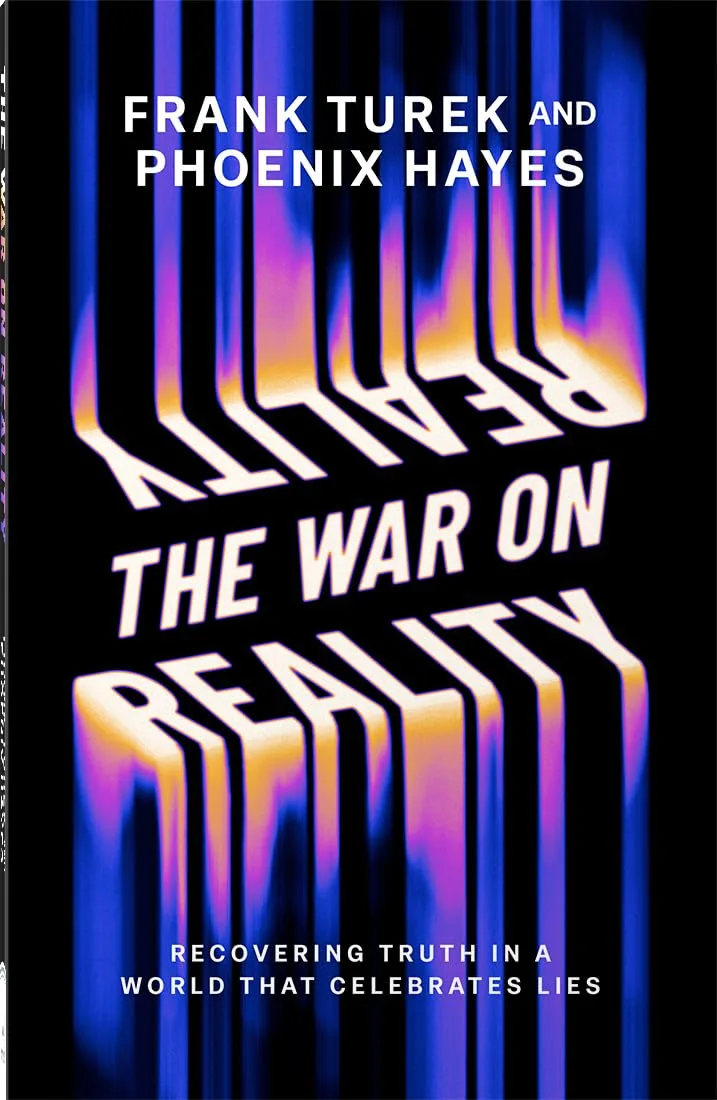
Download Cover Image
Do you want to download the full cover image for The War on Reality: Recovering Truth in a World That Celebrates Lies?