
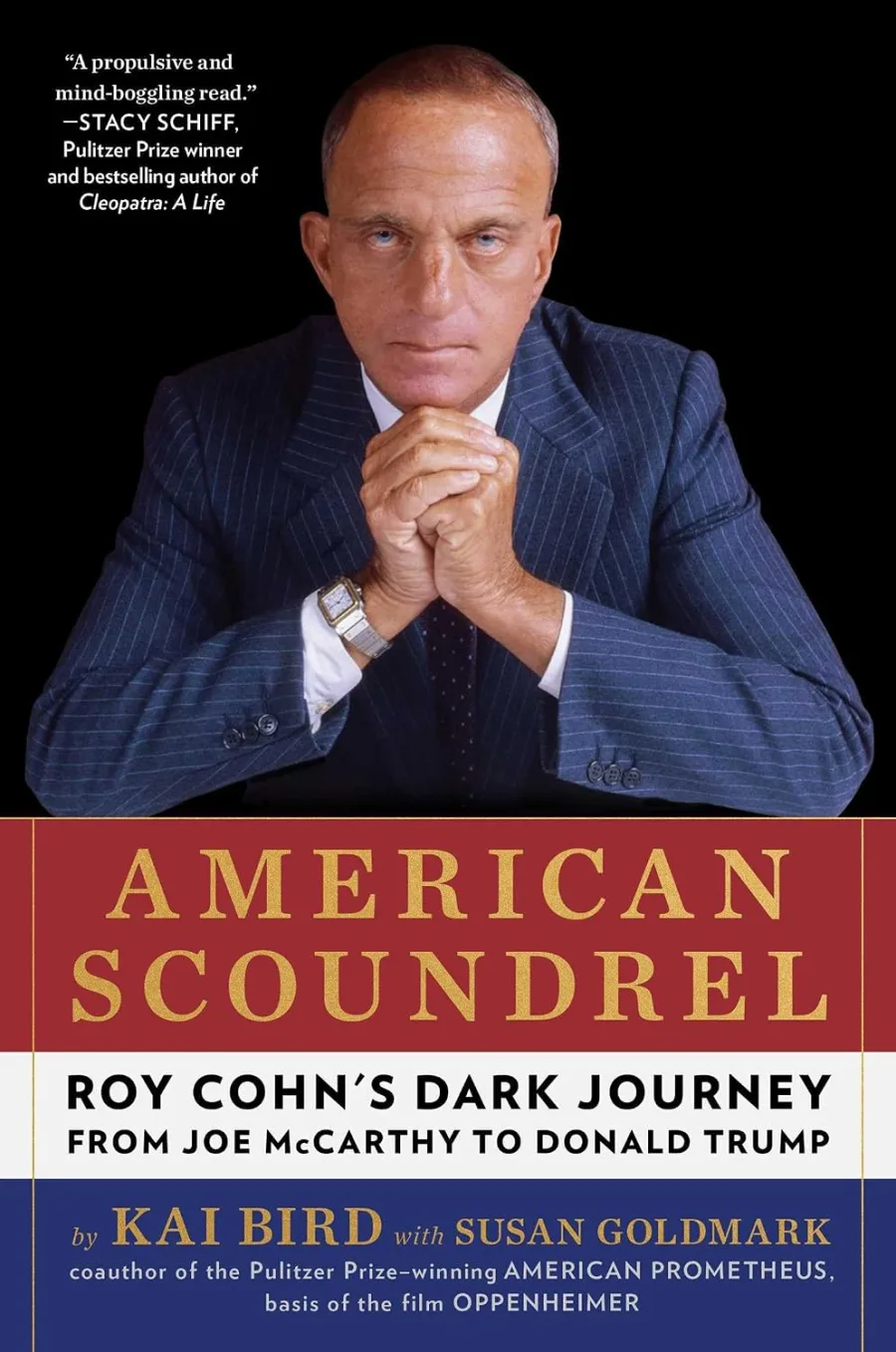
American Scoundrel: Roy Cohn's Dark Journey from Joe McCarthy to Donald Trump
Hardcover
• 528 Pages
• USD 32.00
• English
• 9781668031575
No ratings yet
| Publisher | Scribner |
|---|---|
| ISBN13 | 9781668031575 |
| ASIN/SKU | 1668031574 |
| Book Format | Hardcover |
| Language | English |
| Pages | 528 |
| List Price | USD 32.00 |
| Publishing Date | 01/09/2026 |
| Dimensions | 6 x 1.4 x 9 inches |
| Weight | 1.58 pounds |
| Book Code | BD00070308 |
Buy this Book
Amazon Stores
Ebook Stores
Other Stores
Discover American Scoundrel: Roy Cohn's Dark Journey from Joe McCarthy to Donald Trump by Kai Bird. This book is published by Scribner in Hardcover format, ISBN 9781668031575, ASIN 1668031574, under Biographies and Memoirs, United States Biographies, Political Leader Biographies.
Book Description
“A narrative masterwork. Bird vividly creates the sinister web of charm and deceit that Cohn was able to spin through his decades at the very center of power.” —Marie Brenner, award-winning writer-at-large for Vanity Fair and coproducer of the documentary Where’s My Roy Cohn?
From the Pulitzer Prize–winning coauthor of American Prometheus, inspiration for the box-office sensation Oppenheimer, a penetrating biography of super-lawyer and political fixer Roy Cohn, whose shocking exploits over four decades have shaped the modern political era, most prominently the ascent of Donald Trump.
From the 1950s to the 1980s, the many dramas of American political life had one common denominator: Roy Cohn. In his twenties, the infamous young prosecutor sent Julius and Ethel Rosenberg to the electric chair, and as the chief aide to Senator Joe McCarthy became the baby-faced symbol of ruthless communist-hunting. By his thirties, Cohn had begun working as the Mafia’s hired legal gun. In his forties, he was an informal adviser to Richard Nixon. In his fifties, he partied with the glitterati at Studio 54 and visited the Reagan White House where he traded gossip with the first lady. Perhaps most significant, Cohn mentored the young Donald Trump, who telephoned the older man daily and studiously emulated not only his mannerisms but core philosophies.
Years after his death in 1986 from AIDS-related complications, Cohn emerged as a central figure in Tony Kushner’s Pulitzer Prize–winning play Angels in America. Cohn’s feistiness, his surly defiance—and, yes, his charm—were frequently flourished to conceal vast insecurities, particularly regarding his closeted sexuality.
A street fighter, self-promoting hustler, and a true Zelig of the dark side, Cohn was a nefarious actor in a startling number of history-shaping events whose influence resonates to the present day.
From the Pulitzer Prize–winning coauthor of American Prometheus, inspiration for the box-office sensation Oppenheimer, a penetrating biography of super-lawyer and political fixer Roy Cohn, whose shocking exploits over four decades have shaped the modern political era, most prominently the ascent of Donald Trump.
From the 1950s to the 1980s, the many dramas of American political life had one common denominator: Roy Cohn. In his twenties, the infamous young prosecutor sent Julius and Ethel Rosenberg to the electric chair, and as the chief aide to Senator Joe McCarthy became the baby-faced symbol of ruthless communist-hunting. By his thirties, Cohn had begun working as the Mafia’s hired legal gun. In his forties, he was an informal adviser to Richard Nixon. In his fifties, he partied with the glitterati at Studio 54 and visited the Reagan White House where he traded gossip with the first lady. Perhaps most significant, Cohn mentored the young Donald Trump, who telephoned the older man daily and studiously emulated not only his mannerisms but core philosophies.
Years after his death in 1986 from AIDS-related complications, Cohn emerged as a central figure in Tony Kushner’s Pulitzer Prize–winning play Angels in America. Cohn’s feistiness, his surly defiance—and, yes, his charm—were frequently flourished to conceal vast insecurities, particularly regarding his closeted sexuality.
A street fighter, self-promoting hustler, and a true Zelig of the dark side, Cohn was a nefarious actor in a startling number of history-shaping events whose influence resonates to the present day.
Author Biography
Kai Bird is a Pulitzer Prize-winning historian and biographer. His latest book is American Scoundrel: Roy Cohn's Dark Journey from Joe McCarthy to Donald Trump, co-authored with his wife, Susan Goldmark and published by Scribner/Simon & Schuster on September 1, 2026. Kai's last book was The Outlier: The Unfinished Presidency of Jimmy Carter, published in 2021. He has also written a memoir about the Middle East entitled Crossing Mandelbaum Gate: Coming of Age Between the Arabs and Israelis, 1956-1978 (Scribner, 2010). It was a 2011 Finalist in the National Book Critics Circle Award for Autobiography. He is the co-author with the late Martin J. Sherwin of the Pulitzer Prize-winning biography, American Prometheus: The Triumph and Tragedy of J. Robert Oppenheimer (2005), which also won the National Book Critics Circle Award for Biography and the Duff Cooper Prize for History in London. It was the inspiration for Christopher Nolan's 2023 Academy Award-winning feature, Oppenheimer. In 2014, he published The Good Spy: The Life and Death of Robert Ames (Crown/Random House). Bird's first biography was The Chairman: John J. McCloy, the Making of the American Establishment (1992), followed by The Color of Truth: McGeorge Bundy & William Bundy, Brothers in Arms (1998). He is also co-editor with Lawrence Lifschultz of Hiroshima's Shadow: Writings on the Denial of History and the Smithsonian Controversy (1998). He is the recipient of fellowships from the John Simon Guggenheim Foundation, the Alicia Patterson Foundation, the John D. and Catherine T. MacArthur Foundation's writing fellowship, the Thomas J. Watson Foundation, the German Marshall Fund, the Rockefeller Foundation's Study Center, Bellagio, Italy and the Woodrow Wilson International Center for Scholars in Washington DC. He is a member of the Society of American Historians and a contributing editor of The Nation. Since 2017, he has been the Director of the Leon Levy Center for Biography at CUNY's Graduate Center in New York City.
Editorial Reviews
“In American Scoundrel, the master biographer Kai Bird points us to a universe where ideology matters less than crass opportunism in the pursuit of money, sex, and power—where extreme narcissists will shatter everything around them to get their way. This was Roy Cohn’s world; Donald Trump is his inheritor….American Scoundrel will remind anyone outraged by our current culture that ‘elite impunity’ is nothing new. Then, as now, power and celebrity attracted allies.”
—Martin Di Caro, The American Conservative
“I gobbled up every page of Kai Bird’s American Scoundrel…This is a dirty story but, as Bird notes, one that has turned out to be seminal in American politics…The book is a bounteous cornucopia of midcentury sleaze and uneasily addictive for just that reason. It’s got Mafia hits and frame jobs and blackmail and bribery and election tampering. It’s got forgery and insurance scams and perjury and espionage and sex trafficking and a lot of tax evasion. It makes James Ellroy novels look like Theo of Golden by comparison, and it makes for mesmerizing reading.”
—Laura Miller, Slate
“Roy Marcus Cohn was the kingmaker from hell…Cohn’s brutish course through the corridors of power was, to a large extent, a template for Trump’s later on. In their new book American Scoundrel: Roy Cohn’s Dark Journey from Joe McCarthy to Donald Trump, biographer Kai Bird and his wife and chief researcher, Susan Goldmark, tell the long, sordid tale of how one ‘narcissistic con artist’—as they characterize Cohn —did so much to create another, the man who now occupies the most powerful office in the world.”
—Foreign Affairs
“Effective…Bird gives us a new way to think about Cohn, Trump, and the legacy of McCarthyism…Looking at the long arc of Cohn’s career shows how much of McCarthyism was about ambition and careerism, rather than ideology. Cohn’s friends and clients were obsequious to him because they thought he could get them things no one else could.”
—The Atlantic
“A magisterial biography of the notorious lawyer and Trump whisperer that is indispensable reading for anyone who wants to understand the current political moment.”
—The Forward
“An astonishing biography…The book excels as a masterful dissection of Cohn’s strange, contradictory, and immoral character…It adds up to an extraordinary portrait of a singular American figure whose callousness and brazenness continue to mar the country 40 years after his death.”
—Publishers Weekly (Starred Review)
“The venality and corruption, blackmail and sheer brazenness of the public lying Bird portrays is eye-popping, infuriating, disgusting—yet also, at times, darkly comic.…If you want to understand Donald Trump, read this book.”
—The Bookseller
“A comprehensive portrait of a truculent lawyer who shot to infamy in the 1950s and remained a scandalous figure until his death…A thorough, deeply reported life story of the gleefully villainous lawyer who molded a U.S. president.”
—Kirkus Reviews (Starred Review)
“This deeply researched, admirably balanced, and propulsively paced biography is key to understanding the current political culture.”
—Booklist (Starred Review)
“A PROPULSIVE, MIND BOGGLING READ… Kai Bird pins this alternate moral universe to the page brilliantly and even-handedly.”
—Stacy Schiff, Pulitzer Prize winner and author of Cleopatra: A Life and The Revolutionary: Samuel Adams
“POWERFUL AND ILLUMINATING…Roy Cohn is emblematic of dark and perennial forces in our national life…Bird has delivered a vital volume.”
—Jon Meacham, #1 New York Times bestselling author of The Soul of America: The Battle for Our Better Angels
“THE DEFINITIVE BOOK ON ROY COHN…Cohn’s influence on our time is incalculable and we are living in the long shadow of his legacy….American Scoundrel is essential reading for anyone who wishes to understand Donald Trump’s America.”
—Jeremy Strong, Emmy, Golden Globe, and Tony-winning actor, and Academy Award nominee for his portrayal of Roy Cohn in The Apprentice
“AN EXTRAORDINARY, UP-CLOSE VIEW OF COHN’S INTERNAL WIRING…A brilliantly reported and vividly written biography that will mesmerize readers from its opening pages.”
—Ken Auletta, longtime contributor to The New Yorker and bestselling author of Googled: The End of the World as We Know It
“A MUST-READ FOR THESE DARK DAYS. To understand the president who has hurled this country into chaos, we must tap the root—get to the source. American Scoundrel does just that by detailing the life of Roy Cohn. It is, in the end, a thorough and poignant account of a moral monster.”
—Eddie S. Glaude, Jr., author of America, U.S.A.: How Race Shadows the Nation’s Anniversaries
“A NARRATIVE MASTERWORK. With a scholar’s rigor and a novelist’s sense of drama, Bird vividly creates the sinister web of charm and deceit that Cohn was able to spin through his decades at the very center of power.”
—Marie Brenner, award-winning writer-at-large for Vanity Fair, author of The Desperate Hours, and coproducer of the documentary Where’s My Roy Cohn?
“KAI BIRD DOES THE IMPOSSIBLE. He tells the story of one of America's arch villains, with new evidence of his mendacity, contempt for the law, megalomania, and cruelty, but does so without descending into caricature.”
—David Nasaw, two-time Pulitzer Prize finalist and bestselling author of The Patriarch
“A MUST-READ FOR ANYONE WHO WANTS TO UNDERSTAND NOT JUST THE DARK ROLE PLAYED BY ROY COHN IN TWENTIETH-CENTURY AMERICAN POLITICS, BUT THE MAN’S LASTING INFLUENCE INTO THIS CENTURY….There is, it turns out, a direct line from the malign influence of McCarthyism to that of Trumpism, and Roy Cohn is it.”
—Susan Glasser, staff writer for The New Yorker and bestselling coauthor of The Divider: Trump in the White House, 2017-2021
—Martin Di Caro, The American Conservative
“I gobbled up every page of Kai Bird’s American Scoundrel…This is a dirty story but, as Bird notes, one that has turned out to be seminal in American politics…The book is a bounteous cornucopia of midcentury sleaze and uneasily addictive for just that reason. It’s got Mafia hits and frame jobs and blackmail and bribery and election tampering. It’s got forgery and insurance scams and perjury and espionage and sex trafficking and a lot of tax evasion. It makes James Ellroy novels look like Theo of Golden by comparison, and it makes for mesmerizing reading.”
—Laura Miller, Slate
“Roy Marcus Cohn was the kingmaker from hell…Cohn’s brutish course through the corridors of power was, to a large extent, a template for Trump’s later on. In their new book American Scoundrel: Roy Cohn’s Dark Journey from Joe McCarthy to Donald Trump, biographer Kai Bird and his wife and chief researcher, Susan Goldmark, tell the long, sordid tale of how one ‘narcissistic con artist’—as they characterize Cohn —did so much to create another, the man who now occupies the most powerful office in the world.”
—Foreign Affairs
“Effective…Bird gives us a new way to think about Cohn, Trump, and the legacy of McCarthyism…Looking at the long arc of Cohn’s career shows how much of McCarthyism was about ambition and careerism, rather than ideology. Cohn’s friends and clients were obsequious to him because they thought he could get them things no one else could.”
—The Atlantic
“A magisterial biography of the notorious lawyer and Trump whisperer that is indispensable reading for anyone who wants to understand the current political moment.”
—The Forward
“An astonishing biography…The book excels as a masterful dissection of Cohn’s strange, contradictory, and immoral character…It adds up to an extraordinary portrait of a singular American figure whose callousness and brazenness continue to mar the country 40 years after his death.”
—Publishers Weekly (Starred Review)
“The venality and corruption, blackmail and sheer brazenness of the public lying Bird portrays is eye-popping, infuriating, disgusting—yet also, at times, darkly comic.…If you want to understand Donald Trump, read this book.”
—The Bookseller
“A comprehensive portrait of a truculent lawyer who shot to infamy in the 1950s and remained a scandalous figure until his death…A thorough, deeply reported life story of the gleefully villainous lawyer who molded a U.S. president.”
—Kirkus Reviews (Starred Review)
“This deeply researched, admirably balanced, and propulsively paced biography is key to understanding the current political culture.”
—Booklist (Starred Review)
“A PROPULSIVE, MIND BOGGLING READ… Kai Bird pins this alternate moral universe to the page brilliantly and even-handedly.”
—Stacy Schiff, Pulitzer Prize winner and author of Cleopatra: A Life and The Revolutionary: Samuel Adams
“POWERFUL AND ILLUMINATING…Roy Cohn is emblematic of dark and perennial forces in our national life…Bird has delivered a vital volume.”
—Jon Meacham, #1 New York Times bestselling author of The Soul of America: The Battle for Our Better Angels
“THE DEFINITIVE BOOK ON ROY COHN…Cohn’s influence on our time is incalculable and we are living in the long shadow of his legacy….American Scoundrel is essential reading for anyone who wishes to understand Donald Trump’s America.”
—Jeremy Strong, Emmy, Golden Globe, and Tony-winning actor, and Academy Award nominee for his portrayal of Roy Cohn in The Apprentice
“AN EXTRAORDINARY, UP-CLOSE VIEW OF COHN’S INTERNAL WIRING…A brilliantly reported and vividly written biography that will mesmerize readers from its opening pages.”
—Ken Auletta, longtime contributor to The New Yorker and bestselling author of Googled: The End of the World as We Know It
“A MUST-READ FOR THESE DARK DAYS. To understand the president who has hurled this country into chaos, we must tap the root—get to the source. American Scoundrel does just that by detailing the life of Roy Cohn. It is, in the end, a thorough and poignant account of a moral monster.”
—Eddie S. Glaude, Jr., author of America, U.S.A.: How Race Shadows the Nation’s Anniversaries
“A NARRATIVE MASTERWORK. With a scholar’s rigor and a novelist’s sense of drama, Bird vividly creates the sinister web of charm and deceit that Cohn was able to spin through his decades at the very center of power.”
—Marie Brenner, award-winning writer-at-large for Vanity Fair, author of The Desperate Hours, and coproducer of the documentary Where’s My Roy Cohn?
“KAI BIRD DOES THE IMPOSSIBLE. He tells the story of one of America's arch villains, with new evidence of his mendacity, contempt for the law, megalomania, and cruelty, but does so without descending into caricature.”
—David Nasaw, two-time Pulitzer Prize finalist and bestselling author of The Patriarch
“A MUST-READ FOR ANYONE WHO WANTS TO UNDERSTAND NOT JUST THE DARK ROLE PLAYED BY ROY COHN IN TWENTIETH-CENTURY AMERICAN POLITICS, BUT THE MAN’S LASTING INFLUENCE INTO THIS CENTURY….There is, it turns out, a direct line from the malign influence of McCarthyism to that of Trumpism, and Roy Cohn is it.”
—Susan Glasser, staff writer for The New Yorker and bestselling coauthor of The Divider: Trump in the White House, 2017-2021
Book Summary
Kai Bird and Susan Goldmark’s American Scoundrel: Roy Cohn’s Dark Journey from Joe McCarthy to Donald Trump is a biography of one of the most controversial and consequential figures in modern American political history. Roy Cohn was a lawyer, political operator, fixer, socialite, media manipulator, and master of personal connections whose career stretched from the anti-communist hysteria of the 1950s to the worlds of organized crime, New York real estate, celebrity culture, conservative politics, and, most significantly, Donald Trump. Published in September 2026, the book argues that Cohn’s importance extends far beyond his own scandal-filled life. His methods, worldview, and understanding of power helped create a political style that continued to influence American public life decades after his death.
The book’s central question is essentially this: how did Roy Cohn, a man who never held the presidency and whose career eventually ended in disbarment and disgrace, exert such a lasting influence on American politics? Bird and Goldmark answer by tracing the extraordinary network of people Cohn cultivated and the tactics he developed throughout his life. Cohn understood that formal authority was only one form of power. Personal relationships, fear, publicity, gossip, money, intimidation, and the ability to create favorable narratives could sometimes accomplish more than conventional political or legal institutions. His career became an extended demonstration of how someone could remain influential even when his reputation was deeply damaged.
Cohn was born in the Bronx in 1927 into a privileged and well-connected family. His father was a judge, and his maternal family possessed considerable wealth. From an early age, Cohn learned that connections mattered enormously. His family background opened doors, and his intelligence and aggressiveness allowed him to move through institutions at remarkable speed. His admission to Columbia Law School after initially being rejected became an early lesson in the importance of persistence and influence. Bird and Goldmark portray his upbringing as part of the foundation for a lifelong belief that rules were flexible when the right people were on your side.
Cohn’s meteoric rise began when he became involved in the prosecution of Julius and Ethel Rosenberg, the married couple accused of passing atomic secrets to the Soviet Union. Still in his twenties, Cohn played a significant role in the prosecution that resulted in their conviction and execution in 1953. The Rosenberg case made him nationally famous and established the pattern that would define much of his later career: he was willing to use aggressive, controversial, and highly unconventional methods when he believed they would achieve the desired result. The book presents this episode as one of the most important formative moments in Cohn’s public life because it gave him both visibility and a reputation for ruthlessness.
From there, Cohn became the chief counsel to Senator Joseph McCarthy during the height of the Red Scare. This was the period in which accusations of communist infiltration became a powerful political weapon. McCarthy was already developing a reputation for making dramatic allegations, but Cohn helped turn those allegations into a sophisticated campaign of intimidation and publicity. The two men became closely associated with the Senate investigations that targeted suspected communists and other perceived enemies. Cohn was not simply an assistant following orders; Bird and Goldmark portray him as one of the architects of the aggressive political machinery surrounding McCarthy.
The McCarthy era illustrates one of the book’s most important themes: political power can thrive on accusation even when proof is weak. Cohn understood the value of creating doubt and fear. An accusation did not necessarily have to survive careful scrutiny to damage a person's reputation. Public suspicion could become a weapon in itself. This approach allowed Cohn and McCarthy to generate enormous attention while placing their targets on the defensive. The book connects this strategy to later political forms of media manipulation, suggesting that Cohn learned very early how to turn controversy itself into a source of power.
Cohn also became associated with the destruction of books deemed communist or subversive, helping reinforce his public image as the youthful, aggressive face of anti-communism. He was barely out of his twenties, yet he had become a national symbol. His age was part of his mystique. He looked young, but he behaved with extraordinary confidence and hostility. The contrast helped create the image of a political fighter who was prepared to attack anyone who stood in his way.
Eventually, however, McCarthy’s political campaign collapsed. The Senate censured McCarthy, and his influence faded. Cohn's career might have ended with him, but Cohn proved remarkably adaptable. Rather than disappearing, he moved into the world where his talents were perhaps even more useful: New York City’s network of lawyers, politicians, wealthy businessmen, celebrities, organized-crime figures, journalists, and socialites. This transition is one of the most revealing parts of the biography because it demonstrates that Cohn's fundamental ideology was not really limited to anti-communism. His deeper commitment was to influence itself.
By the time Cohn reached middle age, he had become known as a powerful legal fixer. He represented people who needed someone willing to fight aggressively, exploit relationships, manipulate the press, and operate in gray areas. His clients included organized-crime figures, media personalities, celebrities, businesses, and political figures. He developed a reputation as someone who could make problems disappear—or at least make them someone else's problems.
The biography repeatedly returns to the contradiction at the heart of Cohn's career: he was a lawyer who often seemed contemptuous of the law itself. Cohn's professional identity depended upon the legal system, yet he viewed rules as obstacles to be overcome rather than principles that deserved respect. He cultivated the belief that winning was more important than playing fairly. This attitude became particularly visible when he faced investigations and criminal charges. He was indicted three times on charges involving bribery, perjury, extortion, and other white-collar crimes, but he was acquitted each time.
These experiences reinforced his belief that consequences could be avoided through aggression, relationships, and procedural maneuvering. Cohn presented himself as someone who could survive anything. Even when attacked, he counterattacked. Even when cornered, he created another distraction. Even when his reputation suffered, he found influential people willing to stand beside him. This survival instinct became one of his defining characteristics.
Cohn’s relationship with the media was equally important. He understood that public perception could sometimes matter more than the underlying facts. He cultivated relationships with gossip columnists and journalists, feeding them information when it served his interests. Gossip became a form of currency. By controlling or influencing what appeared in newspapers and gossip columns, Cohn could elevate allies, embarrass enemies, and keep himself at the center of attention.
This media strategy is crucial to Bird and Goldmark’s interpretation of Cohn because it provides a bridge between the political culture of the mid-twentieth century and the media environment of later decades. Cohn operated before social media, but he understood something that would become increasingly important: attention is power. If people are talking about you, you remain relevant. If your opponents are forced to respond to your accusations, you control the conversation. And if negative stories appear, another controversy can push them out of the headlines.
Cohn's social life further expanded his influence. He moved comfortably among politicians, wealthy New Yorkers, celebrities, and cultural figures. He attended glamorous parties at places such as Studio 54 and developed relationships with figures including Richard Nixon and members of the Reagan administration. Nancy Reagan reportedly sought his advice and enjoyed his gossip. His ability to move between worlds was extraordinary. He could speak to a Mafia client, a politician, a journalist, or a celebrity and make each believe that he was uniquely valuable.
Yet beneath the public bravado was a deeply complicated private life. Cohn was a closeted gay man who publicly embraced conservative and often aggressively homophobic political positions. This contradiction is one of the biography's most important psychological themes. Cohn's public identity required him to deny or conceal an essential part of himself while simultaneously moving through social environments where his private life was known to many people around him. Bird and Goldmark present this not as a simple explanation for his behavior but as one part of the profound contradictions that shaped him.
His sexuality became especially significant during the AIDS epidemic. Cohn was diagnosed with AIDS but publicly denied that diagnosis, continuing to project the image of a man who could defeat any accusation or vulnerability. He died in 1986 from AIDS-related complications. His refusal to acknowledge his condition reflected the same psychological pattern that had characterized much of his career: denial, defiance, and an almost desperate insistence that he remained in control.
The most important relationship in American Scoundrel, however, is Cohn’s relationship with Donald Trump. When Trump was still a young New York real-estate developer, he encountered Cohn during a legal battle involving allegations of discriminatory housing practices. Trump recognized something in Cohn that he found enormously useful: Cohn was willing to attack rather than merely defend. Instead of responding cautiously to accusations, he encouraged Trump to fight aggressively, deny wrongdoing, attack his opponents, and use the press as a weapon. Their relationship soon developed beyond attorney and client into something resembling mentorship.
Trump reportedly called Cohn repeatedly—sometimes as many as a dozen times a day—and Cohn described him as a close friend. Cohn taught Trump a practical philosophy of confrontation: never concede weakness, never voluntarily surrender, and always counterattack. If accused, accuse someone else. If criticized, attack the critic. If threatened, make the threat larger. The objective was not necessarily to prove that you were right; it was to ensure that your opponent could not establish uncontested control over the story.
The biography argues that Trump's later public style bears striking similarities to Cohn's methods. The comparison includes aggressive rhetoric, media manipulation, personal loyalty, disdain for conventional rules, strategic use of lawsuits and threats, cultivation of controversy, and a willingness to treat politics as an intensely personal contest. Bird and Goldmark do not portray Trump as simply a copy of Cohn. Instead, they suggest that Trump was an unusually receptive student who adapted Cohn's lessons to a new era.
This is where American Scoundrel becomes more than a biography of one man. Bird and Goldmark use Cohn to examine the evolution of modern American political culture. Their argument is that Cohn represents a bridge between different eras: McCarthyism, New York's machine politics, celebrity culture, conservative media, and the political environment that ultimately produced Trump's presidency. Cohn did not create all of these forces by himself, but he learned how to combine them. He understood that fear, resentment, celebrity, gossip, and personal loyalty could be transformed into political capital.
One of the book’s most important conclusions is that Cohn was not necessarily motivated by a consistent political philosophy. His anti-communism, conservative connections, social relationships, and later alliances were often useful because they gave him access to power. Bird and Goldmark therefore emphasize careerism and opportunism as much as ideology. A person did not necessarily need to share Cohn's beliefs to become useful to him. What mattered was whether the relationship produced leverage.
This helps explain Cohn's ability to survive among people who knew exactly what he was like. Many individuals found him repellent, unethical, or dangerous, yet they continued to associate with him because he could get things done. That paradox is one of the biography's deepest insights. Cohn's power did not depend upon being admired. He only needed to be useful.
The book also shows how Cohn transformed personal relationships into a kind of informal political infrastructure. He knew who could make a phone call, who could plant a story, who could provide access, who could introduce him to a powerful person, and who owed him a favor. His network was more important than any official position. This allowed him to remain influential even when formal institutions rejected him.
After Cohn's death, his cultural legacy continued. He became a central character in Tony Kushner's Pulitzer Prize-winning play Angels in America, where he appears as a symbol of hypocrisy, political cruelty, denial, and the AIDS crisis. His transformation into a dramatic character demonstrates how thoroughly Cohn had entered the American imagination.
Ultimately, American Scoundrel presents Roy Cohn as a deeply contradictory figure: brilliant but reckless, charming but cruel, connected but insecure, socially powerful but privately vulnerable, and deeply invested in political morality while frequently behaving as though morality were irrelevant. Bird and Goldmark do not excuse him, but they attempt to understand the machinery behind his influence.
For readers searching for an American Scoundrel book summary, Roy Cohn biography, Roy Cohn and Donald Trump relationship, Roy Cohn's influence on Trump, Joe McCarthy and Roy Cohn, Roy Cohn McCarthyism, how Roy Cohn shaped Donald Trump, or books about the history of Trumpism, the central lesson of the biography is that political influence often develops long before someone reaches formal political office. Cohn demonstrated how a lawyer, media operator, social connector, and professional provocateur could shape public life without ever being elected to anything.
The book's title, American Scoundrel, captures both its subject and its larger argument. Cohn was not simply an unusually corrupt individual. He represented a style of American power that rewarded shamelessness, aggression, personal loyalty, spectacle, and the ability to turn scandal into publicity. His career showed that institutions could be manipulated by people who understood their weaknesses better than they respected their purposes.
The final significance of Cohn's story lies in what happened after he died. His influence did not die with him. The techniques he perfected survived in the political culture around him and were later adapted by Donald Trump. Bird and Goldmark therefore invite readers to see Cohn not merely as a relic of the McCarthy era but as a missing link between twentieth-century political scandal and the politics of the twenty-first century.
In the end, American Scoundrel is a cautionary story about what happens when winning becomes more important than truth, power more important than principle, and attention more important than accountability. Roy Cohn understood those forces exceptionally well. He taught powerful people how to survive controversy, taught clients how to weaponize the media, and taught Donald Trump how to turn attack into a form of defense.
That is why the biography ultimately asks a question much larger than “Who was Roy Cohn?” It asks how much of Roy Cohn's political method remains embedded in American public life. Cohn died in 1986, but the strategies he cultivated—attack first, never admit defeat, cultivate powerful friends, manipulate the press, personalize political conflict, and treat rules as obstacles rather than boundaries—continued to resonate. Bird and Goldmark's portrait suggests that Cohn's greatest historical importance may therefore be found not in the scandals of his own lifetime, but in the political culture he helped teach others to build.
The book’s central question is essentially this: how did Roy Cohn, a man who never held the presidency and whose career eventually ended in disbarment and disgrace, exert such a lasting influence on American politics? Bird and Goldmark answer by tracing the extraordinary network of people Cohn cultivated and the tactics he developed throughout his life. Cohn understood that formal authority was only one form of power. Personal relationships, fear, publicity, gossip, money, intimidation, and the ability to create favorable narratives could sometimes accomplish more than conventional political or legal institutions. His career became an extended demonstration of how someone could remain influential even when his reputation was deeply damaged.
Cohn was born in the Bronx in 1927 into a privileged and well-connected family. His father was a judge, and his maternal family possessed considerable wealth. From an early age, Cohn learned that connections mattered enormously. His family background opened doors, and his intelligence and aggressiveness allowed him to move through institutions at remarkable speed. His admission to Columbia Law School after initially being rejected became an early lesson in the importance of persistence and influence. Bird and Goldmark portray his upbringing as part of the foundation for a lifelong belief that rules were flexible when the right people were on your side.
Cohn’s meteoric rise began when he became involved in the prosecution of Julius and Ethel Rosenberg, the married couple accused of passing atomic secrets to the Soviet Union. Still in his twenties, Cohn played a significant role in the prosecution that resulted in their conviction and execution in 1953. The Rosenberg case made him nationally famous and established the pattern that would define much of his later career: he was willing to use aggressive, controversial, and highly unconventional methods when he believed they would achieve the desired result. The book presents this episode as one of the most important formative moments in Cohn’s public life because it gave him both visibility and a reputation for ruthlessness.
From there, Cohn became the chief counsel to Senator Joseph McCarthy during the height of the Red Scare. This was the period in which accusations of communist infiltration became a powerful political weapon. McCarthy was already developing a reputation for making dramatic allegations, but Cohn helped turn those allegations into a sophisticated campaign of intimidation and publicity. The two men became closely associated with the Senate investigations that targeted suspected communists and other perceived enemies. Cohn was not simply an assistant following orders; Bird and Goldmark portray him as one of the architects of the aggressive political machinery surrounding McCarthy.
The McCarthy era illustrates one of the book’s most important themes: political power can thrive on accusation even when proof is weak. Cohn understood the value of creating doubt and fear. An accusation did not necessarily have to survive careful scrutiny to damage a person's reputation. Public suspicion could become a weapon in itself. This approach allowed Cohn and McCarthy to generate enormous attention while placing their targets on the defensive. The book connects this strategy to later political forms of media manipulation, suggesting that Cohn learned very early how to turn controversy itself into a source of power.
Cohn also became associated with the destruction of books deemed communist or subversive, helping reinforce his public image as the youthful, aggressive face of anti-communism. He was barely out of his twenties, yet he had become a national symbol. His age was part of his mystique. He looked young, but he behaved with extraordinary confidence and hostility. The contrast helped create the image of a political fighter who was prepared to attack anyone who stood in his way.
Eventually, however, McCarthy’s political campaign collapsed. The Senate censured McCarthy, and his influence faded. Cohn's career might have ended with him, but Cohn proved remarkably adaptable. Rather than disappearing, he moved into the world where his talents were perhaps even more useful: New York City’s network of lawyers, politicians, wealthy businessmen, celebrities, organized-crime figures, journalists, and socialites. This transition is one of the most revealing parts of the biography because it demonstrates that Cohn's fundamental ideology was not really limited to anti-communism. His deeper commitment was to influence itself.
By the time Cohn reached middle age, he had become known as a powerful legal fixer. He represented people who needed someone willing to fight aggressively, exploit relationships, manipulate the press, and operate in gray areas. His clients included organized-crime figures, media personalities, celebrities, businesses, and political figures. He developed a reputation as someone who could make problems disappear—or at least make them someone else's problems.
The biography repeatedly returns to the contradiction at the heart of Cohn's career: he was a lawyer who often seemed contemptuous of the law itself. Cohn's professional identity depended upon the legal system, yet he viewed rules as obstacles to be overcome rather than principles that deserved respect. He cultivated the belief that winning was more important than playing fairly. This attitude became particularly visible when he faced investigations and criminal charges. He was indicted three times on charges involving bribery, perjury, extortion, and other white-collar crimes, but he was acquitted each time.
These experiences reinforced his belief that consequences could be avoided through aggression, relationships, and procedural maneuvering. Cohn presented himself as someone who could survive anything. Even when attacked, he counterattacked. Even when cornered, he created another distraction. Even when his reputation suffered, he found influential people willing to stand beside him. This survival instinct became one of his defining characteristics.
Cohn’s relationship with the media was equally important. He understood that public perception could sometimes matter more than the underlying facts. He cultivated relationships with gossip columnists and journalists, feeding them information when it served his interests. Gossip became a form of currency. By controlling or influencing what appeared in newspapers and gossip columns, Cohn could elevate allies, embarrass enemies, and keep himself at the center of attention.
This media strategy is crucial to Bird and Goldmark’s interpretation of Cohn because it provides a bridge between the political culture of the mid-twentieth century and the media environment of later decades. Cohn operated before social media, but he understood something that would become increasingly important: attention is power. If people are talking about you, you remain relevant. If your opponents are forced to respond to your accusations, you control the conversation. And if negative stories appear, another controversy can push them out of the headlines.
Cohn's social life further expanded his influence. He moved comfortably among politicians, wealthy New Yorkers, celebrities, and cultural figures. He attended glamorous parties at places such as Studio 54 and developed relationships with figures including Richard Nixon and members of the Reagan administration. Nancy Reagan reportedly sought his advice and enjoyed his gossip. His ability to move between worlds was extraordinary. He could speak to a Mafia client, a politician, a journalist, or a celebrity and make each believe that he was uniquely valuable.
Yet beneath the public bravado was a deeply complicated private life. Cohn was a closeted gay man who publicly embraced conservative and often aggressively homophobic political positions. This contradiction is one of the biography's most important psychological themes. Cohn's public identity required him to deny or conceal an essential part of himself while simultaneously moving through social environments where his private life was known to many people around him. Bird and Goldmark present this not as a simple explanation for his behavior but as one part of the profound contradictions that shaped him.
His sexuality became especially significant during the AIDS epidemic. Cohn was diagnosed with AIDS but publicly denied that diagnosis, continuing to project the image of a man who could defeat any accusation or vulnerability. He died in 1986 from AIDS-related complications. His refusal to acknowledge his condition reflected the same psychological pattern that had characterized much of his career: denial, defiance, and an almost desperate insistence that he remained in control.
The most important relationship in American Scoundrel, however, is Cohn’s relationship with Donald Trump. When Trump was still a young New York real-estate developer, he encountered Cohn during a legal battle involving allegations of discriminatory housing practices. Trump recognized something in Cohn that he found enormously useful: Cohn was willing to attack rather than merely defend. Instead of responding cautiously to accusations, he encouraged Trump to fight aggressively, deny wrongdoing, attack his opponents, and use the press as a weapon. Their relationship soon developed beyond attorney and client into something resembling mentorship.
Trump reportedly called Cohn repeatedly—sometimes as many as a dozen times a day—and Cohn described him as a close friend. Cohn taught Trump a practical philosophy of confrontation: never concede weakness, never voluntarily surrender, and always counterattack. If accused, accuse someone else. If criticized, attack the critic. If threatened, make the threat larger. The objective was not necessarily to prove that you were right; it was to ensure that your opponent could not establish uncontested control over the story.
The biography argues that Trump's later public style bears striking similarities to Cohn's methods. The comparison includes aggressive rhetoric, media manipulation, personal loyalty, disdain for conventional rules, strategic use of lawsuits and threats, cultivation of controversy, and a willingness to treat politics as an intensely personal contest. Bird and Goldmark do not portray Trump as simply a copy of Cohn. Instead, they suggest that Trump was an unusually receptive student who adapted Cohn's lessons to a new era.
This is where American Scoundrel becomes more than a biography of one man. Bird and Goldmark use Cohn to examine the evolution of modern American political culture. Their argument is that Cohn represents a bridge between different eras: McCarthyism, New York's machine politics, celebrity culture, conservative media, and the political environment that ultimately produced Trump's presidency. Cohn did not create all of these forces by himself, but he learned how to combine them. He understood that fear, resentment, celebrity, gossip, and personal loyalty could be transformed into political capital.
One of the book’s most important conclusions is that Cohn was not necessarily motivated by a consistent political philosophy. His anti-communism, conservative connections, social relationships, and later alliances were often useful because they gave him access to power. Bird and Goldmark therefore emphasize careerism and opportunism as much as ideology. A person did not necessarily need to share Cohn's beliefs to become useful to him. What mattered was whether the relationship produced leverage.
This helps explain Cohn's ability to survive among people who knew exactly what he was like. Many individuals found him repellent, unethical, or dangerous, yet they continued to associate with him because he could get things done. That paradox is one of the biography's deepest insights. Cohn's power did not depend upon being admired. He only needed to be useful.
The book also shows how Cohn transformed personal relationships into a kind of informal political infrastructure. He knew who could make a phone call, who could plant a story, who could provide access, who could introduce him to a powerful person, and who owed him a favor. His network was more important than any official position. This allowed him to remain influential even when formal institutions rejected him.
After Cohn's death, his cultural legacy continued. He became a central character in Tony Kushner's Pulitzer Prize-winning play Angels in America, where he appears as a symbol of hypocrisy, political cruelty, denial, and the AIDS crisis. His transformation into a dramatic character demonstrates how thoroughly Cohn had entered the American imagination.
Ultimately, American Scoundrel presents Roy Cohn as a deeply contradictory figure: brilliant but reckless, charming but cruel, connected but insecure, socially powerful but privately vulnerable, and deeply invested in political morality while frequently behaving as though morality were irrelevant. Bird and Goldmark do not excuse him, but they attempt to understand the machinery behind his influence.
For readers searching for an American Scoundrel book summary, Roy Cohn biography, Roy Cohn and Donald Trump relationship, Roy Cohn's influence on Trump, Joe McCarthy and Roy Cohn, Roy Cohn McCarthyism, how Roy Cohn shaped Donald Trump, or books about the history of Trumpism, the central lesson of the biography is that political influence often develops long before someone reaches formal political office. Cohn demonstrated how a lawyer, media operator, social connector, and professional provocateur could shape public life without ever being elected to anything.
The book's title, American Scoundrel, captures both its subject and its larger argument. Cohn was not simply an unusually corrupt individual. He represented a style of American power that rewarded shamelessness, aggression, personal loyalty, spectacle, and the ability to turn scandal into publicity. His career showed that institutions could be manipulated by people who understood their weaknesses better than they respected their purposes.
The final significance of Cohn's story lies in what happened after he died. His influence did not die with him. The techniques he perfected survived in the political culture around him and were later adapted by Donald Trump. Bird and Goldmark therefore invite readers to see Cohn not merely as a relic of the McCarthy era but as a missing link between twentieth-century political scandal and the politics of the twenty-first century.
In the end, American Scoundrel is a cautionary story about what happens when winning becomes more important than truth, power more important than principle, and attention more important than accountability. Roy Cohn understood those forces exceptionally well. He taught powerful people how to survive controversy, taught clients how to weaponize the media, and taught Donald Trump how to turn attack into a form of defense.
That is why the biography ultimately asks a question much larger than “Who was Roy Cohn?” It asks how much of Roy Cohn's political method remains embedded in American public life. Cohn died in 1986, but the strategies he cultivated—attack first, never admit defeat, cultivate powerful friends, manipulate the press, personalize political conflict, and treat rules as obstacles rather than boundaries—continued to resonate. Bird and Goldmark's portrait suggests that Cohn's greatest historical importance may therefore be found not in the scandals of his own lifetime, but in the political culture he helped teach others to build.
Sample Chapters
Sample Chapters will be added soon…
Reader Reviews
No reviews yet.
American Scoundrel: Roy Cohn's Dark Journey from Joe McCarthy to Donald Trump
Download Cover Image
Do you want to download the full cover image for American Scoundrel: Roy Cohn's Dark Journey from Joe McCarthy to Donald Trump?