
21 Days of Fear: One Day, One Letter
Paperback
• 424 Pages
• USD 22.99
• English
• 9798347119615
No ratings yet
Teen & Young Adult
Teen & Young Adult Fantasy & Supernatural Mysteries & Thrillers
Teen & Young Adult Mysteries & Detective Stories
| Publisher | Simon & Schuster Books for Young Readers |
|---|---|
| ISBN13 | 9798347119615 |
| ASIN/SKU | B0G5ZDLMRN |
| Book Format | Paperback |
| Language | English |
| Pages | 424 |
| List Price | USD 22.99 |
| Publishing Date | 18/08/2026 |
| Dimensions | 5.88 x 1.06 x 8.25 inches |
| Weight | 1.6 pounds |
| Book Code | BD00070309 |
Buy this Book
Amazon Stores
Ebook Stores
Other Stores
Discover 21 Days of Fear: One Day, One Letter by Hervé Commère. This book is published by Simon and Schuster Books for Young Readers in Paperback format, ISBN 9798347119615, ASIN B0G5ZDLMRN, under Teen and Young Adult, Teen and Young Adult Fantasy and Supernatural Mysteries and Thrillers, Teen and Young Adult Mysteries and Detective Stories.
Book Description
A teen is offered the chance to reunite with his missing sister in this heart-wrenching young adult thriller told in an advent calendar format, with chapter-a-day reading perfectly paced for amping up the chilling suspense!
What would you do to bring your sister back from the dead?
After Lucas’s sister mysteriously disappeared right under his nose ten years ago, his family was torn apart. His mother has been lost in a deep depression, his father unable to speak of what happened, and Lucas trapped in his guilt…until he receives a note that changes everything. He has twenty-one days to find out the truth. Twenty-one days to save his sister…if she really is still alive. Twenty-one days to figure out if he can sacrifice everything to bring her home.
Every action is watched, every choice counted. Can he save his sister without losing himself again?
With this book’s unique advent calendar format, each of the twenty-one chapters is sealed by its own perforated enclosure that readers can gently tear open—by hand or with the help of a ruler—to move through Lucas’s story with him.
What would you do to bring your sister back from the dead?
After Lucas’s sister mysteriously disappeared right under his nose ten years ago, his family was torn apart. His mother has been lost in a deep depression, his father unable to speak of what happened, and Lucas trapped in his guilt…until he receives a note that changes everything. He has twenty-one days to find out the truth. Twenty-one days to save his sister…if she really is still alive. Twenty-one days to figure out if he can sacrifice everything to bring her home.
Every action is watched, every choice counted. Can he save his sister without losing himself again?
With this book’s unique advent calendar format, each of the twenty-one chapters is sealed by its own perforated enclosure that readers can gently tear open—by hand or with the help of a ruler—to move through Lucas’s story with him.
Author Biography
After studying modern literature, Hervé Commère became a bartender and a bar owner. He is the author of several short stories and novels in French, including Les ronds dans l’eau, winner of the Prix marseillais du polar; Imagine le reste, winner of the plume de cristal at the international Festival international du film policier de Liège; Ce qu’il nous faut, c’est un mort, Prix Polars Pourpres et Prix Polar à Mauves-sur-Loire; and Sauf, which was well-received by critics and general audiences alike. His work has been translated to Japanese, Chinese, and English.
Editorial Reviews
Editorial Reviews will be added soon…
Book Summary
Hervé Commère’s 21 Days of Fear: One Day, One Letter is a psychological young adult thriller built around a deeply painful question: how far would you go to bring a missing loved one home, especially when you are suddenly told that person may still be alive? The novel follows Lucas, a young man whose older sister disappeared mysteriously ten years earlier. Her disappearance devastated the family. His mother fell into a profound depression, his father became unable to speak openly about what happened, and Lucas grew up carrying a heavy sense of guilt. Just when he is beginning to rebuild his life, an anonymous letter arrives with a shocking message: his sister may still be alive. But there is a terrible condition. Lucas has only twenty-one days to discover the truth and try to save her. Each day brings another letter, another instruction, another piece of information, and another reason to question everything he thought he knew.
The novel's premise immediately establishes its strongest source of tension: time. Lucas does not have months or years to investigate his sister's disappearance. He has three weeks. The countdown transforms every discovery into an urgent decision and makes the reader feel that the mystery is moving forward whether Lucas is ready or not. The book is deliberately structured around this idea. Each of its twenty-one chapters is sealed separately, creating an unusual “one day, one letter” or advent-calendar reading experience in which readers are encouraged to open one chapter at a time. The physical structure mirrors Lucas's emotional situation: he receives information in carefully controlled portions, never knowing what the next letter will reveal.
Lucas is at the heart of the story, and his character is defined by survivor's guilt, unresolved grief, and a desperate need for answers. His sister's disappearance happened when he was much younger, and because it occurred so suddenly and mysteriously, he has spent years wondering whether he could have done something differently. That kind of guilt is especially destructive because it creates an illusion of control. If Lucas can convince himself that his actions caused the tragedy, then perhaps he can also imagine that another action could undo it. The anonymous letter exploits precisely this vulnerability. It offers him something he has probably wanted for ten years—another chance—but demands that he risk everything to obtain it.
The family history gives the thriller an emotional foundation that goes beyond the mystery itself. Lucas's mother has been consumed by depression since her daughter's disappearance, while his father has effectively closed the subject off. The family has therefore not simply lost a person; it has lost its ability to function normally. The disappearance becomes an invisible presence inside the household. Everyone has been changed by it, but everyone has responded differently. Lucas responds by carrying guilt, his mother by withdrawing into grief, and his father by refusing to speak. The anonymous letters reopen a wound that never properly healed.
The first major turning point comes when Lucas realizes that the letter's author knows far too much about him. This is not a random message from someone trying to attract attention. Whoever is behind the letters understands Lucas's history and appears to know details about his sister's disappearance. That immediately creates two competing possibilities. The sender might genuinely possess information that can help Lucas find his sister, or the entire situation might be an elaborate trap designed to manipulate him. Lucas cannot determine which possibility is true, yet he cannot afford to ignore the letters because the alternative is accepting that his sister is permanently gone.
This uncertainty becomes the central psychological mechanism of the novel. Lucas is constantly forced to decide whether he should trust information that could be deliberately misleading. The letters offer clues, but they also impose conditions. They promise answers but create new questions. Every instruction seems to bring Lucas closer to his sister, while simultaneously making him more dependent on the anonymous sender. The more he follows the instructions, the deeper he enters a game whose rules he does not control.
The structure of 21 Days of Fear makes these decisions especially effective. Each chapter represents another stage of the countdown, and each letter creates a natural cliffhanger. Readers are repeatedly encouraged to ask what the next instruction will be, whether Lucas will follow it, and what the consequences might be. The format has been described by the publisher as a “chapter-a-day” thriller designed to intensify suspense. Readers have also noted that the chapters alternate between the present-day investigation and the history surrounding Lucas and his sister, gradually filling in the missing pieces.
One of the most important themes is the relationship between love and obsession. Lucas's determination to find his sister is completely understandable. For ten years, he has lived with uncertainty, and suddenly he is offered a possibility of reunion. But the novel asks an uncomfortable question: when does devotion become dangerous? If someone tells you that a loved one can be saved, how much are you willing to sacrifice before you stop asking whether the promise is believable? Lucas increasingly finds himself confronted with exactly this dilemma.
His sister is also important precisely because she is absent. For most of the story, she exists through memories, clues, family stories, and the mysterious letters. This allows Commère to explore how people construct memories of someone they have lost. Lucas does not simply want his sister back; he wants the version of the past that disappeared with her. Finding her could potentially repair the family and prove that the years of suffering were not meaningless. That emotional pressure makes Lucas particularly vulnerable to manipulation.
As the countdown continues, the mystery expands beyond the question of where Lucas's sister is. The more he investigates, the more he has to reconsider the original circumstances of her disappearance. Was it really the event his family believed it was? Did Lucas misunderstand something when he was younger? Did someone deliberately hide information from him? And, most importantly, why would someone wait ten years before contacting him?
These questions transform the novel from a simple missing-person story into a psychological mystery about secrets and unreliable narratives. Lucas has spent years living inside a particular version of what happened. The letters force him to challenge that version. Each new revelation changes the meaning of something he previously accepted as fact. This is one of the book's most effective devices because the mystery is not only about discovering new information; it is about realizing that old information may have been misunderstood.
The novel also explores the consequences of family silence. When people refuse to discuss traumatic events, silence can look like protection. Parents may believe they are shielding children from painful truths, while children may interpret silence as evidence that they themselves are somehow responsible. Lucas's father's inability to talk about the disappearance therefore becomes more significant as the investigation progresses. What appears at first to be ordinary grief may conceal other reasons for refusing to revisit the past.
Lucas's mother represents another response to loss. Her depression shows how a disappearance can freeze a person's emotional life. There is no funeral, no definitive answer, and no certainty that the missing person is dead. That ambiguity makes grief especially difficult. A person can neither fully mourn nor fully hope. Lucas's new information therefore has the potential to destroy the fragile balance his family has established. If his sister is alive, ten years of mourning were based on a false assumption. If she is dead, then the anonymous letters have exploited the family's deepest wound.
The thriller's title, 21 Days of Fear, captures this emotional uncertainty. Fear is not limited to physical danger. Lucas fears that his sister is dead, fears that she is alive but suffering, fears that the letters are a trap, fears that he will fail again, and perhaps most painfully, fears discovering the truth itself. Sometimes people imagine that knowing the truth will bring relief, but the novel suggests that truth can also be terrifying. Once Lucas knows what happened, he will no longer be able to hide behind uncertainty.
The phrase “One Day, One Letter” is equally important. Letters are traditionally intimate objects. They allow one person to communicate privately with another, but they also create distance because the recipient cannot immediately respond. In this novel, the letters become instruments of control. Someone else determines what Lucas knows and when he knows it. The sender effectively controls his access to the truth. The result is a strange relationship between intimacy and power: the letters feel personal because they contain information about Lucas, yet they are threatening because he has no idea who is sending them.
The novel's psychological suspense is also strengthened by its treatment of surveillance. The publisher's description emphasizes that “every action is watched” and “every choice counted.” Lucas is therefore not simply solving a mystery; he is participating in an experiment or game in which his behavior is being observed. This creates an unsettling feeling that he has lost his privacy. He cannot easily distinguish between coincidence and deliberate manipulation because he knows someone may be monitoring him.
As the investigation progresses, Lucas is forced into increasingly difficult situations. The letters demand that he follow instructions, pursue clues, revisit painful memories, and make decisions whose consequences he cannot fully predict. The urgency prevents him from carefully weighing every possibility. Fear pushes him toward action, while uncertainty makes every action dangerous. This tension creates the novel's central dilemma: doing nothing could mean losing his sister forever, while doing the wrong thing could place both of them in greater danger.
The book also examines the complicated meaning of sacrifice. Lucas wants to know whether he is willing to sacrifice everything to save his sister. But “everything” can mean many things: his safety, his relationships, his reputation, his future, his emotional stability, and even his sense of self. The story therefore asks whether love should have limits. If rescuing someone requires you to become a person you no longer recognize, have you truly saved them—or have you lost yourself in the process?
This question gives Lucas's journey an important coming-of-age dimension. Although the novel is categorized as young adult psychological thriller fiction, its central conflict is deeply human. Lucas must stop seeing himself only as the guilty younger brother who failed to protect his sister. He has to become someone capable of making decisions in the present rather than endlessly punishing himself for the past. The search for his sister consequently becomes a search for his own identity.
The mystery also works because Commère gradually changes the reader's understanding of the characters. People who initially appear trustworthy may become suspicious, while seemingly insignificant details gain new importance. The novel relies on twists and reversals rather than providing a straightforward investigation. Reader reactions have particularly highlighted its suspenseful structure, unexpected revelations, and surprise ending. The result is a story in which certainty is repeatedly postponed.
Importantly, 21 Days of Fear does not treat its mystery as completely separate from emotion. The plot works because readers understand why Lucas is willing to take risks. If he were simply solving a puzzle, his decisions might seem reckless. But he is pursuing the possibility of recovering a sister he has mourned for ten years. Every clue therefore carries emotional weight. The closer he gets to the truth, the more frightening the possibility becomes that the truth will permanently change his family.
The novel's pacing is particularly suited to readers who enjoy YA thrillers with cliffhangers, anonymous letters, missing-person mysteries, family secrets, psychological suspense, and unexpected plot twists. Its unusual physical format reinforces the suspense rather than functioning merely as a novelty. Each chapter is separately enclosed, encouraging readers to experience the story as a countdown. The English edition published by Simon & Schuster Books for Young Readers is 424 pages and was released on August 18, 2026, with an audience listed as grades 9 and above.
The climax brings Lucas closer to the truth about his sister and forces him to confront the consequences of everything he has done during the twenty-one-day journey. By this point, the question is no longer simply whether she can be found. Lucas must also reckon with what the search has revealed about his family, the people around him, and himself. The mystery's ultimate revelations challenge the assumptions on which he has built his life. The resolution is designed to be surprising rather than completely comforting, preserving the darker psychological tone of the novel.
One of the story's strengths is that it does not reduce its emotional conclusion to a simple idea of “everything is fine once the truth is known.” The years of absence have consequences. Lucas cannot simply recover lost time, and his family cannot instantly undo a decade of grief. The mystery may provide answers, but answers do not automatically repair everything that was broken. This gives the ending a more mature emotional quality and prevents the story from becoming a conventional rescue fantasy.
Ultimately, 21 Days of Fear: One Day, One Letter is a story about how far love can push a person, how deeply guilt can shape a life, and how dangerous hope can become when someone else controls it. Lucas begins with a wound that has never healed: the disappearance of his sister. The anonymous letter gives him hope, but that hope comes with a countdown and a series of demands. What follows is not simply a race against time but a psychological journey through memory, family secrets, fear, manipulation, and sacrifice.
For readers searching for a 21 Days of Fear book summary, Hervé Commère 21 Days of Fear summary, 21 Days of Fear plot, 21 Days of Fear ending explained, One Day One Letter thriller, YA psychological thriller about a missing sister, books about missing siblings, or young adult mystery books with plot twists, the novel stands out because its storytelling format is inseparable from its central mystery. The twenty-one letters are not merely chapters; they are part of the suspense mechanism. Every letter creates a new question, every day reduces Lucas's time, and every decision brings him closer to a truth that may be more painful than the uncertainty he has lived with.
At its deepest level, the novel asks a haunting question: if you were given twenty-one days to save someone you had believed dead for ten years, what would you be willing to sacrifice? Lucas's answer is shaped by love for his sister, guilt over her disappearance, and the desperate belief that he might finally be able to correct the past. But his journey teaches him that saving someone is not necessarily the same thing as undoing history. Some losses cannot be erased, some secrets change everything once revealed, and some choices permanently alter the person who makes them.
That is what gives 21 Days of Fear its emotional force beneath the twists and suspense. It is ultimately not just a thriller about discovering what happened to a missing sister. It is about what happens to a family when a disappearance becomes the center of its existence—and what happens when, after ten years of silence, someone suddenly offers hope. Hervé Commère turns that hope into a ticking clock, a mystery, and a test of loyalty. The result is an immersive young adult psychological thriller in which every day matters, every letter carries a threat or a promise, and the search for the truth becomes inseparable from the question of how much of yourself you are willing to lose to find it.
The novel's premise immediately establishes its strongest source of tension: time. Lucas does not have months or years to investigate his sister's disappearance. He has three weeks. The countdown transforms every discovery into an urgent decision and makes the reader feel that the mystery is moving forward whether Lucas is ready or not. The book is deliberately structured around this idea. Each of its twenty-one chapters is sealed separately, creating an unusual “one day, one letter” or advent-calendar reading experience in which readers are encouraged to open one chapter at a time. The physical structure mirrors Lucas's emotional situation: he receives information in carefully controlled portions, never knowing what the next letter will reveal.
Lucas is at the heart of the story, and his character is defined by survivor's guilt, unresolved grief, and a desperate need for answers. His sister's disappearance happened when he was much younger, and because it occurred so suddenly and mysteriously, he has spent years wondering whether he could have done something differently. That kind of guilt is especially destructive because it creates an illusion of control. If Lucas can convince himself that his actions caused the tragedy, then perhaps he can also imagine that another action could undo it. The anonymous letter exploits precisely this vulnerability. It offers him something he has probably wanted for ten years—another chance—but demands that he risk everything to obtain it.
The family history gives the thriller an emotional foundation that goes beyond the mystery itself. Lucas's mother has been consumed by depression since her daughter's disappearance, while his father has effectively closed the subject off. The family has therefore not simply lost a person; it has lost its ability to function normally. The disappearance becomes an invisible presence inside the household. Everyone has been changed by it, but everyone has responded differently. Lucas responds by carrying guilt, his mother by withdrawing into grief, and his father by refusing to speak. The anonymous letters reopen a wound that never properly healed.
The first major turning point comes when Lucas realizes that the letter's author knows far too much about him. This is not a random message from someone trying to attract attention. Whoever is behind the letters understands Lucas's history and appears to know details about his sister's disappearance. That immediately creates two competing possibilities. The sender might genuinely possess information that can help Lucas find his sister, or the entire situation might be an elaborate trap designed to manipulate him. Lucas cannot determine which possibility is true, yet he cannot afford to ignore the letters because the alternative is accepting that his sister is permanently gone.
This uncertainty becomes the central psychological mechanism of the novel. Lucas is constantly forced to decide whether he should trust information that could be deliberately misleading. The letters offer clues, but they also impose conditions. They promise answers but create new questions. Every instruction seems to bring Lucas closer to his sister, while simultaneously making him more dependent on the anonymous sender. The more he follows the instructions, the deeper he enters a game whose rules he does not control.
The structure of 21 Days of Fear makes these decisions especially effective. Each chapter represents another stage of the countdown, and each letter creates a natural cliffhanger. Readers are repeatedly encouraged to ask what the next instruction will be, whether Lucas will follow it, and what the consequences might be. The format has been described by the publisher as a “chapter-a-day” thriller designed to intensify suspense. Readers have also noted that the chapters alternate between the present-day investigation and the history surrounding Lucas and his sister, gradually filling in the missing pieces.
One of the most important themes is the relationship between love and obsession. Lucas's determination to find his sister is completely understandable. For ten years, he has lived with uncertainty, and suddenly he is offered a possibility of reunion. But the novel asks an uncomfortable question: when does devotion become dangerous? If someone tells you that a loved one can be saved, how much are you willing to sacrifice before you stop asking whether the promise is believable? Lucas increasingly finds himself confronted with exactly this dilemma.
His sister is also important precisely because she is absent. For most of the story, she exists through memories, clues, family stories, and the mysterious letters. This allows Commère to explore how people construct memories of someone they have lost. Lucas does not simply want his sister back; he wants the version of the past that disappeared with her. Finding her could potentially repair the family and prove that the years of suffering were not meaningless. That emotional pressure makes Lucas particularly vulnerable to manipulation.
As the countdown continues, the mystery expands beyond the question of where Lucas's sister is. The more he investigates, the more he has to reconsider the original circumstances of her disappearance. Was it really the event his family believed it was? Did Lucas misunderstand something when he was younger? Did someone deliberately hide information from him? And, most importantly, why would someone wait ten years before contacting him?
These questions transform the novel from a simple missing-person story into a psychological mystery about secrets and unreliable narratives. Lucas has spent years living inside a particular version of what happened. The letters force him to challenge that version. Each new revelation changes the meaning of something he previously accepted as fact. This is one of the book's most effective devices because the mystery is not only about discovering new information; it is about realizing that old information may have been misunderstood.
The novel also explores the consequences of family silence. When people refuse to discuss traumatic events, silence can look like protection. Parents may believe they are shielding children from painful truths, while children may interpret silence as evidence that they themselves are somehow responsible. Lucas's father's inability to talk about the disappearance therefore becomes more significant as the investigation progresses. What appears at first to be ordinary grief may conceal other reasons for refusing to revisit the past.
Lucas's mother represents another response to loss. Her depression shows how a disappearance can freeze a person's emotional life. There is no funeral, no definitive answer, and no certainty that the missing person is dead. That ambiguity makes grief especially difficult. A person can neither fully mourn nor fully hope. Lucas's new information therefore has the potential to destroy the fragile balance his family has established. If his sister is alive, ten years of mourning were based on a false assumption. If she is dead, then the anonymous letters have exploited the family's deepest wound.
The thriller's title, 21 Days of Fear, captures this emotional uncertainty. Fear is not limited to physical danger. Lucas fears that his sister is dead, fears that she is alive but suffering, fears that the letters are a trap, fears that he will fail again, and perhaps most painfully, fears discovering the truth itself. Sometimes people imagine that knowing the truth will bring relief, but the novel suggests that truth can also be terrifying. Once Lucas knows what happened, he will no longer be able to hide behind uncertainty.
The phrase “One Day, One Letter” is equally important. Letters are traditionally intimate objects. They allow one person to communicate privately with another, but they also create distance because the recipient cannot immediately respond. In this novel, the letters become instruments of control. Someone else determines what Lucas knows and when he knows it. The sender effectively controls his access to the truth. The result is a strange relationship between intimacy and power: the letters feel personal because they contain information about Lucas, yet they are threatening because he has no idea who is sending them.
The novel's psychological suspense is also strengthened by its treatment of surveillance. The publisher's description emphasizes that “every action is watched” and “every choice counted.” Lucas is therefore not simply solving a mystery; he is participating in an experiment or game in which his behavior is being observed. This creates an unsettling feeling that he has lost his privacy. He cannot easily distinguish between coincidence and deliberate manipulation because he knows someone may be monitoring him.
As the investigation progresses, Lucas is forced into increasingly difficult situations. The letters demand that he follow instructions, pursue clues, revisit painful memories, and make decisions whose consequences he cannot fully predict. The urgency prevents him from carefully weighing every possibility. Fear pushes him toward action, while uncertainty makes every action dangerous. This tension creates the novel's central dilemma: doing nothing could mean losing his sister forever, while doing the wrong thing could place both of them in greater danger.
The book also examines the complicated meaning of sacrifice. Lucas wants to know whether he is willing to sacrifice everything to save his sister. But “everything” can mean many things: his safety, his relationships, his reputation, his future, his emotional stability, and even his sense of self. The story therefore asks whether love should have limits. If rescuing someone requires you to become a person you no longer recognize, have you truly saved them—or have you lost yourself in the process?
This question gives Lucas's journey an important coming-of-age dimension. Although the novel is categorized as young adult psychological thriller fiction, its central conflict is deeply human. Lucas must stop seeing himself only as the guilty younger brother who failed to protect his sister. He has to become someone capable of making decisions in the present rather than endlessly punishing himself for the past. The search for his sister consequently becomes a search for his own identity.
The mystery also works because Commère gradually changes the reader's understanding of the characters. People who initially appear trustworthy may become suspicious, while seemingly insignificant details gain new importance. The novel relies on twists and reversals rather than providing a straightforward investigation. Reader reactions have particularly highlighted its suspenseful structure, unexpected revelations, and surprise ending. The result is a story in which certainty is repeatedly postponed.
Importantly, 21 Days of Fear does not treat its mystery as completely separate from emotion. The plot works because readers understand why Lucas is willing to take risks. If he were simply solving a puzzle, his decisions might seem reckless. But he is pursuing the possibility of recovering a sister he has mourned for ten years. Every clue therefore carries emotional weight. The closer he gets to the truth, the more frightening the possibility becomes that the truth will permanently change his family.
The novel's pacing is particularly suited to readers who enjoy YA thrillers with cliffhangers, anonymous letters, missing-person mysteries, family secrets, psychological suspense, and unexpected plot twists. Its unusual physical format reinforces the suspense rather than functioning merely as a novelty. Each chapter is separately enclosed, encouraging readers to experience the story as a countdown. The English edition published by Simon & Schuster Books for Young Readers is 424 pages and was released on August 18, 2026, with an audience listed as grades 9 and above.
The climax brings Lucas closer to the truth about his sister and forces him to confront the consequences of everything he has done during the twenty-one-day journey. By this point, the question is no longer simply whether she can be found. Lucas must also reckon with what the search has revealed about his family, the people around him, and himself. The mystery's ultimate revelations challenge the assumptions on which he has built his life. The resolution is designed to be surprising rather than completely comforting, preserving the darker psychological tone of the novel.
One of the story's strengths is that it does not reduce its emotional conclusion to a simple idea of “everything is fine once the truth is known.” The years of absence have consequences. Lucas cannot simply recover lost time, and his family cannot instantly undo a decade of grief. The mystery may provide answers, but answers do not automatically repair everything that was broken. This gives the ending a more mature emotional quality and prevents the story from becoming a conventional rescue fantasy.
Ultimately, 21 Days of Fear: One Day, One Letter is a story about how far love can push a person, how deeply guilt can shape a life, and how dangerous hope can become when someone else controls it. Lucas begins with a wound that has never healed: the disappearance of his sister. The anonymous letter gives him hope, but that hope comes with a countdown and a series of demands. What follows is not simply a race against time but a psychological journey through memory, family secrets, fear, manipulation, and sacrifice.
For readers searching for a 21 Days of Fear book summary, Hervé Commère 21 Days of Fear summary, 21 Days of Fear plot, 21 Days of Fear ending explained, One Day One Letter thriller, YA psychological thriller about a missing sister, books about missing siblings, or young adult mystery books with plot twists, the novel stands out because its storytelling format is inseparable from its central mystery. The twenty-one letters are not merely chapters; they are part of the suspense mechanism. Every letter creates a new question, every day reduces Lucas's time, and every decision brings him closer to a truth that may be more painful than the uncertainty he has lived with.
At its deepest level, the novel asks a haunting question: if you were given twenty-one days to save someone you had believed dead for ten years, what would you be willing to sacrifice? Lucas's answer is shaped by love for his sister, guilt over her disappearance, and the desperate belief that he might finally be able to correct the past. But his journey teaches him that saving someone is not necessarily the same thing as undoing history. Some losses cannot be erased, some secrets change everything once revealed, and some choices permanently alter the person who makes them.
That is what gives 21 Days of Fear its emotional force beneath the twists and suspense. It is ultimately not just a thriller about discovering what happened to a missing sister. It is about what happens to a family when a disappearance becomes the center of its existence—and what happens when, after ten years of silence, someone suddenly offers hope. Hervé Commère turns that hope into a ticking clock, a mystery, and a test of loyalty. The result is an immersive young adult psychological thriller in which every day matters, every letter carries a threat or a promise, and the search for the truth becomes inseparable from the question of how much of yourself you are willing to lose to find it.
Sample Chapters
Sample Chapters will be added soon…
Reader Reviews
No reviews yet.
21 Days of Fear: One Day, One Letter
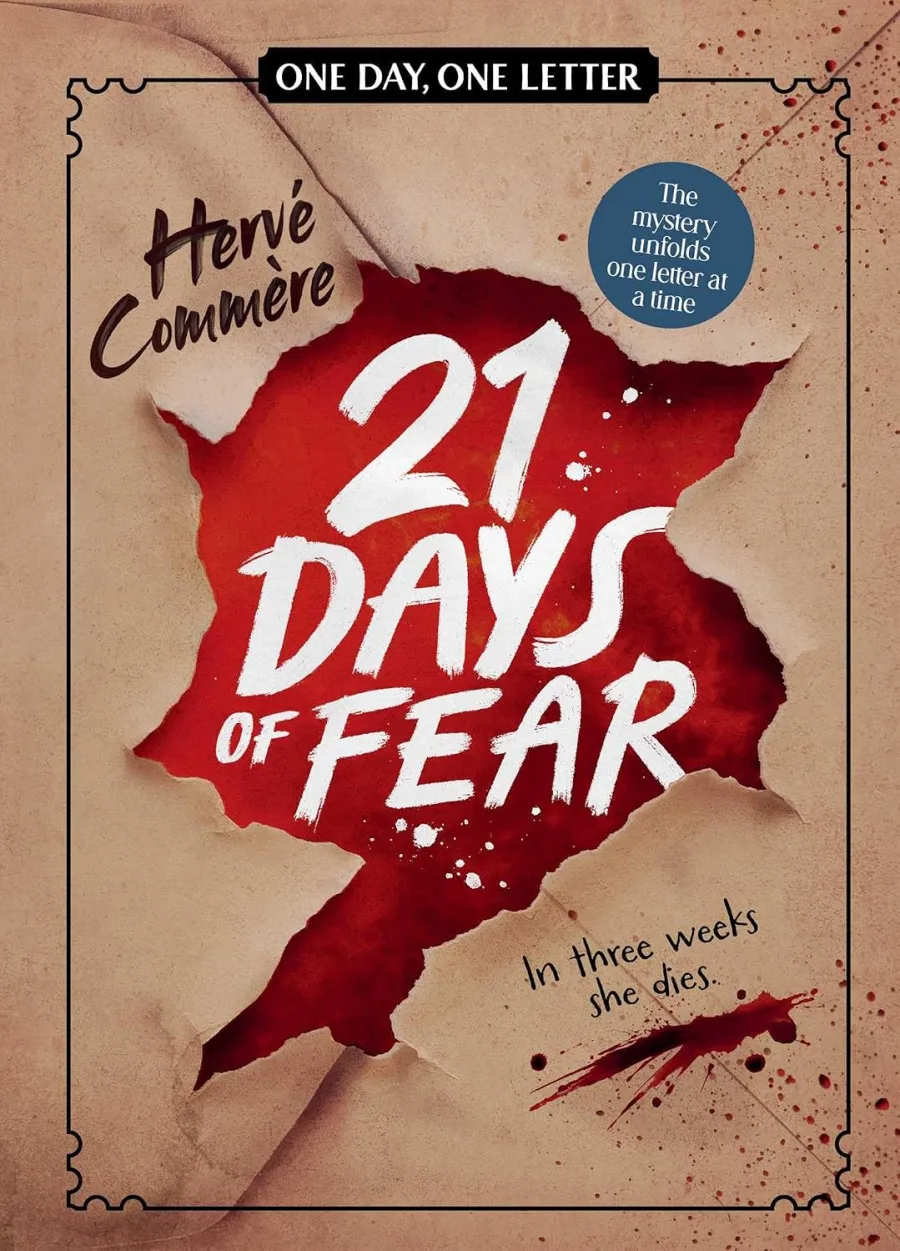
Download Cover Image
Do you want to download the full cover image for 21 Days of Fear: One Day, One Letter?