
Crossing the Wine-Dark Sea: Journeys Through Ancient Literature
Paperback
• 288 Pages
• USD 15.99
• English
• 9781324099406
No ratings yet
| Publisher | Liveright |
|---|---|
| ISBN13 | 9781324099406 |
| ASIN/SKU | 1324099402 |
| Book Format | Paperback |
| Language | English |
| Pages | 288 |
| List Price | USD 15.99 |
| Publishing Date | 01/09/2026 |
| Dimensions | 5.6 x 0.7 x 8.3 inches |
| Weight | 12 ounces |
| Book Code | BD00070313 |
Buy this Book
Amazon Stores
Ebook Stores
Other Stores
Discover Crossing the Wine-Dark Sea: Journeys Through Ancient Literature by Emily Wilson. This book is published by Liveright in Paperback format, ISBN 9781324099406, ASIN 1324099402, under Literature and Fiction, Poetry Literary Criticism, Ancient and Classical Literary Criticism.
Book Description
"An enthralling and profoundly relevant book." ―Salman Rushdie
"I adored reading these joyful, illuminating, and engrossing journeys through ancient literature." ―Madeline Miller
Most Anticipated Books of Fall: Goodreads, Publishers Weekly, Kirkus Reviews
From the most celebrated translator of our time comes a visionary exploration of how translation reshapes and enriches our understanding of the ancient world.
In this sharp and often entertaining tour through antiquity, Emily Wilson―whose renditions of Homer’s Odyssey and Iliad have captured a generation’s imagination―explores the complicated terrain of reading and writing about the ancient past. Drawing on twenty years of scholarship and teaching, Wilson explores the difficult choices that translators must make, the pleasures of finding new solutions to old problems, and the inevitable frustrations of never fully capturing what is in the original work. Across chapters that range from the politics of Helen of Troy to the obscenities of Aristophanes, from Roman imitation of Greek models to contemporary debates over “foreignizing” and “domesticizing” styles, Wilson examines how modern norms of gender, sexuality, violence, humor, and power complicate our readings of ancient works, and how translation always risks denaturing what is unique and strange about the ancient world. Brilliant, erudite, and yet accessible to readers with no classical background, Crossing the Wine-Dark Sea is at once an introduction to the wonders of Greek and Roman literature, a manifesto for the value of translation in a rapidly changing world, and an invitation to encounter ancient cultures anew.
"I adored reading these joyful, illuminating, and engrossing journeys through ancient literature." ―Madeline Miller
Most Anticipated Books of Fall: Goodreads, Publishers Weekly, Kirkus Reviews
From the most celebrated translator of our time comes a visionary exploration of how translation reshapes and enriches our understanding of the ancient world.
In this sharp and often entertaining tour through antiquity, Emily Wilson―whose renditions of Homer’s Odyssey and Iliad have captured a generation’s imagination―explores the complicated terrain of reading and writing about the ancient past. Drawing on twenty years of scholarship and teaching, Wilson explores the difficult choices that translators must make, the pleasures of finding new solutions to old problems, and the inevitable frustrations of never fully capturing what is in the original work. Across chapters that range from the politics of Helen of Troy to the obscenities of Aristophanes, from Roman imitation of Greek models to contemporary debates over “foreignizing” and “domesticizing” styles, Wilson examines how modern norms of gender, sexuality, violence, humor, and power complicate our readings of ancient works, and how translation always risks denaturing what is unique and strange about the ancient world. Brilliant, erudite, and yet accessible to readers with no classical background, Crossing the Wine-Dark Sea is at once an introduction to the wonders of Greek and Roman literature, a manifesto for the value of translation in a rapidly changing world, and an invitation to encounter ancient cultures anew.
Author Biography
Emily Wilson grew up in Oxford, UK, and studied Classics at Balliol College, and English Literature at Corpus Christi College. Her PhD. is from Yale in Classics and Comparative Literature. She is currently a Professor of Classical Studies at the University of Pennsylvania. She is interested in literature, story-telling and how ideas and culture play out through narrative and in words, and in the music of language. She cares about poetry, drama and philosophy of all eras, especially ancient Greek, Roman and early modern. She has written books on tragedy and "overliving", the long afterlife of the death of Socrates, and a life of Seneca. She has also done several verse translations of classical verse drama and epic, including Seneca's tragedies, four plays of Euripides, and Homer's Odyssey.
Her approach to translation is discussed here: http://poems.com/special_features/prose/essay_wilson_odyssey.php
Profiled here: https://www.nytimes.com/2017/11/02/magazine/the-first-woman-to-translate-the-odyssey-into-english.html
Her approach to translation is discussed here: http://poems.com/special_features/prose/essay_wilson_odyssey.php
Profiled here: https://www.nytimes.com/2017/11/02/magazine/the-first-woman-to-translate-the-odyssey-into-english.html
Editorial Reviews
"In these essays, readers can see behind the headlines to [Wilson's] diligent and thoughtful work."
― Kate Tuttle, Boston Globe
"In this dazzling exploration, Wilson, translator of recent editions of Homer’s Iliad and Odyssey, serves as an intrepid guide to the storm-tossed seas of literary translation . . . Through buoyant, accessible analyses and dynamic examples, Wilson artfully connects the ancient world to the present day. This is essential reading."
― Publishers Weekly, starred review
"Enchanting, academic... A lively exploration of ancient literature."
― Kirkus Reviews, starred review
"This fascinating collection of essays explores the challenges and issues that arise from translating classical works . . . an important work for anyone interested in language and literature. Recommended for public and academic libraries alike."
― Library Journal, starred review
"Wilson['s] translations of the Homeric epics the 'Iliad' and the 'Odyssey' have been justly celebrated for their directness and verve.... [A] wonderfully spirited new essay collection.... An expert in the ancient world, [Wilson] nevertheless draws constantly (and productively) from contemporary culture.... Wilson elegantly braids together close, line-by-line readings with larger arguments about how much is often at stake.... You don’t even have to be particularly interested in ancient literature to enjoy this book, though by the time you finish it you probably will be. Wilson’s excitement for her subject is irrepressibly moving.... Even when Wilson issues a barbed critique, she is making room ― for more engagement, more imagination, more complexity."
― Jennifer Szalai, New York Times Book Review
"Wilson is reliably alert to cultural nuance and complexity – not least our own – and does an impressive job of transfusing a classical scholar’s knowledge into the liveliness and uncondescending intelligence of good critical writing."
― Peter McDonald, Times Literary Supplement [UK]
"Fabulous . . . ranges widely, building toward a dazzling final essay in which [Wilson] lays out her particular philosophy of translation."
― Leanne Ogasawara
"A great, approachable collection about the task of translating an alien world and language―the ancient Greeks―into our own."
― Rhian Sasseen
"A masterclass in translation . . . fascinating."
― Blake Morrison, Guardian UK
"Having embarked on an Odyssey of her own, Wilson considers the perils and prejudices of translating the classics . . . [an] engaging investigation into the translator’s art."
― Chris Power, Observer
"Erudite and lively ... Anyone who's been exposed to Wilson's work will learn much from the insights of these essays and will hope her journey as a trusted guide through this distant world continues."
― Harvey Freedenberg, Shelf Awareness
"Emily Wilson’s brilliant reconsiderations of the ancient world―through the figure of Helen of Troy, the remaking of the Iliad by Christopher Logue, the use of comedy to grapple with dark matters, even slavery, and much besides―makes this an enthralling and profoundly relevant book."
― Salman Rushdie
"I adored reading these joyful, illuminating, and engrossing journeys through ancient literature. Wilson’s interest is wide-ranging, moving with elegance and insight across genres and millennia. With wit, passion and clarity, she invites us into each of these fascinating subjects. The final essay especially is required reading for anyone interest in translation, drawing back the veil on how a brilliant scholar and writer approaches her work."
― Madeline Miller
"Vaulting from the ancient to the modern and back again, this collection is erudite, insightful and provocative. An unparalleled insight into the work of a classicist and translator at the height of their powers."
― Paul Cooper, author of Fall of Civilizations
"We’re incredibly lucky to have Emily Wilson writing about the art, politics and ethics of translation and retranslation. Crossing the Wine-Dark Sea is an impressive display of Wilson’s expertise, conviction and wit. Her impact within and without the world of literary translation has been huge."
― Jen Calleja, author of Fair: The Life-Art of Translation
"Emily Wilson unlocks the gates to ancient Greece and Rome: her deep understanding of translation is the key."
― Peter Stothard, author of Horace: Poet on a Volcano
"By turns witty, stylish, ethical and pugilistic, Wilson reveals herself to be as brilliant an essayist as she is a translator…This sparkling collection uses the concept of translation to explore the varieties of the modern West’s addictive relationship to the Greeks and Romans, from its arrant misreadings tot hose moments when the ancients appear as if in a mirror."
― Tim Whitmarsh, author of Battling the Gods
"In her discussion of the possibilities and pitfalls of translations, Wilson has produced a passionately personal―and a times polemic―celebration of language and the power of literature to speak across millennia."
― David Stuttard, author of A History of Ancient Greece in 50 Lives
"Thanks to her best-selling translation of the Odyssey ― and her viral pan of this summer’s blockbuster movie adaptation ― Wilson may be the world’s most famous living classicist. These essays, on topics ranging from the challenges of translating Roman comedy to the commingling of misogyny and desire in the figure of Helen of Troy, show off her scholarly range and her accessible, authoritative, opinionated voice."
― New York Times Book Review
― Kate Tuttle, Boston Globe
"In this dazzling exploration, Wilson, translator of recent editions of Homer’s Iliad and Odyssey, serves as an intrepid guide to the storm-tossed seas of literary translation . . . Through buoyant, accessible analyses and dynamic examples, Wilson artfully connects the ancient world to the present day. This is essential reading."
― Publishers Weekly, starred review
"Enchanting, academic... A lively exploration of ancient literature."
― Kirkus Reviews, starred review
"This fascinating collection of essays explores the challenges and issues that arise from translating classical works . . . an important work for anyone interested in language and literature. Recommended for public and academic libraries alike."
― Library Journal, starred review
"Wilson['s] translations of the Homeric epics the 'Iliad' and the 'Odyssey' have been justly celebrated for their directness and verve.... [A] wonderfully spirited new essay collection.... An expert in the ancient world, [Wilson] nevertheless draws constantly (and productively) from contemporary culture.... Wilson elegantly braids together close, line-by-line readings with larger arguments about how much is often at stake.... You don’t even have to be particularly interested in ancient literature to enjoy this book, though by the time you finish it you probably will be. Wilson’s excitement for her subject is irrepressibly moving.... Even when Wilson issues a barbed critique, she is making room ― for more engagement, more imagination, more complexity."
― Jennifer Szalai, New York Times Book Review
"Wilson is reliably alert to cultural nuance and complexity – not least our own – and does an impressive job of transfusing a classical scholar’s knowledge into the liveliness and uncondescending intelligence of good critical writing."
― Peter McDonald, Times Literary Supplement [UK]
"Fabulous . . . ranges widely, building toward a dazzling final essay in which [Wilson] lays out her particular philosophy of translation."
― Leanne Ogasawara
"A great, approachable collection about the task of translating an alien world and language―the ancient Greeks―into our own."
― Rhian Sasseen
"A masterclass in translation . . . fascinating."
― Blake Morrison, Guardian UK
"Having embarked on an Odyssey of her own, Wilson considers the perils and prejudices of translating the classics . . . [an] engaging investigation into the translator’s art."
― Chris Power, Observer
"Erudite and lively ... Anyone who's been exposed to Wilson's work will learn much from the insights of these essays and will hope her journey as a trusted guide through this distant world continues."
― Harvey Freedenberg, Shelf Awareness
"Emily Wilson’s brilliant reconsiderations of the ancient world―through the figure of Helen of Troy, the remaking of the Iliad by Christopher Logue, the use of comedy to grapple with dark matters, even slavery, and much besides―makes this an enthralling and profoundly relevant book."
― Salman Rushdie
"I adored reading these joyful, illuminating, and engrossing journeys through ancient literature. Wilson’s interest is wide-ranging, moving with elegance and insight across genres and millennia. With wit, passion and clarity, she invites us into each of these fascinating subjects. The final essay especially is required reading for anyone interest in translation, drawing back the veil on how a brilliant scholar and writer approaches her work."
― Madeline Miller
"Vaulting from the ancient to the modern and back again, this collection is erudite, insightful and provocative. An unparalleled insight into the work of a classicist and translator at the height of their powers."
― Paul Cooper, author of Fall of Civilizations
"We’re incredibly lucky to have Emily Wilson writing about the art, politics and ethics of translation and retranslation. Crossing the Wine-Dark Sea is an impressive display of Wilson’s expertise, conviction and wit. Her impact within and without the world of literary translation has been huge."
― Jen Calleja, author of Fair: The Life-Art of Translation
"Emily Wilson unlocks the gates to ancient Greece and Rome: her deep understanding of translation is the key."
― Peter Stothard, author of Horace: Poet on a Volcano
"By turns witty, stylish, ethical and pugilistic, Wilson reveals herself to be as brilliant an essayist as she is a translator…This sparkling collection uses the concept of translation to explore the varieties of the modern West’s addictive relationship to the Greeks and Romans, from its arrant misreadings tot hose moments when the ancients appear as if in a mirror."
― Tim Whitmarsh, author of Battling the Gods
"In her discussion of the possibilities and pitfalls of translations, Wilson has produced a passionately personal―and a times polemic―celebration of language and the power of literature to speak across millennia."
― David Stuttard, author of A History of Ancient Greece in 50 Lives
"Thanks to her best-selling translation of the Odyssey ― and her viral pan of this summer’s blockbuster movie adaptation ― Wilson may be the world’s most famous living classicist. These essays, on topics ranging from the challenges of translating Roman comedy to the commingling of misogyny and desire in the figure of Helen of Troy, show off her scholarly range and her accessible, authoritative, opinionated voice."
― New York Times Book Review
Book Summary
Emily Wilson’s Crossing the Wine-Dark Sea: Journeys Through Ancient Literature is an engaging collection of essays about one of the most difficult and fascinating problems in literature: how do we bring ancient words into the modern world without losing what made them strange, powerful, funny, disturbing, or beautiful in the first place? Published in 2026, the book draws on Wilson’s two decades of scholarship and teaching, as well as her experience translating Homer’s Odyssey and Iliad. Rather than functioning as a conventional history of classical literature, it is a personal, intellectual journey through translation, interpretation, adaptation, gender, sexuality, violence, comedy, cultural influence, and the changing ways readers encounter ancient Greece and Rome. Wilson writes for readers who may have little or no background in Classics, making complicated questions about Greek and Latin literature unusually accessible.
At the center of Crossing the Wine-Dark Sea is Wilson’s conviction that translation is never merely the conversion of words from one language into another. Every translation involves choices. A translator must decide how a particular word should sound, what emotional effect it should create, how closely its rhythm should resemble the original, whether an unfamiliar cultural idea should remain strange to modern readers, and whether an ancient expression should be replaced with something more immediately understandable. Wilson argues that there is no completely neutral translation because language itself carries cultural assumptions and associations. Even a translator who tries to be extremely literal is making interpretive decisions. The result is that every translation becomes, in some sense, a new encounter with an old work.
This idea gives the book its larger purpose. Wilson wants readers to stop thinking of ancient literature as something fixed permanently in the past. Homer, Sappho, Sophocles, Euripides, Aristophanes, Catullus, and other classical writers continue to change as their works are translated, performed, taught, adapted, and read in different historical periods. A modern translation can make an ancient poem feel intimate and immediate, but it can also unintentionally erase aspects of the original culture. Wilson therefore asks readers to consider both the possibilities and dangers of bringing antiquity into the present. The goal is not to make ancient literature completely familiar but to allow its unfamiliarity to challenge modern assumptions.
One of the book’s most important themes is the tension between faithfulness and readability in literary translation. A translator who follows the original wording too closely may produce English that is technically accurate but lifeless. Conversely, a translator who makes everything sound natural to a modern audience may create a smooth and entertaining text while losing important features of the ancient work. Wilson rejects the idea that literal translation is automatically the most faithful approach. A literary work communicates through sound, rhythm, pacing, repetition, imagery, tone, humor, and emotional effect as well as dictionary meaning. Consequently, reproducing what a poem does to its readers can sometimes require departing from its exact wording.
Wilson explores this problem through a wide variety of ancient texts. Her discussion of Sappho, for example, demonstrates how modern readers can project contemporary expectations onto ancient poetry. Sappho's surviving fragments often concern desire, longing, absence, and attraction toward women. Wilson considers how modern feminist and queer scholarship has sometimes attempted to recover particular ideas about community, mutuality, or identity from Sappho. But she also cautions against forcing the ancient poet into a modern ideological framework. For Wilson, Sappho’s power can lie precisely in her ability to make readers experience exclusion, loneliness, longing, and desire without neatly resolving those experiences into contemporary categories.
The figure of Helen of Troy receives similarly careful treatment. Helen has been interpreted in dramatically different ways across centuries: as an adulterous woman responsible for catastrophe, as a victim, as an embodiment of beauty, and as a complicated literary construction whose relationship to desire and representation is constantly changing. Wilson’s discussion of Helen examines how ancient and modern cultures have used her story to think about female sexuality, blame, beauty, and the dangerous power of images. Rather than simply asking whether Helen was “guilty” or “innocent,” Wilson encourages readers to examine the cultural assumptions behind those questions. Her treatment illustrates one of the book’s recurring arguments: ancient literature becomes most interesting when we allow its contradictions to remain visible.
Wilson is equally interested in the parts of classical literature that traditional education sometimes treats as secondary or embarrassing. Her discussion of Aristophanes and ancient comedy is a good example. Aristophanes’ plays are filled with sexual jokes, obscenity, political satire, exaggerated characters, and deliberately outrageous language. Translating such comedy creates a special problem because jokes depend heavily on rhythm, cultural references, sound, timing, and wordplay. A literal translation can preserve the basic meaning of a joke while completely destroying its comic effect. Wilson therefore argues that translators need to reproduce something of the original's energy and linguistic playfulness.
Her comparisons between Aristophanes and contemporary popular music, including Cardi B and Megan Thee Stallion, are deliberately provocative but also intellectually useful. Wilson is not suggesting that ancient Greek comedy and contemporary hip-hop are identical. Instead, she uses the comparison to show how rhythm, sound, sexual language, performance, and verbal invention can create meaning. A modern reader may understand the force of Aristophanes more clearly when thinking about how contemporary performers manipulate language for comic or provocative effect. This approach also challenges the stereotype that classical literature is necessarily formal, solemn, and respectable. Ancient writers could be bawdy, aggressive, crude, playful, and politically outrageous.
Another major concern is the relationship between Greek and Roman literature. Wilson examines how Roman writers borrowed from, imitated, transformed, and competed with Greek models. Roman engagement with Greek literature was not simply a matter of copying an older civilization. Writers such as Catullus, Virgil, and others inherited Greek genres and literary traditions but reshaped them for Roman audiences. Translation and adaptation were therefore already fundamental parts of classical culture itself. This becomes an important insight for understanding Wilson’s larger argument: the ancient world was never culturally isolated or completely original. Greek and Roman writers were themselves readers, imitators, adapters, and creative translators.
The book also examines the problem of modern popularization of the classics. Wilson discusses influential figures such as Edith Hamilton, whose retellings helped generations of English-speaking readers encounter Greek mythology. Rather than dismissing popular versions simply because they simplify scholarship, Wilson recognizes the enormous cultural value of making ancient stories accessible. A popular retelling may not provide the most historically precise account, but it can give readers something equally important: curiosity. Wilson’s broader attitude is inclusive. She wants classical literature to belong not only to specialists but to anyone who finds something meaningful in these ancient stories.
This inclusive approach also shapes Wilson’s discussion of contemporary literature and culture. The book reaches beyond ancient Greece and Rome to consider modern writers and translators, including Han Kang, as well as contemporary cultural figures. These comparisons demonstrate that translation is not simply an ancient-to-modern activity. Literature continually crosses boundaries between languages, cultures, genres, and historical periods. The ancient world can influence modern literature, while modern literature can change the way we perceive antiquity.
A particularly significant concept in the book is the distinction between “foreignizing” and “domesticizing” translation. A domesticating translator makes an ancient text feel natural and familiar to modern readers. A foreignizing translator preserves some of the original’s strangeness, reminding readers that they are encountering a different culture. Wilson sees value in both approaches but resists simplistic loyalty to either one. If a translation domesticates everything, ancient culture may disappear beneath modern assumptions. If it foreignizes everything, the work may become so strange that readers cannot connect with it. The translator’s task is therefore a continual negotiation between accessibility and difference.
This concern becomes especially powerful when Wilson discusses gender, sexuality, slavery, violence, and power. Ancient texts contain ideas that can be deeply uncomfortable for modern readers. The temptation is either to excuse them because they are ancient or to judge them entirely according to present-day standards. Wilson proposes something more demanding: read the ancient text carefully enough to understand its own assumptions while also remaining conscious of how those assumptions affect modern readers. The past should not simply confirm what we already believe. It should have the ability to surprise us, challenge us, and perhaps even change us. Publishers Weekly summarizes this aspect of her argument as a call to “open ourselves to the strangeness of the past.”
The book culminates in a particularly revealing examination of Wilson’s own translation of Homer’s Odyssey. This final essay gives readers an unusual opportunity to see what happens inside a translator’s mind. One famous example concerns the opening description of Odysseus. Wilson chose the relatively simple phrase “a complicated man” for the Greek polytropos, a choice that differs considerably from more elaborate translations. She explains the reasoning behind such decisions and demonstrates how a seemingly ordinary English word can carry enormous interpretive consequences. The point is not that her translation is the only correct one. Rather, translation is an artistic process in which different solutions illuminate different dimensions of the original.
Wilson's discussion of Homer also reveals why multiple translations of the same ancient work are valuable. If one translation were definitive, there would be little reason to translate Homer again. But each generation approaches ancient literature with different linguistic habits, cultural expectations, and literary tastes. New translations can reveal possibilities hidden by older versions. This does not make earlier translators useless; instead, it creates a conversation across generations. Reading several translations can actually bring readers closer to the complexity of the original because the differences expose the choices involved.
Ultimately, Crossing the Wine-Dark Sea is both a book about ancient literature and a book about how human beings communicate across time. Wilson shows that the distance between Homer’s world and ours is not an obstacle that can simply be eliminated. It is part of what makes the encounter meaningful. Ancient literature survives because every generation asks new questions of it. Translators, teachers, writers, performers, and readers continually reshape the way these works are understood.
For readers searching for an Emily Wilson book summary, Crossing the Wine-Dark Sea summary, Emily Wilson translation philosophy, best books about classical literature, ancient Greek literature explained, Homer translation analysis, literary translation and Classics, or Greek and Roman literature for beginners, the book offers an unusually accessible entry point. It does not require extensive knowledge of Greek or Latin, yet it raises sophisticated questions about language, interpretation, culture, and literary history. Its essays can be read individually, but together they form a coherent argument about why ancient literature remains alive.
The deepest lesson of Crossing the Wine-Dark Sea is that translation is not a transparent window onto the past; it is a bridge that inevitably changes both sides. Every bridge involves choices about where to build it and what it can carry. Wilson embraces those choices rather than pretending they do not exist. She treats translation as an imaginative, ethical, and literary act—one that requires humility because no translator can capture everything, but also confidence because creative choices can reveal possibilities that literal equivalence might conceal.
In the end, Wilson asks readers to approach the classics with both curiosity and skepticism. We should not assume that ancient texts are sacred monuments whose meanings were fixed thousands of years ago. Nor should we reduce them to modern versions of ourselves. Instead, we should allow their differences to remain meaningful. Homer can still surprise us. Sappho can still unsettle our categories. Aristophanes can still make us laugh. Helen can still complicate our ideas about beauty and blame. And translation can continue to give these ancient voices new forms without pretending that the distance between their world and ours has disappeared.
That is what makes Crossing the Wine-Dark Sea more than a collection of essays about Classics. It is a meditation on language, cultural memory, literary interpretation, and the enduring human desire to understand people who lived long before us. Emily Wilson demonstrates that ancient literature is not valuable because it belongs to a supposedly superior past, but because it continues to create questions that have no simple answers. The journey across the “wine-dark sea” is therefore not simply a journey toward antiquity. It is a journey between worlds—and, ultimately, a way of discovering how much richer literature becomes when we accept that no single translation, interpretation, or generation can have the final word.
Crossing the Wine-Dark Sea: Journeys Through Ancient Literature is a 288-page 2026 work published by Liveright in the United States and Profile Books in the UK. Its subjects include ancient Greek and Roman literature, literary criticism, translation, poetry, and the history of Classics.
At the center of Crossing the Wine-Dark Sea is Wilson’s conviction that translation is never merely the conversion of words from one language into another. Every translation involves choices. A translator must decide how a particular word should sound, what emotional effect it should create, how closely its rhythm should resemble the original, whether an unfamiliar cultural idea should remain strange to modern readers, and whether an ancient expression should be replaced with something more immediately understandable. Wilson argues that there is no completely neutral translation because language itself carries cultural assumptions and associations. Even a translator who tries to be extremely literal is making interpretive decisions. The result is that every translation becomes, in some sense, a new encounter with an old work.
This idea gives the book its larger purpose. Wilson wants readers to stop thinking of ancient literature as something fixed permanently in the past. Homer, Sappho, Sophocles, Euripides, Aristophanes, Catullus, and other classical writers continue to change as their works are translated, performed, taught, adapted, and read in different historical periods. A modern translation can make an ancient poem feel intimate and immediate, but it can also unintentionally erase aspects of the original culture. Wilson therefore asks readers to consider both the possibilities and dangers of bringing antiquity into the present. The goal is not to make ancient literature completely familiar but to allow its unfamiliarity to challenge modern assumptions.
One of the book’s most important themes is the tension between faithfulness and readability in literary translation. A translator who follows the original wording too closely may produce English that is technically accurate but lifeless. Conversely, a translator who makes everything sound natural to a modern audience may create a smooth and entertaining text while losing important features of the ancient work. Wilson rejects the idea that literal translation is automatically the most faithful approach. A literary work communicates through sound, rhythm, pacing, repetition, imagery, tone, humor, and emotional effect as well as dictionary meaning. Consequently, reproducing what a poem does to its readers can sometimes require departing from its exact wording.
Wilson explores this problem through a wide variety of ancient texts. Her discussion of Sappho, for example, demonstrates how modern readers can project contemporary expectations onto ancient poetry. Sappho's surviving fragments often concern desire, longing, absence, and attraction toward women. Wilson considers how modern feminist and queer scholarship has sometimes attempted to recover particular ideas about community, mutuality, or identity from Sappho. But she also cautions against forcing the ancient poet into a modern ideological framework. For Wilson, Sappho’s power can lie precisely in her ability to make readers experience exclusion, loneliness, longing, and desire without neatly resolving those experiences into contemporary categories.
The figure of Helen of Troy receives similarly careful treatment. Helen has been interpreted in dramatically different ways across centuries: as an adulterous woman responsible for catastrophe, as a victim, as an embodiment of beauty, and as a complicated literary construction whose relationship to desire and representation is constantly changing. Wilson’s discussion of Helen examines how ancient and modern cultures have used her story to think about female sexuality, blame, beauty, and the dangerous power of images. Rather than simply asking whether Helen was “guilty” or “innocent,” Wilson encourages readers to examine the cultural assumptions behind those questions. Her treatment illustrates one of the book’s recurring arguments: ancient literature becomes most interesting when we allow its contradictions to remain visible.
Wilson is equally interested in the parts of classical literature that traditional education sometimes treats as secondary or embarrassing. Her discussion of Aristophanes and ancient comedy is a good example. Aristophanes’ plays are filled with sexual jokes, obscenity, political satire, exaggerated characters, and deliberately outrageous language. Translating such comedy creates a special problem because jokes depend heavily on rhythm, cultural references, sound, timing, and wordplay. A literal translation can preserve the basic meaning of a joke while completely destroying its comic effect. Wilson therefore argues that translators need to reproduce something of the original's energy and linguistic playfulness.
Her comparisons between Aristophanes and contemporary popular music, including Cardi B and Megan Thee Stallion, are deliberately provocative but also intellectually useful. Wilson is not suggesting that ancient Greek comedy and contemporary hip-hop are identical. Instead, she uses the comparison to show how rhythm, sound, sexual language, performance, and verbal invention can create meaning. A modern reader may understand the force of Aristophanes more clearly when thinking about how contemporary performers manipulate language for comic or provocative effect. This approach also challenges the stereotype that classical literature is necessarily formal, solemn, and respectable. Ancient writers could be bawdy, aggressive, crude, playful, and politically outrageous.
Another major concern is the relationship between Greek and Roman literature. Wilson examines how Roman writers borrowed from, imitated, transformed, and competed with Greek models. Roman engagement with Greek literature was not simply a matter of copying an older civilization. Writers such as Catullus, Virgil, and others inherited Greek genres and literary traditions but reshaped them for Roman audiences. Translation and adaptation were therefore already fundamental parts of classical culture itself. This becomes an important insight for understanding Wilson’s larger argument: the ancient world was never culturally isolated or completely original. Greek and Roman writers were themselves readers, imitators, adapters, and creative translators.
The book also examines the problem of modern popularization of the classics. Wilson discusses influential figures such as Edith Hamilton, whose retellings helped generations of English-speaking readers encounter Greek mythology. Rather than dismissing popular versions simply because they simplify scholarship, Wilson recognizes the enormous cultural value of making ancient stories accessible. A popular retelling may not provide the most historically precise account, but it can give readers something equally important: curiosity. Wilson’s broader attitude is inclusive. She wants classical literature to belong not only to specialists but to anyone who finds something meaningful in these ancient stories.
This inclusive approach also shapes Wilson’s discussion of contemporary literature and culture. The book reaches beyond ancient Greece and Rome to consider modern writers and translators, including Han Kang, as well as contemporary cultural figures. These comparisons demonstrate that translation is not simply an ancient-to-modern activity. Literature continually crosses boundaries between languages, cultures, genres, and historical periods. The ancient world can influence modern literature, while modern literature can change the way we perceive antiquity.
A particularly significant concept in the book is the distinction between “foreignizing” and “domesticizing” translation. A domesticating translator makes an ancient text feel natural and familiar to modern readers. A foreignizing translator preserves some of the original’s strangeness, reminding readers that they are encountering a different culture. Wilson sees value in both approaches but resists simplistic loyalty to either one. If a translation domesticates everything, ancient culture may disappear beneath modern assumptions. If it foreignizes everything, the work may become so strange that readers cannot connect with it. The translator’s task is therefore a continual negotiation between accessibility and difference.
This concern becomes especially powerful when Wilson discusses gender, sexuality, slavery, violence, and power. Ancient texts contain ideas that can be deeply uncomfortable for modern readers. The temptation is either to excuse them because they are ancient or to judge them entirely according to present-day standards. Wilson proposes something more demanding: read the ancient text carefully enough to understand its own assumptions while also remaining conscious of how those assumptions affect modern readers. The past should not simply confirm what we already believe. It should have the ability to surprise us, challenge us, and perhaps even change us. Publishers Weekly summarizes this aspect of her argument as a call to “open ourselves to the strangeness of the past.”
The book culminates in a particularly revealing examination of Wilson’s own translation of Homer’s Odyssey. This final essay gives readers an unusual opportunity to see what happens inside a translator’s mind. One famous example concerns the opening description of Odysseus. Wilson chose the relatively simple phrase “a complicated man” for the Greek polytropos, a choice that differs considerably from more elaborate translations. She explains the reasoning behind such decisions and demonstrates how a seemingly ordinary English word can carry enormous interpretive consequences. The point is not that her translation is the only correct one. Rather, translation is an artistic process in which different solutions illuminate different dimensions of the original.
Wilson's discussion of Homer also reveals why multiple translations of the same ancient work are valuable. If one translation were definitive, there would be little reason to translate Homer again. But each generation approaches ancient literature with different linguistic habits, cultural expectations, and literary tastes. New translations can reveal possibilities hidden by older versions. This does not make earlier translators useless; instead, it creates a conversation across generations. Reading several translations can actually bring readers closer to the complexity of the original because the differences expose the choices involved.
Ultimately, Crossing the Wine-Dark Sea is both a book about ancient literature and a book about how human beings communicate across time. Wilson shows that the distance between Homer’s world and ours is not an obstacle that can simply be eliminated. It is part of what makes the encounter meaningful. Ancient literature survives because every generation asks new questions of it. Translators, teachers, writers, performers, and readers continually reshape the way these works are understood.
For readers searching for an Emily Wilson book summary, Crossing the Wine-Dark Sea summary, Emily Wilson translation philosophy, best books about classical literature, ancient Greek literature explained, Homer translation analysis, literary translation and Classics, or Greek and Roman literature for beginners, the book offers an unusually accessible entry point. It does not require extensive knowledge of Greek or Latin, yet it raises sophisticated questions about language, interpretation, culture, and literary history. Its essays can be read individually, but together they form a coherent argument about why ancient literature remains alive.
The deepest lesson of Crossing the Wine-Dark Sea is that translation is not a transparent window onto the past; it is a bridge that inevitably changes both sides. Every bridge involves choices about where to build it and what it can carry. Wilson embraces those choices rather than pretending they do not exist. She treats translation as an imaginative, ethical, and literary act—one that requires humility because no translator can capture everything, but also confidence because creative choices can reveal possibilities that literal equivalence might conceal.
In the end, Wilson asks readers to approach the classics with both curiosity and skepticism. We should not assume that ancient texts are sacred monuments whose meanings were fixed thousands of years ago. Nor should we reduce them to modern versions of ourselves. Instead, we should allow their differences to remain meaningful. Homer can still surprise us. Sappho can still unsettle our categories. Aristophanes can still make us laugh. Helen can still complicate our ideas about beauty and blame. And translation can continue to give these ancient voices new forms without pretending that the distance between their world and ours has disappeared.
That is what makes Crossing the Wine-Dark Sea more than a collection of essays about Classics. It is a meditation on language, cultural memory, literary interpretation, and the enduring human desire to understand people who lived long before us. Emily Wilson demonstrates that ancient literature is not valuable because it belongs to a supposedly superior past, but because it continues to create questions that have no simple answers. The journey across the “wine-dark sea” is therefore not simply a journey toward antiquity. It is a journey between worlds—and, ultimately, a way of discovering how much richer literature becomes when we accept that no single translation, interpretation, or generation can have the final word.
Crossing the Wine-Dark Sea: Journeys Through Ancient Literature is a 288-page 2026 work published by Liveright in the United States and Profile Books in the UK. Its subjects include ancient Greek and Roman literature, literary criticism, translation, poetry, and the history of Classics.
Sample Chapters
Sample Chapters will be added soon…
Reader Reviews
No reviews yet.
Crossing the Wine-Dark Sea: Journeys Through Ancient Literature
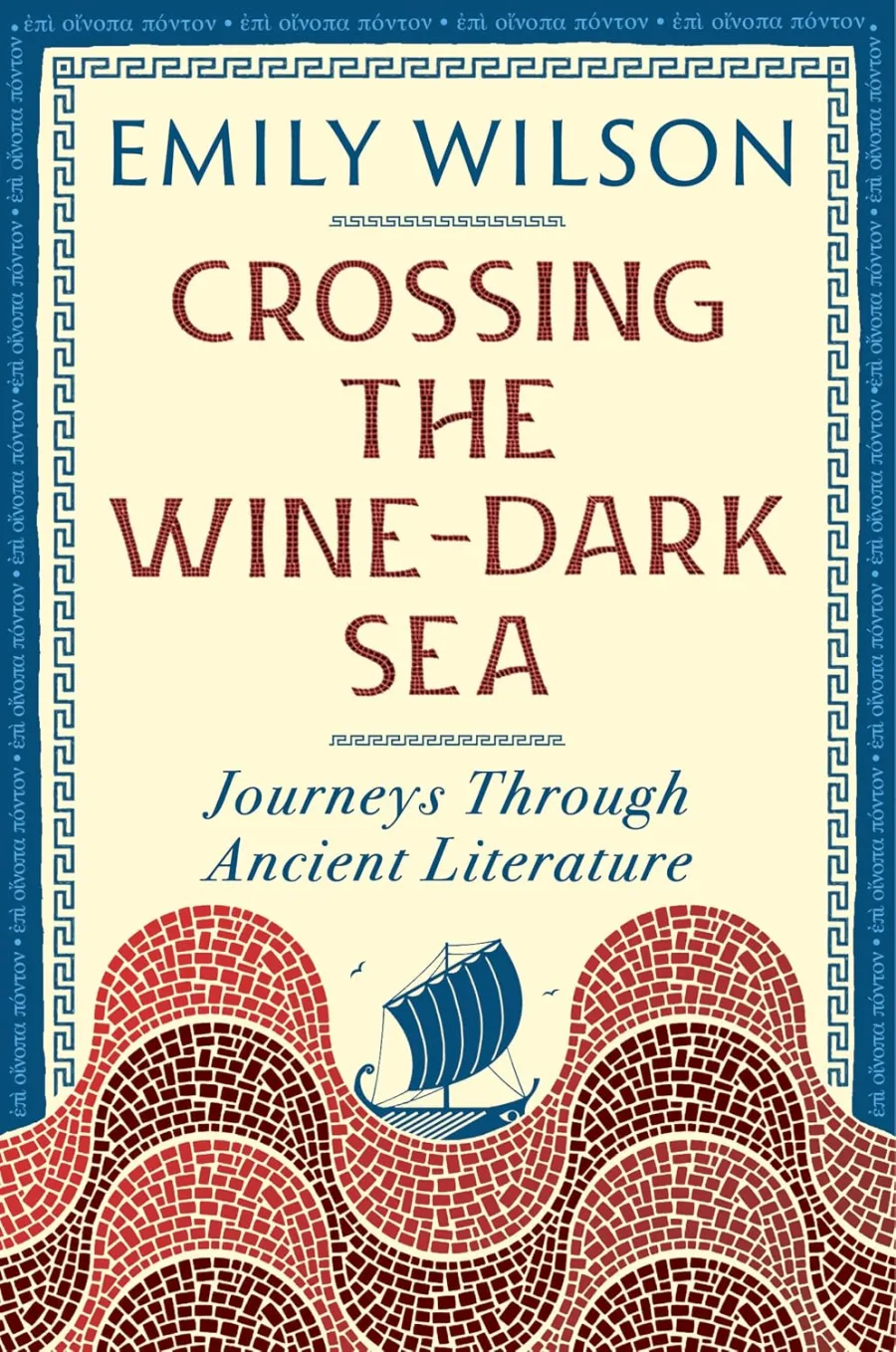
Download Cover Image
Do you want to download the full cover image for Crossing the Wine-Dark Sea: Journeys Through Ancient Literature?