
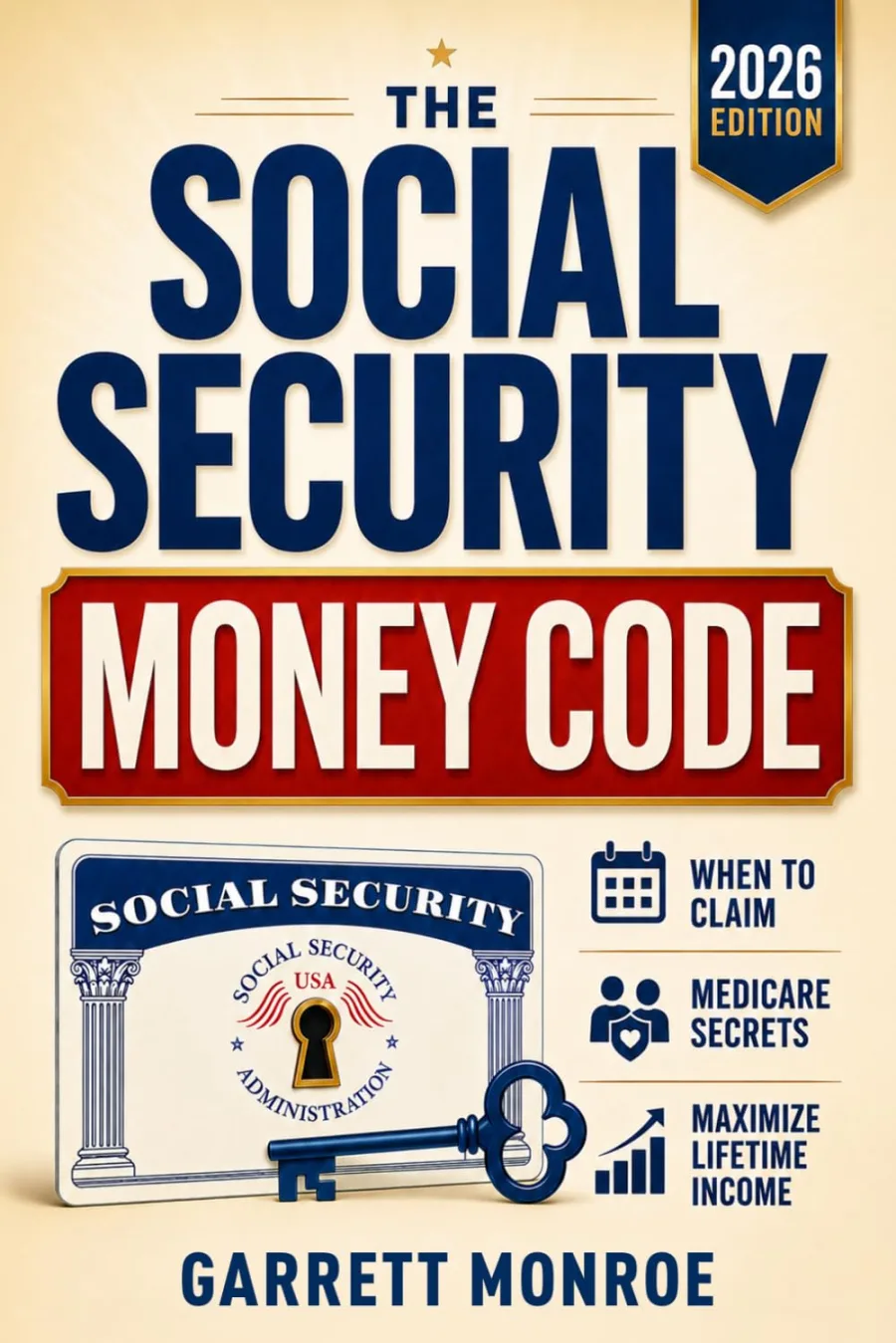
The Social Security Money Code
Paperback
• 153 Pages
• USD 21.97
• English
• 9798993878737
No ratings yet
| Publisher | Legacy Books LLC |
|---|---|
| ISBN13 | 9798993878737 |
| ASIN/SKU | B0HFT4JMCN |
| Book Format | Paperback |
| Language | English |
| Pages | 153 |
| List Price | USD 21.97 |
| Publishing Date | 19/08/2026 |
| Dimensions | 6 x 0.35 x 9 inches |
| Weight | 7.5 ounces |
| Book Code | BD00070315 |
Buy this Book
Amazon Stores
Ebook Stores
Other Stores
Discover The Social Security Money Code by Garrett Monroe. This book is published by Legacy Books LLC in Paperback format, ISBN 9798993878737, ASIN B0HFT4JMCN, under Business and Money, Medicaid and Medicare, Retirement Planning.
Book Description
The Most Complete Social Security & Medicare Guide You'll Ever Need To Maximize Your Retirement Income (Updated Edition - Featuring The Latest Rules, Tax Updates & Medicare Changes)
Introducing The Perfect Investment Under $20 To Help Protect Tens Of Thousands Of Dollars In Lifetime Retirement Income While Giving You Greater Confidence In Every Retirement Decision.
Plus 10 FREE Retirement Planning & Social Security Bonuses Included With Your Purchase
Stop Losing Retirement Income You Spent Decades Earning! Discover When To Claim Social Security, Avoid Costly Medicare & Tax Mistakes, Keep More Of Every Monthly Check & Maximize Every Dollar Of Lifetime Benefits You've Earned Starting Today.
Every Year, Millions Of Americans Unknowingly Lock Themselves Into Permanently Reduced Social Security Benefits, Higher Medicare Premiums And Unnecessary Taxes Simply Because They Didn't Understand The Rules.
The Good News? Most Of These Costly Mistakes Are Avoidable When You Know What To Do Before Making Your Claim. (And That’s Exactly Where This Book Comes In!)
Whether You're Nearing Retirement, Already Collecting Benefits Or Helping A Loved One Prepare For Retirement, This Book Provides Clear, Practical Strategies You Can Apply Immediately.
Inside You'll Discover How To:
Choose The Best Age To Claim Based On Your Unique Situation, Not Just Generic Rules That Could Cost You Tens Of Thousands Of Dollars In Retirement Income
The Little-Known Strategies To Avoid Medicare Enrollment Mistakes That Can Trigger Permanent Penalties, Higher Premiums & Years Of Unnecessary Costs
Finally Understand How Social Security Benefits Are Really Taxed (And The Smart Income Strategies That Could Help You Keep More Of Every Monthly Check)
Coordinate Social Security, Retirement Accounts & Medicare Like A Professional So Every Decision Works Together To Maximize Your Retirement Income
Unlock Often-Overlooked Spousal, Survivor & Divorced-Spouse Benefits That Thousands Of Eligible Americans Never Realize They're Entitled To
Here's A Few More Ways We'll Help You Protect Your Retirement Income:
Discover How Working During Retirement Could Unexpectedly Reduce Your Benefits And The Simple Strategies To Help Avoid Costly Surprises
The Almost Unknown Medicare IRMAA Strategies That Can Help You Avoid Paying Hundreds Or Even Thousands More In Premiums Than Necessary
How Required Minimum Distributions Can Trigger Higher Taxes, Increase Medicare Costs & Reduce The Retirement Income You Actually Get To Keep
Master The Critical Filing Deadlines, Government Rules & Often-Missed Decisions Before A Simple Oversight Becomes A Permanent Financial Mistake
And SO Much More...
PLUS You'll Receive 10 FREE Retirement Planning & Social Security Bonuses:
Social Security Money Code Action Plan
Interactive Claiming Age Calculator
10-Year Retirement Roadmap
Major Life Change Planning Checklist
Social Security & Medicare Quick Reference Guide
12-Month Pre-Claiming Countdown
"Call SSA Like A Pro" Script Pack
Tax-Free Retirement Paycheck Blueprint
Free Government Benefits Beyond Social Security Guide
Widow(er) First-90-Days Action Card
Now it's time to make sure you receive every benefit you've earned, without unnecessary taxes or costly claiming mistakes reducing your retirement income.
Scroll Up And Click "Buy Now" To Start Protecting Your Retirement Income, Maximizing Your Benefits & Unlocking Your Social Security Money Code Today.
Introducing The Perfect Investment Under $20 To Help Protect Tens Of Thousands Of Dollars In Lifetime Retirement Income While Giving You Greater Confidence In Every Retirement Decision.
Plus 10 FREE Retirement Planning & Social Security Bonuses Included With Your Purchase
Stop Losing Retirement Income You Spent Decades Earning! Discover When To Claim Social Security, Avoid Costly Medicare & Tax Mistakes, Keep More Of Every Monthly Check & Maximize Every Dollar Of Lifetime Benefits You've Earned Starting Today.
Every Year, Millions Of Americans Unknowingly Lock Themselves Into Permanently Reduced Social Security Benefits, Higher Medicare Premiums And Unnecessary Taxes Simply Because They Didn't Understand The Rules.
The Good News? Most Of These Costly Mistakes Are Avoidable When You Know What To Do Before Making Your Claim. (And That’s Exactly Where This Book Comes In!)
Whether You're Nearing Retirement, Already Collecting Benefits Or Helping A Loved One Prepare For Retirement, This Book Provides Clear, Practical Strategies You Can Apply Immediately.
Inside You'll Discover How To:
Choose The Best Age To Claim Based On Your Unique Situation, Not Just Generic Rules That Could Cost You Tens Of Thousands Of Dollars In Retirement Income
The Little-Known Strategies To Avoid Medicare Enrollment Mistakes That Can Trigger Permanent Penalties, Higher Premiums & Years Of Unnecessary Costs
Finally Understand How Social Security Benefits Are Really Taxed (And The Smart Income Strategies That Could Help You Keep More Of Every Monthly Check)
Coordinate Social Security, Retirement Accounts & Medicare Like A Professional So Every Decision Works Together To Maximize Your Retirement Income
Unlock Often-Overlooked Spousal, Survivor & Divorced-Spouse Benefits That Thousands Of Eligible Americans Never Realize They're Entitled To
Here's A Few More Ways We'll Help You Protect Your Retirement Income:
Discover How Working During Retirement Could Unexpectedly Reduce Your Benefits And The Simple Strategies To Help Avoid Costly Surprises
The Almost Unknown Medicare IRMAA Strategies That Can Help You Avoid Paying Hundreds Or Even Thousands More In Premiums Than Necessary
How Required Minimum Distributions Can Trigger Higher Taxes, Increase Medicare Costs & Reduce The Retirement Income You Actually Get To Keep
Master The Critical Filing Deadlines, Government Rules & Often-Missed Decisions Before A Simple Oversight Becomes A Permanent Financial Mistake
And SO Much More...
PLUS You'll Receive 10 FREE Retirement Planning & Social Security Bonuses:
Social Security Money Code Action Plan
Interactive Claiming Age Calculator
10-Year Retirement Roadmap
Major Life Change Planning Checklist
Social Security & Medicare Quick Reference Guide
12-Month Pre-Claiming Countdown
"Call SSA Like A Pro" Script Pack
Tax-Free Retirement Paycheck Blueprint
Free Government Benefits Beyond Social Security Guide
Widow(er) First-90-Days Action Card
Now it's time to make sure you receive every benefit you've earned, without unnecessary taxes or costly claiming mistakes reducing your retirement income.
Scroll Up And Click "Buy Now" To Start Protecting Your Retirement Income, Maximizing Your Benefits & Unlocking Your Social Security Money Code Today.
Author Biography
Garrett Monroe is a pen name for a team of writers with business experience in retirement, estate, trust, and financial planning. They’ve built teams, understand how to manage people, and know what it takes to be a successful entrepreneur. These writers have come together to share their knowledge and produce a series of books to help you take your business endeavors and financial life to the next level.
Editorial Reviews
"The Social Security Money Code takes a complex and often confusing subject and explains it in a practical, easy-to-understand way. Garrett Monroe does an excellent job connecting Social Security claiming strategies with Medicare and retirement taxes, showing readers how to avoid costly mistakes and get every dollar they're entitled to."
- Adam Shipkosky, Certified Public Accountant & IRS Enrolled Agent specializing in retirement taxation and retirement income planning
"This book breaks down Social Security and retirement planning into a clear, easy-to-read guide, packed with simple visuals that make the concepts highly digestible. Even after 35 years as a CPA specializing in retirement taxation, I still found a wealth of valuable insights here. It pulls together everything you need to know in one place. A must-read for anyone preparing for retirement."
- Kevin A. Marshall, Certified Public Accountant with 35+ years of experience in retirement taxation and author of Tax Credits Are Sexy
"Garrett Monroe's The Social Security Money Code cuts through government jargon to deliver a practical roadmap for anyone nearing retirement. Rather than treating Social Security as an isolated decision, Monroe shows how claiming strategies can affect taxes, spousal benefits, and Medicare premiums. Packed with up-to-date guidance and practical tools, it's an essential resource for making informed claiming decisions with confidence."
- Justin W. Jones, Tax Attorney and IRS Enrolled Agent specializing in retirement taxation
"The topic of Social Security and income maximization is one of the most important financial and tax planning decisions many people will face. The Social Security Money Code is a fantastic guide to understanding your Social Security benefits. It explains the numerous factors involved in when to begin claiming and how different life events can affect your benefit amount. The details and concepts are presented professionally and in an easy-to-understand way, making this a valuable tool for making informed retirement decisions."
- Timothy Sheardy, Tax professional with 18 years of experience in retirement planning, Social Security maximization, and retirement tax strategies
"The Social Security Money Code is a clear and practical guide for readers who feel overwhelmed by retirement rules. Garrett Monroe turns complex topics into sensible decisions through the four-part Money Code Framework. As someone who advises U.S. healthcare organizations on Medicare policy, I found the book especially strong when it connects claiming age with household benefits, taxes, and Medicare costs rather than treating each issue separately. This is a useful, timely, and reassuring resource for anyone approaching retirement who wants to protect the income they've earned."
- Dr. Adil Maqbool, Physician and healthcare consultant with experience advising U.S. healthcare organizations on Medicare policy
- Adam Shipkosky, Certified Public Accountant & IRS Enrolled Agent specializing in retirement taxation and retirement income planning
"This book breaks down Social Security and retirement planning into a clear, easy-to-read guide, packed with simple visuals that make the concepts highly digestible. Even after 35 years as a CPA specializing in retirement taxation, I still found a wealth of valuable insights here. It pulls together everything you need to know in one place. A must-read for anyone preparing for retirement."
- Kevin A. Marshall, Certified Public Accountant with 35+ years of experience in retirement taxation and author of Tax Credits Are Sexy
"Garrett Monroe's The Social Security Money Code cuts through government jargon to deliver a practical roadmap for anyone nearing retirement. Rather than treating Social Security as an isolated decision, Monroe shows how claiming strategies can affect taxes, spousal benefits, and Medicare premiums. Packed with up-to-date guidance and practical tools, it's an essential resource for making informed claiming decisions with confidence."
- Justin W. Jones, Tax Attorney and IRS Enrolled Agent specializing in retirement taxation
"The topic of Social Security and income maximization is one of the most important financial and tax planning decisions many people will face. The Social Security Money Code is a fantastic guide to understanding your Social Security benefits. It explains the numerous factors involved in when to begin claiming and how different life events can affect your benefit amount. The details and concepts are presented professionally and in an easy-to-understand way, making this a valuable tool for making informed retirement decisions."
- Timothy Sheardy, Tax professional with 18 years of experience in retirement planning, Social Security maximization, and retirement tax strategies
"The Social Security Money Code is a clear and practical guide for readers who feel overwhelmed by retirement rules. Garrett Monroe turns complex topics into sensible decisions through the four-part Money Code Framework. As someone who advises U.S. healthcare organizations on Medicare policy, I found the book especially strong when it connects claiming age with household benefits, taxes, and Medicare costs rather than treating each issue separately. This is a useful, timely, and reassuring resource for anyone approaching retirement who wants to protect the income they've earned."
- Dr. Adil Maqbool, Physician and healthcare consultant with experience advising U.S. healthcare organizations on Medicare policy
Book Summary
The Social Security Money Code by Garrett Monroe is a practical retirement-planning guide built around one deceptively simple question: how can retirees get the greatest possible value from the Social Security benefits they have spent decades earning? Rather than treating Social Security as an automatic monthly payment that begins at a certain age, Garrett Monroe presents retirement income as a series of interconnected financial decisions. When to claim Social Security, when to enroll in Medicare, how retirement-account withdrawals affect taxes, whether a spouse or former spouse may qualify for benefits, and how income affects Medicare premiums can all influence how much money a household ultimately keeps. The book’s central message is that retirement security is not determined solely by how much someone has saved. It is also determined by how intelligently that money and government benefits are coordinated. The 2026 edition specifically emphasizes current rules, tax updates, and Medicare changes.
At the heart of the book is the Social Security claiming decision. Many people approach retirement with a simple assumption: claim benefits as soon as they become available, or wait until a traditional milestone such as full retirement age. Monroe challenges this one-size-fits-all approach. The appropriate claiming age depends on an individual's circumstances, including health, life expectancy, employment, marital status, other retirement income, financial needs, and the role Social Security will play in the overall retirement plan. Claiming earlier can provide income sooner but may result in permanently smaller monthly benefits, while delaying can increase the eventual benefit. The important point is that there is no universally perfect age for everyone. Instead, the book encourages readers to think about Social Security as a lifetime-income decision and compare different claiming strategies before filing. Its focus is therefore not simply on maximizing the monthly check but on maximizing the value of benefits over the course of retirement.
This perspective becomes particularly important for married couples. Social Security is not merely an individual program; the claiming decisions of one spouse can affect the financial security of both. The book highlights often-overlooked spousal benefits and encourages retirees to look beyond the benefits shown on an individual's own record. Coordinating the timing of two people's claims can potentially produce a more effective household income strategy than having each person make an independent decision. The same principle applies to survivor benefits. A retirement strategy that looks attractive while both spouses are alive may look very different after the death of one spouse. Monroe therefore emphasizes planning for the possibility of widowhood rather than assuming that today's household income will remain unchanged throughout retirement.
The book also addresses divorced-spouse benefits, an area that many retirees may overlook simply because they are no longer married to the person whose work record could matter. Monroe's approach is to encourage readers to understand the rules before assuming they are limited to their own Social Security record. For people who have experienced divorce, remarriage, widowhood, or other major life changes, the eligibility rules can become especially important. The broader lesson is that Social Security planning requires looking at a person's complete family and employment history rather than relying on a simplified rule of thumb. The book's inclusion of these circumstances makes it particularly relevant to people approaching retirement who have complicated family situations.
A second major theme is Medicare. Monroe treats Medicare enrollment as more than an administrative task that can be handled casually once someone reaches retirement age. According to the book's description, mistakes surrounding enrollment can lead to penalties, higher premiums, and unnecessary costs that may continue for years. This is why timing matters. Retirees may be transitioning from employer-sponsored health coverage, changing jobs, retiring after decades of employment, or coordinating coverage with a spouse. A decision that seems minor at the time can have long-lasting financial consequences. The book therefore encourages readers to understand important Medicare deadlines and make enrollment decisions deliberately rather than assuming that everything will happen automatically.
The connection between Medicare and income is another important part of Monroe's financial framework. Retirees sometimes think about taxes and healthcare premiums as separate subjects, but the book explains why they need to be considered together. Higher income can affect Medicare costs through income-related premium adjustments, meaning that the amount a retiree withdraws from retirement accounts or realizes from other sources may have consequences beyond the income tax bill itself. The book specifically draws attention to Medicare's Income-Related Monthly Adjustment Amount, commonly known as IRMAA. For retirees with substantial income, managing taxable income can therefore become a healthcare-planning issue as well as a tax-planning issue.
Taxation of Social Security benefits forms another major component of The Social Security Money Code. A common misconception is that Social Security is automatically tax-free because the benefits are government-provided. In reality, depending on a person's overall income and circumstances, some Social Security benefits may be subject to federal income taxation. Monroe's approach is to encourage readers to consider Social Security taxes as part of a broader retirement-income strategy. The question is not simply how much income someone receives but how different sources of income interact. Social Security, pensions, investment income, and withdrawals from retirement accounts can all influence the tax picture.
This leads naturally to the book's discussion of retirement-account withdrawals and Required Minimum Distributions, or RMDs. For retirees with traditional tax-deferred accounts, withdrawals can become an important source of taxable income. Monroe emphasizes that RMDs can create consequences beyond the immediate tax bill. They may increase taxable income, potentially affect the taxation of Social Security benefits, and contribute to higher Medicare premiums. In other words, a retirement account cannot be evaluated in isolation. A withdrawal that looks reasonable from a cash-flow perspective may produce an unexpected tax or Medicare consequence. The book encourages readers to think several steps ahead rather than reacting to mandatory withdrawals after they occur.
Working during retirement introduces another layer of complexity. Some people begin collecting Social Security while continuing to earn wages. Depending on age and circumstances, employment income can affect benefits under Social Security's earnings rules. Monroe highlights this as another situation in which retirees can experience unpleasant surprises if they do not understand the rules beforehand. The broader philosophy of the book is consistent throughout: retirement decisions should be planned before they become irreversible or expensive. Knowing how employment income interacts with benefits can help retirees make more informed decisions about when to file and how much they want to work.
One of the strongest themes running through the book is the importance of coordination. Monroe does not present Social Security as a stand-alone financial product. Instead, it is one piece of a retirement-income system that also includes savings, investment accounts, taxes, Medicare, employment income, and family benefits. A decision that improves one part of the system can sometimes weaken another. For example, delaying Social Security might require drawing more heavily from savings in the short term, while claiming earlier could reduce future guaranteed income. Taking large retirement-account distributions may provide needed cash but could also increase taxes or Medicare premiums. The best strategy therefore depends on the interaction among multiple variables.
The book also emphasizes deadlines and administrative details. Retirement planning is often associated with broad financial concepts such as saving, investing, and budgeting, but government programs contain numerous filing requirements, eligibility rules, and important dates. Missing a deadline or misunderstanding a rule can potentially create consequences that are difficult or expensive to reverse. Monroe's focus on checklists, countdowns, action plans, and practical reference materials reflects the idea that successful retirement planning requires execution as well as knowledge. The published edition includes resources such as a Social Security Money Code Action Plan, a claiming-age calculator, a 10-year retirement roadmap, a major-life-change checklist, a Social Security and Medicare quick-reference guide, and a 12-month pre-claiming countdown.
The practical tone is one of the book's defining characteristics. Rather than presenting retirement planning exclusively through technical financial terminology, Monroe frames the subject around mistakes that ordinary retirees can recognize: claiming too early without considering the long-term consequences, overlooking a benefit for which a spouse or former spouse may qualify, missing a Medicare enrollment deadline, taking withdrawals without considering their effect on taxes, or discovering that higher income has increased Medicare premiums. This makes the book particularly relevant to readers who are approaching retirement but do not consider themselves financial experts.
Ultimately, The Social Security Money Code argues that retirement income should be managed intentionally rather than passively. The book's "code" is essentially the collection of rules, timing decisions, tax considerations, benefit opportunities, and coordination strategies that determine how effectively someone converts years of work and savings into sustainable retirement income. Its most important lesson is that maximizing retirement income does not necessarily mean chasing the largest possible payment today. It means considering the entire retirement horizon and asking how each decision affects taxes, healthcare costs, household income, survivor protection, and financial security in later years.
For someone searching for a Social Security claiming strategy, how to maximize Social Security benefits, the best age to claim Social Security, Social Security and Medicare planning, how Social Security benefits are taxed, IRMAA strategies, RMD tax planning, spousal Social Security benefits, divorced-spouse Social Security benefits, or retirement income planning, Monroe's book is positioned as a comprehensive practical guide to these interconnected questions. It is especially useful conceptually for people nearing retirement who realize that the difference between a good retirement plan and an expensive mistake can come down to timing and coordination.
The broader human message is reassuring rather than intimidating. Retirement planning can appear overwhelming because government programs contain complicated rules and because financial decisions made in one's sixties can affect decades of life afterward. The Social Security Money Code attempts to turn that complexity into a manageable process. Instead of expecting retirees to memorize every regulation, it encourages them to ask the right questions, understand the major financial interactions, prepare before critical deadlines, and make decisions based on their own circumstances. In that sense, the book is less about finding one secret trick and more about developing a disciplined way of thinking about retirement.
The book was published in 2026 by Legacy Books LLC and is approximately 153–154 pages in paperback, with an audiobook edition narrated by N.W. Edwards. Its stated subject areas include personal finance, retirement planning, Social Security, Medicare, taxation, and government benefits.
In conclusion, The Social Security Money Code presents Social Security as one of the most important financial assets many Americans possess, but also one that requires careful planning to use effectively. Garrett Monroe's central argument is that retirees should not simply ask, “When can I start collecting?” They should ask a much larger set of questions: When should I claim? How does my decision affect my spouse? What happens if I die first? What benefits might I qualify for through a former spouse? When should I enroll in Medicare? How will retirement-account withdrawals affect my taxes? Could those withdrawals increase Medicare premiums? What happens if I continue working? And which deadlines must I meet to avoid costly mistakes?
By bringing these questions together, the book presents retirement as an interconnected financial system rather than a collection of isolated decisions. Its practical emphasis is ultimately about helping readers retain more of the money they have earned, reduce avoidable costs, and enter retirement with greater confidence. The most valuable lesson is therefore not a single claiming-age rule or tax trick. It is the recognition that timing, coordination, and preparation can be just as important as the amount of money saved for retirement.
At the heart of the book is the Social Security claiming decision. Many people approach retirement with a simple assumption: claim benefits as soon as they become available, or wait until a traditional milestone such as full retirement age. Monroe challenges this one-size-fits-all approach. The appropriate claiming age depends on an individual's circumstances, including health, life expectancy, employment, marital status, other retirement income, financial needs, and the role Social Security will play in the overall retirement plan. Claiming earlier can provide income sooner but may result in permanently smaller monthly benefits, while delaying can increase the eventual benefit. The important point is that there is no universally perfect age for everyone. Instead, the book encourages readers to think about Social Security as a lifetime-income decision and compare different claiming strategies before filing. Its focus is therefore not simply on maximizing the monthly check but on maximizing the value of benefits over the course of retirement.
This perspective becomes particularly important for married couples. Social Security is not merely an individual program; the claiming decisions of one spouse can affect the financial security of both. The book highlights often-overlooked spousal benefits and encourages retirees to look beyond the benefits shown on an individual's own record. Coordinating the timing of two people's claims can potentially produce a more effective household income strategy than having each person make an independent decision. The same principle applies to survivor benefits. A retirement strategy that looks attractive while both spouses are alive may look very different after the death of one spouse. Monroe therefore emphasizes planning for the possibility of widowhood rather than assuming that today's household income will remain unchanged throughout retirement.
The book also addresses divorced-spouse benefits, an area that many retirees may overlook simply because they are no longer married to the person whose work record could matter. Monroe's approach is to encourage readers to understand the rules before assuming they are limited to their own Social Security record. For people who have experienced divorce, remarriage, widowhood, or other major life changes, the eligibility rules can become especially important. The broader lesson is that Social Security planning requires looking at a person's complete family and employment history rather than relying on a simplified rule of thumb. The book's inclusion of these circumstances makes it particularly relevant to people approaching retirement who have complicated family situations.
A second major theme is Medicare. Monroe treats Medicare enrollment as more than an administrative task that can be handled casually once someone reaches retirement age. According to the book's description, mistakes surrounding enrollment can lead to penalties, higher premiums, and unnecessary costs that may continue for years. This is why timing matters. Retirees may be transitioning from employer-sponsored health coverage, changing jobs, retiring after decades of employment, or coordinating coverage with a spouse. A decision that seems minor at the time can have long-lasting financial consequences. The book therefore encourages readers to understand important Medicare deadlines and make enrollment decisions deliberately rather than assuming that everything will happen automatically.
The connection between Medicare and income is another important part of Monroe's financial framework. Retirees sometimes think about taxes and healthcare premiums as separate subjects, but the book explains why they need to be considered together. Higher income can affect Medicare costs through income-related premium adjustments, meaning that the amount a retiree withdraws from retirement accounts or realizes from other sources may have consequences beyond the income tax bill itself. The book specifically draws attention to Medicare's Income-Related Monthly Adjustment Amount, commonly known as IRMAA. For retirees with substantial income, managing taxable income can therefore become a healthcare-planning issue as well as a tax-planning issue.
Taxation of Social Security benefits forms another major component of The Social Security Money Code. A common misconception is that Social Security is automatically tax-free because the benefits are government-provided. In reality, depending on a person's overall income and circumstances, some Social Security benefits may be subject to federal income taxation. Monroe's approach is to encourage readers to consider Social Security taxes as part of a broader retirement-income strategy. The question is not simply how much income someone receives but how different sources of income interact. Social Security, pensions, investment income, and withdrawals from retirement accounts can all influence the tax picture.
This leads naturally to the book's discussion of retirement-account withdrawals and Required Minimum Distributions, or RMDs. For retirees with traditional tax-deferred accounts, withdrawals can become an important source of taxable income. Monroe emphasizes that RMDs can create consequences beyond the immediate tax bill. They may increase taxable income, potentially affect the taxation of Social Security benefits, and contribute to higher Medicare premiums. In other words, a retirement account cannot be evaluated in isolation. A withdrawal that looks reasonable from a cash-flow perspective may produce an unexpected tax or Medicare consequence. The book encourages readers to think several steps ahead rather than reacting to mandatory withdrawals after they occur.
Working during retirement introduces another layer of complexity. Some people begin collecting Social Security while continuing to earn wages. Depending on age and circumstances, employment income can affect benefits under Social Security's earnings rules. Monroe highlights this as another situation in which retirees can experience unpleasant surprises if they do not understand the rules beforehand. The broader philosophy of the book is consistent throughout: retirement decisions should be planned before they become irreversible or expensive. Knowing how employment income interacts with benefits can help retirees make more informed decisions about when to file and how much they want to work.
One of the strongest themes running through the book is the importance of coordination. Monroe does not present Social Security as a stand-alone financial product. Instead, it is one piece of a retirement-income system that also includes savings, investment accounts, taxes, Medicare, employment income, and family benefits. A decision that improves one part of the system can sometimes weaken another. For example, delaying Social Security might require drawing more heavily from savings in the short term, while claiming earlier could reduce future guaranteed income. Taking large retirement-account distributions may provide needed cash but could also increase taxes or Medicare premiums. The best strategy therefore depends on the interaction among multiple variables.
The book also emphasizes deadlines and administrative details. Retirement planning is often associated with broad financial concepts such as saving, investing, and budgeting, but government programs contain numerous filing requirements, eligibility rules, and important dates. Missing a deadline or misunderstanding a rule can potentially create consequences that are difficult or expensive to reverse. Monroe's focus on checklists, countdowns, action plans, and practical reference materials reflects the idea that successful retirement planning requires execution as well as knowledge. The published edition includes resources such as a Social Security Money Code Action Plan, a claiming-age calculator, a 10-year retirement roadmap, a major-life-change checklist, a Social Security and Medicare quick-reference guide, and a 12-month pre-claiming countdown.
The practical tone is one of the book's defining characteristics. Rather than presenting retirement planning exclusively through technical financial terminology, Monroe frames the subject around mistakes that ordinary retirees can recognize: claiming too early without considering the long-term consequences, overlooking a benefit for which a spouse or former spouse may qualify, missing a Medicare enrollment deadline, taking withdrawals without considering their effect on taxes, or discovering that higher income has increased Medicare premiums. This makes the book particularly relevant to readers who are approaching retirement but do not consider themselves financial experts.
Ultimately, The Social Security Money Code argues that retirement income should be managed intentionally rather than passively. The book's "code" is essentially the collection of rules, timing decisions, tax considerations, benefit opportunities, and coordination strategies that determine how effectively someone converts years of work and savings into sustainable retirement income. Its most important lesson is that maximizing retirement income does not necessarily mean chasing the largest possible payment today. It means considering the entire retirement horizon and asking how each decision affects taxes, healthcare costs, household income, survivor protection, and financial security in later years.
For someone searching for a Social Security claiming strategy, how to maximize Social Security benefits, the best age to claim Social Security, Social Security and Medicare planning, how Social Security benefits are taxed, IRMAA strategies, RMD tax planning, spousal Social Security benefits, divorced-spouse Social Security benefits, or retirement income planning, Monroe's book is positioned as a comprehensive practical guide to these interconnected questions. It is especially useful conceptually for people nearing retirement who realize that the difference between a good retirement plan and an expensive mistake can come down to timing and coordination.
The broader human message is reassuring rather than intimidating. Retirement planning can appear overwhelming because government programs contain complicated rules and because financial decisions made in one's sixties can affect decades of life afterward. The Social Security Money Code attempts to turn that complexity into a manageable process. Instead of expecting retirees to memorize every regulation, it encourages them to ask the right questions, understand the major financial interactions, prepare before critical deadlines, and make decisions based on their own circumstances. In that sense, the book is less about finding one secret trick and more about developing a disciplined way of thinking about retirement.
The book was published in 2026 by Legacy Books LLC and is approximately 153–154 pages in paperback, with an audiobook edition narrated by N.W. Edwards. Its stated subject areas include personal finance, retirement planning, Social Security, Medicare, taxation, and government benefits.
In conclusion, The Social Security Money Code presents Social Security as one of the most important financial assets many Americans possess, but also one that requires careful planning to use effectively. Garrett Monroe's central argument is that retirees should not simply ask, “When can I start collecting?” They should ask a much larger set of questions: When should I claim? How does my decision affect my spouse? What happens if I die first? What benefits might I qualify for through a former spouse? When should I enroll in Medicare? How will retirement-account withdrawals affect my taxes? Could those withdrawals increase Medicare premiums? What happens if I continue working? And which deadlines must I meet to avoid costly mistakes?
By bringing these questions together, the book presents retirement as an interconnected financial system rather than a collection of isolated decisions. Its practical emphasis is ultimately about helping readers retain more of the money they have earned, reduce avoidable costs, and enter retirement with greater confidence. The most valuable lesson is therefore not a single claiming-age rule or tax trick. It is the recognition that timing, coordination, and preparation can be just as important as the amount of money saved for retirement.
Sample Chapters
Sample Chapters will be added soon…
Reader Reviews
No reviews yet.
The Social Security Money Code
Download Cover Image
Do you want to download the full cover image for The Social Security Money Code?