
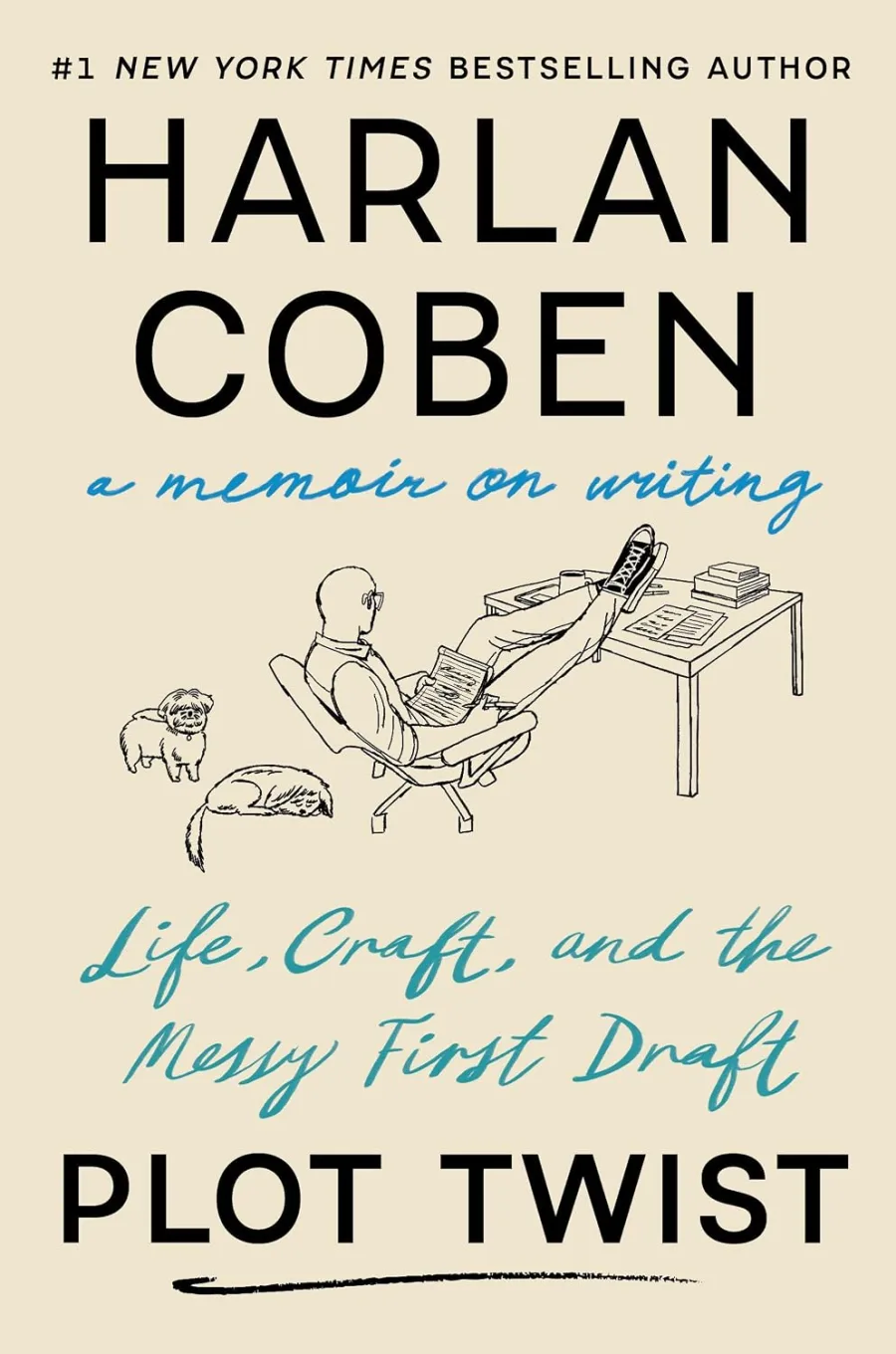
Plot Twist: Life, Craft, and the Messy First Draft: A Memoir on Writing
Hardcover
• 320 Pages
• USD 32.50
• English
• 9781538784624
No ratings yet
| Publisher | Grand Central Publishing |
|---|---|
| ISBN13 | 9781538784624 |
| ASIN/SKU | 1538784629 |
| Book Format | Hardcover |
| Language | English |
| Pages | 320 |
| List Price | USD 32.50 |
| Publishing Date | 08/09/2026 |
| Dimensions | 5.85 x 1.06 x 8.7 inches |
| Weight | 13.6 ounces |
| Book Code | BD00070451 |
Buy this Book
Amazon Stores
Ebook Stores
Other Stores
Discover Plot Twist: Life, Craft, and the Messy First Draft: A Memoir on Writing by Harlan Coben. This book is published by Grand Central Publishing in Hardcover format, ISBN 9781538784624, ASIN 1538784629, under Biographies and Memoirs, Author Biographies, Memoirs.
Book Description
#1 New York Times bestselling author Harlan Coben offers a look behind the curtain at his own writing process in an inspiring, candid memoir filled with indispensable insights and techniques.
“For aspiring writers, Harlan’s advice, stories, and anecdotes are wise, proven, and valuable. For published authors, his book evokes memories of what it was like back then. It’s a romp, a riot, and a joy to read.” ―John Grisham
With 100 million books in print world-wide and over twenty blockbuster television and film adaptations of his work, Harlan Coben has much to teach us about the creative process. Part deeply personal memoir, part masterclass in storytelling, Plot Twist is a refreshingly honest look at the life of a writer whose stories have thrilled us for decades.
Plumbing memories from his suburban childhood and his early years trying to break into publishing, Coben tells his own story for the first time, revealing the real-world inspirations for some of his most beloved characters as well as the innovative plots that drive his propulsive novels. Filled with useful tips and techniques on the creative process, Coben does away with the traditional "categories" of writing―characters, plot, setting, etc―and looks at the process holistically.
Plot Twist is a masterclass on the act of being a writer, and everything that comes with it: the self-doubt, the hubris, the contradictions, the passion and dedication. At the end of the day, his calculus is a simple one: “If it helps me produce pages, good. If it doesn’t, bad.” This book will help every aspiring writer produce pages.
Honest, funny, insightful, and at times deeply moving, this is both a captivating memoir and an essential guide for anyone looking to master the art of storytelling from one of our most beloved authors.
“For aspiring writers, Harlan’s advice, stories, and anecdotes are wise, proven, and valuable. For published authors, his book evokes memories of what it was like back then. It’s a romp, a riot, and a joy to read.” ―John Grisham
With 100 million books in print world-wide and over twenty blockbuster television and film adaptations of his work, Harlan Coben has much to teach us about the creative process. Part deeply personal memoir, part masterclass in storytelling, Plot Twist is a refreshingly honest look at the life of a writer whose stories have thrilled us for decades.
Plumbing memories from his suburban childhood and his early years trying to break into publishing, Coben tells his own story for the first time, revealing the real-world inspirations for some of his most beloved characters as well as the innovative plots that drive his propulsive novels. Filled with useful tips and techniques on the creative process, Coben does away with the traditional "categories" of writing―characters, plot, setting, etc―and looks at the process holistically.
Plot Twist is a masterclass on the act of being a writer, and everything that comes with it: the self-doubt, the hubris, the contradictions, the passion and dedication. At the end of the day, his calculus is a simple one: “If it helps me produce pages, good. If it doesn’t, bad.” This book will help every aspiring writer produce pages.
Honest, funny, insightful, and at times deeply moving, this is both a captivating memoir and an essential guide for anyone looking to master the art of storytelling from one of our most beloved authors.
Author Biography
With over 80 million books in print worldwide, Harlan Coben is the #1 New York Times author of thirty five novels including WIN, THE BOY FROM THE WOODS, RUN AWAY, FOOL ME ONCE, TELL NO ONE and the renowned Myron Bolitar series. His books are published in 46 languages around the globe.
Harlan is the creator and executive producer of several Netflix television dramas including FOOL ME ONCE, STAY CLOSE, THE STRANGER, SAFE, THE FIVE, THE INNOCENT and THE WOODS. He is also the creator and executive producer of the Prime Video series Harlan Coben’s SHELTER, based on his young adult books featuring Mickey Bolitar. Harlan was the showrunner and executive producer for two French TV mini-series, UNE CHANCE DE TROP (NO SECOND CHANCE) and JUST UN REGARD (JUST ONE LOOK). KEINE ZWEIT CHANCE, also based on Harlan’s novel, aired in Germany on Sat1.
Harlan’s novel TELL NO ONE (NE LE DIS A PERSONNE) was turned into the renowned French film, directed by Guillaume Canet and starring Francois Cluzet. The movie was the top box office foreign-language film of the year in the USA, won the Lumiere (French Golden Globe) for best picture and was nominated for nine Cesars (French Oscar) and won four, including best actor, best director and best music.
Winner of the Edgar Award, Shamus Award and Anthony Award – the first author to win all three – international bestselling author Harlan Coben’s critically-acclaimed novels have been called “ingenious” (New York Times), “poignant and insightful” (Los Angeles Times), “consistently entertaining” (Houston Chronicle), “superb” (Chicago Tribune) and “must reading” (Philadelphia Inquirer).
In his first books, Coben immersed himself in the exploits of sports agent Myron Bolitar. Critics loved the series, saying, “You race to turn pages…both suspenseful and often surprisingly funny” (People). After seven books Coben wanted to try something different. “I came up with a great idea that simply would not work for Myron,” says Coben. The result was the critically acclaimed New York Times bestseller TELL NO ONE, which became the most decorated thriller of the year. Two books later, Bookspan, recognizing Coben’s broad international appeal, named NO SECOND CHANCE its first ever International Book of the Month in 2003 – the Main Selection in 15 different countries.
Harlan was the first writer in more than a decade to be invited to write fiction for the NEW YORK TIMES op-ed page. His Father’s Day short story, THE KEY TO MY FATHER, appeared June 15, 2003. His essays and columns have appeared in many top publications including the New York Times, Parade Magazine and Bloomberg Views.
Harlan has received an eclectic variety of honors from all over the world. In Paris, he was awarded the prestigious Vermeil Medal of Honor for contributions to culture and society by the Mayor of Paris. He has won the El Premio del Novela Negra RBA in Spain, the Grand Prix de Lectrices in France, and the CWA/ITV3 Bestseller Dagger for favorite crime novelist in England. On the other end of the spectrum, Little League Baseball inducted Harlan into their Hall of Excellence in 2013, and Harlan is also a member of the New England Basketball Hall of Fame from his playing days at Amherst College.
Harlan was born in Newark, New Jersey. He still lives in New Jersey with his wife, Anne Armstrong-Coben MD, a pediatrician, and their four children.
Harlan is the creator and executive producer of several Netflix television dramas including FOOL ME ONCE, STAY CLOSE, THE STRANGER, SAFE, THE FIVE, THE INNOCENT and THE WOODS. He is also the creator and executive producer of the Prime Video series Harlan Coben’s SHELTER, based on his young adult books featuring Mickey Bolitar. Harlan was the showrunner and executive producer for two French TV mini-series, UNE CHANCE DE TROP (NO SECOND CHANCE) and JUST UN REGARD (JUST ONE LOOK). KEINE ZWEIT CHANCE, also based on Harlan’s novel, aired in Germany on Sat1.
Harlan’s novel TELL NO ONE (NE LE DIS A PERSONNE) was turned into the renowned French film, directed by Guillaume Canet and starring Francois Cluzet. The movie was the top box office foreign-language film of the year in the USA, won the Lumiere (French Golden Globe) for best picture and was nominated for nine Cesars (French Oscar) and won four, including best actor, best director and best music.
Winner of the Edgar Award, Shamus Award and Anthony Award – the first author to win all three – international bestselling author Harlan Coben’s critically-acclaimed novels have been called “ingenious” (New York Times), “poignant and insightful” (Los Angeles Times), “consistently entertaining” (Houston Chronicle), “superb” (Chicago Tribune) and “must reading” (Philadelphia Inquirer).
In his first books, Coben immersed himself in the exploits of sports agent Myron Bolitar. Critics loved the series, saying, “You race to turn pages…both suspenseful and often surprisingly funny” (People). After seven books Coben wanted to try something different. “I came up with a great idea that simply would not work for Myron,” says Coben. The result was the critically acclaimed New York Times bestseller TELL NO ONE, which became the most decorated thriller of the year. Two books later, Bookspan, recognizing Coben’s broad international appeal, named NO SECOND CHANCE its first ever International Book of the Month in 2003 – the Main Selection in 15 different countries.
Harlan was the first writer in more than a decade to be invited to write fiction for the NEW YORK TIMES op-ed page. His Father’s Day short story, THE KEY TO MY FATHER, appeared June 15, 2003. His essays and columns have appeared in many top publications including the New York Times, Parade Magazine and Bloomberg Views.
Harlan has received an eclectic variety of honors from all over the world. In Paris, he was awarded the prestigious Vermeil Medal of Honor for contributions to culture and society by the Mayor of Paris. He has won the El Premio del Novela Negra RBA in Spain, the Grand Prix de Lectrices in France, and the CWA/ITV3 Bestseller Dagger for favorite crime novelist in England. On the other end of the spectrum, Little League Baseball inducted Harlan into their Hall of Excellence in 2013, and Harlan is also a member of the New England Basketball Hall of Fame from his playing days at Amherst College.
Harlan was born in Newark, New Jersey. He still lives in New Jersey with his wife, Anne Armstrong-Coben MD, a pediatrician, and their four children.
Editorial Reviews
“For aspiring writers, Harlan’s advice, stories, and anecdotes are wise, proven, and valuable. For published authors, his book evokes memories of what it was like back then. It’s a romp, a riot, and a joy to read.”―John Grisham
“This is such a gift to every aspiring writer.”―Reese Witherspoon
"Harlan Coben is a good friend, a great writer, and a very smart guy. Years ago he told me two things that helped my career a lot—and they're both in this book."
―Lee Child
"Harlan Coben's memoir, Plot Twist, is fun to read, fast-paced, inspiring, and filled with practical, hands-on advice for aspiring writers. I found myself captivated by both his process and his life stories. With his trademark wit and honesty, he offers a no-nonsense approach to the craft—and the career—of writing. A winner!”
―Kristin Hannah
“Harlan Coben is a stone-cold genius.”―Richard Osman
“Throughout, Coben’s humor and humanity shine through, making this a must-read for his many fans and aspiring writers seeking practical guidance from a literary insider.” ―Publishers Weekly
“Entertaining memories and advice are mixed together throughout, but what comes through most strongly is Coben’s discipline and dedication to his craft.”―Booklist
“This is such a gift to every aspiring writer.”―Reese Witherspoon
"Harlan Coben is a good friend, a great writer, and a very smart guy. Years ago he told me two things that helped my career a lot—and they're both in this book."
―Lee Child
"Harlan Coben's memoir, Plot Twist, is fun to read, fast-paced, inspiring, and filled with practical, hands-on advice for aspiring writers. I found myself captivated by both his process and his life stories. With his trademark wit and honesty, he offers a no-nonsense approach to the craft—and the career—of writing. A winner!”
―Kristin Hannah
“Harlan Coben is a stone-cold genius.”―Richard Osman
“Throughout, Coben’s humor and humanity shine through, making this a must-read for his many fans and aspiring writers seeking practical guidance from a literary insider.” ―Publishers Weekly
“Entertaining memories and advice are mixed together throughout, but what comes through most strongly is Coben’s discipline and dedication to his craft.”―Booklist
Book Summary
Plot Twist: Life, Craft, and the Messy First Draft by Harlan Coben is part memoir, part writing guide, and part candid conversation about what it actually means to build a life around storytelling. Published in September 2026, the book draws on Coben’s decades-long career as a bestselling thriller writer and his experience turning novels into successful television adaptations. Rather than presenting writing as a mysterious gift possessed by a special few, Coben makes the process sound much more human: writing is messy, uncertain, repetitive, occasionally exhilarating, and often frustrating. The book moves between memories from his childhood, stories from his early attempts to become a published author, reflections on his major novels, and practical advice about creating fiction. Its central philosophy is simple: stop waiting for perfect inspiration and start producing pages.
One of the most appealing features of Plot Twist is the way Coben connects his writing advice to his own life. He does not position himself as someone who always knew exactly what he was doing. Instead, he looks back at the uncertain early stages of his career, including the years before he became an internationally recognized author. He began writing seriously while still young and spent years working in the travel industry before publishing his first novels. His breakthrough did not arrive as a magical moment when everything suddenly became easy. It developed gradually through persistence, mistakes, experimentation, and the willingness to continue writing even when there was little evidence that success was guaranteed.
Coben's childhood becomes an important part of this story because books were everywhere in his family home. He describes growing up in suburban New Jersey in a household overflowing with books, an environment that helped make reading and storytelling feel natural rather than unusual. This background helps explain one of the book's broader arguments: writers are shaped by what they absorb. Before a person becomes a writer, that person is usually a reader, observer, listener, and collector of experiences. Coben's fascination with stories did not suddenly appear when he decided to publish a novel. It developed through years of exposure to books, people, conversations, places, and the ordinary details of life.
His early professional life is equally important because it demonstrates how different reality can be from the romantic image of the successful novelist. Coben worked as a travel agent and spent years trying to establish himself as a writer. When his first Myron Bolitar novel, Deal Breaker, was published in 1995, the advance was modest by the standards of his later career. In an excerpt released by his publisher, Coben recalls receiving a $5,000 advance for that first novel and later seeing copies of the book on a store shelf. The memory is funny but also revealing: becoming a published author is only the beginning. The real challenge is learning how to keep writing after the excitement of publication fades.
This leads to one of the book's most practical lessons: writers should focus on what they can control. Coben argues that writers cannot control publishing trends, sales rankings, marketing decisions, reviews, or the changing tastes of readers. They can control the words they put on the page. This distinction becomes a recurring principle throughout Plot Twist. Writers who constantly compare themselves with bestselling authors, worry about market trends, or obsess over how their work will be received can become paralyzed before they have finished the manuscript. Coben's solution is deliberately straightforward: write. The work itself is the part of the career over which an author has the greatest control.
For readers looking for Harlan Coben's writing advice, one of the most important ideas in Plot Twist is that there is no single correct way to begin a story. Coben pushes back against rigid writing rules and the tendency to divide storytelling into neat categories such as character, plot, setting, conflict, and structure. He does not deny that these elements matter. Instead, he argues that the creative process is more interconnected and unpredictable than writing manuals sometimes suggest. A writer might begin with a character, a striking situation, a setting, a piece of dialogue, a question, or an intriguing plot idea. What matters is discovering something that makes the writer want to keep going.
This flexible approach is particularly relevant to Coben's own thrillers. His novels often begin with an intriguing “what if?” situation that can eventually grow into a complex mystery. Rather than pretending that every idea arrives fully formed, he describes himself as someone who gathers possibilities and lets them develop. Publishers Weekly highlights his “magpie-like” approach to fiction, including the way a real-world article about a woman pretending to be pregnant helped inspire part of his novel The Stranger. This demonstrates one of his most useful lessons for aspiring writers: ideas are everywhere, but writers have to notice them. A newspaper story, strange conversation, personal memory, news report, unusual person, or seemingly insignificant event can become the seed of a novel.
Coben's concept of the “messy first draft” is another central idea. The phrase does not merely describe an imperfect manuscript; it describes a healthier attitude toward creativity. Writers often become stuck because they expect the first version to be good. Coben's method is much less precious. The early manuscript can be confused, incomplete, repetitive, or awkward. Its purpose is to give the writer something to work with. Once the material exists on the page, it can be shaped, rewritten, reorganized, strengthened, or discarded. A blank page, by contrast, offers nothing to revise.
Interestingly, Coben's process does not necessarily treat revision as a completely separate stage from drafting. Kirkus describes what it calls the “Coben Method” as a system of writing and rewriting simultaneously, meaning that what might traditionally be called a first draft can already contain substantial revision. In that sense, Coben's “messy first draft” is not necessarily a single uncontrolled rush from beginning to end. It is an evolving document that becomes clearer through repeated work.
Another memorable framework in the book is Coben's division of writerly success into inspiration, perspiration, and desperation. Inspiration is the idea—the spark that makes a writer think there may be a story worth telling. Perspiration is the difficult work required to turn that idea into pages. Desperation is the deeper internal need to write, the feeling that storytelling is not merely a pleasant hobby but something the writer must do. Publishers Weekly identifies these three qualities as central to Coben's explanation of writing success.
The inclusion of “desperation” is important because Coben does not romanticize motivation. There will be days when the writer does not feel inspired. There will be moments when the story appears weak, the characters refuse to cooperate, and the manuscript seems impossible to finish. Professional writers are not immune to self-doubt. In fact, Coben openly discusses self-doubt, hubris, contradictions, passion, and dedication as ordinary parts of the writing life. His message is reassuring precisely because it does not promise that successful writers stop struggling. They simply learn how to continue working while they struggle.
Coben also challenges the idea that writers must follow universal rules. His advice is deliberately pragmatic. If a particular technique helps a writer produce better pages, use it. If it does not help, abandon it. This philosophy is summarized by his practical calculus: if something helps him produce pages, it is useful; if it does not, it is not. This may sound obvious, but it is an important antidote to the enormous amount of conflicting writing advice available to aspiring authors. One successful writer may insist on outlining every chapter, while another may insist that outlining destroys creativity. Coben's position is essentially that neither method is sacred. The best method is the one that enables the individual writer to create.
The memoir also explores the relationship between real life and fiction. Coben draws from memories and experiences but does not suggest that fiction is simply disguised autobiography. Instead, real life provides raw material. Writers notice people, places, fears, habits, relationships, and contradictions, and those observations can later reappear transformed in fiction. A writer might remember an argument from years earlier and use only its emotional texture. A stranger encountered briefly may inspire a character. A news story may become a plot device. A childhood memory may provide the emotional foundation for an entirely fictional situation.
This explains why Coben is interested in the idea that fiction and memoir can overlap. The factual details of a novel may be invented, but the emotions behind them can still be truthful. Writers draw upon what they have experienced, feared, imagined, or observed. In this sense, every story can contain traces of the person who wrote it. Coben's own memories therefore become more than nostalgic anecdotes; they illustrate how a writer's life continually feeds the creative process.
The book is also valuable because Coben discusses the business and career side of writing without allowing it to overwhelm the creative discussion. His career eventually expanded far beyond publishing novels. His books have sold more than 100 million copies worldwide and inspired more than twenty television and film adaptations, while his stories have reached readers in dozens of languages. Yet the book repeatedly returns to the same basic principle: none of that began with an enormous media franchise. It began with one writer trying to produce one manuscript.
For aspiring novelists, this is perhaps the most encouraging part of Plot Twist. Coben's career demonstrates that success is cumulative. A writer does not necessarily become successful because of one brilliant afternoon of inspiration. The career is built through hundreds or thousands of ordinary working sessions. One page becomes ten pages, ten become a chapter, chapters become a manuscript, and manuscripts become books. Even setbacks become part of the education. The early career described by Coben is valuable precisely because it shows that the bestselling author readers know today once had to learn the same basic lessons about rejection, uncertainty, discipline, and persistence.
For readers searching for a summary of Plot Twist by Harlan Coben, Harlan Coben writing advice, how Harlan Coben writes thrillers, Harlan Coben's writing process, books about writing fiction, memoirs by bestselling authors, or how to write a novel, the book can best be understood as an argument for practical creativity. Coben is not offering a rigid ten-step formula for producing a bestseller. Instead, he offers something more useful: permission to experiment, make mistakes, write badly, revise, steal inspiration from ordinary life, ignore unhelpful rules, and keep producing pages.
Ultimately, Plot Twist is as much a book about being a writer as it is about writing. Its lessons extend beyond plot construction and suspense. Coben examines the psychology of creativity—the insecurity, ambition, excitement, frustration, vanity, humor, and stubbornness involved in trying to turn imagination into finished work. The memoir works because he does not present his success as proof that he possessed some mysterious talent unavailable to ordinary people. Instead, he emphasizes work. Inspiration matters, but inspiration without effort produces very little. Talent matters, but talent without persistence remains unrealized. The writer's job is to keep returning to the page.
The book's deepest lesson is therefore refreshingly simple: do not wait until you know exactly how to write the book before you begin writing it. The first attempt may be messy. The plot may change. Characters may surprise you. The structure may collapse and need rebuilding. You may doubt whether the idea is good enough. None of that means you should stop. The manuscript becomes better because you work on it, not because you somehow discover the perfect method before beginning. Coben's own career becomes evidence for this philosophy. From an aspiring novelist earning modest advances to an author with more than 100 million books in print and a vast screen career, the journey was made one project at a time.
In the end, Plot Twist: Life, Craft, and the Messy First Draft is an unusually approachable book about the creative life because it combines professional experience with humility and humor. Coben gives aspiring writers practical encouragement without pretending that writing is easy. He reminds readers that comparison is usually a distraction, that inspiration can come from unexpected places, that there is no universal formula for starting a novel, and that revision is part of creation rather than evidence of failure. Most importantly, he insists that writers should focus on the thing they can actually control: the work itself. For anyone dreaming of writing a novel, struggling with a first draft, battling self-doubt, or simply wondering how a bestselling thriller writer turns ideas into books, Coben's memoir offers a humane and motivating answer: accept the mess, keep experimenting, keep revising, and above all, keep writing.
One of the most appealing features of Plot Twist is the way Coben connects his writing advice to his own life. He does not position himself as someone who always knew exactly what he was doing. Instead, he looks back at the uncertain early stages of his career, including the years before he became an internationally recognized author. He began writing seriously while still young and spent years working in the travel industry before publishing his first novels. His breakthrough did not arrive as a magical moment when everything suddenly became easy. It developed gradually through persistence, mistakes, experimentation, and the willingness to continue writing even when there was little evidence that success was guaranteed.
Coben's childhood becomes an important part of this story because books were everywhere in his family home. He describes growing up in suburban New Jersey in a household overflowing with books, an environment that helped make reading and storytelling feel natural rather than unusual. This background helps explain one of the book's broader arguments: writers are shaped by what they absorb. Before a person becomes a writer, that person is usually a reader, observer, listener, and collector of experiences. Coben's fascination with stories did not suddenly appear when he decided to publish a novel. It developed through years of exposure to books, people, conversations, places, and the ordinary details of life.
His early professional life is equally important because it demonstrates how different reality can be from the romantic image of the successful novelist. Coben worked as a travel agent and spent years trying to establish himself as a writer. When his first Myron Bolitar novel, Deal Breaker, was published in 1995, the advance was modest by the standards of his later career. In an excerpt released by his publisher, Coben recalls receiving a $5,000 advance for that first novel and later seeing copies of the book on a store shelf. The memory is funny but also revealing: becoming a published author is only the beginning. The real challenge is learning how to keep writing after the excitement of publication fades.
This leads to one of the book's most practical lessons: writers should focus on what they can control. Coben argues that writers cannot control publishing trends, sales rankings, marketing decisions, reviews, or the changing tastes of readers. They can control the words they put on the page. This distinction becomes a recurring principle throughout Plot Twist. Writers who constantly compare themselves with bestselling authors, worry about market trends, or obsess over how their work will be received can become paralyzed before they have finished the manuscript. Coben's solution is deliberately straightforward: write. The work itself is the part of the career over which an author has the greatest control.
For readers looking for Harlan Coben's writing advice, one of the most important ideas in Plot Twist is that there is no single correct way to begin a story. Coben pushes back against rigid writing rules and the tendency to divide storytelling into neat categories such as character, plot, setting, conflict, and structure. He does not deny that these elements matter. Instead, he argues that the creative process is more interconnected and unpredictable than writing manuals sometimes suggest. A writer might begin with a character, a striking situation, a setting, a piece of dialogue, a question, or an intriguing plot idea. What matters is discovering something that makes the writer want to keep going.
This flexible approach is particularly relevant to Coben's own thrillers. His novels often begin with an intriguing “what if?” situation that can eventually grow into a complex mystery. Rather than pretending that every idea arrives fully formed, he describes himself as someone who gathers possibilities and lets them develop. Publishers Weekly highlights his “magpie-like” approach to fiction, including the way a real-world article about a woman pretending to be pregnant helped inspire part of his novel The Stranger. This demonstrates one of his most useful lessons for aspiring writers: ideas are everywhere, but writers have to notice them. A newspaper story, strange conversation, personal memory, news report, unusual person, or seemingly insignificant event can become the seed of a novel.
Coben's concept of the “messy first draft” is another central idea. The phrase does not merely describe an imperfect manuscript; it describes a healthier attitude toward creativity. Writers often become stuck because they expect the first version to be good. Coben's method is much less precious. The early manuscript can be confused, incomplete, repetitive, or awkward. Its purpose is to give the writer something to work with. Once the material exists on the page, it can be shaped, rewritten, reorganized, strengthened, or discarded. A blank page, by contrast, offers nothing to revise.
Interestingly, Coben's process does not necessarily treat revision as a completely separate stage from drafting. Kirkus describes what it calls the “Coben Method” as a system of writing and rewriting simultaneously, meaning that what might traditionally be called a first draft can already contain substantial revision. In that sense, Coben's “messy first draft” is not necessarily a single uncontrolled rush from beginning to end. It is an evolving document that becomes clearer through repeated work.
Another memorable framework in the book is Coben's division of writerly success into inspiration, perspiration, and desperation. Inspiration is the idea—the spark that makes a writer think there may be a story worth telling. Perspiration is the difficult work required to turn that idea into pages. Desperation is the deeper internal need to write, the feeling that storytelling is not merely a pleasant hobby but something the writer must do. Publishers Weekly identifies these three qualities as central to Coben's explanation of writing success.
The inclusion of “desperation” is important because Coben does not romanticize motivation. There will be days when the writer does not feel inspired. There will be moments when the story appears weak, the characters refuse to cooperate, and the manuscript seems impossible to finish. Professional writers are not immune to self-doubt. In fact, Coben openly discusses self-doubt, hubris, contradictions, passion, and dedication as ordinary parts of the writing life. His message is reassuring precisely because it does not promise that successful writers stop struggling. They simply learn how to continue working while they struggle.
Coben also challenges the idea that writers must follow universal rules. His advice is deliberately pragmatic. If a particular technique helps a writer produce better pages, use it. If it does not help, abandon it. This philosophy is summarized by his practical calculus: if something helps him produce pages, it is useful; if it does not, it is not. This may sound obvious, but it is an important antidote to the enormous amount of conflicting writing advice available to aspiring authors. One successful writer may insist on outlining every chapter, while another may insist that outlining destroys creativity. Coben's position is essentially that neither method is sacred. The best method is the one that enables the individual writer to create.
The memoir also explores the relationship between real life and fiction. Coben draws from memories and experiences but does not suggest that fiction is simply disguised autobiography. Instead, real life provides raw material. Writers notice people, places, fears, habits, relationships, and contradictions, and those observations can later reappear transformed in fiction. A writer might remember an argument from years earlier and use only its emotional texture. A stranger encountered briefly may inspire a character. A news story may become a plot device. A childhood memory may provide the emotional foundation for an entirely fictional situation.
This explains why Coben is interested in the idea that fiction and memoir can overlap. The factual details of a novel may be invented, but the emotions behind them can still be truthful. Writers draw upon what they have experienced, feared, imagined, or observed. In this sense, every story can contain traces of the person who wrote it. Coben's own memories therefore become more than nostalgic anecdotes; they illustrate how a writer's life continually feeds the creative process.
The book is also valuable because Coben discusses the business and career side of writing without allowing it to overwhelm the creative discussion. His career eventually expanded far beyond publishing novels. His books have sold more than 100 million copies worldwide and inspired more than twenty television and film adaptations, while his stories have reached readers in dozens of languages. Yet the book repeatedly returns to the same basic principle: none of that began with an enormous media franchise. It began with one writer trying to produce one manuscript.
For aspiring novelists, this is perhaps the most encouraging part of Plot Twist. Coben's career demonstrates that success is cumulative. A writer does not necessarily become successful because of one brilliant afternoon of inspiration. The career is built through hundreds or thousands of ordinary working sessions. One page becomes ten pages, ten become a chapter, chapters become a manuscript, and manuscripts become books. Even setbacks become part of the education. The early career described by Coben is valuable precisely because it shows that the bestselling author readers know today once had to learn the same basic lessons about rejection, uncertainty, discipline, and persistence.
For readers searching for a summary of Plot Twist by Harlan Coben, Harlan Coben writing advice, how Harlan Coben writes thrillers, Harlan Coben's writing process, books about writing fiction, memoirs by bestselling authors, or how to write a novel, the book can best be understood as an argument for practical creativity. Coben is not offering a rigid ten-step formula for producing a bestseller. Instead, he offers something more useful: permission to experiment, make mistakes, write badly, revise, steal inspiration from ordinary life, ignore unhelpful rules, and keep producing pages.
Ultimately, Plot Twist is as much a book about being a writer as it is about writing. Its lessons extend beyond plot construction and suspense. Coben examines the psychology of creativity—the insecurity, ambition, excitement, frustration, vanity, humor, and stubbornness involved in trying to turn imagination into finished work. The memoir works because he does not present his success as proof that he possessed some mysterious talent unavailable to ordinary people. Instead, he emphasizes work. Inspiration matters, but inspiration without effort produces very little. Talent matters, but talent without persistence remains unrealized. The writer's job is to keep returning to the page.
The book's deepest lesson is therefore refreshingly simple: do not wait until you know exactly how to write the book before you begin writing it. The first attempt may be messy. The plot may change. Characters may surprise you. The structure may collapse and need rebuilding. You may doubt whether the idea is good enough. None of that means you should stop. The manuscript becomes better because you work on it, not because you somehow discover the perfect method before beginning. Coben's own career becomes evidence for this philosophy. From an aspiring novelist earning modest advances to an author with more than 100 million books in print and a vast screen career, the journey was made one project at a time.
In the end, Plot Twist: Life, Craft, and the Messy First Draft is an unusually approachable book about the creative life because it combines professional experience with humility and humor. Coben gives aspiring writers practical encouragement without pretending that writing is easy. He reminds readers that comparison is usually a distraction, that inspiration can come from unexpected places, that there is no universal formula for starting a novel, and that revision is part of creation rather than evidence of failure. Most importantly, he insists that writers should focus on the thing they can actually control: the work itself. For anyone dreaming of writing a novel, struggling with a first draft, battling self-doubt, or simply wondering how a bestselling thriller writer turns ideas into books, Coben's memoir offers a humane and motivating answer: accept the mess, keep experimenting, keep revising, and above all, keep writing.
Sample Chapters
Sample Chapters will be added soon…
Reader Reviews
No reviews yet.
Plot Twist: Life, Craft, and the Messy First Draft: A Memoir on Writing
Download Cover Image
Do you want to download the full cover image for Plot Twist: Life, Craft, and the Messy First Draft: A Memoir on Writing?