
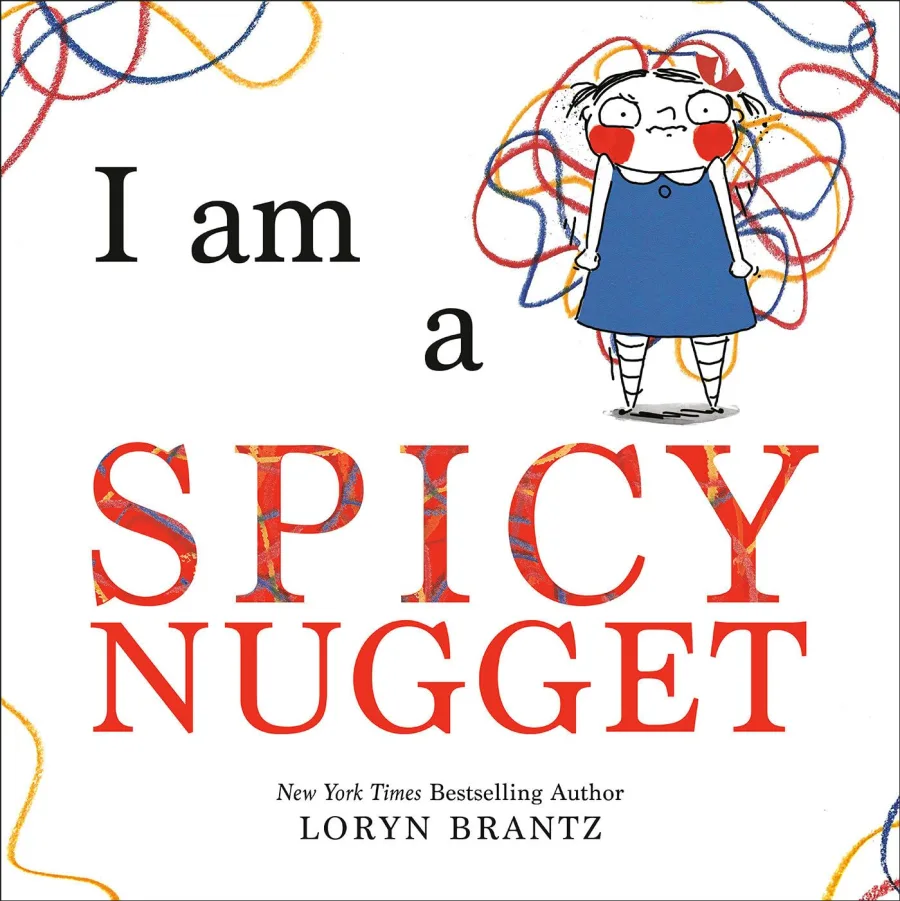
I Am a Spicy Nugget
Hardcover
• 40 Pages
• USD 18.99
• English
• 9798217042142
No ratings yet
| Publisher | Viking Books for Young Readers |
|---|---|
| ISBN13 | 9798217042142 |
| ASIN/SKU | B0G5WFP8V9 |
| Book Format | Hardcover |
| Language | English |
| Pages | 40 |
| List Price | USD 18.99 |
| Publishing Date | 08/09/2026 |
| Dimensions | 10.38 x 0.35 x 10.38 inches |
| Weight | 15.8 ounces |
| Book Code | BD00070462 |
Buy this Book
Amazon Stores
Ebook Stores
Other Stores
Discover I Am a Spicy Nugget by Loryn Brantz. This book is published by Viking Books for Young Readers in Hardcover format, ISBN 9798217042142, ASIN B0G5WFP8V9, under Children's Books, Children's Books on Emotions and Feelings, Children's Humor.
Book Description
From the New York Times bestselling creator of Feminist Baby and Poems of Parenting comes the hilariously relatable story about a girl whose big emotions turn her into a spicy nugget!
“What a delicious book. Funny, fun, wise, and tender. Loryn Brantz truly gets kids (and grownups, too).”—B. J. Novak, #1 bestselling author of The Book With No Pictures
Angry? Overwhelmed? Confused that a simple request for a pet penguin has been unreasonably denied? Then you might be at risk of becoming . . .
A SUPER HOT SIZZLING EXTRA SPICY NUGGET!
Follow one such nugget as she releases fiery fury on all who dare approach (stuffed animals, beware!). But big emotions and even bigger personalities are no match for a little patience and a lot of love—the best remedies for soothing even your spiciest feelings.
“What a delicious book. Funny, fun, wise, and tender. Loryn Brantz truly gets kids (and grownups, too).”—B. J. Novak, #1 bestselling author of The Book With No Pictures
Angry? Overwhelmed? Confused that a simple request for a pet penguin has been unreasonably denied? Then you might be at risk of becoming . . .
A SUPER HOT SIZZLING EXTRA SPICY NUGGET!
Follow one such nugget as she releases fiery fury on all who dare approach (stuffed animals, beware!). But big emotions and even bigger personalities are no match for a little patience and a lot of love—the best remedies for soothing even your spiciest feelings.
Author Biography
Loryn Brantz is an Emmy Award–winning author, artist, poet, and director. She is the creator of numerous beloved children’s books, including the best-selling series Feminist Baby and It Had to Be You (Love Poems Your Baby Can See). Her work can be seen on Sesame Street, Jim Henson’s Pajanimals, Ms. Rachel, and more. Her latest book, Poems of Parenting, is a New York Times bestseller.
Her greatest desire is to make the world a better place through art, even if just a little — but hopefully, a lot. Loryn lives in New York City with her husband, architect Jake J. Brotter, and children, Dalia and Ronen.
Her greatest desire is to make the world a better place through art, even if just a little — but hopefully, a lot. Loryn lives in New York City with her husband, architect Jake J. Brotter, and children, Dalia and Ronen.
Editorial Reviews
Raves for I Am a Spicy Nugget
"An adorable story that all kids with a case of the grumps will relate to"
—Dan Santat, Caldecott Medalist and National Book Award Winner
"What a delicious book. Funny, fun, wise, and tender. Loryn Brantz truly gets kids (and grownups, too)."
—B. J. Novak, author of the #1 New York Times bestselling The Book With No Pictures
"For everyone who has ever felt like a spicy nugget (I'm looking at you, too, grown-ups), this is a great reminder that feeling angry is OK! Between relatable and humorous moments, I Am a Spicy Nugget quietly offers wonderful, safe examples of how to let anger out."
—Kaitlin Becker, Emmy Nominated Actor/Singer/Writer, best known for her work on Sprout's The Sunny Side Up Show and as Meekah on Blippi
"An adorable story that all kids with a case of the grumps will relate to"
—Dan Santat, Caldecott Medalist and National Book Award Winner
"What a delicious book. Funny, fun, wise, and tender. Loryn Brantz truly gets kids (and grownups, too)."
—B. J. Novak, author of the #1 New York Times bestselling The Book With No Pictures
"For everyone who has ever felt like a spicy nugget (I'm looking at you, too, grown-ups), this is a great reminder that feeling angry is OK! Between relatable and humorous moments, I Am a Spicy Nugget quietly offers wonderful, safe examples of how to let anger out."
—Kaitlin Becker, Emmy Nominated Actor/Singer/Writer, best known for her work on Sprout's The Sunny Side Up Show and as Meekah on Blippi
Book Summary
I Am a Spicy Nugget by Loryn Brantz is a funny, warm, and emotionally intelligent picture book about one of the biggest challenges of early childhood: what happens when a perfectly ordinary disappointment suddenly feels like the end of the world. Published by Viking Books for Young Readers on September 8, 2026, this 40-page picture book is aimed primarily at children ages three to five and kindergarten readers. Brantz, who is known for Feminist Baby and Poems of Parenting, turns a familiar childhood experience—getting angry when things do not go your way—into a wonderfully imaginative story about becoming a “spicy nugget.” The result is not simply a funny book about tantrums. It is a gentle introduction to emotional regulation, anger, patience, self-awareness, and the reassuring idea that having big feelings does not make a child bad.
The story begins with a wonderfully unreasonable request from the child's perspective: she wants to adopt a pet penguin, name it Marshmallow, and feed it carrots. When that request is denied, the disappointment feels enormous. Adults may see the situation as obviously manageable, but young children often experience frustration with extraordinary intensity because they are still developing the ability to regulate emotions, delay gratification, and understand why another person might say no. In this story, that emotional explosion has a hilarious physical consequence. The little girl transforms into a spicy nugget, a fiery, furious version of herself. The premise is deliberately silly, but the feeling behind it is extremely real.
This transformation is the central comic device of the book. Instead of simply telling children, “You are angry,” Brantz gives anger a memorable identity. The child becomes a little nugget filled with heat and fury, making an invisible emotional experience visible. This is particularly effective for young readers because preschool children often understand emotions more easily when they can connect them with concrete images, characters, colors, sounds, and physical actions. A child who has experienced a tantrum can recognize the spicy nugget immediately. The exaggerated character makes the experience funny enough to talk about without making the child's actual feelings seem silly or unimportant.
The story becomes even more entertaining as the child's anger grows. She is not merely a spicy nugget; she becomes an increasingly hot, sizzling, extra-spicy version of one. Publishers Weekly describes Brantz's visual treatment as a representation of rage taking over the child's body, with increasingly intense red imagery and a face overwhelmed by fury. This visual progression is an important part of the book's emotional storytelling. Children can see the anger becoming larger and hotter on the page, just as an actual tantrum can feel as though it is getting bigger and bigger until the child no longer feels in control.
The book's humor is important because it makes a difficult subject approachable. A serious lesson about anger can easily become preachy, particularly for very young children. Brantz avoids that problem by embracing the absurdity of the situation. The idea of becoming a fiery nugget because someone refused to provide a pet penguin is funny, but beneath the joke is a very useful message: big emotions can happen over small things. Children do not always need their reasons to be objectively important for their feelings to be real. The book gives them permission to recognize that mismatch without shame.
One of the strongest themes in I Am a Spicy Nugget is therefore emotional validation. The book does not tell children that anger itself is wrong. Instead, it distinguishes between having an emotion and hurting someone because of that emotion. This distinction is essential for healthy emotional development. According to the published review material, the child eventually recognizes that being angry is okay as long as she does not hurt anybody. That is a simple principle, but it carries considerable value: children can learn that emotions are allowed while certain behaviors are not.
This is also why the book works well as a children's book about anger management. It does not attempt to eliminate anger. Instead, it introduces the idea that anger can be experienced safely. A young child may yell, stomp, cry, become physically tense, or feel as though the emotion is taking over. The book acknowledges that intensity while gradually showing that the feeling can pass. This is a much healthier lesson than teaching children that “good” children never get angry. Everyone becomes frustrated. Everyone reaches emotional limits. The important skill is learning what to do next.
The next stage of the story is particularly important because the spicy nugget eventually begins to come down from the emotional peak. Rather than remaining trapped in fury, the child interacts with her teddy bear and recognizes that she needs some space. Publishers Weekly notes that the story's de-escalation involves the child taking a time-out and breathing. These are simple strategies, but they are presented naturally rather than as a formal lesson. The child is not given a complicated list of therapeutic techniques. She simply begins to create enough distance from the emotional explosion to regain control.
The breathing element is especially useful for young readers. When children are extremely angry, telling them to “calm down” rarely helps by itself. A concrete action such as stopping, taking space, and breathing gives them something they can actually attempt. The book therefore introduces the beginnings of self-regulation without making the concept intimidating. Children can understand that the spicy feeling may be very strong, but they can also learn that their bodies can eventually become calmer.
Another meaningful message is that children are not emotionless robots. The book explicitly rejects the expectation that people should never experience anger, frustration, sadness, or other difficult emotions. This is one of the most humane aspects of Brantz's approach. Emotional maturity does not mean eliminating unpleasant feelings. It means becoming better at recognizing and handling them. For preschoolers, this distinction is especially important because emotional control is still developing. Expecting perfect composure is unrealistic; teaching children that emotions can be managed is much more constructive.
The role of the empathetic adult is also important. After the emotional storm passes, the child reconnects with a caring grown-up. The adult does not shame the child for having become a spicy nugget. Instead, the relationship provides reassurance, understanding, and love. This reflects an important principle in early childhood emotional development: children often need co-regulation before they can consistently self-regulate. In other words, a calm adult can help a child return to calm. The book's message is not that children must handle every emotion completely by themselves. It shows that patience and love from adults remain part of the process.
This makes I Am a Spicy Nugget particularly useful for parents dealing with toddler tantrums and preschool meltdowns. A parent can use the book's playful vocabulary as a shared language. Instead of saying, “You're behaving terribly,” an adult might recognize that the child has become a spicy nugget and then help her find a safe way back to calm. Used thoughtfully, such language can reduce shame and create distance between the child and the behavior. The child can begin to understand, “I am having a huge angry feeling” rather than “I am a bad child.”
The book is also useful because it acknowledges that the trigger for anger can be surprisingly small. The denied penguin request is intentionally ridiculous, but that is precisely why it works. Young children can become furious because they cannot have a certain snack, cannot wear a particular outfit, have to leave the playground, or are told that a toy cannot come home with them. Adults know that these moments are temporary, but children experience them differently. Brantz captures that emotional truth without making fun of the child herself.
Visually, the story appears to move from emotional heat toward greater calm. Publishers Weekly notes that the intense red imagery eventually gives way to ribbons of primary colors as the child settles and reconnects with the adult. This visual change reinforces one of the book's most comforting ideas: feelings change. Anger can feel permanent while it is happening, but it is not permanent. The emotional state that seems overwhelming at one moment can soften later.
The book's language is also well suited to a read-aloud experience. Its central phrase, “I am a spicy nugget,” is memorable, rhythmic, and easy for children to repeat. Publishers Weekly specifically describes the book as built for a full-tilt read-aloud. This matters because repeated phrases allow children to participate in the storytelling. They can shout the phrase when the character becomes furious, imitate the escalating intensity, and then gradually soften their voices as the character calms down. The reading experience can therefore mirror the emotional arc of the story.
For parents and teachers searching for a summary of I Am a Spicy Nugget, a children's book about anger, books that help toddlers understand big emotions, books about tantrums and emotional regulation, or picture books for teaching children how to calm down, Brantz's story offers an unusually accessible approach. Its educational value comes from its emotional honesty rather than from formal instruction. Children see that anger is real, powerful, and sometimes funny, but they also see that anger does not have to control them forever.
The book is also significant because it extends Loryn Brantz's larger interest in the emotional lives of children and parents. She is an Emmy Award-winning author, artist, poet, and director whose work has appeared on Sesame Street, Elmo's World, and Ms. Rachel. Her previous books include the bestselling Feminist Baby series and Poems of Parenting. That background helps explain the combination of humor, visual simplicity, emotional awareness, and parent-friendly language found in I Am a Spicy Nugget.
Ultimately, I Am a Spicy Nugget is a book about learning that anger is a feeling, not an identity. The little girl becomes a spicy nugget when disappointment overwhelms her, but she does not remain one. She feels the anger, lets it become visible, takes space, breathes, reconnects, and eventually returns to herself. That emotional journey is the heart of the book. Brantz does not ask children to become perfectly calm or perfectly obedient. Instead, she offers a much kinder lesson: you are allowed to have enormous feelings, but you can learn to express them without hurting yourself or other people. For adults, the story is a reminder that patience and love are often more effective than punishment or shame. For children, it offers a funny and memorable way to understand something they experience every day. In the end, being a “spicy nugget” is not presented as a failure. It is simply one temporary state of being human—and with breathing, space, understanding, and connection, even the hottest little nugget can cool down.
The story begins with a wonderfully unreasonable request from the child's perspective: she wants to adopt a pet penguin, name it Marshmallow, and feed it carrots. When that request is denied, the disappointment feels enormous. Adults may see the situation as obviously manageable, but young children often experience frustration with extraordinary intensity because they are still developing the ability to regulate emotions, delay gratification, and understand why another person might say no. In this story, that emotional explosion has a hilarious physical consequence. The little girl transforms into a spicy nugget, a fiery, furious version of herself. The premise is deliberately silly, but the feeling behind it is extremely real.
This transformation is the central comic device of the book. Instead of simply telling children, “You are angry,” Brantz gives anger a memorable identity. The child becomes a little nugget filled with heat and fury, making an invisible emotional experience visible. This is particularly effective for young readers because preschool children often understand emotions more easily when they can connect them with concrete images, characters, colors, sounds, and physical actions. A child who has experienced a tantrum can recognize the spicy nugget immediately. The exaggerated character makes the experience funny enough to talk about without making the child's actual feelings seem silly or unimportant.
The story becomes even more entertaining as the child's anger grows. She is not merely a spicy nugget; she becomes an increasingly hot, sizzling, extra-spicy version of one. Publishers Weekly describes Brantz's visual treatment as a representation of rage taking over the child's body, with increasingly intense red imagery and a face overwhelmed by fury. This visual progression is an important part of the book's emotional storytelling. Children can see the anger becoming larger and hotter on the page, just as an actual tantrum can feel as though it is getting bigger and bigger until the child no longer feels in control.
The book's humor is important because it makes a difficult subject approachable. A serious lesson about anger can easily become preachy, particularly for very young children. Brantz avoids that problem by embracing the absurdity of the situation. The idea of becoming a fiery nugget because someone refused to provide a pet penguin is funny, but beneath the joke is a very useful message: big emotions can happen over small things. Children do not always need their reasons to be objectively important for their feelings to be real. The book gives them permission to recognize that mismatch without shame.
One of the strongest themes in I Am a Spicy Nugget is therefore emotional validation. The book does not tell children that anger itself is wrong. Instead, it distinguishes between having an emotion and hurting someone because of that emotion. This distinction is essential for healthy emotional development. According to the published review material, the child eventually recognizes that being angry is okay as long as she does not hurt anybody. That is a simple principle, but it carries considerable value: children can learn that emotions are allowed while certain behaviors are not.
This is also why the book works well as a children's book about anger management. It does not attempt to eliminate anger. Instead, it introduces the idea that anger can be experienced safely. A young child may yell, stomp, cry, become physically tense, or feel as though the emotion is taking over. The book acknowledges that intensity while gradually showing that the feeling can pass. This is a much healthier lesson than teaching children that “good” children never get angry. Everyone becomes frustrated. Everyone reaches emotional limits. The important skill is learning what to do next.
The next stage of the story is particularly important because the spicy nugget eventually begins to come down from the emotional peak. Rather than remaining trapped in fury, the child interacts with her teddy bear and recognizes that she needs some space. Publishers Weekly notes that the story's de-escalation involves the child taking a time-out and breathing. These are simple strategies, but they are presented naturally rather than as a formal lesson. The child is not given a complicated list of therapeutic techniques. She simply begins to create enough distance from the emotional explosion to regain control.
The breathing element is especially useful for young readers. When children are extremely angry, telling them to “calm down” rarely helps by itself. A concrete action such as stopping, taking space, and breathing gives them something they can actually attempt. The book therefore introduces the beginnings of self-regulation without making the concept intimidating. Children can understand that the spicy feeling may be very strong, but they can also learn that their bodies can eventually become calmer.
Another meaningful message is that children are not emotionless robots. The book explicitly rejects the expectation that people should never experience anger, frustration, sadness, or other difficult emotions. This is one of the most humane aspects of Brantz's approach. Emotional maturity does not mean eliminating unpleasant feelings. It means becoming better at recognizing and handling them. For preschoolers, this distinction is especially important because emotional control is still developing. Expecting perfect composure is unrealistic; teaching children that emotions can be managed is much more constructive.
The role of the empathetic adult is also important. After the emotional storm passes, the child reconnects with a caring grown-up. The adult does not shame the child for having become a spicy nugget. Instead, the relationship provides reassurance, understanding, and love. This reflects an important principle in early childhood emotional development: children often need co-regulation before they can consistently self-regulate. In other words, a calm adult can help a child return to calm. The book's message is not that children must handle every emotion completely by themselves. It shows that patience and love from adults remain part of the process.
This makes I Am a Spicy Nugget particularly useful for parents dealing with toddler tantrums and preschool meltdowns. A parent can use the book's playful vocabulary as a shared language. Instead of saying, “You're behaving terribly,” an adult might recognize that the child has become a spicy nugget and then help her find a safe way back to calm. Used thoughtfully, such language can reduce shame and create distance between the child and the behavior. The child can begin to understand, “I am having a huge angry feeling” rather than “I am a bad child.”
The book is also useful because it acknowledges that the trigger for anger can be surprisingly small. The denied penguin request is intentionally ridiculous, but that is precisely why it works. Young children can become furious because they cannot have a certain snack, cannot wear a particular outfit, have to leave the playground, or are told that a toy cannot come home with them. Adults know that these moments are temporary, but children experience them differently. Brantz captures that emotional truth without making fun of the child herself.
Visually, the story appears to move from emotional heat toward greater calm. Publishers Weekly notes that the intense red imagery eventually gives way to ribbons of primary colors as the child settles and reconnects with the adult. This visual change reinforces one of the book's most comforting ideas: feelings change. Anger can feel permanent while it is happening, but it is not permanent. The emotional state that seems overwhelming at one moment can soften later.
The book's language is also well suited to a read-aloud experience. Its central phrase, “I am a spicy nugget,” is memorable, rhythmic, and easy for children to repeat. Publishers Weekly specifically describes the book as built for a full-tilt read-aloud. This matters because repeated phrases allow children to participate in the storytelling. They can shout the phrase when the character becomes furious, imitate the escalating intensity, and then gradually soften their voices as the character calms down. The reading experience can therefore mirror the emotional arc of the story.
For parents and teachers searching for a summary of I Am a Spicy Nugget, a children's book about anger, books that help toddlers understand big emotions, books about tantrums and emotional regulation, or picture books for teaching children how to calm down, Brantz's story offers an unusually accessible approach. Its educational value comes from its emotional honesty rather than from formal instruction. Children see that anger is real, powerful, and sometimes funny, but they also see that anger does not have to control them forever.
The book is also significant because it extends Loryn Brantz's larger interest in the emotional lives of children and parents. She is an Emmy Award-winning author, artist, poet, and director whose work has appeared on Sesame Street, Elmo's World, and Ms. Rachel. Her previous books include the bestselling Feminist Baby series and Poems of Parenting. That background helps explain the combination of humor, visual simplicity, emotional awareness, and parent-friendly language found in I Am a Spicy Nugget.
Ultimately, I Am a Spicy Nugget is a book about learning that anger is a feeling, not an identity. The little girl becomes a spicy nugget when disappointment overwhelms her, but she does not remain one. She feels the anger, lets it become visible, takes space, breathes, reconnects, and eventually returns to herself. That emotional journey is the heart of the book. Brantz does not ask children to become perfectly calm or perfectly obedient. Instead, she offers a much kinder lesson: you are allowed to have enormous feelings, but you can learn to express them without hurting yourself or other people. For adults, the story is a reminder that patience and love are often more effective than punishment or shame. For children, it offers a funny and memorable way to understand something they experience every day. In the end, being a “spicy nugget” is not presented as a failure. It is simply one temporary state of being human—and with breathing, space, understanding, and connection, even the hottest little nugget can cool down.
Sample Chapters
Sample Chapters will be added soon…
Reader Reviews
No reviews yet.
I Am a Spicy Nugget
Download Cover Image
Do you want to download the full cover image for I Am a Spicy Nugget?