
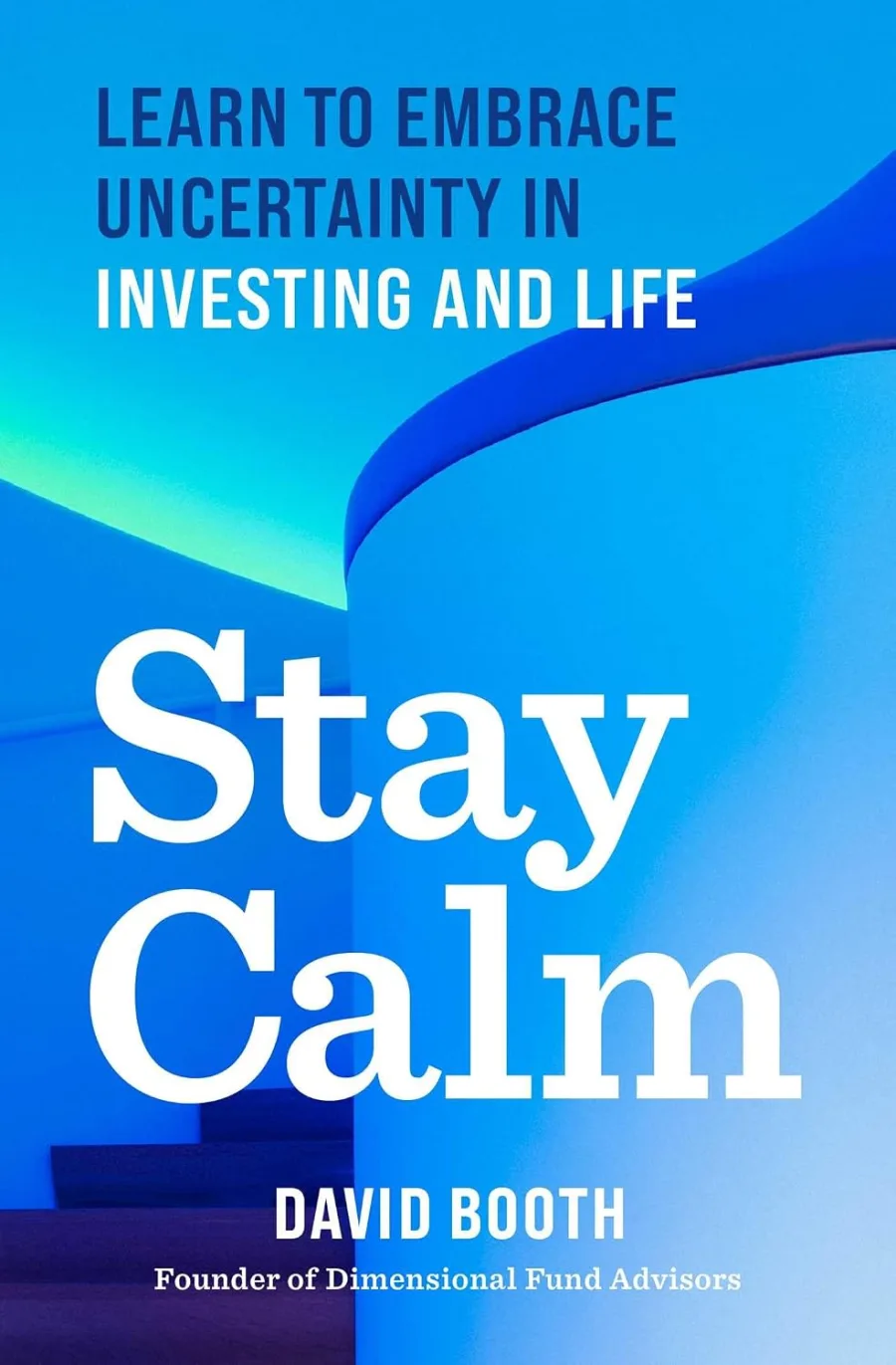
Stay Calm: Learn to Embrace Uncertainty in Investing and Life
Hardcover
• 240 Pages
• USD 32.00
• English
• 9798893311952
No ratings yet
| Publisher | Authors Equity |
|---|---|
| ISBN13 | 9798893311952 |
| ASIN/SKU | B0GPDHGH8K |
| Book Format | Hardcover |
| Language | English |
| Pages | 240 |
| List Price | USD 32.00 |
| Publishing Date | 01/09/2026 |
| Dimensions | 5.5 x 1.1 x 8.38 inches |
| Weight | 15.2 ounces |
| Book Code | BD00070463 |
Buy this Book
Amazon Stores
Ebook Stores
Other Stores
Discover Stay Calm: Learn to Embrace Uncertainty in Investing and Life by David Booth. This book is published by Authors Equity in Hardcover format, ISBN 9798893311952, ASIN B0GPDHGH8K, under Business and Money, Theory of Economics, Introduction to Investing.
Book Description
"Success—in anything, from fitness to business to investing—comes from discipline and patience, not chasing shortcuts. David Booth, who is a visionary and a great friend, reminds us that staying calm, loving the process, and focusing on what we can control is the real path to lasting results. This book is about building strength the smart way—over time." —Arnold Schwarzenegger, longtime Dimensional shareholder
From one of the pioneers of index investing and a founder of factor investing comes a clear, calming, and empowering guide to building true wealth—rooted not in predictions, hacks, or market timing but in the science of how markets actually work.
“Uncertainty isn’t something to fear—it’s where possibility lives.” —David Booth
For more than 50 years, David Booth has been at the center of a monumental transformation in personal finance. As founder of Dimensional Fund Advisors, Booth has worked alongside Nobel laureates Gene Fama, Merton Miller, Myron Scholes, and Robert Merton, helping to transform investing from a game of speculation into a discipline grounded in evidence, diversification, and long-term thinking. In Stay Calm, he shares the lessons, mindset, and stories behind that revolution—and shows readers how to apply them in their own lives.
In this accessible and engaging book, Booth explains why trying to pick stocks or predict the market’s next move is a losing game, and why trusting markets—not gurus—gives ordinary investors a powerful advantage. Drawing on decades of data and experience, he explores:
Why market prices reflect information faster than any individual can, and why this is good news for investors
How to build a resilient, low-stress investment strategy using diversification, discipline, and patience
How to avoid the emotional traps that cause investors to buy high, sell low, and miss long-term gains
Why uncertainty is not a danger to be eliminated but a source of opportunity
What “true wealth” really means—and how money can support a life of purpose, freedom, and meaning
Warm, wise, and refreshingly free of jargon, Stay Calm is both a practical guide to long-term investing and a philosophy for living with clarity and confidence. Whether you’re just starting out, rethinking your financial plan, or guiding others, this book will change the way you think about markets, risk, and what really matters.
From one of the pioneers of index investing and a founder of factor investing comes a clear, calming, and empowering guide to building true wealth—rooted not in predictions, hacks, or market timing but in the science of how markets actually work.
“Uncertainty isn’t something to fear—it’s where possibility lives.” —David Booth
For more than 50 years, David Booth has been at the center of a monumental transformation in personal finance. As founder of Dimensional Fund Advisors, Booth has worked alongside Nobel laureates Gene Fama, Merton Miller, Myron Scholes, and Robert Merton, helping to transform investing from a game of speculation into a discipline grounded in evidence, diversification, and long-term thinking. In Stay Calm, he shares the lessons, mindset, and stories behind that revolution—and shows readers how to apply them in their own lives.
In this accessible and engaging book, Booth explains why trying to pick stocks or predict the market’s next move is a losing game, and why trusting markets—not gurus—gives ordinary investors a powerful advantage. Drawing on decades of data and experience, he explores:
Why market prices reflect information faster than any individual can, and why this is good news for investors
How to build a resilient, low-stress investment strategy using diversification, discipline, and patience
How to avoid the emotional traps that cause investors to buy high, sell low, and miss long-term gains
Why uncertainty is not a danger to be eliminated but a source of opportunity
What “true wealth” really means—and how money can support a life of purpose, freedom, and meaning
Warm, wise, and refreshingly free of jargon, Stay Calm is both a practical guide to long-term investing and a philosophy for living with clarity and confidence. Whether you’re just starting out, rethinking your financial plan, or guiding others, this book will change the way you think about markets, risk, and what really matters.
Author Biography
From his first sales experience selling shoes as a teenager in Lawrence, Kansas, to working on the team that launched the first index fund, to pioneering what would come to be known as factor investing, David Booth didn't just witness the financial revolution—he helped lead it. For five decades, he’s bridged the worlds of academic theory and practical investing, collaborating with Nobel laureates to build Dimensional Fund Advisors into a trillion-dollar global firm that has democratized evidence-based investing for millions.
Booth earned degrees in economics and business from the University of Kansas, followed by an MBA from the University of Chicago. His Chicago education proved instrumental to his success, leading to a transformative gift to the business school in 2008. The University of Chicago Booth School of Business now bears his name, and the contribution continues to support faculty and their field-defining research.
Through his visionary application of financial theory to real-world investing, Booth has established himself as one of the most influential figures in investing—an outsider who challenged Wall Street’s conventional wisdom and won.
Booth earned degrees in economics and business from the University of Kansas, followed by an MBA from the University of Chicago. His Chicago education proved instrumental to his success, leading to a transformative gift to the business school in 2008. The University of Chicago Booth School of Business now bears his name, and the contribution continues to support faculty and their field-defining research.
Through his visionary application of financial theory to real-world investing, Booth has established himself as one of the most influential figures in investing—an outsider who challenged Wall Street’s conventional wisdom and won.
Editorial Reviews
"A relaxed and friendly book anyone can read in a few sittings. It’s partly a memoir about [David Booth's] early years at the forefront of the index-fund revolution and partly a basic guide to lifelong buy-and-hold investing. ... Booth’s writing is soothing, and his overall message—investing is simply a bet on human innovation and progress—is a truism worth repeating. Young people, in particular, might benefit from reading it." -- Jason Zweig, The Wall Street Journal
"Success—in anything, from fitness to business to investing—comes from discipline and patience, not chasing shortcuts. David Booth, who is a visionary and a great friend, reminds us that staying calm, loving the process, and focusing on what we can control is the real path to lasting results. This book is about building strength the smart way—over time." -- Arnold Schwarzenegger, longtime Dimensional shareholder
"Booth is a keen observer who draws lessons from his experience as a young shoe salesman, a student, an early proponent of passive investing, and a founder, CEO, and Chairman of a successful money management firm. There are many takeaways. Most will help readers have a good investment experience. All will point readers toward a better life." -- Kenneth French, Roth Family Distinguished Professor of Finance, Emeritus, Tuck School of Business at Dartmouth College and Director at Dimensional
"David Booth built one of the most successful investment firms in the world. He had a big idea, the right collaborators, and the discipline to trust evidence over instinct for five decades.
Stay Calm is the story that legends are created from. And David Booth is the rarest kind of person to learn it from: calm in all circumstances, brilliant, and always willing to try a better way." -- Michael Ovitz, Co-Founder of Creative Artists Agency
"From humble beginnings to global impact, this concise yet powerful memoir charts the extraordinary rise of David Booth. It is a story of entrepreneurial success and transformative philanthropy, set against the backdrop of the revolution in modern finance. By weaving together the pioneering history of the University of Chicago and Dimensional Fund Advisors with personal wisdom, David offers a rare, ringside view of an industry’s evolution—and the timeless lessons he learned along the way." -- Madhav Rajan, Dean of the University of Chicago Booth School of Business
"This is David Booth’s take on life and investing after a long history with both. It’s an interesting read and unlike most books of this sort, it’s also fun." -- Eugene Fama, Nobel laureate in Economic Sciences and Director at Dimensional
"There was a financial revolution in our time, brought about through a combination of computers, data collection, and theory. David Booth and the University of Chicago were at the center of it. Stay Calm is in part a chronicle of this financial revolution. But more relevantly, it’s a story about scientific principles of investing that shows how easy it is today for anyone to invest well." -- Errol Morris, Academy Award®–winning filmmaker
"Raised in Kansas and shaped by the University of Chicago, David Booth has built a career on a single conviction: that the rewards of public markets shouldn’t be reserved for insiders. For more than fifty years, David has worked to give anyone willing to learn how markets work the same fighting chance as the privileged few. He has measured his success by how many people he’s helped to reach their financial goals. This book is for everyone David hasn’t met yet. Reading it will change the way you see your money and possibly your life." -- Senator Bill Bradley, Dimensional Consultant
"No one has done more to bring the SCIENCE of investing to the broader public than David Booth. His commitment to understanding markets—through deep, evidence-based, academic research—is unparalleled." -- Barry Ritholtz, Chairman and Chief Investment Officer of Ritholtz Wealth Management
"In Stay Calm, David Booth presents a timeless framework for thoughtful, science-based investing, honed by forty-five years of experience as founder of Dimensional Fund Advisors. Compact yet deeply insightful, this book is a rare gem that can benefit readers of every background and level of investing knowledge from novice to experienced professional. It is a book to be read—and reread often, especially in times of heightened uncertainty." -- Robert C. Merton, School of Management Distinguished Professor of Finance at MIT Sloan School of Management, Nobel laureate in Economic Sciences, and Dimensional Consultant
"Success—in anything, from fitness to business to investing—comes from discipline and patience, not chasing shortcuts. David Booth, who is a visionary and a great friend, reminds us that staying calm, loving the process, and focusing on what we can control is the real path to lasting results. This book is about building strength the smart way—over time." -- Arnold Schwarzenegger, longtime Dimensional shareholder
"Booth is a keen observer who draws lessons from his experience as a young shoe salesman, a student, an early proponent of passive investing, and a founder, CEO, and Chairman of a successful money management firm. There are many takeaways. Most will help readers have a good investment experience. All will point readers toward a better life." -- Kenneth French, Roth Family Distinguished Professor of Finance, Emeritus, Tuck School of Business at Dartmouth College and Director at Dimensional
"David Booth built one of the most successful investment firms in the world. He had a big idea, the right collaborators, and the discipline to trust evidence over instinct for five decades.
Stay Calm is the story that legends are created from. And David Booth is the rarest kind of person to learn it from: calm in all circumstances, brilliant, and always willing to try a better way." -- Michael Ovitz, Co-Founder of Creative Artists Agency
"From humble beginnings to global impact, this concise yet powerful memoir charts the extraordinary rise of David Booth. It is a story of entrepreneurial success and transformative philanthropy, set against the backdrop of the revolution in modern finance. By weaving together the pioneering history of the University of Chicago and Dimensional Fund Advisors with personal wisdom, David offers a rare, ringside view of an industry’s evolution—and the timeless lessons he learned along the way." -- Madhav Rajan, Dean of the University of Chicago Booth School of Business
"This is David Booth’s take on life and investing after a long history with both. It’s an interesting read and unlike most books of this sort, it’s also fun." -- Eugene Fama, Nobel laureate in Economic Sciences and Director at Dimensional
"There was a financial revolution in our time, brought about through a combination of computers, data collection, and theory. David Booth and the University of Chicago were at the center of it. Stay Calm is in part a chronicle of this financial revolution. But more relevantly, it’s a story about scientific principles of investing that shows how easy it is today for anyone to invest well." -- Errol Morris, Academy Award®–winning filmmaker
"Raised in Kansas and shaped by the University of Chicago, David Booth has built a career on a single conviction: that the rewards of public markets shouldn’t be reserved for insiders. For more than fifty years, David has worked to give anyone willing to learn how markets work the same fighting chance as the privileged few. He has measured his success by how many people he’s helped to reach their financial goals. This book is for everyone David hasn’t met yet. Reading it will change the way you see your money and possibly your life." -- Senator Bill Bradley, Dimensional Consultant
"No one has done more to bring the SCIENCE of investing to the broader public than David Booth. His commitment to understanding markets—through deep, evidence-based, academic research—is unparalleled." -- Barry Ritholtz, Chairman and Chief Investment Officer of Ritholtz Wealth Management
"In Stay Calm, David Booth presents a timeless framework for thoughtful, science-based investing, honed by forty-five years of experience as founder of Dimensional Fund Advisors. Compact yet deeply insightful, this book is a rare gem that can benefit readers of every background and level of investing knowledge from novice to experienced professional. It is a book to be read—and reread often, especially in times of heightened uncertainty." -- Robert C. Merton, School of Management Distinguished Professor of Finance at MIT Sloan School of Management, Nobel laureate in Economic Sciences, and Dimensional Consultant
Book Summary
Stay Calm: Learn to Embrace Uncertainty in Investing and Life by David Booth is both an investment guide and a personal philosophy about how to live intelligently when the future cannot be known. Published on September 1, 2026, the 240-page book comes from one of the pioneers of modern index investing and the founder of Dimensional Fund Advisors. Booth draws on more than five decades of experience in finance, academic research, and investor education to make a simple but powerful argument: uncertainty is not an obstacle that investors must somehow eliminate. It is an unavoidable part of investing—and of life—and learning to accept it can actually make better decisions possible.
The central message of Stay Calm is contained in its title. Booth believes that successful investing requires a temperament capable of remaining steady when markets become frightening, exciting, or confusing. Investors are constantly exposed to predictions about recessions, inflation, interest rates, elections, wars, technological revolutions, market crashes, and the next big investment opportunity. The natural reaction is to try to predict what will happen and then act before everyone else. Booth argues that this instinct is usually counterproductive. Instead of trying to forecast the next market move, investors should build a sensible plan, diversify broadly, understand why markets work, and develop the discipline to remain invested through periods of uncertainty.
A major reason the book is compelling is that Booth does not present these ideas as abstract financial theory. His philosophy developed from a lifetime spent watching markets, studying financial evidence, working with leading economists, and observing how ordinary people behave when their money is at risk. Booth founded Dimensional Fund Advisors in 1981 and was involved in the development of index and factor investing. His career included close collaboration with influential economists such as Eugene Fama, Merton Miller, Myron Scholes, Robert Merton, and Douglas Diamond. His experience gives Stay Calm the character of a memoir as much as an investment book: readers are introduced not only to investment principles but also to the people, discoveries, mistakes, and experiences that shaped Booth's thinking.
One of the book's most human themes is the difference between what we can control and what we cannot. Investors cannot control whether the stock market rises tomorrow. They cannot control geopolitical events, corporate earnings, interest-rate decisions, recessions, or technological changes. They can, however, control how much they save, how they diversify, how much risk they take, how much they pay in fees, how they construct a financial plan, and how they respond emotionally when markets decline. Booth believes that a large part of investment success comes from moving attention away from uncontrollable events and toward decisions that can actually improve long-term outcomes.
This principle also explains why Booth sees uncertainty as an opportunity rather than simply a threat. If the future were perfectly predictable, there would be little reason for risky assets to offer higher expected returns. Investors receive compensation for accepting uncertainty. Stocks are not attractive because they are safe; they are attractive because ownership of productive businesses gives investors an opportunity to participate in economic growth while accepting the possibility of disappointing outcomes. Booth extends this idea beyond finance. Starting a business, changing careers, getting married, moving to a new place, or beginning a new project all involve uncertainty. Yet uncertainty is also what makes growth and discovery possible.
The book's discussion of market prediction is particularly important for anyone searching for a practical explanation of why trying to time the market is so difficult. Booth's conclusion is not that markets are perfectly predictable if investors simply gather enough information. It is almost the opposite. Public markets incorporate enormous quantities of information extremely quickly. By the time a news story becomes widely known, investors have already reacted to it. Trying to identify the next big movement therefore requires consistently knowing something that millions of other participants do not already know. Booth argues that ordinary investors are better served by trusting the information-processing power of markets than by assuming they can repeatedly outsmart everyone else.
This is closely connected to Booth's criticism of stock picking and market timing. The desire to find the next winning company is understandable. Stories about spectacular gains are much more exciting than stories about patiently owning a diversified portfolio. But Booth emphasizes that individual success stories do not demonstrate a repeatable investment strategy. A stock can rise dramatically, but identifying such a stock beforehand and doing so consistently is an entirely different challenge. His preferred alternative is to participate broadly in markets rather than betting heavily on a small number of companies or predictions.
The historical development of index investing forms an important part of the book. Booth's own career is connected to the transformation of investing from a field dominated by stock selection and active management toward one increasingly influenced by academic research, indexing, and systematic portfolio construction. Before this transformation, many investors assumed that professional managers could reliably outperform the market through superior research and judgment. Academic evidence challenged that assumption. Booth's experience at the University of Chicago and his later work helped turn those academic insights into practical investment products.
The lesson is not simply that “active investing is bad” and “passive investing is good.” A more useful interpretation of Booth's argument is that investors should be skeptical of unnecessary complexity and unsupported confidence. An investment strategy should have a clear reason for existing. If someone claims to know exactly what the market will do next, the appropriate response is not immediate belief but careful questioning. What evidence supports the prediction? Is the approach repeatable? What are the costs? What happens when the prediction is wrong? Booth's emphasis on evidence is one of the most valuable aspects of Stay Calm because it gives readers a way to evaluate investment advice rather than simply replacing one guru with another.
Another major theme is diversification. Booth argues that investors should avoid allowing a single company, sector, country, or investment theme to determine their financial future. Diversification does not eliminate market risk, but it can reduce the damage caused by being wrong about one particular investment. This is especially relevant in periods when a handful of companies or industries appear unstoppable. Today's most successful sector can eventually become tomorrow's disappointment. A diversified portfolio recognizes that the future is uncertain and therefore avoids making one forecast the foundation of an entire financial plan.
The book also examines the emotional traps of investing. Human beings are not naturally designed to think like long-term investors. When prices rise rapidly, fear of missing out can encourage people to buy after substantial gains have already occurred. When prices fall sharply, fear can push people to sell after losses have already happened. This creates the familiar pattern of buying high and selling low. Booth's solution is not to pretend that fear and excitement can be eliminated. Instead, investors should construct portfolios and financial plans they can actually live with. A theoretically optimal portfolio is useless if its owner abandons it during the first serious downturn.
This makes risk tolerance an especially practical concept in the book. Risk is not simply a mathematical number. Two investors can experience the same market decline very differently. One may remain comfortable because the portfolio fits the person's goals and financial situation; another may panic because the losses threaten near-term plans. Booth encourages investors to understand how much uncertainty they can genuinely tolerate before choosing an investment strategy. The goal is not to find an investment with no risk, because such an investment does not meaningfully exist. The goal is to create a plan whose risks are manageable enough that the investor can stick with it.
Booth also emphasizes planning rather than prediction. This may be the most practical takeaway from the entire book. Instead of asking, “Where will the market be next year?” investors should ask questions such as: What are my goals? When will I need the money? How much can I save? How much volatility can I tolerate? How diversified is my portfolio? What would happen if markets fell substantially? How should I respond? By answering these questions in advance, investors reduce the need to make emotional decisions during stressful periods.
The idea of staying invested becomes particularly important during market downturns. Booth points out that markets can recover quickly, and investors who leave after a major decline may miss the subsequent rebound. There are no “do-overs” in investing: if an investor exits the market before a recovery, simply deciding later to get back in does not guarantee that the timing will work. This does not mean that every investor should blindly hold every investment forever. It means that changes to a portfolio should generally come from a thoughtful financial plan rather than panic caused by headlines or short-term price movements.
Another distinctive aspect of Stay Calm is its connection between investing and life. Booth does not treat money as the ultimate goal. His broader concept of “true wealth” includes freedom, purpose, relationships, and the ability to live a meaningful life. The official book description explicitly asks what true wealth means and how money can support a life of purpose, freedom, and meaning. This reframes investing. The purpose of accumulating wealth is not simply to watch a portfolio balance become larger. Money is a tool that can provide choices, security, flexibility, and opportunities to spend time on things that matter.
This perspective also explains why Booth repeatedly connects patience and discipline with success. Whether someone is investing, building a career, improving physical fitness, developing a business, or nurturing relationships, meaningful results rarely arrive instantly. Shortcuts are attractive precisely because they promise to remove uncertainty and effort. Booth's philosophy argues for something less exciting but more durable: establish a sound process and give it enough time to work. The message has been echoed by figures such as Arnold Schwarzenegger, who describes the book's emphasis on discipline, patience, and focusing on what can be controlled.
For readers searching for a summary of Stay Calm: Learn to Embrace Uncertainty in Investing and Life, David Booth's investment philosophy, how to stay calm during stock market crashes, why market timing does not work, index investing explained, how to invest for the long term, or how to handle uncertainty in investing, the book offers a coherent answer: stop trying to predict everything. Build a diversified strategy based on evidence, understand your own risk tolerance, make a plan, control what you can, and remain disciplined when the market behaves unpredictably. Its investment philosophy is ultimately less about finding the perfect stock than about creating a system that protects investors from their own worst impulses.
Ultimately, Stay Calm is a reminder that good investing is less about knowing the future than about being prepared for its uncertainty. David Booth's decades of experience lead him to a surprisingly reassuring conclusion: investors do not need to know which company will dominate next year, when the next recession will begin, or exactly where markets will be tomorrow. They need a sensible plan that can survive uncertainty. Markets fluctuate because the future is unknown, but that same uncertainty creates the possibility of economic growth, innovation, and long-term investment returns. The book's deepest lesson is therefore psychological as much as financial. Calm does not come from discovering a crystal ball. It comes from accepting that there is no crystal ball, making thoughtful decisions anyway, and having enough patience to let those decisions compound over time. In Booth's view, the investor's greatest advantage may not be superior intelligence or an ability to predict markets. It may simply be the discipline to stay calm, stay diversified, stay invested, and remember that money is ultimately valuable because of the life it helps make possible.
The central message of Stay Calm is contained in its title. Booth believes that successful investing requires a temperament capable of remaining steady when markets become frightening, exciting, or confusing. Investors are constantly exposed to predictions about recessions, inflation, interest rates, elections, wars, technological revolutions, market crashes, and the next big investment opportunity. The natural reaction is to try to predict what will happen and then act before everyone else. Booth argues that this instinct is usually counterproductive. Instead of trying to forecast the next market move, investors should build a sensible plan, diversify broadly, understand why markets work, and develop the discipline to remain invested through periods of uncertainty.
A major reason the book is compelling is that Booth does not present these ideas as abstract financial theory. His philosophy developed from a lifetime spent watching markets, studying financial evidence, working with leading economists, and observing how ordinary people behave when their money is at risk. Booth founded Dimensional Fund Advisors in 1981 and was involved in the development of index and factor investing. His career included close collaboration with influential economists such as Eugene Fama, Merton Miller, Myron Scholes, Robert Merton, and Douglas Diamond. His experience gives Stay Calm the character of a memoir as much as an investment book: readers are introduced not only to investment principles but also to the people, discoveries, mistakes, and experiences that shaped Booth's thinking.
One of the book's most human themes is the difference between what we can control and what we cannot. Investors cannot control whether the stock market rises tomorrow. They cannot control geopolitical events, corporate earnings, interest-rate decisions, recessions, or technological changes. They can, however, control how much they save, how they diversify, how much risk they take, how much they pay in fees, how they construct a financial plan, and how they respond emotionally when markets decline. Booth believes that a large part of investment success comes from moving attention away from uncontrollable events and toward decisions that can actually improve long-term outcomes.
This principle also explains why Booth sees uncertainty as an opportunity rather than simply a threat. If the future were perfectly predictable, there would be little reason for risky assets to offer higher expected returns. Investors receive compensation for accepting uncertainty. Stocks are not attractive because they are safe; they are attractive because ownership of productive businesses gives investors an opportunity to participate in economic growth while accepting the possibility of disappointing outcomes. Booth extends this idea beyond finance. Starting a business, changing careers, getting married, moving to a new place, or beginning a new project all involve uncertainty. Yet uncertainty is also what makes growth and discovery possible.
The book's discussion of market prediction is particularly important for anyone searching for a practical explanation of why trying to time the market is so difficult. Booth's conclusion is not that markets are perfectly predictable if investors simply gather enough information. It is almost the opposite. Public markets incorporate enormous quantities of information extremely quickly. By the time a news story becomes widely known, investors have already reacted to it. Trying to identify the next big movement therefore requires consistently knowing something that millions of other participants do not already know. Booth argues that ordinary investors are better served by trusting the information-processing power of markets than by assuming they can repeatedly outsmart everyone else.
This is closely connected to Booth's criticism of stock picking and market timing. The desire to find the next winning company is understandable. Stories about spectacular gains are much more exciting than stories about patiently owning a diversified portfolio. But Booth emphasizes that individual success stories do not demonstrate a repeatable investment strategy. A stock can rise dramatically, but identifying such a stock beforehand and doing so consistently is an entirely different challenge. His preferred alternative is to participate broadly in markets rather than betting heavily on a small number of companies or predictions.
The historical development of index investing forms an important part of the book. Booth's own career is connected to the transformation of investing from a field dominated by stock selection and active management toward one increasingly influenced by academic research, indexing, and systematic portfolio construction. Before this transformation, many investors assumed that professional managers could reliably outperform the market through superior research and judgment. Academic evidence challenged that assumption. Booth's experience at the University of Chicago and his later work helped turn those academic insights into practical investment products.
The lesson is not simply that “active investing is bad” and “passive investing is good.” A more useful interpretation of Booth's argument is that investors should be skeptical of unnecessary complexity and unsupported confidence. An investment strategy should have a clear reason for existing. If someone claims to know exactly what the market will do next, the appropriate response is not immediate belief but careful questioning. What evidence supports the prediction? Is the approach repeatable? What are the costs? What happens when the prediction is wrong? Booth's emphasis on evidence is one of the most valuable aspects of Stay Calm because it gives readers a way to evaluate investment advice rather than simply replacing one guru with another.
Another major theme is diversification. Booth argues that investors should avoid allowing a single company, sector, country, or investment theme to determine their financial future. Diversification does not eliminate market risk, but it can reduce the damage caused by being wrong about one particular investment. This is especially relevant in periods when a handful of companies or industries appear unstoppable. Today's most successful sector can eventually become tomorrow's disappointment. A diversified portfolio recognizes that the future is uncertain and therefore avoids making one forecast the foundation of an entire financial plan.
The book also examines the emotional traps of investing. Human beings are not naturally designed to think like long-term investors. When prices rise rapidly, fear of missing out can encourage people to buy after substantial gains have already occurred. When prices fall sharply, fear can push people to sell after losses have already happened. This creates the familiar pattern of buying high and selling low. Booth's solution is not to pretend that fear and excitement can be eliminated. Instead, investors should construct portfolios and financial plans they can actually live with. A theoretically optimal portfolio is useless if its owner abandons it during the first serious downturn.
This makes risk tolerance an especially practical concept in the book. Risk is not simply a mathematical number. Two investors can experience the same market decline very differently. One may remain comfortable because the portfolio fits the person's goals and financial situation; another may panic because the losses threaten near-term plans. Booth encourages investors to understand how much uncertainty they can genuinely tolerate before choosing an investment strategy. The goal is not to find an investment with no risk, because such an investment does not meaningfully exist. The goal is to create a plan whose risks are manageable enough that the investor can stick with it.
Booth also emphasizes planning rather than prediction. This may be the most practical takeaway from the entire book. Instead of asking, “Where will the market be next year?” investors should ask questions such as: What are my goals? When will I need the money? How much can I save? How much volatility can I tolerate? How diversified is my portfolio? What would happen if markets fell substantially? How should I respond? By answering these questions in advance, investors reduce the need to make emotional decisions during stressful periods.
The idea of staying invested becomes particularly important during market downturns. Booth points out that markets can recover quickly, and investors who leave after a major decline may miss the subsequent rebound. There are no “do-overs” in investing: if an investor exits the market before a recovery, simply deciding later to get back in does not guarantee that the timing will work. This does not mean that every investor should blindly hold every investment forever. It means that changes to a portfolio should generally come from a thoughtful financial plan rather than panic caused by headlines or short-term price movements.
Another distinctive aspect of Stay Calm is its connection between investing and life. Booth does not treat money as the ultimate goal. His broader concept of “true wealth” includes freedom, purpose, relationships, and the ability to live a meaningful life. The official book description explicitly asks what true wealth means and how money can support a life of purpose, freedom, and meaning. This reframes investing. The purpose of accumulating wealth is not simply to watch a portfolio balance become larger. Money is a tool that can provide choices, security, flexibility, and opportunities to spend time on things that matter.
This perspective also explains why Booth repeatedly connects patience and discipline with success. Whether someone is investing, building a career, improving physical fitness, developing a business, or nurturing relationships, meaningful results rarely arrive instantly. Shortcuts are attractive precisely because they promise to remove uncertainty and effort. Booth's philosophy argues for something less exciting but more durable: establish a sound process and give it enough time to work. The message has been echoed by figures such as Arnold Schwarzenegger, who describes the book's emphasis on discipline, patience, and focusing on what can be controlled.
For readers searching for a summary of Stay Calm: Learn to Embrace Uncertainty in Investing and Life, David Booth's investment philosophy, how to stay calm during stock market crashes, why market timing does not work, index investing explained, how to invest for the long term, or how to handle uncertainty in investing, the book offers a coherent answer: stop trying to predict everything. Build a diversified strategy based on evidence, understand your own risk tolerance, make a plan, control what you can, and remain disciplined when the market behaves unpredictably. Its investment philosophy is ultimately less about finding the perfect stock than about creating a system that protects investors from their own worst impulses.
Ultimately, Stay Calm is a reminder that good investing is less about knowing the future than about being prepared for its uncertainty. David Booth's decades of experience lead him to a surprisingly reassuring conclusion: investors do not need to know which company will dominate next year, when the next recession will begin, or exactly where markets will be tomorrow. They need a sensible plan that can survive uncertainty. Markets fluctuate because the future is unknown, but that same uncertainty creates the possibility of economic growth, innovation, and long-term investment returns. The book's deepest lesson is therefore psychological as much as financial. Calm does not come from discovering a crystal ball. It comes from accepting that there is no crystal ball, making thoughtful decisions anyway, and having enough patience to let those decisions compound over time. In Booth's view, the investor's greatest advantage may not be superior intelligence or an ability to predict markets. It may simply be the discipline to stay calm, stay diversified, stay invested, and remember that money is ultimately valuable because of the life it helps make possible.
Sample Chapters
Sample Chapters will be added soon…
Reader Reviews
No reviews yet.
Stay Calm: Learn to Embrace Uncertainty in Investing and Life
Download Cover Image
Do you want to download the full cover image for Stay Calm: Learn to Embrace Uncertainty in Investing and Life?