
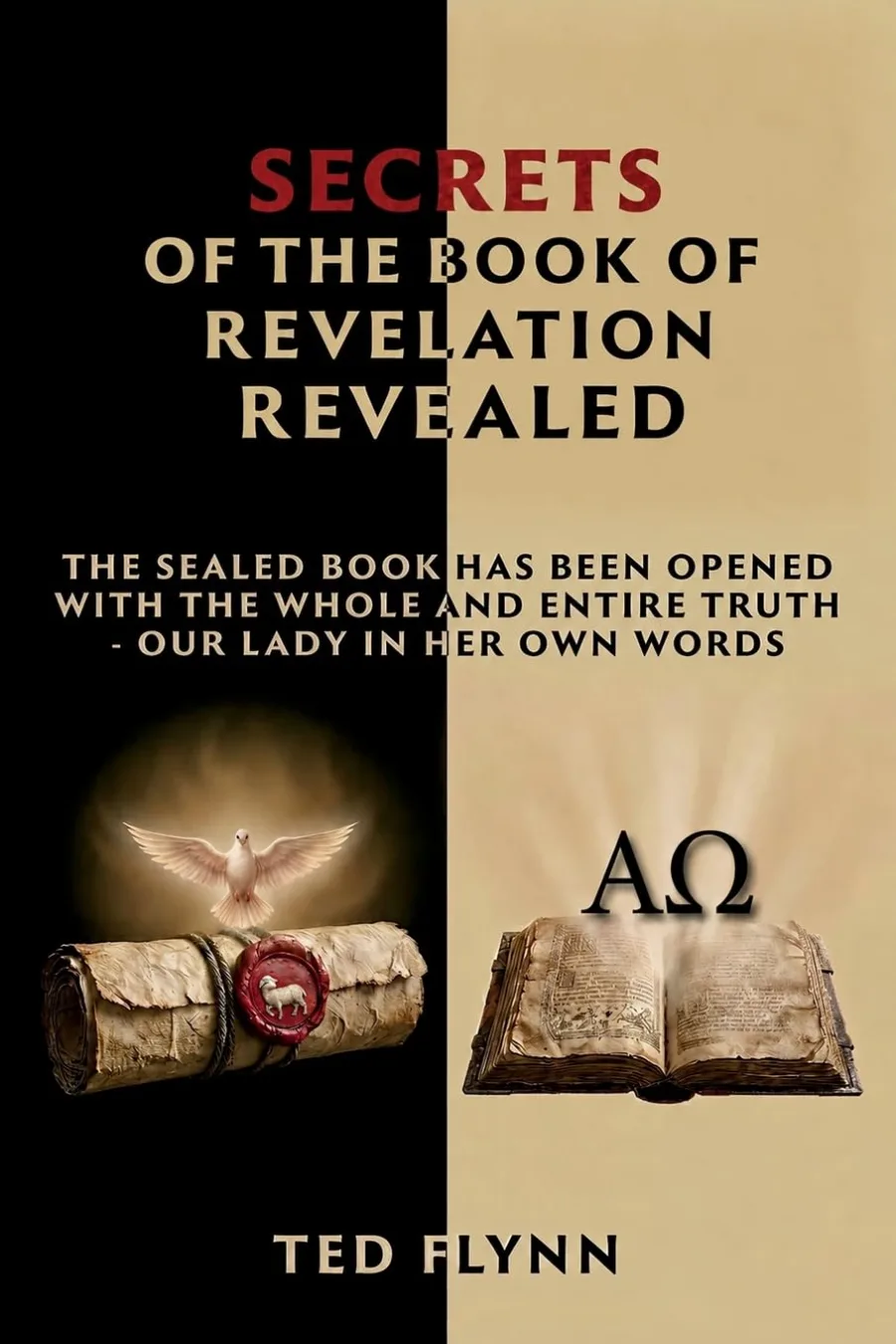
Secrets of the Book of Revelation Revealed
Paperback
• 320 Pages
• USD 25.99
• English
• 9780963430793
No ratings yet
| Publisher | MaxKol |
|---|---|
| ISBN13 | 9780963430793 |
| ASIN/SKU | 0963430793 |
| Book Format | Paperback |
| Language | English |
| Pages | 320 |
| List Price | USD 25.99 |
| Publishing Date | 25/08/2026 |
| Dimensions | 6 x 0.73 x 9 inches |
| Weight | 15.2 ounces |
| Book Code | BD00070465 |
Buy this Book
Amazon Stores
Ebook Stores
Other Stores
Discover Secrets of the Book of Revelation Revealed by Ted Flynn. This book is published by MaxKol in Paperback format, ISBN 9780963430793, ASIN 0963430793, under Christian Books and Bibles, Christian Forgiveness and Mercy, Christian Mariology.
Book Description
Fatima, Akita, Japan, LaSalette, France, Quito, Ecuador, Marie Julie-Jahenny, Blessed Anne Catherine Emmerich, Saint John Bosco, Malachi Martin, Sister Lucia. Servant of God Father Stefano Gobbi provide insight to the times in which we are living. the concept of where our safety lies is addressed in detail as well as the long history in the Scriptures, and the Church there will always remain a REMNANT Heaven protects.
Perfect love casts out all fear, and that is addressed. It will be a time of purification for man, but Pope Benedict XVI was resolute the Church was in a time of transition and we are living in the End Times. With that being said, a glorious day awaits man that when issues are put into proper perspective Our Lady says it will be a time of GREAT HOPE and a time to be JOYOUS. The old is passing away and a New Dawn awaits us.
The reader will be encouraged Heaven has a plan and we are watching it unravel now at an accelerated speed. Our Lady said, "You will know you are in the times spoken of, by the events themself."
Perfect love casts out all fear, and that is addressed. It will be a time of purification for man, but Pope Benedict XVI was resolute the Church was in a time of transition and we are living in the End Times. With that being said, a glorious day awaits man that when issues are put into proper perspective Our Lady says it will be a time of GREAT HOPE and a time to be JOYOUS. The old is passing away and a New Dawn awaits us.
The reader will be encouraged Heaven has a plan and we are watching it unravel now at an accelerated speed. Our Lady said, "You will know you are in the times spoken of, by the events themself."
Author Biography
Author Biography will be added soon…
Editorial Reviews
Editorial Reviews will be added soon…
Book Summary
Secrets of the Book of Revelation Revealed: The Sealed Book Has Been Opened with the Full and Entire Truth—Our Lady in Her Own Words by Ted Flynn is a Catholic book about biblical prophecy, Marian apparitions, the spiritual crisis of the modern world, and the possibility that humanity is entering a decisive period foretold in Scripture. Released on September 2, 2026, by MaxKol Communications, the book runs approximately 320 pages and draws together material from Catholic visionaries, saints, mystics, popes, and writers whom Flynn believes shed light on the mysteries of the Book of Revelation. Rather than treating Revelation as an isolated biblical text that belongs only to the distant past or an unknowable future, Flynn approaches it as a prophetic book whose symbols may illuminate events taking place in the present age. His argument is explicitly rooted in Catholic interpretations of prophecy and private revelation, so readers should understand the book as a faith-based interpretation rather than as an established scholarly consensus about the meaning of Revelation.
The central premise of Secrets of the Book of Revelation Revealed is that certain mysteries surrounding Revelation have reached what Flynn regards as an appointed time for greater understanding. The book's subtitle presents its central claim dramatically: the sealed book has been opened and its meaning can now be understood through the words associated with Our Lady and various Catholic prophetic traditions. The publisher's description says Flynn draws on apparitions at Fatima, Akita, La Salette, and Quito, along with the writings or teachings associated with figures including Blessed Anne Catherine Emmerich, Saint John Bosco, Malachi Martin, Sister Lucia of Fatima, Marie Julie Jahenny, and Father Stefano Gobbi. The result is a wide-ranging attempt to connect biblical prophecy with centuries of Catholic spiritual reflection.
One of the book's defining characteristics is therefore its combination of Scripture and private revelation. Flynn does not approach Revelation simply by examining its historical context, literary structure, or symbolism. Instead, he places the biblical text alongside messages attributed to Marian apparitions and statements from saints and Catholic spiritual figures. This allows him to construct a larger prophetic framework in which different events and warnings appear to reinforce one another. Fatima becomes especially important because of its warnings about the future of humanity and the Church, while Akita, La Salette, Quito, and other traditions are presented as additional pieces of a much larger spiritual puzzle.
The book's discussion of Our Lady and Marian prophecy is central to this framework. Flynn presents the Virgin Mary as a messenger through whom Heaven provides warnings and encouragement to humanity. The book's description repeatedly emphasizes that these messages are not intended merely to frighten people about the future. Instead, they are meant to help believers understand the spiritual dangers of the present and respond through faith, repentance, prayer, and trust in God. This gives the book a distinctive tone. Although it deals with subjects such as the Antichrist, purification, spiritual warfare, and the End Times, its intended conclusion is not despair. Flynn stresses that divine protection and hope remain available even during periods of extraordinary difficulty.
A major theme is the meaning of the End Times. Flynn argues that Christians should not automatically imagine the biblical End Times as a single dramatic event that suddenly arrives at some clearly identifiable future date. Instead, his interpretation suggests that the signs described in Scripture may unfold gradually through historical developments. In recent discussions surrounding the book, Flynn has explicitly argued that Revelation is unfolding in the present and that current crises in the Church and society should be considered alongside prophetic warnings. This approach encourages readers to look at contemporary events through a theological lens, asking whether social, political, technological, and moral developments resemble patterns described in biblical prophecy.
Among the most important subjects Flynn examines is the Antichrist. The Antichrist is one of the most mysterious figures associated with Christian eschatology, and the book treats the subject as more than a frightening character from an apocalyptic story. Flynn connects the concept to broader questions about rebellion against God, ideological systems, spiritual deception, and the misuse of power. An excerpt from the book published by Signs and Wonders focuses on Archbishop Fulton J. Sheen's 1947 warning about the Antichrist and the possibility of a new era of spiritual deception. Through material such as this, Flynn seeks to show that the Antichrist can be understood not merely as an individual but within a wider spiritual conflict involving rejection of God and the manipulation of humanity.
Another major subject is the Abomination of Desolation, a phrase that appears in biblical discussions of the End Times and has generated centuries of interpretation. Flynn specifically identifies the Abomination of Desolation as one of the topics explored in the book. His larger purpose is to help readers understand how Old Testament prophecy, the teachings of Jesus, the Book of Revelation, and Catholic prophetic traditions can be considered together. Rather than treating each prophetic passage independently, he looks for connections among them. For readers already familiar with Catholic eschatology, this makes the book particularly relevant because it attempts to build a unified interpretation from many different sources.
The Third Secret of Fatima is another important theme. Fatima occupies a special place in modern Catholic prophetic discussion, and Flynn uses it as part of his attempt to understand the Church's current spiritual situation. The book's description specifically lists the Third Secret of Fatima among its major subjects. Flynn's approach is not simply historical. He considers Fatima as part of a continuing prophetic conversation about the future of the Church and the moral direction of humanity. The importance he gives to Fatima also reflects his broader conviction that Marian apparitions should be read alongside Scripture rather than treated as unrelated supernatural stories.
The book's treatment of spiritual warfare is equally important. Flynn's work frequently divides history into a struggle between forces oriented toward God and forces opposed to Him, and this new book places Revelation within that larger conflict. His understanding of the End Times is therefore not purely about predicting dates or identifying political events. It is fundamentally about the spiritual condition of humanity. Sin, moral confusion, loss of faith, persecution, deception, and attacks on the Church become signs of a deeper battle. This perspective gives the book its urgent tone while also explaining why Flynn repeatedly returns to prayer, repentance, faith, and spiritual protection.
The idea of purification is another central element. The publisher's description says that the book addresses a coming period of purification associated with humanity's grievous sin. Purification, in this context, is not presented merely as punishment. It can also be understood as a process through which false values are exposed and humanity is called back toward God. The book therefore connects suffering and crisis with moral and spiritual transformation. For Flynn, the correct response to a troubled world is not simply to complain about declining conditions but to examine one's own life, deepen one's faith, and prepare spiritually.
This emphasis explains why hope is such an important counterweight to the book's darker themes. Flynn's message is not ultimately that humanity is doomed. The book's publisher emphasizes that a glorious future awaits humanity and that the coming transformation can be understood as a time of great hope and joy. The old order, in this interpretation, is passing away while a “New Dawn” awaits. The message is therefore one of preparation rather than panic. Even when the world appears chaotic, Flynn believes Heaven has a plan and that divine providence remains active.
The concept of a faithful remnant is closely related to this message. According to the book description, Flynn argues that throughout Scripture and Church history there remains a remnant that Heaven protects. This idea is deeply rooted in biblical tradition: even during periods of widespread corruption or crisis, not everyone abandons faith. For Flynn, the remnant represents those who remain faithful when cultural pressure, fear, or confusion makes faith difficult. The concept gives the reader an important psychological and spiritual message: believers do not need to control the entire world in order to remain faithful. Their responsibility is to persevere.
The book also explores where safety can be found during times of crisis. Its publisher description says Flynn addresses the concept of where safety lies in detail. The answer within his Catholic framework is fundamentally spiritual. Physical preparation may have its place, but genuine security cannot ultimately come from political institutions, technology, wealth, or human control. The believer's deepest refuge is God. This is why the book repeatedly returns to trust in Jesus and Mary. A reader who approaches the book looking for a detailed survival manual may therefore find that its real focus is spiritual preparation.
Flynn's contemporary interpretation becomes especially striking when he discusses technology and modern systems of control. In recent interviews about the book, he has connected artificial intelligence, surveillance, digital identity, and increasingly centralized technological infrastructure with themes found in Revelation, particularly the biblical imagery concerning the ability to buy and sell. These are Flynn's interpretations rather than established conclusions of biblical scholarship, and readers should distinguish prophetic speculation from demonstrable historical facts. Nevertheless, this material shows how the book attempts to make Revelation relevant to the modern technological environment rather than leaving it confined to ancient symbolism.
The book's treatment of modern society also reflects concern about moral and spiritual disorientation. Flynn believes that technological progress does not automatically produce moral progress. A society can become extraordinarily sophisticated while simultaneously becoming confused about human dignity, truth, freedom, and responsibility. In this framework, Revelation becomes a warning against building systems of power without a corresponding spiritual foundation. The book therefore asks readers to look beyond surface-level political disagreements and consider deeper questions about what kind of civilization humanity is constructing.
At the same time, Secrets of the Book of Revelation Revealed is not written primarily as an academic biblical commentary. It is better understood as a Catholic prophetic reflection that brings together Scripture, Marian apparitions, saints, mystics, theological voices, and contemporary concerns. The range of sources is enormous, stretching from biblical prophecy to twentieth-century Catholic figures such as Fulton Sheen and Stefano Gobbi. The book's strength for sympathetic readers lies precisely in this synthesis. It attempts to show that what may appear to be disconnected warnings from different periods can form a coherent spiritual narrative when viewed together.
For readers searching for a summary of Secrets of the Book of Revelation Revealed, Ted Flynn's interpretation of Revelation, the Third Secret of Fatima explained, the Antichrist and Catholic prophecy, the Abomination of Desolation, Marian apparitions and the End Times, or what Catholics believe about the Book of Revelation, the book offers a strongly faith-centered perspective. Its central argument is that the mysteries of Revelation should not be approached solely as terrifying predictions. They should be understood as warnings intended to awaken humanity, expose spiritual deception, encourage repentance, and prepare believers for a period of profound transformation. The author sees contemporary events as potentially significant signs, but his ultimate emphasis is on spiritual readiness rather than date-setting.
Ultimately, Secrets of the Book of Revelation Revealed is a book about warning, preparation, purification, and hope. Ted Flynn brings together Fatima, Akita, La Salette, Quito, Catholic saints, mystics, prophetic writings, Scripture, and contemporary developments in an attempt to explain why he believes the mysteries of Revelation are becoming increasingly relevant. The book's most important lesson is not simply that frightening events may lie ahead. It is that fear should not become the final response to prophecy. Flynn repeatedly directs the reader toward faith, prayer, repentance, trust, and the conviction that evil does not have the final word. His vision of the End Times ultimately contains a paradox: the darker the period becomes, the more important hope becomes. For Flynn, Revelation is not merely a prediction of catastrophe but a promise that history is moving toward divine judgment, renewal, and victory. The reader is therefore encouraged not to obsess over identifying every prophetic symbol or predicting the exact timing of future events, but to examine personal faith and moral life, remain spiritually alert, and trust that a greater purpose is unfolding even when the world appears chaotic. In that sense, Secrets of the Book of Revelation Revealed presents Revelation not simply as a book about the end of the world, but as a call to understand the present, live faithfully within uncertainty, and believe that beyond purification lies renewal.
The central premise of Secrets of the Book of Revelation Revealed is that certain mysteries surrounding Revelation have reached what Flynn regards as an appointed time for greater understanding. The book's subtitle presents its central claim dramatically: the sealed book has been opened and its meaning can now be understood through the words associated with Our Lady and various Catholic prophetic traditions. The publisher's description says Flynn draws on apparitions at Fatima, Akita, La Salette, and Quito, along with the writings or teachings associated with figures including Blessed Anne Catherine Emmerich, Saint John Bosco, Malachi Martin, Sister Lucia of Fatima, Marie Julie Jahenny, and Father Stefano Gobbi. The result is a wide-ranging attempt to connect biblical prophecy with centuries of Catholic spiritual reflection.
One of the book's defining characteristics is therefore its combination of Scripture and private revelation. Flynn does not approach Revelation simply by examining its historical context, literary structure, or symbolism. Instead, he places the biblical text alongside messages attributed to Marian apparitions and statements from saints and Catholic spiritual figures. This allows him to construct a larger prophetic framework in which different events and warnings appear to reinforce one another. Fatima becomes especially important because of its warnings about the future of humanity and the Church, while Akita, La Salette, Quito, and other traditions are presented as additional pieces of a much larger spiritual puzzle.
The book's discussion of Our Lady and Marian prophecy is central to this framework. Flynn presents the Virgin Mary as a messenger through whom Heaven provides warnings and encouragement to humanity. The book's description repeatedly emphasizes that these messages are not intended merely to frighten people about the future. Instead, they are meant to help believers understand the spiritual dangers of the present and respond through faith, repentance, prayer, and trust in God. This gives the book a distinctive tone. Although it deals with subjects such as the Antichrist, purification, spiritual warfare, and the End Times, its intended conclusion is not despair. Flynn stresses that divine protection and hope remain available even during periods of extraordinary difficulty.
A major theme is the meaning of the End Times. Flynn argues that Christians should not automatically imagine the biblical End Times as a single dramatic event that suddenly arrives at some clearly identifiable future date. Instead, his interpretation suggests that the signs described in Scripture may unfold gradually through historical developments. In recent discussions surrounding the book, Flynn has explicitly argued that Revelation is unfolding in the present and that current crises in the Church and society should be considered alongside prophetic warnings. This approach encourages readers to look at contemporary events through a theological lens, asking whether social, political, technological, and moral developments resemble patterns described in biblical prophecy.
Among the most important subjects Flynn examines is the Antichrist. The Antichrist is one of the most mysterious figures associated with Christian eschatology, and the book treats the subject as more than a frightening character from an apocalyptic story. Flynn connects the concept to broader questions about rebellion against God, ideological systems, spiritual deception, and the misuse of power. An excerpt from the book published by Signs and Wonders focuses on Archbishop Fulton J. Sheen's 1947 warning about the Antichrist and the possibility of a new era of spiritual deception. Through material such as this, Flynn seeks to show that the Antichrist can be understood not merely as an individual but within a wider spiritual conflict involving rejection of God and the manipulation of humanity.
Another major subject is the Abomination of Desolation, a phrase that appears in biblical discussions of the End Times and has generated centuries of interpretation. Flynn specifically identifies the Abomination of Desolation as one of the topics explored in the book. His larger purpose is to help readers understand how Old Testament prophecy, the teachings of Jesus, the Book of Revelation, and Catholic prophetic traditions can be considered together. Rather than treating each prophetic passage independently, he looks for connections among them. For readers already familiar with Catholic eschatology, this makes the book particularly relevant because it attempts to build a unified interpretation from many different sources.
The Third Secret of Fatima is another important theme. Fatima occupies a special place in modern Catholic prophetic discussion, and Flynn uses it as part of his attempt to understand the Church's current spiritual situation. The book's description specifically lists the Third Secret of Fatima among its major subjects. Flynn's approach is not simply historical. He considers Fatima as part of a continuing prophetic conversation about the future of the Church and the moral direction of humanity. The importance he gives to Fatima also reflects his broader conviction that Marian apparitions should be read alongside Scripture rather than treated as unrelated supernatural stories.
The book's treatment of spiritual warfare is equally important. Flynn's work frequently divides history into a struggle between forces oriented toward God and forces opposed to Him, and this new book places Revelation within that larger conflict. His understanding of the End Times is therefore not purely about predicting dates or identifying political events. It is fundamentally about the spiritual condition of humanity. Sin, moral confusion, loss of faith, persecution, deception, and attacks on the Church become signs of a deeper battle. This perspective gives the book its urgent tone while also explaining why Flynn repeatedly returns to prayer, repentance, faith, and spiritual protection.
The idea of purification is another central element. The publisher's description says that the book addresses a coming period of purification associated with humanity's grievous sin. Purification, in this context, is not presented merely as punishment. It can also be understood as a process through which false values are exposed and humanity is called back toward God. The book therefore connects suffering and crisis with moral and spiritual transformation. For Flynn, the correct response to a troubled world is not simply to complain about declining conditions but to examine one's own life, deepen one's faith, and prepare spiritually.
This emphasis explains why hope is such an important counterweight to the book's darker themes. Flynn's message is not ultimately that humanity is doomed. The book's publisher emphasizes that a glorious future awaits humanity and that the coming transformation can be understood as a time of great hope and joy. The old order, in this interpretation, is passing away while a “New Dawn” awaits. The message is therefore one of preparation rather than panic. Even when the world appears chaotic, Flynn believes Heaven has a plan and that divine providence remains active.
The concept of a faithful remnant is closely related to this message. According to the book description, Flynn argues that throughout Scripture and Church history there remains a remnant that Heaven protects. This idea is deeply rooted in biblical tradition: even during periods of widespread corruption or crisis, not everyone abandons faith. For Flynn, the remnant represents those who remain faithful when cultural pressure, fear, or confusion makes faith difficult. The concept gives the reader an important psychological and spiritual message: believers do not need to control the entire world in order to remain faithful. Their responsibility is to persevere.
The book also explores where safety can be found during times of crisis. Its publisher description says Flynn addresses the concept of where safety lies in detail. The answer within his Catholic framework is fundamentally spiritual. Physical preparation may have its place, but genuine security cannot ultimately come from political institutions, technology, wealth, or human control. The believer's deepest refuge is God. This is why the book repeatedly returns to trust in Jesus and Mary. A reader who approaches the book looking for a detailed survival manual may therefore find that its real focus is spiritual preparation.
Flynn's contemporary interpretation becomes especially striking when he discusses technology and modern systems of control. In recent interviews about the book, he has connected artificial intelligence, surveillance, digital identity, and increasingly centralized technological infrastructure with themes found in Revelation, particularly the biblical imagery concerning the ability to buy and sell. These are Flynn's interpretations rather than established conclusions of biblical scholarship, and readers should distinguish prophetic speculation from demonstrable historical facts. Nevertheless, this material shows how the book attempts to make Revelation relevant to the modern technological environment rather than leaving it confined to ancient symbolism.
The book's treatment of modern society also reflects concern about moral and spiritual disorientation. Flynn believes that technological progress does not automatically produce moral progress. A society can become extraordinarily sophisticated while simultaneously becoming confused about human dignity, truth, freedom, and responsibility. In this framework, Revelation becomes a warning against building systems of power without a corresponding spiritual foundation. The book therefore asks readers to look beyond surface-level political disagreements and consider deeper questions about what kind of civilization humanity is constructing.
At the same time, Secrets of the Book of Revelation Revealed is not written primarily as an academic biblical commentary. It is better understood as a Catholic prophetic reflection that brings together Scripture, Marian apparitions, saints, mystics, theological voices, and contemporary concerns. The range of sources is enormous, stretching from biblical prophecy to twentieth-century Catholic figures such as Fulton Sheen and Stefano Gobbi. The book's strength for sympathetic readers lies precisely in this synthesis. It attempts to show that what may appear to be disconnected warnings from different periods can form a coherent spiritual narrative when viewed together.
For readers searching for a summary of Secrets of the Book of Revelation Revealed, Ted Flynn's interpretation of Revelation, the Third Secret of Fatima explained, the Antichrist and Catholic prophecy, the Abomination of Desolation, Marian apparitions and the End Times, or what Catholics believe about the Book of Revelation, the book offers a strongly faith-centered perspective. Its central argument is that the mysteries of Revelation should not be approached solely as terrifying predictions. They should be understood as warnings intended to awaken humanity, expose spiritual deception, encourage repentance, and prepare believers for a period of profound transformation. The author sees contemporary events as potentially significant signs, but his ultimate emphasis is on spiritual readiness rather than date-setting.
Ultimately, Secrets of the Book of Revelation Revealed is a book about warning, preparation, purification, and hope. Ted Flynn brings together Fatima, Akita, La Salette, Quito, Catholic saints, mystics, prophetic writings, Scripture, and contemporary developments in an attempt to explain why he believes the mysteries of Revelation are becoming increasingly relevant. The book's most important lesson is not simply that frightening events may lie ahead. It is that fear should not become the final response to prophecy. Flynn repeatedly directs the reader toward faith, prayer, repentance, trust, and the conviction that evil does not have the final word. His vision of the End Times ultimately contains a paradox: the darker the period becomes, the more important hope becomes. For Flynn, Revelation is not merely a prediction of catastrophe but a promise that history is moving toward divine judgment, renewal, and victory. The reader is therefore encouraged not to obsess over identifying every prophetic symbol or predicting the exact timing of future events, but to examine personal faith and moral life, remain spiritually alert, and trust that a greater purpose is unfolding even when the world appears chaotic. In that sense, Secrets of the Book of Revelation Revealed presents Revelation not simply as a book about the end of the world, but as a call to understand the present, live faithfully within uncertainty, and believe that beyond purification lies renewal.
Sample Chapters
Sample Chapters will be added soon…
Reader Reviews
No reviews yet.
Secrets of the Book of Revelation Revealed
Download Cover Image
Do you want to download the full cover image for Secrets of the Book of Revelation Revealed?