
The Romagus Papers: Confessions of an Engine Nerd
Hardcover
• 317 Pages
• USD 36.00
• English
• 9798191804873
No ratings yet
| Publisher | Independently Published |
|---|---|
| ISBN13 | 9798191804873 |
| ASIN/SKU | B0HF6PKXXJ |
| Book Format | Hardcover |
| Language | English |
| Pages | 317 |
| List Price | USD 36.00 |
| Publishing Date | 03/09/2026 |
| Dimensions | 6.24 x 0.91 x 9.24 inches |
| Weight | 1.21 pounds |
| Book Code | BD00070494 |
Buy this Book
Amazon Stores
Ebook Stores
Other Stores
Discover The Romagus Papers: Confessions of an Engine Nerd by Kyle Romagus. This book is published by Independently Published in Hardcover format, ISBN 9798191804873, ASIN B0HF6PKXXJ, under Engineering and Transportation, Firefighting and Prevention, History and Philosophy of Science.
Book Description
THE FIREGROUND DOES NOT REWARD CONFIDENCE OR TRADITION. IT REWARDS UNDERSTANDING!
For decades, the fire service has excelled at teaching firefighters what to do—stretching lines, forcing doors, and flowing water—but has often failed to teach them how to think. We train mechanical skills for the controlled environment of the academy, but the street demands real-time judgment, timing, and adaptability.
In The Romagus Papers, Kyle Romagus challenges the deeply ingrained assumptions of modern engine company operations. Moving beyond step-by-step recruit manuals, Romagus connects the dots between fire behavior, building construction, and water application to reframe the nozzle as a decision-making tool rather than just a weapon.
This book will teach you:
Why reading the building matters more than chasing visible fire.
How to recognize the subtle differences between actually winning and just working hard.
Why waiting until you "see fire" is one of the most dangerous myths still taught today.
The critical shift from blind compliance to cognitive autonomy at the nozzle.
The Romagus Papers is an urgent reminder that extinguishment is not the ultimate goal—rescue is the objective, and controlling the environment is how we achieve it. If you are ready to stop reacting to the fire and start dictating the outcome, this is your guide.
For decades, the fire service has excelled at teaching firefighters what to do—stretching lines, forcing doors, and flowing water—but has often failed to teach them how to think. We train mechanical skills for the controlled environment of the academy, but the street demands real-time judgment, timing, and adaptability.
In The Romagus Papers, Kyle Romagus challenges the deeply ingrained assumptions of modern engine company operations. Moving beyond step-by-step recruit manuals, Romagus connects the dots between fire behavior, building construction, and water application to reframe the nozzle as a decision-making tool rather than just a weapon.
This book will teach you:
Why reading the building matters more than chasing visible fire.
How to recognize the subtle differences between actually winning and just working hard.
Why waiting until you "see fire" is one of the most dangerous myths still taught today.
The critical shift from blind compliance to cognitive autonomy at the nozzle.
The Romagus Papers is an urgent reminder that extinguishment is not the ultimate goal—rescue is the objective, and controlling the environment is how we achieve it. If you are ready to stop reacting to the fire and start dictating the outcome, this is your guide.
Author Biography
Author Biography will be added soon…
Editorial Reviews
Editorial Reviews will be added soon…
Book Summary
The Romagus Papers: Confessions of an Engine Nerd by Kyle Romagus is a modern fire-service book about one of the most demanding and consequential parts of firefighting: the engine company and the decisions made on the fireground. Released in September 2026, the book is not a conventional textbook arranged as a linear course. Romagus describes it as a collection of roughly 29 short, content-driven articles, generally around 1,200–1,300 words each, designed so that individual sections can be used as starting points for conversations, training discussions, and debates among firefighters. Its central concern is not simply what firefighters should do, but how they should think when operating an engine company under pressure. The book grows out of Romagus's years of firefighting, teaching, research, note-taking, experimentation, and conversations with other practitioners. Firehouse Vigilance describes it as work built over years of firegrounds, firehouses, training grounds, classrooms, conferences, research, and practical testing.
The title, Confessions of an Engine Nerd, immediately tells the reader something about Romagus's approach. He is not trying to present himself as an untouchable expert whose conclusions must simply be accepted. Instead, the book reflects the curiosity of someone who is fascinated by engine-company work and constantly wants to understand why certain tactics work, why others fail, and how firefighters can make better decisions. Romagus has explained that much of the book was created through voice-to-text conversations with himself—essentially recording his own “confessions” and then developing those thoughts into chapters. That origin is important because it helps explain the conversational quality of the work. The book is intended to feel less like a dry manual and more like an experienced firefighter sitting down with other firefighters and saying, “Let's talk about why we do this.”
The central theme is fireground thinking. Romagus is interested in the mental process behind engine-company operations rather than simply listing procedures. His stated goal was to make the book content-driven rather than chronological, allowing readers to select a particular section when a related question comes up during training or conversation. This makes the book particularly useful for company officers, firefighters, instructors, recruits, and experienced personnel who want to challenge assumptions that have become routine. The book repeatedly encourages readers to question familiar practices instead of automatically treating tradition as evidence that something is correct.
A particularly important perspective comes from Romagus's experience working with low-manpower engine companies. He explains that the entire book is influenced by this reality. Early in his career, he experienced one- and two-person engine companies, and he later worked in three-person engine-company environments. Consequently, his discussion of tactics is grounded in the problem of accomplishing critical fireground tasks when staffing is limited. This is a significant strength because staffing assumptions can dramatically change how tactics work in practice. A procedure that appears straightforward with a large crew may become much more complicated when only a few firefighters are available. Romagus therefore approaches engine-company operations from the perspective of making good decisions with the personnel actually present rather than relying on idealized staffing.
The book's focus on decision-making at the nozzle is another major thread. The nozzle firefighter occupies a uniquely important position because the person controlling the line is directly connected to the application of water and therefore to changes in the fire environment. Romagus's discussions emphasize that nozzle work is not merely a mechanical task. The firefighter must observe conditions, interpret what the fire is doing, understand what the water is accomplishing, and decide how to proceed. This makes the nozzle a place where judgment and tactical knowledge meet. The idea of “Victim on the Nozzle,” one of the articles associated with the book's development, illustrates this emphasis on connecting fire attack decisions to the people firefighters are trying to protect.
Another major theme is the relationship between water application, movement, and fire behavior. Discussions surrounding the book have highlighted Romagus's thinking about “flow and move,” particularly the danger of turning a tactical concept into a rigid formula. In a recent discussion, Romagus argued for caution about moving too quickly while flowing water, especially when visibility is poor and interior conditions are changing rapidly. His point is not that movement and water application should never occur together, but that firefighters need to understand what the nozzle is doing to the fire environment and what hazards movement creates. This reflects the broader philosophy of the book: tactics should be understood rather than performed mechanically.
That idea leads into one of the book's strongest messages: training should create judgment, not merely muscle memory. A firefighter can memorize hose stretches, nozzle techniques, and operational sequences, but emergencies rarely unfold exactly like training scenarios. Real buildings contain furniture, debris, unexpected layouts, changing fire conditions, and victims whose locations are unknown. Romagus therefore encourages firefighters to train in ways that force them to think about changing conditions. Firehouse Vigilance describes the book as an invitation to take ideas to the drill ground, flow them, test them, discuss them around the kitchen table, and then decide what they mean for a particular company or department.
This emphasis on testing ideas also distinguishes the book from simple opinion-based firefighting commentary. Romagus's methodology grows from a combination of experience, reading, research, teaching, experimentation, and conversations. The resulting philosophy is essentially scientific in spirit: observe a problem, develop an idea, test it, question the result, and remain willing to change your mind. That does not mean every fireground question has a laboratory-perfect answer. Instead, it means firefighters should become comfortable asking whether a long-standing practice actually produces the outcome they believe it does.
The book also carries an important message about accountability in the fire service. Romagus has explained that he hopes the book can eventually be read even by members of the public who want to understand what good fireground performance should look like. He sees public understanding as potentially useful because citizens can then ask their local fire departments meaningful questions about training and operational standards. This is a surprisingly broad goal for a technical fire-service book. It suggests that Romagus views professional accountability as part of public safety rather than as an internal matter belonging only to firefighters.
At the same time, The Romagus Papers is deeply concerned with professional humility. The story behind the book's creation demonstrates this clearly. Romagus had been writing articles for years but often deleted them because he did not think they were good enough to publish. Eventually, encouragement from colleagues pushed him toward sharing his ideas rather than keeping them private. This personal background gives the book another layer: knowledge becomes more valuable when it is shared, challenged, and improved through discussion. An instructor who keeps every lesson in his own head benefits only himself. An instructor who writes, teaches, and invites criticism contributes to the development of the profession.
The collection format reinforces this philosophy. Because the chapters are short and self-contained, the reader does not necessarily have to approach the book from beginning to end. One section can become the subject of a morning training discussion, another can be used during an officer-development conversation, and another can stimulate debate about hose handling or nozzle decisions. Romagus intentionally designed the articles so that they could be pulled into conversations rather than simply consumed as a complete narrative. In this respect, the book functions almost like a toolbox for critical thinking.
Another important lesson is that experience alone is not enough. A firefighter can attend hundreds of calls and still carry incorrect assumptions forward if those experiences are never examined. Romagus's approach asks firefighters to convert experience into knowledge by reflecting on what happened, why it happened, and what could be done differently. Mistakes and close calls therefore become opportunities for improvement rather than experiences that are simply forgotten once the apparatus returns to quarters. This reflective approach is particularly valuable in a profession where the cost of poor decisions can be extremely high.
The book also challenges the tendency to confuse confidence with competence. A firefighter who sounds certain may not necessarily understand the underlying problem. Romagus instead promotes a mindset in which firefighters can say, in effect, “I think this is the right answer, but let's test it.” That attitude is especially important as fire behavior, building construction, research, equipment, and training practices continue to evolve. Firehouse Vigilance emphasizes that Romagus is not asking readers simply to accept his conclusions; he wants them to question, challenge, test, and determine what works for their own companies and departments.
Ultimately, The Romagus Papers: Confessions of an Engine Nerd is best understood as a book about how to think like an engine-company firefighter rather than simply a manual about how to operate an engine. Its discussions of low staffing, nozzle work, water application, movement, fireground decision-making, training, research, accountability, and professional development all connect to one larger principle: firefighters should understand the reasons behind their actions. The strongest engine companies are not simply the ones with impressive equipment or confident reputations. They are companies whose members understand fundamentals, communicate clearly, train deliberately, question assumptions, and can adapt when conditions change.
For readers searching for a summary of The Romagus Papers, Kyle Romagus fire-service book, engine company firefighting tactics, fireground decision-making, firefighter training, nozzle operations, or low-manpower engine company operations, the book offers a particularly practical perspective. It is written for firefighters, but its underlying lesson is broader: expertise is not the ability to memorize the right answer; it is the ability to recognize changing circumstances, understand the problem, make a reasoned decision, and learn from the result. The book's own origin reinforces that philosophy. What began as notes, conversations, discarded articles, teaching experiences, and questions eventually became a collection intended to make other firefighters think more deeply about their craft.
In the end, The Romagus Papers is not presented as the final word on firefighting. In fact, Firehouse Vigilance describes it as a “tour guide” rather than the destination, leaving responsibility with the firefighter who reads it. That may be the most useful way to understand the entire project. Romagus does not simply hand readers a list of answers and ask them to memorize it. He gives them questions, observations, arguments, experiences, and practical ideas, then challenges them to take those ideas back to the apparatus floor, the training ground, and the kitchen table. For a profession where seconds matter and conditions can change rapidly, that habit of thoughtful preparation may be one of the most valuable skills an engine company can develop.
The title, Confessions of an Engine Nerd, immediately tells the reader something about Romagus's approach. He is not trying to present himself as an untouchable expert whose conclusions must simply be accepted. Instead, the book reflects the curiosity of someone who is fascinated by engine-company work and constantly wants to understand why certain tactics work, why others fail, and how firefighters can make better decisions. Romagus has explained that much of the book was created through voice-to-text conversations with himself—essentially recording his own “confessions” and then developing those thoughts into chapters. That origin is important because it helps explain the conversational quality of the work. The book is intended to feel less like a dry manual and more like an experienced firefighter sitting down with other firefighters and saying, “Let's talk about why we do this.”
The central theme is fireground thinking. Romagus is interested in the mental process behind engine-company operations rather than simply listing procedures. His stated goal was to make the book content-driven rather than chronological, allowing readers to select a particular section when a related question comes up during training or conversation. This makes the book particularly useful for company officers, firefighters, instructors, recruits, and experienced personnel who want to challenge assumptions that have become routine. The book repeatedly encourages readers to question familiar practices instead of automatically treating tradition as evidence that something is correct.
A particularly important perspective comes from Romagus's experience working with low-manpower engine companies. He explains that the entire book is influenced by this reality. Early in his career, he experienced one- and two-person engine companies, and he later worked in three-person engine-company environments. Consequently, his discussion of tactics is grounded in the problem of accomplishing critical fireground tasks when staffing is limited. This is a significant strength because staffing assumptions can dramatically change how tactics work in practice. A procedure that appears straightforward with a large crew may become much more complicated when only a few firefighters are available. Romagus therefore approaches engine-company operations from the perspective of making good decisions with the personnel actually present rather than relying on idealized staffing.
The book's focus on decision-making at the nozzle is another major thread. The nozzle firefighter occupies a uniquely important position because the person controlling the line is directly connected to the application of water and therefore to changes in the fire environment. Romagus's discussions emphasize that nozzle work is not merely a mechanical task. The firefighter must observe conditions, interpret what the fire is doing, understand what the water is accomplishing, and decide how to proceed. This makes the nozzle a place where judgment and tactical knowledge meet. The idea of “Victim on the Nozzle,” one of the articles associated with the book's development, illustrates this emphasis on connecting fire attack decisions to the people firefighters are trying to protect.
Another major theme is the relationship between water application, movement, and fire behavior. Discussions surrounding the book have highlighted Romagus's thinking about “flow and move,” particularly the danger of turning a tactical concept into a rigid formula. In a recent discussion, Romagus argued for caution about moving too quickly while flowing water, especially when visibility is poor and interior conditions are changing rapidly. His point is not that movement and water application should never occur together, but that firefighters need to understand what the nozzle is doing to the fire environment and what hazards movement creates. This reflects the broader philosophy of the book: tactics should be understood rather than performed mechanically.
That idea leads into one of the book's strongest messages: training should create judgment, not merely muscle memory. A firefighter can memorize hose stretches, nozzle techniques, and operational sequences, but emergencies rarely unfold exactly like training scenarios. Real buildings contain furniture, debris, unexpected layouts, changing fire conditions, and victims whose locations are unknown. Romagus therefore encourages firefighters to train in ways that force them to think about changing conditions. Firehouse Vigilance describes the book as an invitation to take ideas to the drill ground, flow them, test them, discuss them around the kitchen table, and then decide what they mean for a particular company or department.
This emphasis on testing ideas also distinguishes the book from simple opinion-based firefighting commentary. Romagus's methodology grows from a combination of experience, reading, research, teaching, experimentation, and conversations. The resulting philosophy is essentially scientific in spirit: observe a problem, develop an idea, test it, question the result, and remain willing to change your mind. That does not mean every fireground question has a laboratory-perfect answer. Instead, it means firefighters should become comfortable asking whether a long-standing practice actually produces the outcome they believe it does.
The book also carries an important message about accountability in the fire service. Romagus has explained that he hopes the book can eventually be read even by members of the public who want to understand what good fireground performance should look like. He sees public understanding as potentially useful because citizens can then ask their local fire departments meaningful questions about training and operational standards. This is a surprisingly broad goal for a technical fire-service book. It suggests that Romagus views professional accountability as part of public safety rather than as an internal matter belonging only to firefighters.
At the same time, The Romagus Papers is deeply concerned with professional humility. The story behind the book's creation demonstrates this clearly. Romagus had been writing articles for years but often deleted them because he did not think they were good enough to publish. Eventually, encouragement from colleagues pushed him toward sharing his ideas rather than keeping them private. This personal background gives the book another layer: knowledge becomes more valuable when it is shared, challenged, and improved through discussion. An instructor who keeps every lesson in his own head benefits only himself. An instructor who writes, teaches, and invites criticism contributes to the development of the profession.
The collection format reinforces this philosophy. Because the chapters are short and self-contained, the reader does not necessarily have to approach the book from beginning to end. One section can become the subject of a morning training discussion, another can be used during an officer-development conversation, and another can stimulate debate about hose handling or nozzle decisions. Romagus intentionally designed the articles so that they could be pulled into conversations rather than simply consumed as a complete narrative. In this respect, the book functions almost like a toolbox for critical thinking.
Another important lesson is that experience alone is not enough. A firefighter can attend hundreds of calls and still carry incorrect assumptions forward if those experiences are never examined. Romagus's approach asks firefighters to convert experience into knowledge by reflecting on what happened, why it happened, and what could be done differently. Mistakes and close calls therefore become opportunities for improvement rather than experiences that are simply forgotten once the apparatus returns to quarters. This reflective approach is particularly valuable in a profession where the cost of poor decisions can be extremely high.
The book also challenges the tendency to confuse confidence with competence. A firefighter who sounds certain may not necessarily understand the underlying problem. Romagus instead promotes a mindset in which firefighters can say, in effect, “I think this is the right answer, but let's test it.” That attitude is especially important as fire behavior, building construction, research, equipment, and training practices continue to evolve. Firehouse Vigilance emphasizes that Romagus is not asking readers simply to accept his conclusions; he wants them to question, challenge, test, and determine what works for their own companies and departments.
Ultimately, The Romagus Papers: Confessions of an Engine Nerd is best understood as a book about how to think like an engine-company firefighter rather than simply a manual about how to operate an engine. Its discussions of low staffing, nozzle work, water application, movement, fireground decision-making, training, research, accountability, and professional development all connect to one larger principle: firefighters should understand the reasons behind their actions. The strongest engine companies are not simply the ones with impressive equipment or confident reputations. They are companies whose members understand fundamentals, communicate clearly, train deliberately, question assumptions, and can adapt when conditions change.
For readers searching for a summary of The Romagus Papers, Kyle Romagus fire-service book, engine company firefighting tactics, fireground decision-making, firefighter training, nozzle operations, or low-manpower engine company operations, the book offers a particularly practical perspective. It is written for firefighters, but its underlying lesson is broader: expertise is not the ability to memorize the right answer; it is the ability to recognize changing circumstances, understand the problem, make a reasoned decision, and learn from the result. The book's own origin reinforces that philosophy. What began as notes, conversations, discarded articles, teaching experiences, and questions eventually became a collection intended to make other firefighters think more deeply about their craft.
In the end, The Romagus Papers is not presented as the final word on firefighting. In fact, Firehouse Vigilance describes it as a “tour guide” rather than the destination, leaving responsibility with the firefighter who reads it. That may be the most useful way to understand the entire project. Romagus does not simply hand readers a list of answers and ask them to memorize it. He gives them questions, observations, arguments, experiences, and practical ideas, then challenges them to take those ideas back to the apparatus floor, the training ground, and the kitchen table. For a profession where seconds matter and conditions can change rapidly, that habit of thoughtful preparation may be one of the most valuable skills an engine company can develop.
Sample Chapters
Sample Chapters will be added soon…
Reader Reviews
No reviews yet.
The Romagus Papers: Confessions of an Engine Nerd
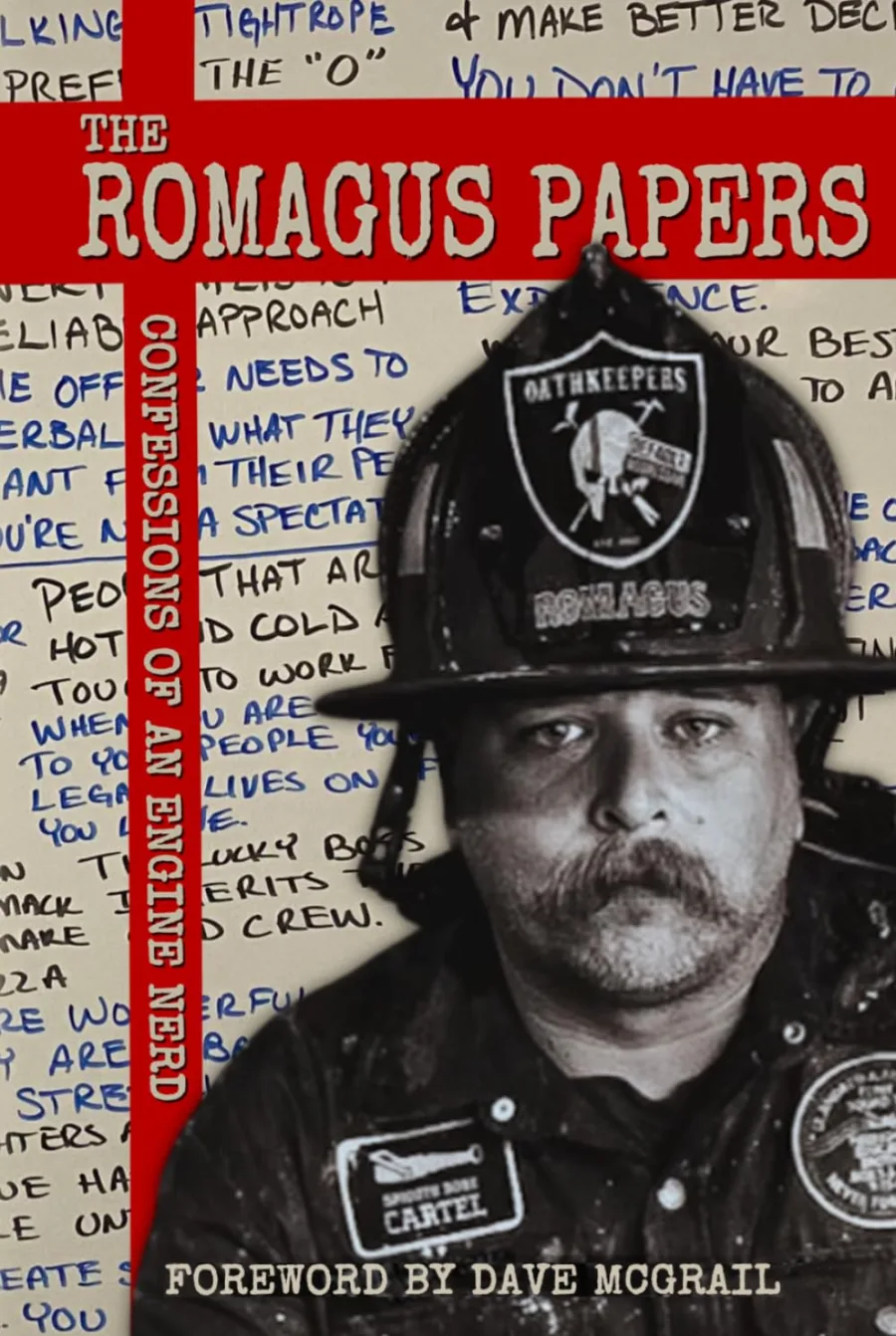
Download Cover Image
Do you want to download the full cover image for The Romagus Papers: Confessions of an Engine Nerd?