
The Way of the Superior Man
Paperback
• 224 Pages
• USD 19.99
• English
• 9781622038329
No ratings yet
| Publisher | St. Martin's Essentials / Sounds True |
|---|---|
| ISBN13 | 9781622038329 |
| ASIN/SKU | 1622038320 |
| Book Format | Paperback |
| Language | English |
| Pages | 224 |
| List Price | USD 19.99 |
| Publishing Date | 01/02/2017 |
| Dimensions | 6.05 x 0.7 x 8.95 inches |
| Weight | 9.6 ounces |
| Book Code | BD00070495 |
Buy this Book
Amazon Stores
Ebook Stores
Other Stores
Discover The Way of the Superior Man by David Deida. This book is published by St. Martin's Essentials / Sounds True in Paperback format, ISBN 9781622038329, ASIN 1622038320, under Politics and Social Sciences, General Gender Studies, Men's Gender Studies.
Book Description
Over a million copies sold!
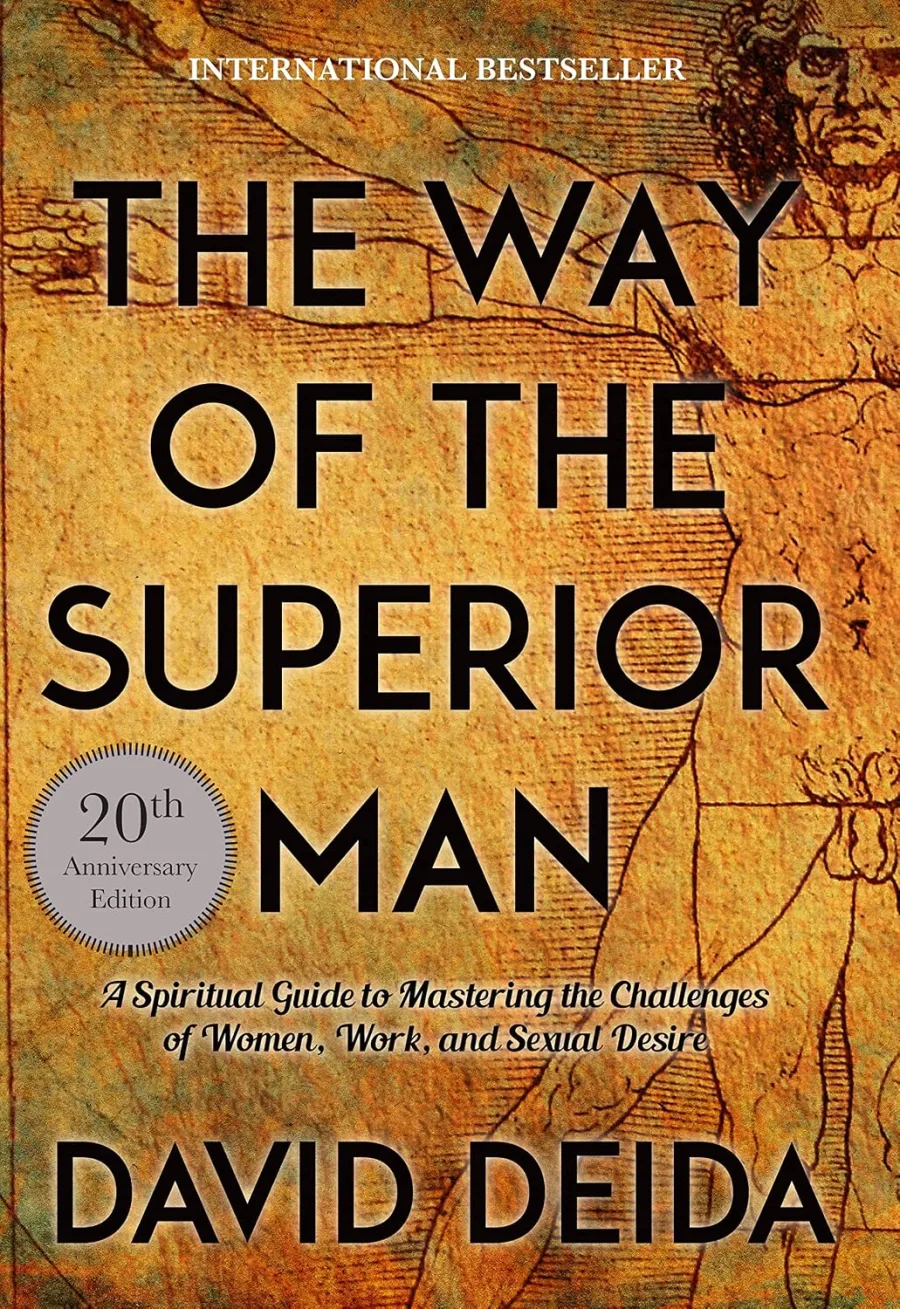
This 20th-anniversary edition of the classic guide to male spirituality offers the next generation the opportunity to cultivate trust in the moment and put forth the best versions of themselves in an ever-changing world. This edition also includes an all-new introduction from author David Deida.
In The Way of the Superior Man, Deida explores the most important issues in men’s lives―from career and family to women and intimacy to love and spirituality―to offer a practical guidebook for living a masculine life of integrity, authenticity, and freedom.
Praise for The Way of the Superior Man:
“The Way of the Superior Man lays out a challenge before all men to fulfill their true purpose and to be authentically masculine. It will guide you on your journey to a successful and spiritually complete way of life. Step up to the plate with this book in your hand.” ―Tony Robbins, author of Awaken the Giant Within and Unlimited Power
This 20th-anniversary edition of the classic guide to male spirituality offers the next generation the opportunity to cultivate trust in the moment and put forth the best versions of themselves in an ever-changing world. This edition also includes an all-new introduction from author David Deida.
In The Way of the Superior Man, Deida explores the most important issues in men’s lives―from career and family to women and intimacy to love and spirituality―to offer a practical guidebook for living a masculine life of integrity, authenticity, and freedom.
Praise for The Way of the Superior Man:
“The Way of the Superior Man lays out a challenge before all men to fulfill their true purpose and to be authentically masculine. It will guide you on your journey to a successful and spiritually complete way of life. Step up to the plate with this book in your hand.” ―Tony Robbins, author of Awaken the Giant Within and Unlimited Power
Author Biography
DAVID DEIDA
Globally acknowledged as one of the most insightful and provocative teachers of our time, bestselling author David Deida continues to revolutionize the way that men and women grow spiritually and sexually. His eleven books have been published in over thirty-five languages. His teachings on a radically practical spirituality have been hailed as among the most original and authentic contributions to the field of self-development currently available. Deida has been named to Watkins' Spiritual 100 List—recognizing the world's most spiritually influential figures—for more than fifteen years. A founding member of Integral Institute, he has taught and conducted research at the University of California, San Diego School of Medicine; University of California, Santa Cruz; San Jose State University; Lexington Institute in Boston; and Ecole Polytechnique in Paris. In addition to the internationally bestselling classic for men, The Way of the Superior Man, his books include Dear Lover for women, The Enlightened Sex Manual for couples, and most recently, The Man of Zero.
Books by David Deida
The Man of Zero
The Way of the Superior Man
Dear Lover
Blue Truth
The Enlightened Sex Manual
Intimate Communion
Finding God Through Sex
Wild Nights
Waiting to Love
It's a Guy Thing
Instant Enlightenment
Globally acknowledged as one of the most insightful and provocative teachers of our time, bestselling author David Deida continues to revolutionize the way that men and women grow spiritually and sexually. His eleven books have been published in over thirty-five languages. His teachings on a radically practical spirituality have been hailed as among the most original and authentic contributions to the field of self-development currently available. Deida has been named to Watkins' Spiritual 100 List—recognizing the world's most spiritually influential figures—for more than fifteen years. A founding member of Integral Institute, he has taught and conducted research at the University of California, San Diego School of Medicine; University of California, Santa Cruz; San Jose State University; Lexington Institute in Boston; and Ecole Polytechnique in Paris. In addition to the internationally bestselling classic for men, The Way of the Superior Man, his books include Dear Lover for women, The Enlightened Sex Manual for couples, and most recently, The Man of Zero.
Books by David Deida
The Man of Zero
The Way of the Superior Man
Dear Lover
Blue Truth
The Enlightened Sex Manual
Intimate Communion
Finding God Through Sex
Wild Nights
Waiting to Love
It's a Guy Thing
Instant Enlightenment
Editorial Reviews
“The Way of the Superior Man lays out a challenge before all men to fulfill their true purpose and to be authentically masculine. It will guide you on your journey to a successful and spiritually complete way of life. Step up to the plate with this book in your hand.” ―Tony Robbins, author of Awaken the Giant Within and Unlimited Power
“David Deida must have the biggest balls in contemporary spirituality.” ―Vijay Rana, Watkins Mind Body Spirit
“As a woman, I’ve never felt so understood and validated.” ―Marci Shimoff, coauthor of Chicken Soup for the Woman’s Soul
“The openness, the love! What lively new language David Deida finds for the unsayable!” ―Coleman Barks, author of The Essential Rumi
“Every once in a while, someone comes along whose work is clearly a next step. Their ideas seem to answer some collective question hanging out in the culture. Their books and seminars become an underground buzz and, within a period of time, their ideas become part of our cultural vernacular. David Deida is such a person. In a time not too far off from now, his ideas will have spread like wildfire.” ―Marianne Williamson, author of A Return to Love
“Finally, a guide for the non-castrated male. This book will offend and infuriate some, inspire and test others, but challenge virtually everybody. Few are the books that discuss strong sexuality within strong spirituality. Love it or loathe it, it is a shout from the heart of one perspective of the eternal masculine.” ―Ken Wilber, author of Sex, Ecology, Spirituality; No Boundary; and Grace and Grit
“There are few categories I know of for an original like David Deida; for his teachings there is no pigeonhole. He is a bridge-builder between East and West, between ancient and modern wisdom traditions. David is in the dynamic living oral tradition of maverick spiritual teachers who, like free-jazz musicians, can riff directly on Reality, outside of established forms. Mark my words: in a future that I hope is not too far off, David Deida’s original western Dharma will be widely known as one of the most sublime and accessible expressions of the essence of spiritual practice that is freely offered today.” ―Lama Surya Das, author of Awakening the Buddha Within
“David Deida’s work reveals a depth of loving the human condition and understanding its immanent spirituality I’ve seldom seen, even in a glimmer. It’s hard for me to find words with which to express my appreciation and admiration for this unique gift.” ―Jenny Wade, PhD, author of Changes of Mind
“David Deida brings spirituality down from the clouds and back into our bodies where it belongs. His no-nonsense approach to refining our spiritual sensibilities comes as a welcome intervention to both New Age and conservative trends in contemporary spirituality. Deida helps us to get REAL in a world where reality is an increasingly rare commodity.” ―Mariana Caplan, author of Halfway Up the Mountain: The Error of Premature Claims to Enlightenment
“I feel that Deida has reached a new level of poetic genius in his writing, and his understanding of feminine psychology astounds me.” ―Miranda Shaw, PhD, author of Passionate Enlightenment: Women in Tantric Buddhism
“The Way of the Superior Man is a bold and challenging and very perceptive book. The cutting-edge masculinity of these pages is sexually strong and spiritually clear . . . Deida challenges and instructs men to live on their edge, to go forth uncompromisingly in search of their own deepest truths and greatest purpose. He pulls no punches and brooks no weakness.” ―NAPRA Review
“With uncommon honesty and unparalleled insight into the deepest desires of the masculine heart, Deida explores the most challenging and important issues in men’s lives. Covering everything from work and career, to dealing with sex, women, and love, to finding purpose in an increasingly superficial and mechanical world, The Way of the Superior Man reveals how a man can live a life of fulfillment without compromise by relaxing into the truth of his very being, discovering his deepest vision, and giving his gifts without holding anything back. What emerges is a wholly revolutionary look at what it means to be a man in today’s world as well as an astonishingly practical guidebook to living a masculine life of integrity, authenticity, and freedom.” ―The Midwest Book Review, Reviewer’s Choice
“David Deida must have the biggest balls in contemporary spirituality.” ―Vijay Rana, Watkins Mind Body Spirit
“As a woman, I’ve never felt so understood and validated.” ―Marci Shimoff, coauthor of Chicken Soup for the Woman’s Soul
“The openness, the love! What lively new language David Deida finds for the unsayable!” ―Coleman Barks, author of The Essential Rumi
“Every once in a while, someone comes along whose work is clearly a next step. Their ideas seem to answer some collective question hanging out in the culture. Their books and seminars become an underground buzz and, within a period of time, their ideas become part of our cultural vernacular. David Deida is such a person. In a time not too far off from now, his ideas will have spread like wildfire.” ―Marianne Williamson, author of A Return to Love
“Finally, a guide for the non-castrated male. This book will offend and infuriate some, inspire and test others, but challenge virtually everybody. Few are the books that discuss strong sexuality within strong spirituality. Love it or loathe it, it is a shout from the heart of one perspective of the eternal masculine.” ―Ken Wilber, author of Sex, Ecology, Spirituality; No Boundary; and Grace and Grit
“There are few categories I know of for an original like David Deida; for his teachings there is no pigeonhole. He is a bridge-builder between East and West, between ancient and modern wisdom traditions. David is in the dynamic living oral tradition of maverick spiritual teachers who, like free-jazz musicians, can riff directly on Reality, outside of established forms. Mark my words: in a future that I hope is not too far off, David Deida’s original western Dharma will be widely known as one of the most sublime and accessible expressions of the essence of spiritual practice that is freely offered today.” ―Lama Surya Das, author of Awakening the Buddha Within
“David Deida’s work reveals a depth of loving the human condition and understanding its immanent spirituality I’ve seldom seen, even in a glimmer. It’s hard for me to find words with which to express my appreciation and admiration for this unique gift.” ―Jenny Wade, PhD, author of Changes of Mind
“David Deida brings spirituality down from the clouds and back into our bodies where it belongs. His no-nonsense approach to refining our spiritual sensibilities comes as a welcome intervention to both New Age and conservative trends in contemporary spirituality. Deida helps us to get REAL in a world where reality is an increasingly rare commodity.” ―Mariana Caplan, author of Halfway Up the Mountain: The Error of Premature Claims to Enlightenment
“I feel that Deida has reached a new level of poetic genius in his writing, and his understanding of feminine psychology astounds me.” ―Miranda Shaw, PhD, author of Passionate Enlightenment: Women in Tantric Buddhism
“The Way of the Superior Man is a bold and challenging and very perceptive book. The cutting-edge masculinity of these pages is sexually strong and spiritually clear . . . Deida challenges and instructs men to live on their edge, to go forth uncompromisingly in search of their own deepest truths and greatest purpose. He pulls no punches and brooks no weakness.” ―NAPRA Review
“With uncommon honesty and unparalleled insight into the deepest desires of the masculine heart, Deida explores the most challenging and important issues in men’s lives. Covering everything from work and career, to dealing with sex, women, and love, to finding purpose in an increasingly superficial and mechanical world, The Way of the Superior Man reveals how a man can live a life of fulfillment without compromise by relaxing into the truth of his very being, discovering his deepest vision, and giving his gifts without holding anything back. What emerges is a wholly revolutionary look at what it means to be a man in today’s world as well as an astonishingly practical guidebook to living a masculine life of integrity, authenticity, and freedom.” ―The Midwest Book Review, Reviewer’s Choice
Book Summary
David Deida’s The Way of the Superior Man: A Spiritual Guide to Mastering the Challenges of Women, Work, and Sexual Desire is a provocative personal-development and spirituality book about purpose, relationships, masculinity, sexuality, emotional openness, and the search for a meaningful life. First published in 1997 and later revised, the book became widely known for presenting a distinctive philosophy of masculine development. The 20th-anniversary edition describes Deida’s central concern as helping men live with integrity, authenticity, freedom, and a deeper trust in the present moment. Although the title can initially sound like a traditional guide to male dominance or toughness, Deida's argument is more nuanced. He rejects both the emotionally closed “macho” ideal and the opposite extreme of becoming so accommodating that a person loses direction. His ideal man combines strength with openness, purpose with love, and decisiveness with spiritual awareness. At the same time, many of the book's ideas about “masculine” and “feminine” energies are intentionally provocative and have been criticized as overly gender-essentialist, so the book is best approached as a particular philosophical framework rather than as an objective scientific account of men and women.
At the heart of The Way of the Superior Man is Deida's idea that a meaningful life requires a person to discover what he is genuinely here to do and then organize his life around that purpose. For Deida, purpose is deeper than simply having a successful career, earning money, supporting a family, or achieving social status. A man's purpose is connected to the contribution he most deeply wants to make to the world. The book therefore asks readers to look beyond comfort and ask difficult questions about what they would still pursue if fear, approval, and convenience were removed. Deida argues that postponing one's real life until circumstances become easier is a form of avoidance. His official table of contents repeatedly returns to this theme, with chapters encouraging readers to discover their purpose, put purpose ahead of relationship, remain willing to change their lives, and avoid becoming lost in routine duties.
This emphasis on purpose is also connected to Deida's broader understanding of masculine development. The “Superior Man” is not superior because he controls other people. Rather, he is supposed to become increasingly capable of standing firmly in his own truth while remaining open-hearted. The publisher summarizes this ideal as a movement beyond both the “macho jerk” and the excessively passive, overly accommodating ideal, describing the goal as bringing together “heart” and “spine.” In practical terms, this means developing courage without becoming aggressive, compassion without becoming directionless, and confidence without needing constant validation. The book repeatedly asks the reader to examine whether his decisions come from genuine conviction or from fear of discomfort, rejection, conflict, or failure.
One of Deida's most important concepts is living at one's “edge.” The edge is the point just beyond one's current comfort zone where genuine growth becomes possible. If a person always chooses what is safe, familiar, and emotionally comfortable, he may remain functional but fail to develop. Deida therefore encourages readers to identify the places where they habitually retreat and deliberately move slightly beyond them. This does not mean acting recklessly. Instead, it means learning to remain present when fear, uncertainty, embarrassment, or emotional discomfort arises. The idea has become one of the more practically useful aspects of the book because it turns personal development into an ongoing practice rather than a theoretical goal. Contemporary summaries of the book similarly identify “the edge” as a central mechanism for growth.
The book's discussion of relationships is built around another controversial concept: masculine and feminine polarity. Deida argues that romantic attraction can be strengthened when partners embody contrasting energies, which he describes as masculine and feminine. In his framework, the masculine is associated with direction, stillness, purpose, and consciousness, while the feminine is associated with emotional movement, creativity, change, and expression. Importantly, these terms can be understood as psychological or relational energies rather than simply biological categories, although Deida frequently connects them to men and women. His argument is that when partners become excessively similar in their relational roles, erotic tension may weaken because the polarity that contributes to attraction becomes less pronounced.
This part of the book is also where modern readers are most likely to disagree with Deida. The concept of masculine and feminine polarity can offer some readers a useful vocabulary for understanding attraction and relational dynamics, but the book sometimes treats these tendencies as more universal and fixed than contemporary psychology would support. Critics have pointed to the essentialist nature of the framework, particularly its tendency to associate certain emotional and behavioral characteristics with men or women. Therefore, the most useful way to read this section is not necessarily as a literal description of every man and woman, but as Deida's particular model for understanding desire, polarity, and intimacy.
Deida also argues that a man should not expect his partner to remove every difficulty from his life. Relationships, in his view, are not supposed to provide permanent emotional comfort or rescue someone from personal responsibility. Instead, intimate relationships can expose unresolved fears and weaknesses. A partner's needs, complaints, emotional reactions, or changing desires may become opportunities to practice patience, honesty, courage, and presence. The book therefore treats romantic relationships as a form of spiritual training. Rather than seeing relationship conflict simply as something to eliminate, Deida asks the reader to consider what the conflict reveals about his own attachment, insecurity, avoidance, or lack of clarity.
This leads naturally into the book's discussion of emotional openness. Deida believes that strength without vulnerability becomes rigid, while vulnerability without inner stability can become helplessness. The ideal is an open heart supported by a strong internal center. He repeatedly encourages the reader to remain emotionally available even when love hurts. Instead of shutting down when disappointed, criticized, or frightened, the Superior Man is supposed to remain present and connected. This is one of the book's more enduring messages because it reframes emotional strength. Strength is not defined by the absence of emotion; it is defined by the ability to experience emotion without allowing fear to dictate every action.
Sexuality occupies a major place in the book because Deida does not separate sexual desire from spirituality. He treats sexuality as a powerful form of energy that can either be pursued compulsively for temporary pleasure or approached consciously as part of intimacy and personal growth. His discussion of sexual polarity is closely connected to his broader philosophy of masculine and feminine energies. For Deida, sexual fulfillment involves presence, openness, trust, attraction, and the willingness to experience intimacy without reducing sex to performance or validation. His work is therefore deliberately different from conventional dating advice: sexuality is presented as part of a larger spiritual and emotional practice. The publisher describes the book as addressing career and family alongside women, intimacy, love, and spirituality, showing how Deida sees these areas as interconnected rather than isolated.
Another recurring idea is that desire should not automatically become a command. A person can experience attraction, temptation, fear, anger, or the desire for comfort without immediately acting on it. Deida encourages greater awareness of these impulses so that a person can decide whether they actually serve his deeper purpose. This is especially relevant to his treatment of sexual desire. The goal is not necessarily to suppress desire but to develop enough consciousness to direct it rather than being controlled by it. In that sense, discipline becomes an expression of freedom: the more clearly a person understands his impulses, the less likely he is to become their prisoner.
The book also places considerable emphasis on presence. Deida repeatedly encourages readers to stop waiting for some future moment when everything will finally be resolved. There is always another goal, another challenge, another relationship problem, or another personal limitation. If fulfillment is constantly postponed until life becomes perfect, the present disappears. His answer is to live fully now while continuing to grow. The official edition describes this as cultivating trust in the moment and putting forth one's best self in an ever-changing world. This is an important distinction: Deida does not argue that a person should stop pursuing improvement. Instead, he suggests that growth should happen from a place of presence rather than from the belief that one will finally become worthy or complete after achieving a future goal.
The book's approach to work follows the same philosophy. Career should not become merely a collection of tasks performed for money, security, or social approval. Deida wants readers to consider whether their work expresses their deepest gifts. He warns against becoming so absorbed in obligations that the larger purpose of life disappears. The official table of contents includes warnings against getting lost in tasks and duties and encourages readers to discover their purpose rather than simply following expectations. This makes the book relevant beyond romantic relationships. Its deeper question is how to build a life in which work, love, sexuality, family, and spiritual development are connected to a coherent sense of meaning.
Family relationships are treated with similar seriousness. Deida encourages readers to stop using family obligations as automatic excuses for avoiding difficult choices. This does not mean abandoning responsibilities. Rather, he wants people to distinguish genuine responsibility from fear disguised as responsibility. A person may remain in an unfulfilling situation because change feels frightening and then tell himself that he is doing it for his family. Deida challenges this reasoning by asking whether the person is actually living with integrity. His philosophy insists that authentic responsibility includes being honest about one's deepest commitments.
Ultimately, The Way of the Superior Man is a book about integration. Its ideal man is not simply ambitious, sexually confident, emotionally sensitive, spiritually aware, or relationship-oriented. He is supposed to integrate all of these dimensions. Deida's “superior” man lives with purpose while remaining capable of love; he maintains direction without becoming rigid; he embraces sexuality without becoming controlled by it; and he allows himself to feel deeply without surrendering his sense of responsibility. The phrase “unify heart and spine,” emphasized in Deida's own description of the book, captures this central philosophy particularly well.
For readers searching for a summary of The Way of the Superior Man, David Deida's teachings on masculinity, The Way of the Superior Man key ideas, Deida's relationship advice, or a guide to masculine purpose, polarity, intimacy, and personal growth, the book remains influential because it asks unusually direct questions about how a man wants to live. Its strongest contribution is its insistence that authenticity requires action: knowing one's values is not enough if daily choices continually contradict them. At the same time, modern readers should approach its claims about gender roles and masculine/feminine nature critically, separating useful principles about presence, purpose, courage, and emotional openness from claims that may not fit every person's identity or relationship. The lasting value of The Way of the Superior Man therefore lies less in accepting every prescription literally and more in using its questions as prompts for self-examination. What is your deepest purpose? Where are you avoiding discomfort? Are you living from fear or conviction? Can you remain open without losing your center? And can your relationships become places where you practice honesty, love, growth, and presence rather than merely seeking comfort? Those questions form the enduring core of Deida's philosophy and explain why the book continues to attract readers interested in self-improvement, relationships, masculinity, spirituality, sexual intimacy, and purpose-driven living.
At the heart of The Way of the Superior Man is Deida's idea that a meaningful life requires a person to discover what he is genuinely here to do and then organize his life around that purpose. For Deida, purpose is deeper than simply having a successful career, earning money, supporting a family, or achieving social status. A man's purpose is connected to the contribution he most deeply wants to make to the world. The book therefore asks readers to look beyond comfort and ask difficult questions about what they would still pursue if fear, approval, and convenience were removed. Deida argues that postponing one's real life until circumstances become easier is a form of avoidance. His official table of contents repeatedly returns to this theme, with chapters encouraging readers to discover their purpose, put purpose ahead of relationship, remain willing to change their lives, and avoid becoming lost in routine duties.
This emphasis on purpose is also connected to Deida's broader understanding of masculine development. The “Superior Man” is not superior because he controls other people. Rather, he is supposed to become increasingly capable of standing firmly in his own truth while remaining open-hearted. The publisher summarizes this ideal as a movement beyond both the “macho jerk” and the excessively passive, overly accommodating ideal, describing the goal as bringing together “heart” and “spine.” In practical terms, this means developing courage without becoming aggressive, compassion without becoming directionless, and confidence without needing constant validation. The book repeatedly asks the reader to examine whether his decisions come from genuine conviction or from fear of discomfort, rejection, conflict, or failure.
One of Deida's most important concepts is living at one's “edge.” The edge is the point just beyond one's current comfort zone where genuine growth becomes possible. If a person always chooses what is safe, familiar, and emotionally comfortable, he may remain functional but fail to develop. Deida therefore encourages readers to identify the places where they habitually retreat and deliberately move slightly beyond them. This does not mean acting recklessly. Instead, it means learning to remain present when fear, uncertainty, embarrassment, or emotional discomfort arises. The idea has become one of the more practically useful aspects of the book because it turns personal development into an ongoing practice rather than a theoretical goal. Contemporary summaries of the book similarly identify “the edge” as a central mechanism for growth.
The book's discussion of relationships is built around another controversial concept: masculine and feminine polarity. Deida argues that romantic attraction can be strengthened when partners embody contrasting energies, which he describes as masculine and feminine. In his framework, the masculine is associated with direction, stillness, purpose, and consciousness, while the feminine is associated with emotional movement, creativity, change, and expression. Importantly, these terms can be understood as psychological or relational energies rather than simply biological categories, although Deida frequently connects them to men and women. His argument is that when partners become excessively similar in their relational roles, erotic tension may weaken because the polarity that contributes to attraction becomes less pronounced.
This part of the book is also where modern readers are most likely to disagree with Deida. The concept of masculine and feminine polarity can offer some readers a useful vocabulary for understanding attraction and relational dynamics, but the book sometimes treats these tendencies as more universal and fixed than contemporary psychology would support. Critics have pointed to the essentialist nature of the framework, particularly its tendency to associate certain emotional and behavioral characteristics with men or women. Therefore, the most useful way to read this section is not necessarily as a literal description of every man and woman, but as Deida's particular model for understanding desire, polarity, and intimacy.
Deida also argues that a man should not expect his partner to remove every difficulty from his life. Relationships, in his view, are not supposed to provide permanent emotional comfort or rescue someone from personal responsibility. Instead, intimate relationships can expose unresolved fears and weaknesses. A partner's needs, complaints, emotional reactions, or changing desires may become opportunities to practice patience, honesty, courage, and presence. The book therefore treats romantic relationships as a form of spiritual training. Rather than seeing relationship conflict simply as something to eliminate, Deida asks the reader to consider what the conflict reveals about his own attachment, insecurity, avoidance, or lack of clarity.
This leads naturally into the book's discussion of emotional openness. Deida believes that strength without vulnerability becomes rigid, while vulnerability without inner stability can become helplessness. The ideal is an open heart supported by a strong internal center. He repeatedly encourages the reader to remain emotionally available even when love hurts. Instead of shutting down when disappointed, criticized, or frightened, the Superior Man is supposed to remain present and connected. This is one of the book's more enduring messages because it reframes emotional strength. Strength is not defined by the absence of emotion; it is defined by the ability to experience emotion without allowing fear to dictate every action.
Sexuality occupies a major place in the book because Deida does not separate sexual desire from spirituality. He treats sexuality as a powerful form of energy that can either be pursued compulsively for temporary pleasure or approached consciously as part of intimacy and personal growth. His discussion of sexual polarity is closely connected to his broader philosophy of masculine and feminine energies. For Deida, sexual fulfillment involves presence, openness, trust, attraction, and the willingness to experience intimacy without reducing sex to performance or validation. His work is therefore deliberately different from conventional dating advice: sexuality is presented as part of a larger spiritual and emotional practice. The publisher describes the book as addressing career and family alongside women, intimacy, love, and spirituality, showing how Deida sees these areas as interconnected rather than isolated.
Another recurring idea is that desire should not automatically become a command. A person can experience attraction, temptation, fear, anger, or the desire for comfort without immediately acting on it. Deida encourages greater awareness of these impulses so that a person can decide whether they actually serve his deeper purpose. This is especially relevant to his treatment of sexual desire. The goal is not necessarily to suppress desire but to develop enough consciousness to direct it rather than being controlled by it. In that sense, discipline becomes an expression of freedom: the more clearly a person understands his impulses, the less likely he is to become their prisoner.
The book also places considerable emphasis on presence. Deida repeatedly encourages readers to stop waiting for some future moment when everything will finally be resolved. There is always another goal, another challenge, another relationship problem, or another personal limitation. If fulfillment is constantly postponed until life becomes perfect, the present disappears. His answer is to live fully now while continuing to grow. The official edition describes this as cultivating trust in the moment and putting forth one's best self in an ever-changing world. This is an important distinction: Deida does not argue that a person should stop pursuing improvement. Instead, he suggests that growth should happen from a place of presence rather than from the belief that one will finally become worthy or complete after achieving a future goal.
The book's approach to work follows the same philosophy. Career should not become merely a collection of tasks performed for money, security, or social approval. Deida wants readers to consider whether their work expresses their deepest gifts. He warns against becoming so absorbed in obligations that the larger purpose of life disappears. The official table of contents includes warnings against getting lost in tasks and duties and encourages readers to discover their purpose rather than simply following expectations. This makes the book relevant beyond romantic relationships. Its deeper question is how to build a life in which work, love, sexuality, family, and spiritual development are connected to a coherent sense of meaning.
Family relationships are treated with similar seriousness. Deida encourages readers to stop using family obligations as automatic excuses for avoiding difficult choices. This does not mean abandoning responsibilities. Rather, he wants people to distinguish genuine responsibility from fear disguised as responsibility. A person may remain in an unfulfilling situation because change feels frightening and then tell himself that he is doing it for his family. Deida challenges this reasoning by asking whether the person is actually living with integrity. His philosophy insists that authentic responsibility includes being honest about one's deepest commitments.
Ultimately, The Way of the Superior Man is a book about integration. Its ideal man is not simply ambitious, sexually confident, emotionally sensitive, spiritually aware, or relationship-oriented. He is supposed to integrate all of these dimensions. Deida's “superior” man lives with purpose while remaining capable of love; he maintains direction without becoming rigid; he embraces sexuality without becoming controlled by it; and he allows himself to feel deeply without surrendering his sense of responsibility. The phrase “unify heart and spine,” emphasized in Deida's own description of the book, captures this central philosophy particularly well.
For readers searching for a summary of The Way of the Superior Man, David Deida's teachings on masculinity, The Way of the Superior Man key ideas, Deida's relationship advice, or a guide to masculine purpose, polarity, intimacy, and personal growth, the book remains influential because it asks unusually direct questions about how a man wants to live. Its strongest contribution is its insistence that authenticity requires action: knowing one's values is not enough if daily choices continually contradict them. At the same time, modern readers should approach its claims about gender roles and masculine/feminine nature critically, separating useful principles about presence, purpose, courage, and emotional openness from claims that may not fit every person's identity or relationship. The lasting value of The Way of the Superior Man therefore lies less in accepting every prescription literally and more in using its questions as prompts for self-examination. What is your deepest purpose? Where are you avoiding discomfort? Are you living from fear or conviction? Can you remain open without losing your center? And can your relationships become places where you practice honesty, love, growth, and presence rather than merely seeking comfort? Those questions form the enduring core of Deida's philosophy and explain why the book continues to attract readers interested in self-improvement, relationships, masculinity, spirituality, sexual intimacy, and purpose-driven living.
Sample Chapters
Sample Chapters will be added soon…
Reader Reviews
No reviews yet.
The Way of the Superior Man
Download Cover Image
Do you want to download the full cover image for The Way of the Superior Man?