
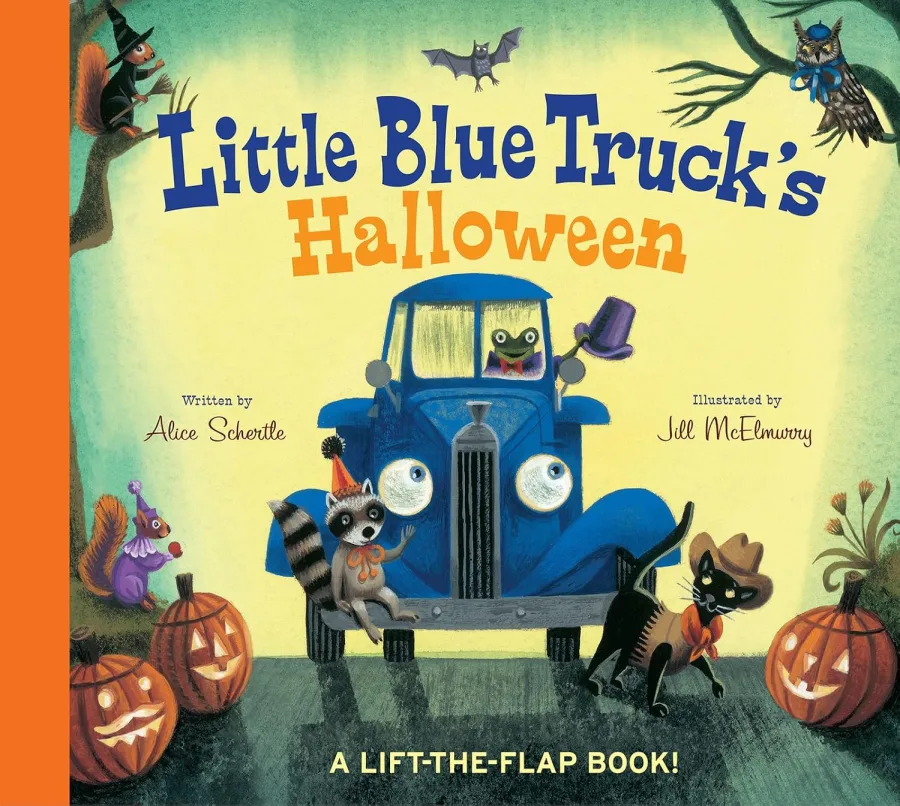
Little Blue Truck's Halloween
Alice Schertle, Jill McElmurry (Illustrator)
Board Book
• 16 Pages
• USD 16.99
• English
• 9780544772533
No ratings yet
| Publisher | Clarion Books |
|---|---|
| ISBN13 | 9780544772533 |
| ASIN/SKU | 0544772539 |
| Book Format | Board Book |
| Language | English |
| Pages | 16 |
| List Price | USD 16.99 |
| Publishing Date | 05/07/2016 |
| Dimensions | 9 x 0.72 x 8.12 inches |
| Weight | 13.9 ounces |
| Book Code | BD00070500 |
Buy this Book
Amazon Stores
Ebook Stores
Other Stores
Discover Little Blue Truck's Halloween by Alice Schertle. This book is published by Clarion Books in Board Book format, ISBN 9780544772533, ASIN 0544772539, under Children's Books, Children's Halloween Books, Children's Books on Cars, Trucks and Buses.
Book Description
Celebrate Halloween with the #1 New York Times bestselling Little Blue Truck and friends!
Beep! Beep! It’s Halloween! Little Blue Truck is picking up his animal friends for a costume party.
Lift the flaps in this large, sturdy board book to find out who’s dressed up in each costume! Will Blue wear a costume too?
Beep! Beep! It’s Halloween! Little Blue Truck is picking up his animal friends for a costume party.
Lift the flaps in this large, sturdy board book to find out who’s dressed up in each costume! Will Blue wear a costume too?
Author Biography
Alice Schertle has written many well-loved books for children, including Little Blue Truck, Little Blue Truck Leads the Way, and All You Need for a Snowman. She lives in Plainfield, Massachusetts.
Editorial Reviews
"The children demand anthropomorphic vehicles. And among them, none is as adorable as the vintage blue pick-up in the Little Blue Truck series.... [T]he only thing that would make these books cuter is if the truck only ever spoke in 'beeps'—and he does!" —The A.V. Club "McElmurry’s richly rendered scenes and the animals’ elegant costumes conjure up a sense of nostalgia that befits Little Blue Truck’s own vintage looks." —Publishers Weekly "Lovely curvy shapes and autumn colors fade to dusky blues as night falls, and children are sure to notice the traditional elements of a Halloween party: apple bobbing, lit jack-o'-lanterns, and punch and treats. Beloved Little Blue takes a bit of the mystery—and fear—out of Halloween costumes." —Kirkus
Book Summary
Alice Schertle’s Little Blue Truck’s Halloween, illustrated by Jill McElmurry, is a cheerful Halloween board book that turns a simple ride to a costume party into an interactive guessing game for very young children. First published in 2016 by Houghton Mifflin Harcourt, the book is a 16-page lift-the-flap story aimed primarily at toddlers and preschoolers. Rather than presenting a complicated Halloween plot, Schertle uses rhyme, repetition, familiar farm animals, costumes, and surprise reveals to create a short story that children can actively participate in. Little Blue Truck and his friend Toad travel toward a Halloween party, picking up animal friends along the way, while readers are repeatedly invited to guess which animal is hiding underneath each costume. The result is a warm, playful, and non-scary Halloween story that introduces young children to costumes, autumn imagery, friendship, and the excitement of a seasonal celebration.
The story begins with Little Blue Truck and Toad heading down the road to a Halloween party. From the opening, the mood is energetic and welcoming rather than frightening. Little Blue's familiar “beep” becomes part of the rhythmic pattern of the story, immediately connecting this Halloween adventure with the larger Little Blue Truck series. The two friends are not simply going to the party themselves; they are gathering other friends along the way. This gives the story its basic structure. As they travel, they encounter animals dressed in costumes, and each new character becomes another little mystery for the child to solve. The journey therefore feels like a sequence of small discoveries, with each stop providing another opportunity to guess, lift a flap, and celebrate the answer.
The most distinctive feature of Little Blue Truck’s Halloween is its lift-the-flap design. Each costumed animal is initially hidden behind a large, sturdy flap, and the text offers clues about who might be underneath. Children can look at the costume, notice recognizable details, listen to the rhyme, and make their own guess before lifting the flap. Once the flap is opened, the mystery is resolved as the animal identifies itself with its familiar sound. This creates a simple but highly effective reading pattern: clue, guess, reveal, and celebration. For toddlers, this repetition is especially valuable because it allows them to anticipate what comes next. After only a few pages, children can begin participating before an adult has finished reading the words.
The costumes themselves provide much of the book's charm. The farm animals are dressed in imaginative outfits that transform familiar characters into something temporarily new. A sheep appears as a clown, a duck wears a tutu, a cow is dressed as a queen, a pig becomes a witch, the hen and her chick become pirates, and the horse takes on the appearance of a dragon. These costumes are humorous because children already know what the animals normally look like. The fun comes from seeing something familiar in an unexpected role. The visual clues also make the guessing game accessible to very young children. Even when an animal's face is hidden, recognizable features remain visible, allowing children to make educated guesses.
This guessing element gives the book an educational quality without making it feel like a lesson. Children practice identifying animals, recognizing visual clues, predicting outcomes, and matching sounds with characters. When the flap opens and the sheep says “Baa!” or the duck says “Quack!”, children reinforce their understanding of animal names and sounds. The repeated structure also supports early language development because young readers hear the same kinds of sentence patterns again and again. The rhyming text makes the words memorable and gives adults natural opportunities to pause and let children supply the final sound or answer. The book's short length, simple vocabulary, and predictable pattern make it particularly suitable for shared reading with toddlers and preschoolers.
The story's Halloween setting is equally important. Schertle introduces autumn through visual details such as colorful leaves, jack-o'-lanterns, costumes, and the gradual change from daylight to evening. As Little Blue and his friends continue toward the party, the world becomes increasingly festive. The illustrations by Jill McElmurry capture this transition beautifully, using warm fall colors before moving toward the darker blues of nighttime. The result is a Halloween atmosphere that feels magical without becoming threatening. Kirkus Reviews specifically notes that the book takes some of the mystery and fear out of Halloween costumes, making it especially appropriate for the youngest trick-or-treaters.
That non-scary approach is one of the book's greatest strengths. Halloween can be overwhelming for very young children because costumes can hide familiar faces and traditional Halloween imagery sometimes emphasizes ghosts, monsters, or frightening creatures. Little Blue Truck’s Halloween approaches the holiday differently. Its costumes are playful and its mysteries are reassuring because the child quickly learns that every strange-looking figure is simply a familiar farm animal underneath. The act of lifting the flap literally removes the uncertainty. This makes the book a gentle introduction to Halloween costumes for toddlers who may still be learning that a person or animal can look different while remaining the same underneath.
Little Blue Truck's role in the story also reinforces the importance of friendship. He and Toad travel together, and the purpose of their journey is connected to bringing friends along to the party. The animals are not isolated characters appearing randomly; they form a friendly group that gradually comes together. By the time they reach the celebration, the truck is carrying a collection of costumed friends ready to enjoy the evening. The story therefore presents Halloween as a social experience. Dressing up is fun, but sharing the excitement with friends makes the celebration more meaningful. This theme fits naturally with the broader values of the Little Blue Truck series, where cooperation, kindness, and community frequently play important roles.
The party itself provides a satisfying conclusion to the journey. Once the animals arrive at the barn, the Halloween celebration includes familiar party activities such as treats, punch, music, dancing, apple bobbing, and glowing jack-o'-lanterns. These details expand the book beyond the simple guessing game and show children what a Halloween party can look like. The atmosphere is lively but comfortable. Children who have attended Halloween parties may recognize many of the activities, while children encountering them for the first time can understand the celebration through the pictures and simple text. The party also demonstrates why Little Blue and Toad have been gathering everyone along the road: the adventure has been leading toward a shared celebration.
A final surprise gives the story an especially playful ending. Once the other animals are gathered at the party, there is still a mystery to solve involving a large ghostlike figure with glowing eyes. The reader is once again encouraged to wonder who could possibly be hiding underneath the costume. The answer connects directly to Little Blue Truck himself, allowing the familiar character to participate in the costume fun rather than remaining merely the vehicle that transports everyone else. The final reveal provides the same sense of surprise as the earlier flaps while giving the story a satisfying circular structure: the character who has been helping everyone else reach the party has a costume and a surprise of his own.
Jill McElmurry's illustrations are essential to the experience because the story depends heavily on visual clues. Her artwork makes the farm animals immediately recognizable while giving their costumes enough personality to encourage guessing. The fall setting is colorful and expressive, and the illustrations gradually move from daytime autumn scenery toward a darker Halloween evening. This visual progression gives the very short book a stronger sense of movement and atmosphere. The pictures also help children understand the story even before they can follow every word. For a board book intended for very young readers, that combination of expressive artwork and simple text is particularly effective.
The physical format further supports the book's purpose. It is a sturdy board book with large interactive flaps, making it easier for small hands to explore than a traditional paper picture book. Library records identify it as a lift-the-flap board book intended for very young children, with a Lexile measure and early reading designation reflecting its simplicity. The interactive elements also encourage children to treat reading as an activity rather than something they simply watch an adult do. They can point, guess, lift, reveal, repeat sounds, and eventually begin anticipating the pattern independently.
Ultimately, Little Blue Truck’s Halloween is a delightful Halloween book for toddlers and preschoolers that succeeds by keeping its story simple, interactive, and reassuring. Its main themes are friendship, imagination, costumes, curiosity, prediction, and the joy of celebrating together. Rather than focusing on the frightening side of Halloween, Alice Schertle creates a gentle seasonal adventure in which every mystery has a friendly answer. Little Blue Truck and Toad's journey to the barn becomes a playful lesson in observation and participation, while the farm animals' costumes introduce children to the imaginative tradition of dressing up. The sturdy lift-the-flap format, rhyming language, repeated animal sounds, and colorful illustrations make it particularly well suited to read-aloud sessions, bedtime reading, classroom Halloween activities, and first introductions to the holiday.
For parents searching for a non-scary Halloween picture book, a Little Blue Truck Halloween book, or an interactive lift-the-flap book for toddlers, this title offers a particularly inviting choice. It is short enough to hold a young child's attention but interactive enough to encourage repeated reading. More importantly, it captures something essential about early childhood reading: children love knowing that they can participate in the story. Every costume becomes a puzzle, every flap becomes a moment of discovery, and every familiar animal sound becomes an opportunity to join in. By the final “Boo,” Halloween has been transformed from something potentially mysterious into something warm, funny, and familiar—a celebration where friends dress up, travel together, share treats, and enjoy being surprised.
The story begins with Little Blue Truck and Toad heading down the road to a Halloween party. From the opening, the mood is energetic and welcoming rather than frightening. Little Blue's familiar “beep” becomes part of the rhythmic pattern of the story, immediately connecting this Halloween adventure with the larger Little Blue Truck series. The two friends are not simply going to the party themselves; they are gathering other friends along the way. This gives the story its basic structure. As they travel, they encounter animals dressed in costumes, and each new character becomes another little mystery for the child to solve. The journey therefore feels like a sequence of small discoveries, with each stop providing another opportunity to guess, lift a flap, and celebrate the answer.
The most distinctive feature of Little Blue Truck’s Halloween is its lift-the-flap design. Each costumed animal is initially hidden behind a large, sturdy flap, and the text offers clues about who might be underneath. Children can look at the costume, notice recognizable details, listen to the rhyme, and make their own guess before lifting the flap. Once the flap is opened, the mystery is resolved as the animal identifies itself with its familiar sound. This creates a simple but highly effective reading pattern: clue, guess, reveal, and celebration. For toddlers, this repetition is especially valuable because it allows them to anticipate what comes next. After only a few pages, children can begin participating before an adult has finished reading the words.
The costumes themselves provide much of the book's charm. The farm animals are dressed in imaginative outfits that transform familiar characters into something temporarily new. A sheep appears as a clown, a duck wears a tutu, a cow is dressed as a queen, a pig becomes a witch, the hen and her chick become pirates, and the horse takes on the appearance of a dragon. These costumes are humorous because children already know what the animals normally look like. The fun comes from seeing something familiar in an unexpected role. The visual clues also make the guessing game accessible to very young children. Even when an animal's face is hidden, recognizable features remain visible, allowing children to make educated guesses.
This guessing element gives the book an educational quality without making it feel like a lesson. Children practice identifying animals, recognizing visual clues, predicting outcomes, and matching sounds with characters. When the flap opens and the sheep says “Baa!” or the duck says “Quack!”, children reinforce their understanding of animal names and sounds. The repeated structure also supports early language development because young readers hear the same kinds of sentence patterns again and again. The rhyming text makes the words memorable and gives adults natural opportunities to pause and let children supply the final sound or answer. The book's short length, simple vocabulary, and predictable pattern make it particularly suitable for shared reading with toddlers and preschoolers.
The story's Halloween setting is equally important. Schertle introduces autumn through visual details such as colorful leaves, jack-o'-lanterns, costumes, and the gradual change from daylight to evening. As Little Blue and his friends continue toward the party, the world becomes increasingly festive. The illustrations by Jill McElmurry capture this transition beautifully, using warm fall colors before moving toward the darker blues of nighttime. The result is a Halloween atmosphere that feels magical without becoming threatening. Kirkus Reviews specifically notes that the book takes some of the mystery and fear out of Halloween costumes, making it especially appropriate for the youngest trick-or-treaters.
That non-scary approach is one of the book's greatest strengths. Halloween can be overwhelming for very young children because costumes can hide familiar faces and traditional Halloween imagery sometimes emphasizes ghosts, monsters, or frightening creatures. Little Blue Truck’s Halloween approaches the holiday differently. Its costumes are playful and its mysteries are reassuring because the child quickly learns that every strange-looking figure is simply a familiar farm animal underneath. The act of lifting the flap literally removes the uncertainty. This makes the book a gentle introduction to Halloween costumes for toddlers who may still be learning that a person or animal can look different while remaining the same underneath.
Little Blue Truck's role in the story also reinforces the importance of friendship. He and Toad travel together, and the purpose of their journey is connected to bringing friends along to the party. The animals are not isolated characters appearing randomly; they form a friendly group that gradually comes together. By the time they reach the celebration, the truck is carrying a collection of costumed friends ready to enjoy the evening. The story therefore presents Halloween as a social experience. Dressing up is fun, but sharing the excitement with friends makes the celebration more meaningful. This theme fits naturally with the broader values of the Little Blue Truck series, where cooperation, kindness, and community frequently play important roles.
The party itself provides a satisfying conclusion to the journey. Once the animals arrive at the barn, the Halloween celebration includes familiar party activities such as treats, punch, music, dancing, apple bobbing, and glowing jack-o'-lanterns. These details expand the book beyond the simple guessing game and show children what a Halloween party can look like. The atmosphere is lively but comfortable. Children who have attended Halloween parties may recognize many of the activities, while children encountering them for the first time can understand the celebration through the pictures and simple text. The party also demonstrates why Little Blue and Toad have been gathering everyone along the road: the adventure has been leading toward a shared celebration.
A final surprise gives the story an especially playful ending. Once the other animals are gathered at the party, there is still a mystery to solve involving a large ghostlike figure with glowing eyes. The reader is once again encouraged to wonder who could possibly be hiding underneath the costume. The answer connects directly to Little Blue Truck himself, allowing the familiar character to participate in the costume fun rather than remaining merely the vehicle that transports everyone else. The final reveal provides the same sense of surprise as the earlier flaps while giving the story a satisfying circular structure: the character who has been helping everyone else reach the party has a costume and a surprise of his own.
Jill McElmurry's illustrations are essential to the experience because the story depends heavily on visual clues. Her artwork makes the farm animals immediately recognizable while giving their costumes enough personality to encourage guessing. The fall setting is colorful and expressive, and the illustrations gradually move from daytime autumn scenery toward a darker Halloween evening. This visual progression gives the very short book a stronger sense of movement and atmosphere. The pictures also help children understand the story even before they can follow every word. For a board book intended for very young readers, that combination of expressive artwork and simple text is particularly effective.
The physical format further supports the book's purpose. It is a sturdy board book with large interactive flaps, making it easier for small hands to explore than a traditional paper picture book. Library records identify it as a lift-the-flap board book intended for very young children, with a Lexile measure and early reading designation reflecting its simplicity. The interactive elements also encourage children to treat reading as an activity rather than something they simply watch an adult do. They can point, guess, lift, reveal, repeat sounds, and eventually begin anticipating the pattern independently.
Ultimately, Little Blue Truck’s Halloween is a delightful Halloween book for toddlers and preschoolers that succeeds by keeping its story simple, interactive, and reassuring. Its main themes are friendship, imagination, costumes, curiosity, prediction, and the joy of celebrating together. Rather than focusing on the frightening side of Halloween, Alice Schertle creates a gentle seasonal adventure in which every mystery has a friendly answer. Little Blue Truck and Toad's journey to the barn becomes a playful lesson in observation and participation, while the farm animals' costumes introduce children to the imaginative tradition of dressing up. The sturdy lift-the-flap format, rhyming language, repeated animal sounds, and colorful illustrations make it particularly well suited to read-aloud sessions, bedtime reading, classroom Halloween activities, and first introductions to the holiday.
For parents searching for a non-scary Halloween picture book, a Little Blue Truck Halloween book, or an interactive lift-the-flap book for toddlers, this title offers a particularly inviting choice. It is short enough to hold a young child's attention but interactive enough to encourage repeated reading. More importantly, it captures something essential about early childhood reading: children love knowing that they can participate in the story. Every costume becomes a puzzle, every flap becomes a moment of discovery, and every familiar animal sound becomes an opportunity to join in. By the final “Boo,” Halloween has been transformed from something potentially mysterious into something warm, funny, and familiar—a celebration where friends dress up, travel together, share treats, and enjoy being surprised.
Sample Chapters
Sample Chapters will be added soon…
Reader Reviews
No reviews yet.
Little Blue Truck's Halloween
Download Cover Image
Do you want to download the full cover image for Little Blue Truck's Halloween?