
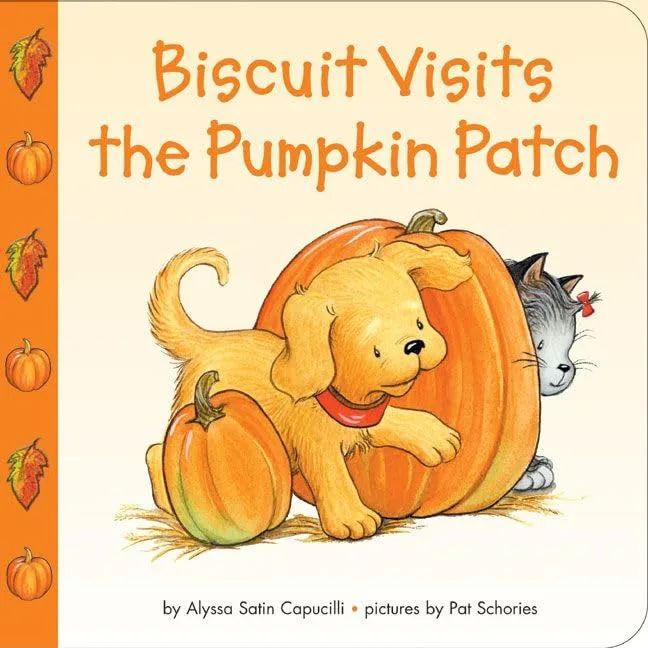
Biscuit Visits the Pumpkin Patch
Alyssa Satin Capucilli, Pat Schories (Illustrator)
Board Book
• 16 Pages
• USD 6.99
• English
• 9780060094669
No ratings yet
| Publisher | HarperCollins |
|---|---|
| ISBN13 | 9780060094669 |
| ASIN/SKU | 0060094664 |
| Book Format | Board Book |
| Language | English |
| Pages | 16 |
| List Price | USD 6.99 |
| Publishing Date | 27/07/2006 |
| Dimensions | 0.5 x 7 x 7 inches |
| Weight | 5.7 ounces |
| Book Code | BD00070503 |
Buy this Book
Amazon Stores
Ebook Stores
Other Stores
Discover Biscuit Visits the Pumpkin Patch by Alyssa Satin Capucilli. This book is published by HarperCollins in Board Book format, ISBN 9780060094669, ASIN 0060094664, under Children's Books, Children's Recycling and Green Living Books, Children's Halloween Books.
Book Description
Get in the fall spirit and join Biscuit on an adventure to find the perfect pumpkin in this board book!
What will Biscuit find in the pumpkin patch? The perfect pumpkin and some friendly surprises! Join Biscuit, the much-loved little yellow puppy, for a fun fall outing.
This board book is a sweet and friendly celebration of fall and will help introduce preschoolers to that fall favorite: a visit to the pumpkin patch!
Perfect for Halloween reading
A charming cozy seasonal pick
What will Biscuit find in the pumpkin patch? The perfect pumpkin and some friendly surprises! Join Biscuit, the much-loved little yellow puppy, for a fun fall outing.
This board book is a sweet and friendly celebration of fall and will help introduce preschoolers to that fall favorite: a visit to the pumpkin patch!
Perfect for Halloween reading
A charming cozy seasonal pick
Author Biography
Alyssa Satin Capucilli is the author of the popular books about the little yellow puppy named Biscuit. She lives in Hastings-on-Hudson, New York.
Photo from Goodreads.
Photo from Goodreads.
Editorial Reviews
Editorial Reviews will be added soon…
Book Summary
Alyssa Satin Capucilli’s Biscuit Visits the Pumpkin Patch, illustrated by Pat Schories, is a gentle, cheerful board book that takes young readers on a simple autumn adventure with Biscuit, the much-loved little yellow puppy. First published in 2004 by HarperFestival, the book is only 16 pages long and is designed especially for very young children and preschool listeners. Rather than relying on a complicated plot, Capucilli builds the story around the pleasures of a familiar seasonal outing: visiting a pumpkin patch, exploring the pumpkins, finding the right ones, and encountering friendly surprises along the way. The book’s simplicity is one of its greatest strengths because it gives toddlers an easy-to-follow story while introducing them to autumn, pumpkins, Halloween traditions, animals, friendship, and the joy of discovering something new.
The story begins with Biscuit going to a pumpkin patch with his young owner and friend. The pumpkin patch immediately becomes a place of exploration and excitement. Instead of treating the visit as merely a trip to choose one pumpkin, the story allows young readers to experience the setting through Biscuit’s curious perspective. There are pumpkins to look at, choices to make, and new things to discover. Biscuit’s natural enthusiasm makes the ordinary activity of selecting pumpkins feel like an adventure. The central purpose of the visit is to find the perfect pumpkins, including pumpkins that can be used for jack-o’-lanterns and pies. This simple goal gives the book a clear beginning, middle, and end while keeping the narrative accessible to children who are just developing their understanding of stories.
One of the most appealing aspects of Biscuit Visits the Pumpkin Patch is the way it transforms a familiar fall activity into an opportunity for observation and discovery. Biscuit does not simply arrive, choose a pumpkin, and leave. His curiosity encourages readers to look carefully at the world around him. The pumpkin patch becomes a setting where children can think about differences in color, shape, size, and appearance. A pumpkin is no longer just a pumpkin; it becomes something to compare, examine, and choose. For a preschool child, this kind of experience can support early concepts such as matching, classification, description, and decision-making without turning the story into an obvious lesson. The educational value remains naturally embedded in the fun of the adventure.
Biscuit himself is the heart of the story. As in other books in the Biscuit series, he is an affectionate and playful puppy whose curiosity drives much of the action. His presence makes the story particularly attractive to children who enjoy animal characters. Biscuit is not presented as a distant or complicated character; instead, he behaves in ways that young children can easily understand. He explores, becomes interested in what is around him, and participates in the excitement of the outing. His personality gives the book warmth and energy. Because Biscuit is a recurring character in Capucilli’s books, children who already know him may experience the story as another enjoyable visit with a familiar friend, while first-time readers can understand the adventure without needing extensive background information.
The relationship between Biscuit and the little girl also adds an important emotional dimension. Their outing is a shared experience, and the pleasure of the pumpkin patch comes partly from being together. The story quietly reinforces the idea that ordinary activities can become special when they are enjoyed with someone else. This is particularly appropriate for very young readers, for whom family outings, seasonal traditions, and time spent with trusted adults are important parts of everyday life. The book therefore works not only as a Halloween or autumn story but also as a gentle celebration of companionship and shared discovery. Library descriptions also identify friendship as one of the story's themes.
Another important element is Biscuit’s helpfulness. The story specifically presents him as participating in the search for the right pumpkins. The published description explains that Biscuit helps pick the perfect pumpkins for both jack-o’-lanterns and pies. For children, this creates a small but meaningful model of cooperation. Biscuit is not simply an observer; he is part of the activity. His involvement suggests that even a small puppy can contribute to a shared task. This can encourage children to think about their own role when helping parents, siblings, teachers, or friends with everyday activities.
The pumpkin patch itself provides the story with its seasonal identity. Autumn is introduced through an experience that children can easily imagine: walking among pumpkins and choosing one to take home. The book does not depend on frightening Halloween imagery, which makes it especially approachable for toddlers who may not yet be comfortable with ghosts, monsters, or other traditional Halloween characters. The story instead focuses on pumpkins, friendship, exploration, and the pleasant anticipation surrounding the season. Reviews and catalog descriptions similarly characterize the book as a gentle introduction to fall and the pumpkin-patch tradition.
This makes Biscuit Visits the Pumpkin Patch particularly useful as a preschool read-aloud. Its short length and straightforward storyline allow adults to read it in a few minutes, while the illustrations provide opportunities for conversation. Children can be encouraged to identify pumpkins, describe what Biscuit is doing, talk about autumn, or imagine which pumpkin they would choose. The book's format is also deliberately suited to young hands: it was published as a board book, with colorful illustrations and a compact 16-page structure. These characteristics make it appropriate for shared reading before bedtime, during classroom story time, or as part of an autumn or Halloween-themed activity.
Pat Schories’s illustrations are equally important to the experience. Because the text is intentionally simple, the pictures carry much of the atmosphere and visual storytelling. Biscuit’s expressive presence helps children understand his curiosity and excitement even before they can read the words themselves. The colorful pumpkin-patch setting gives young readers a concrete visual representation of autumn. In a book aimed at emerging readers, this balance between short text and expressive artwork is particularly effective because children can follow the story through the pictures while gradually developing connections between spoken language, printed words, and visual meaning.
At a deeper level, the book celebrates curiosity. Biscuit's adventure suggests that there is value in looking closely at ordinary places and being open to unexpected discoveries. The premise promises not only the perfect pumpkin but also “friendly surprises,” making the journey itself as important as the final choice. This is an appealing message for young children because their everyday world is full of first experiences. A trip to a farm, a walk through a garden, or a visit to a seasonal market can feel enormous and exciting when seen through a child's eyes. Biscuit captures that sense of wonder without exaggerating the situation.
The book also works well as an introduction to seasonal traditions. Children who have never visited a pumpkin patch can learn what such a place is like through Biscuit's experience. Those who have already participated in pumpkin picking may recognize familiar elements and connect the story to their own memories. The pumpkins selected for jack-o’-lanterns and pies also introduce children to the different ways pumpkins can become part of family traditions. In this sense, the story can easily lead to conversations about Halloween, autumn weather, farm visits, cooking, decorating, and other seasonal activities.
Ultimately, Biscuit Visits the Pumpkin Patch is not meant to deliver a complex moral or dramatic storyline. Its purpose is smaller and more intimate: to give very young children a warm, reassuring story about a happy autumn outing. Capucilli understands that preschool literature does not always need elaborate conflict. Sometimes a familiar character, a colorful setting, a simple goal, and a few pleasant surprises are enough. Biscuit's search for the perfect pumpkin becomes a celebration of curiosity, friendship, cooperation, seasonal change, and the happiness found in ordinary experiences.
For parents, teachers, and anyone looking for a Halloween or fall book for toddlers and preschoolers, Biscuit Visits the Pumpkin Patch offers an especially gentle choice. It introduces the pumpkin-patch experience without making Halloween frightening, encourages children to observe and participate, and gives them a lovable animal companion in Biscuit. More importantly, it reminds young readers that adventures do not have to be big to be memorable. A simple visit to a pumpkin patch can become a wonderful story when approached with curiosity, companionship, and a little puppy enthusiasm. That combination of warmth, simplicity, seasonal charm, and early-learning potential explains why this short Biscuit story remains a natural choice for autumn story time and preschool reading.
The story begins with Biscuit going to a pumpkin patch with his young owner and friend. The pumpkin patch immediately becomes a place of exploration and excitement. Instead of treating the visit as merely a trip to choose one pumpkin, the story allows young readers to experience the setting through Biscuit’s curious perspective. There are pumpkins to look at, choices to make, and new things to discover. Biscuit’s natural enthusiasm makes the ordinary activity of selecting pumpkins feel like an adventure. The central purpose of the visit is to find the perfect pumpkins, including pumpkins that can be used for jack-o’-lanterns and pies. This simple goal gives the book a clear beginning, middle, and end while keeping the narrative accessible to children who are just developing their understanding of stories.
One of the most appealing aspects of Biscuit Visits the Pumpkin Patch is the way it transforms a familiar fall activity into an opportunity for observation and discovery. Biscuit does not simply arrive, choose a pumpkin, and leave. His curiosity encourages readers to look carefully at the world around him. The pumpkin patch becomes a setting where children can think about differences in color, shape, size, and appearance. A pumpkin is no longer just a pumpkin; it becomes something to compare, examine, and choose. For a preschool child, this kind of experience can support early concepts such as matching, classification, description, and decision-making without turning the story into an obvious lesson. The educational value remains naturally embedded in the fun of the adventure.
Biscuit himself is the heart of the story. As in other books in the Biscuit series, he is an affectionate and playful puppy whose curiosity drives much of the action. His presence makes the story particularly attractive to children who enjoy animal characters. Biscuit is not presented as a distant or complicated character; instead, he behaves in ways that young children can easily understand. He explores, becomes interested in what is around him, and participates in the excitement of the outing. His personality gives the book warmth and energy. Because Biscuit is a recurring character in Capucilli’s books, children who already know him may experience the story as another enjoyable visit with a familiar friend, while first-time readers can understand the adventure without needing extensive background information.
The relationship between Biscuit and the little girl also adds an important emotional dimension. Their outing is a shared experience, and the pleasure of the pumpkin patch comes partly from being together. The story quietly reinforces the idea that ordinary activities can become special when they are enjoyed with someone else. This is particularly appropriate for very young readers, for whom family outings, seasonal traditions, and time spent with trusted adults are important parts of everyday life. The book therefore works not only as a Halloween or autumn story but also as a gentle celebration of companionship and shared discovery. Library descriptions also identify friendship as one of the story's themes.
Another important element is Biscuit’s helpfulness. The story specifically presents him as participating in the search for the right pumpkins. The published description explains that Biscuit helps pick the perfect pumpkins for both jack-o’-lanterns and pies. For children, this creates a small but meaningful model of cooperation. Biscuit is not simply an observer; he is part of the activity. His involvement suggests that even a small puppy can contribute to a shared task. This can encourage children to think about their own role when helping parents, siblings, teachers, or friends with everyday activities.
The pumpkin patch itself provides the story with its seasonal identity. Autumn is introduced through an experience that children can easily imagine: walking among pumpkins and choosing one to take home. The book does not depend on frightening Halloween imagery, which makes it especially approachable for toddlers who may not yet be comfortable with ghosts, monsters, or other traditional Halloween characters. The story instead focuses on pumpkins, friendship, exploration, and the pleasant anticipation surrounding the season. Reviews and catalog descriptions similarly characterize the book as a gentle introduction to fall and the pumpkin-patch tradition.
This makes Biscuit Visits the Pumpkin Patch particularly useful as a preschool read-aloud. Its short length and straightforward storyline allow adults to read it in a few minutes, while the illustrations provide opportunities for conversation. Children can be encouraged to identify pumpkins, describe what Biscuit is doing, talk about autumn, or imagine which pumpkin they would choose. The book's format is also deliberately suited to young hands: it was published as a board book, with colorful illustrations and a compact 16-page structure. These characteristics make it appropriate for shared reading before bedtime, during classroom story time, or as part of an autumn or Halloween-themed activity.
Pat Schories’s illustrations are equally important to the experience. Because the text is intentionally simple, the pictures carry much of the atmosphere and visual storytelling. Biscuit’s expressive presence helps children understand his curiosity and excitement even before they can read the words themselves. The colorful pumpkin-patch setting gives young readers a concrete visual representation of autumn. In a book aimed at emerging readers, this balance between short text and expressive artwork is particularly effective because children can follow the story through the pictures while gradually developing connections between spoken language, printed words, and visual meaning.
At a deeper level, the book celebrates curiosity. Biscuit's adventure suggests that there is value in looking closely at ordinary places and being open to unexpected discoveries. The premise promises not only the perfect pumpkin but also “friendly surprises,” making the journey itself as important as the final choice. This is an appealing message for young children because their everyday world is full of first experiences. A trip to a farm, a walk through a garden, or a visit to a seasonal market can feel enormous and exciting when seen through a child's eyes. Biscuit captures that sense of wonder without exaggerating the situation.
The book also works well as an introduction to seasonal traditions. Children who have never visited a pumpkin patch can learn what such a place is like through Biscuit's experience. Those who have already participated in pumpkin picking may recognize familiar elements and connect the story to their own memories. The pumpkins selected for jack-o’-lanterns and pies also introduce children to the different ways pumpkins can become part of family traditions. In this sense, the story can easily lead to conversations about Halloween, autumn weather, farm visits, cooking, decorating, and other seasonal activities.
Ultimately, Biscuit Visits the Pumpkin Patch is not meant to deliver a complex moral or dramatic storyline. Its purpose is smaller and more intimate: to give very young children a warm, reassuring story about a happy autumn outing. Capucilli understands that preschool literature does not always need elaborate conflict. Sometimes a familiar character, a colorful setting, a simple goal, and a few pleasant surprises are enough. Biscuit's search for the perfect pumpkin becomes a celebration of curiosity, friendship, cooperation, seasonal change, and the happiness found in ordinary experiences.
For parents, teachers, and anyone looking for a Halloween or fall book for toddlers and preschoolers, Biscuit Visits the Pumpkin Patch offers an especially gentle choice. It introduces the pumpkin-patch experience without making Halloween frightening, encourages children to observe and participate, and gives them a lovable animal companion in Biscuit. More importantly, it reminds young readers that adventures do not have to be big to be memorable. A simple visit to a pumpkin patch can become a wonderful story when approached with curiosity, companionship, and a little puppy enthusiasm. That combination of warmth, simplicity, seasonal charm, and early-learning potential explains why this short Biscuit story remains a natural choice for autumn story time and preschool reading.
Sample Chapters
Sample Chapters will be added soon…
Reader Reviews
No reviews yet.
Biscuit Visits the Pumpkin Patch
Download Cover Image
Do you want to download the full cover image for Biscuit Visits the Pumpkin Patch?