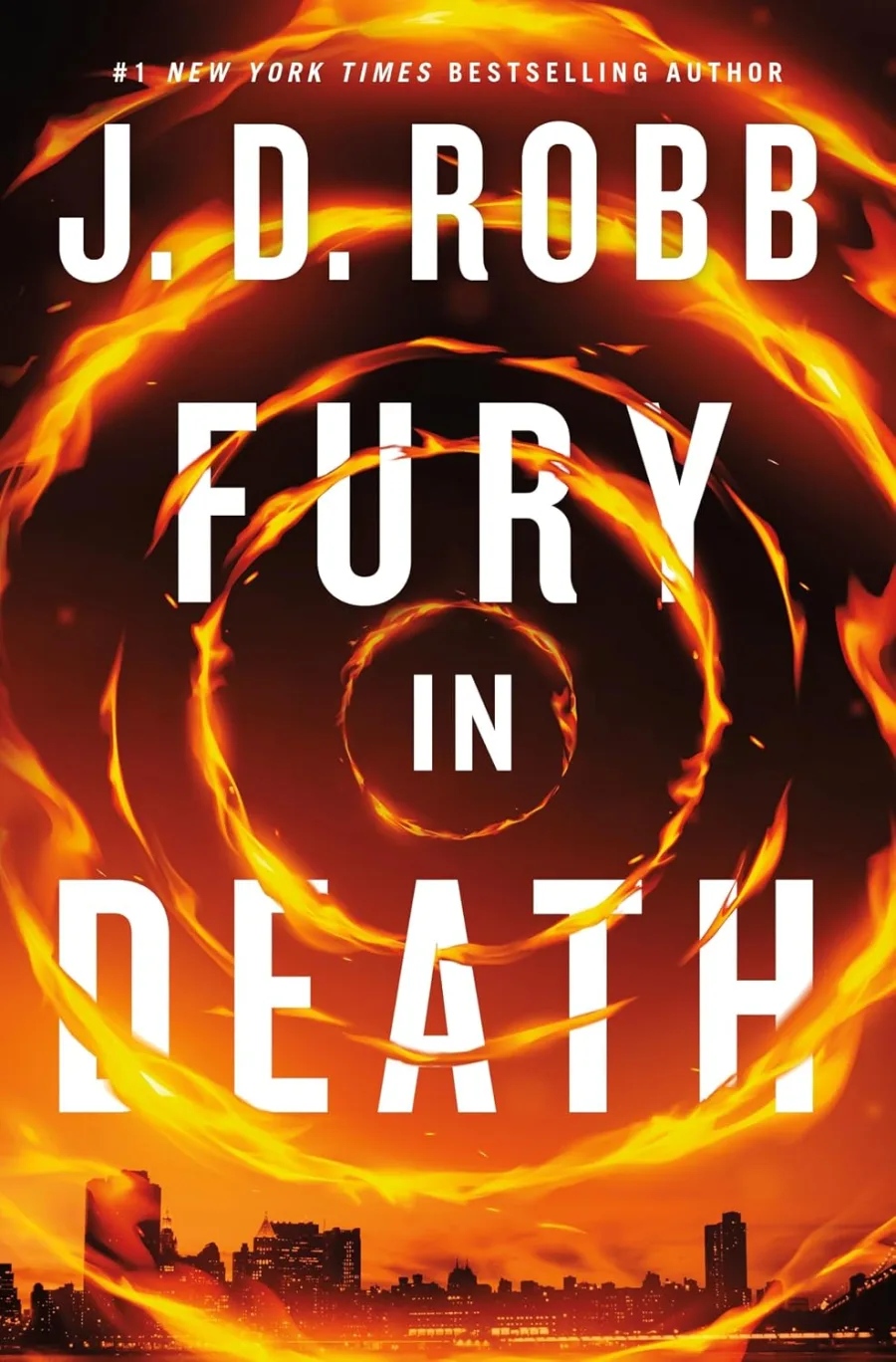
Fury in Death
eBook
• 363 Pages
• USD 14.99
• English
• 9781250414571
No ratings yet
| Publisher | St. Martin's Press |
|---|---|
| ISBN13 | 9781250414571 |
| ASIN/SKU | B0G75QJGLQ |
| Book Format | eBook |
| Language | English |
| Pages | 363 |
| List Price | USD 14.99 |
| Series Title | In Death |
| Publishing Date | 08/09/2026 |
| Book Code | BD00070563 |
Buy this Book
Amazon Stores
Ebook Stores
Other Stores
Discover Fury in Death by J. D. Robb. This book is published by St. Martin's Press in eBook format, ISBN 9781250414571, ASIN B0G75QJGLQ, under Mystery, Thriller and Suspense, Police Procedurals, Women Sleuths.
Book Description
In the new crime thriller from the #1 New York Times-bestselling author, Lt. Eve Dallas journeys into the darkness where murder is born…
NYSPD lieutenant Eve Dallas never knows what to expect when she gets word of a body. It could be an elderly man who made the mistake of climbing a ladder in slippery footwear. And the next call could be a wealthy biotech executive beaten to death in his home office—but what was Larry Chu’s mistake?
The victim’s corpse is so mangled and damaged it’s hard to believe a lone, unarmed assailant could have managed it. The killer was clearly unnaturally strong—and smart enough to find a way into Chu’s highly secure building. Most of all, whoever did this was very, very angry.
The excessive violence leads Dallas to conclude that this was a deeply personal act, born of a rage that she can’t excuse but can understand thanks to her own traumatic past. And though the motive seems rooted in heated emotion rather than cold hard cash, she can’t ignore the suspicious bank account in the Cayman Islands, or the shadowy, profit-hungry company Chu worked for. The mystery only grows when it turns out Chu isn’t the only victim—and Dallas will need to tear through one layer of secrecy after another to reveal what lies behind this explosion of fury...
NYSPD lieutenant Eve Dallas never knows what to expect when she gets word of a body. It could be an elderly man who made the mistake of climbing a ladder in slippery footwear. And the next call could be a wealthy biotech executive beaten to death in his home office—but what was Larry Chu’s mistake?
The victim’s corpse is so mangled and damaged it’s hard to believe a lone, unarmed assailant could have managed it. The killer was clearly unnaturally strong—and smart enough to find a way into Chu’s highly secure building. Most of all, whoever did this was very, very angry.
The excessive violence leads Dallas to conclude that this was a deeply personal act, born of a rage that she can’t excuse but can understand thanks to her own traumatic past. And though the motive seems rooted in heated emotion rather than cold hard cash, she can’t ignore the suspicious bank account in the Cayman Islands, or the shadowy, profit-hungry company Chu worked for. The mystery only grows when it turns out Chu isn’t the only victim—and Dallas will need to tear through one layer of secrecy after another to reveal what lies behind this explosion of fury...
Author Biography
J.D. ROBB is the pseudonym for #1 New York Times bestselling author Nora Roberts. She is the author of over 200 novels, including the futuristic suspense In Death series. There are more than 500 million copies of her books in print.
Editorial Reviews
Editorial Reviews will be added soon…
Book Summary
J. D. Robb’s Fury in Death is a gripping futuristic crime thriller and the 63rd installment in the long-running In Death series. The novel once again follows Lieutenant Eve Dallas of the New York City Police and her investigation into a murder that initially looks like a horrifying but isolated act of violence. Instead, the case opens the door to an old conspiracy involving corporate greed, scientific abuse, political corruption, revenge, and a devastating personal tragedy. Set in the futuristic New York of 2061, the novel combines the familiar police-procedural structure of the In Death books with a particularly emotional question: what happens when someone who has been failed by the law decides to create his own version of justice?
The story begins years before Eve’s investigation, in 2048, with scientist Steven Redman. Redman works for the powerful Banner-Wyst Corporation and is involved in a scientific project known as Rainmaker. His research is intended to help stabilize the climate and address environmental disasters such as drought and famine. However, Redman discovers something deeply disturbing. People within the corporation are planning to turn the technology into a weapon. Instead of using scientific progress to help humanity, they intend to manipulate weather patterns for power and profit. The discovery forces Redman to make a desperate decision. He corrupts his research files and prepares to take evidence to the authorities.
Redman believes he still has a chance to expose what Banner-Wyst is doing. Then, in a cruel twist of fate, everything changes. While he is away from home, an explosion destroys his apartment building. His pregnant wife, Ari, and their young son, Luke, are killed. Redman survives, but the emotional shock is catastrophic. His family is gone, his research has been betrayed, and the people responsible appear to escape justice. The tragedy becomes the foundation for the fury that eventually drives the novel’s central conflict.
Thirteen years later, Eve Dallas is called to investigate the murder of Larry Chu, a wealthy biotech executive associated with Banner-Wyst. Chu has been brutally beaten to death inside his own highly secured home office. The scene immediately troubles Eve because the killing is extraordinarily violent. The amount of damage inflicted on the victim suggests that the murderer possessed extraordinary strength, yet there is no obvious weapon that could explain the devastation. Even more troubling, the killer managed to penetrate a secure environment, disable security systems, and leave very little behind.
Eve quickly understands that this is not an ordinary murder. The violence feels personal. There is no immediate evidence that money or robbery motivated the killing, and Eve’s instincts tell her that the murderer was driven by rage. That distinction becomes important because Eve understands rage better than many detectives could. Her own traumatic past has taught her that extreme violence can grow from buried pain, although understanding a motive does not mean excusing the crime.
As Eve and her partner Peabody begin working through Chu’s background, the case becomes increasingly complicated. Chu had connections to Banner-Wyst, and investigators discover suspicious financial activity, including money held in offshore accounts. What first appears to be a murder committed by an angry individual begins to look like part of a larger pattern. The corporation itself becomes impossible to ignore, and Eve starts looking beyond the victim to the people who may have had reasons to fear him—or silence him.
The investigation eventually leads Eve toward the events of 2048 and the destruction of Steven Redman’s family. The connection is chilling. The bombing that killed Ari and Luke was not necessarily the tragic accident it had been made to appear. Instead, evidence points toward a deliberate act designed to eliminate a threat to Banner-Wyst. Redman’s scientific discovery had placed powerful people in danger, and his family became collateral damage in a corporate effort to protect its interests.
The more Eve uncovers, the clearer the revenge pattern becomes. The people being targeted are not random. They are connected to the conspiracy that destroyed Redman’s family and suppressed the truth about what Banner-Wyst was doing. Each murder represents another step in an old vendetta. The killer is not simply lashing out blindly; he is working through a list of people he believes deserve punishment.
This is where Fury in Death becomes more than a conventional murder mystery. Eve is investigating someone whose anger is understandable even though his actions are criminal. Redman has suffered a loss so enormous that revenge has become the organizing principle of his life. He believes the legal system failed him, so he has created his own system of accountability. Eve, however, cannot accept that logic. For her, justice has to remain connected to law, evidence, and due process.
The contrast between Eve and Redman gives the novel much of its emotional power. Both understand trauma. Both know what it means to carry terrible memories. Both are capable of confronting violence without looking away. But they choose different paths. Eve uses her pain to strengthen her determination to protect others. Redman allows his pain to consume him until vengeance becomes more important than survival.
The investigation also reveals the dangerous extent of Banner-Wyst’s activities. What Eve finds is not simply a company with unethical executives. The corporation has been involved in secret projects and scientific experiments that demonstrate how easily advanced technology can become a tool for exploitation. The same scientific ambition that could have helped humanity has been distorted by people who see disasters, resources, and even human lives as opportunities for profit.
Roarke, Eve’s husband and one of her most important investigative allies, plays a crucial role as the case expands. His extraordinary technological knowledge and business experience help Eve follow financial trails and corporate connections that would otherwise be difficult to uncover. Their relationship also provides the emotional balance that has become central to the In Death series. Eve may be relentless in her professional life, but Roarke gives her a private space where she can process the emotional weight of the cases she carries.
As Eve closes in on the truth, the killer becomes increasingly dangerous. Redman is not simply intelligent; he has transformed himself physically as well. His obsession with revenge has led him to develop and use a powerful substance known as Fury, which enhances his physical strength. But the enhancement comes at an enormous cost. His body is deteriorating, meaning that every act of revenge is bringing him closer to his own death.
This development makes Redman a tragic figure rather than a simple villain. He has become both hunter and victim. He has spent years preparing to punish the people he believes responsible for destroying his family, but the very process has destroyed what remained of his own future. Revenge has given him a purpose, yet it has also consumed his body and isolated him from ordinary life.
The confrontation between Eve and Redman becomes particularly significant because neither character can simply dismiss the other. Redman sees Eve as someone who understands what loss can do to a person. Eve sees the pain behind his actions, but she refuses to allow sympathy to become an excuse for murder. Her objective is not to defeat Redman emotionally; it is to stop the killing and expose the people who created the circumstances that produced it.
Eventually, Eve’s investigation exposes the corporate conspiracy behind the murders. The evidence begins to establish that powerful figures within Banner-Wyst were responsible for decisions that led to the deaths of Redman’s family and the destruction of his life. The truth is brought into the light, and the people responsible face legal consequences. Eve succeeds in doing something that is central to her character: she proves that justice can still be achieved without becoming vengeance.
For Redman, however, the revelation comes too late. His body has been damaged beyond recovery by the substance he created and used. Near the end of the story, he is dying in the hospital. Eve meets with him, and their final encounter is quiet rather than triumphant. Redman learns that the people responsible for his family’s deaths are finally facing justice. Knowing that the truth has been uncovered allows him to let go of some of the anger that has sustained him for thirteen years.
His death gives the novel its most poignant emotional note. Redman is responsible for terrible acts, but Robb does not portray him as someone who was born evil. He is a man destroyed by grief, betrayal, and an overwhelming desire to make someone pay. Eve recognizes that distinction. She does not forgive his murders, but she can understand the human pain underneath them.
The ending therefore reinforces one of the major themes of Fury in Death: the difference between justice and revenge. Revenge may feel satisfying to someone who has been wronged, but it cannot restore the dead or repair the life that was destroyed. It can only create another cycle of suffering. Eve’s approach is slower and less emotionally satisfying, but it has the power to expose an entire system of corruption rather than simply eliminating individual targets.
Another important theme is the abuse of scientific progress. The novel asks what happens when discoveries designed to benefit society are controlled by people motivated by greed. Banner-Wyst represents the danger of treating science as a commodity without ethical responsibility. In the futuristic world of the In Death series, advanced technology can make life safer and easier, but it can also make wrongdoing more powerful when placed in the wrong hands.
Ultimately, Fury in Death is both a murder mystery and a story about grief. Eve Dallas investigates a series of brutal killings, but beneath the police procedural lies the story of a man who lost his family and spent thirteen years turning his grief into fury. Eve’s investigation gradually transforms the case from a search for a murderer into an excavation of the past. By uncovering the truth, she gives the victims a form of justice and prevents Redman’s revenge from becoming the only version of the story.
For readers searching for a Fury in Death summary, the book can best be described as a futuristic police procedural involving Eve Dallas, a revenge-driven killer, corporate corruption, scientific conspiracy, and a decades-old tragedy. Fans of the In Death series will find the familiar combination of mystery, technology, forensic investigation, Eve and Roarke’s relationship, and emotional character development. At the same time, the story stands out because its central crime is driven less by greed than by grief and fury.
In the end, Fury in Death delivers a powerful reminder that understanding someone’s pain does not mean approving their actions. Eve Dallas recognizes the rage behind the murders because she knows what trauma can do, but she refuses to surrender her belief in justice. That tension between compassion and accountability gives the novel its emotional strength. The result is a dark, suspenseful, and deeply human addition to J. D. Robb’s In Death series—one that uses a futuristic murder investigation to explore grief, corporate greed, scientific responsibility, revenge, forgiveness, and the difficult difference between punishment and true justice.
The story begins years before Eve’s investigation, in 2048, with scientist Steven Redman. Redman works for the powerful Banner-Wyst Corporation and is involved in a scientific project known as Rainmaker. His research is intended to help stabilize the climate and address environmental disasters such as drought and famine. However, Redman discovers something deeply disturbing. People within the corporation are planning to turn the technology into a weapon. Instead of using scientific progress to help humanity, they intend to manipulate weather patterns for power and profit. The discovery forces Redman to make a desperate decision. He corrupts his research files and prepares to take evidence to the authorities.
Redman believes he still has a chance to expose what Banner-Wyst is doing. Then, in a cruel twist of fate, everything changes. While he is away from home, an explosion destroys his apartment building. His pregnant wife, Ari, and their young son, Luke, are killed. Redman survives, but the emotional shock is catastrophic. His family is gone, his research has been betrayed, and the people responsible appear to escape justice. The tragedy becomes the foundation for the fury that eventually drives the novel’s central conflict.
Thirteen years later, Eve Dallas is called to investigate the murder of Larry Chu, a wealthy biotech executive associated with Banner-Wyst. Chu has been brutally beaten to death inside his own highly secured home office. The scene immediately troubles Eve because the killing is extraordinarily violent. The amount of damage inflicted on the victim suggests that the murderer possessed extraordinary strength, yet there is no obvious weapon that could explain the devastation. Even more troubling, the killer managed to penetrate a secure environment, disable security systems, and leave very little behind.
Eve quickly understands that this is not an ordinary murder. The violence feels personal. There is no immediate evidence that money or robbery motivated the killing, and Eve’s instincts tell her that the murderer was driven by rage. That distinction becomes important because Eve understands rage better than many detectives could. Her own traumatic past has taught her that extreme violence can grow from buried pain, although understanding a motive does not mean excusing the crime.
As Eve and her partner Peabody begin working through Chu’s background, the case becomes increasingly complicated. Chu had connections to Banner-Wyst, and investigators discover suspicious financial activity, including money held in offshore accounts. What first appears to be a murder committed by an angry individual begins to look like part of a larger pattern. The corporation itself becomes impossible to ignore, and Eve starts looking beyond the victim to the people who may have had reasons to fear him—or silence him.
The investigation eventually leads Eve toward the events of 2048 and the destruction of Steven Redman’s family. The connection is chilling. The bombing that killed Ari and Luke was not necessarily the tragic accident it had been made to appear. Instead, evidence points toward a deliberate act designed to eliminate a threat to Banner-Wyst. Redman’s scientific discovery had placed powerful people in danger, and his family became collateral damage in a corporate effort to protect its interests.
The more Eve uncovers, the clearer the revenge pattern becomes. The people being targeted are not random. They are connected to the conspiracy that destroyed Redman’s family and suppressed the truth about what Banner-Wyst was doing. Each murder represents another step in an old vendetta. The killer is not simply lashing out blindly; he is working through a list of people he believes deserve punishment.
This is where Fury in Death becomes more than a conventional murder mystery. Eve is investigating someone whose anger is understandable even though his actions are criminal. Redman has suffered a loss so enormous that revenge has become the organizing principle of his life. He believes the legal system failed him, so he has created his own system of accountability. Eve, however, cannot accept that logic. For her, justice has to remain connected to law, evidence, and due process.
The contrast between Eve and Redman gives the novel much of its emotional power. Both understand trauma. Both know what it means to carry terrible memories. Both are capable of confronting violence without looking away. But they choose different paths. Eve uses her pain to strengthen her determination to protect others. Redman allows his pain to consume him until vengeance becomes more important than survival.
The investigation also reveals the dangerous extent of Banner-Wyst’s activities. What Eve finds is not simply a company with unethical executives. The corporation has been involved in secret projects and scientific experiments that demonstrate how easily advanced technology can become a tool for exploitation. The same scientific ambition that could have helped humanity has been distorted by people who see disasters, resources, and even human lives as opportunities for profit.
Roarke, Eve’s husband and one of her most important investigative allies, plays a crucial role as the case expands. His extraordinary technological knowledge and business experience help Eve follow financial trails and corporate connections that would otherwise be difficult to uncover. Their relationship also provides the emotional balance that has become central to the In Death series. Eve may be relentless in her professional life, but Roarke gives her a private space where she can process the emotional weight of the cases she carries.
As Eve closes in on the truth, the killer becomes increasingly dangerous. Redman is not simply intelligent; he has transformed himself physically as well. His obsession with revenge has led him to develop and use a powerful substance known as Fury, which enhances his physical strength. But the enhancement comes at an enormous cost. His body is deteriorating, meaning that every act of revenge is bringing him closer to his own death.
This development makes Redman a tragic figure rather than a simple villain. He has become both hunter and victim. He has spent years preparing to punish the people he believes responsible for destroying his family, but the very process has destroyed what remained of his own future. Revenge has given him a purpose, yet it has also consumed his body and isolated him from ordinary life.
The confrontation between Eve and Redman becomes particularly significant because neither character can simply dismiss the other. Redman sees Eve as someone who understands what loss can do to a person. Eve sees the pain behind his actions, but she refuses to allow sympathy to become an excuse for murder. Her objective is not to defeat Redman emotionally; it is to stop the killing and expose the people who created the circumstances that produced it.
Eventually, Eve’s investigation exposes the corporate conspiracy behind the murders. The evidence begins to establish that powerful figures within Banner-Wyst were responsible for decisions that led to the deaths of Redman’s family and the destruction of his life. The truth is brought into the light, and the people responsible face legal consequences. Eve succeeds in doing something that is central to her character: she proves that justice can still be achieved without becoming vengeance.
For Redman, however, the revelation comes too late. His body has been damaged beyond recovery by the substance he created and used. Near the end of the story, he is dying in the hospital. Eve meets with him, and their final encounter is quiet rather than triumphant. Redman learns that the people responsible for his family’s deaths are finally facing justice. Knowing that the truth has been uncovered allows him to let go of some of the anger that has sustained him for thirteen years.
His death gives the novel its most poignant emotional note. Redman is responsible for terrible acts, but Robb does not portray him as someone who was born evil. He is a man destroyed by grief, betrayal, and an overwhelming desire to make someone pay. Eve recognizes that distinction. She does not forgive his murders, but she can understand the human pain underneath them.
The ending therefore reinforces one of the major themes of Fury in Death: the difference between justice and revenge. Revenge may feel satisfying to someone who has been wronged, but it cannot restore the dead or repair the life that was destroyed. It can only create another cycle of suffering. Eve’s approach is slower and less emotionally satisfying, but it has the power to expose an entire system of corruption rather than simply eliminating individual targets.
Another important theme is the abuse of scientific progress. The novel asks what happens when discoveries designed to benefit society are controlled by people motivated by greed. Banner-Wyst represents the danger of treating science as a commodity without ethical responsibility. In the futuristic world of the In Death series, advanced technology can make life safer and easier, but it can also make wrongdoing more powerful when placed in the wrong hands.
Ultimately, Fury in Death is both a murder mystery and a story about grief. Eve Dallas investigates a series of brutal killings, but beneath the police procedural lies the story of a man who lost his family and spent thirteen years turning his grief into fury. Eve’s investigation gradually transforms the case from a search for a murderer into an excavation of the past. By uncovering the truth, she gives the victims a form of justice and prevents Redman’s revenge from becoming the only version of the story.
For readers searching for a Fury in Death summary, the book can best be described as a futuristic police procedural involving Eve Dallas, a revenge-driven killer, corporate corruption, scientific conspiracy, and a decades-old tragedy. Fans of the In Death series will find the familiar combination of mystery, technology, forensic investigation, Eve and Roarke’s relationship, and emotional character development. At the same time, the story stands out because its central crime is driven less by greed than by grief and fury.
In the end, Fury in Death delivers a powerful reminder that understanding someone’s pain does not mean approving their actions. Eve Dallas recognizes the rage behind the murders because she knows what trauma can do, but she refuses to surrender her belief in justice. That tension between compassion and accountability gives the novel its emotional strength. The result is a dark, suspenseful, and deeply human addition to J. D. Robb’s In Death series—one that uses a futuristic murder investigation to explore grief, corporate greed, scientific responsibility, revenge, forgiveness, and the difficult difference between punishment and true justice.
Sample Chapters
Sample Chapters will be added soon…
Reader Reviews
No reviews yet.
Fury in Death