
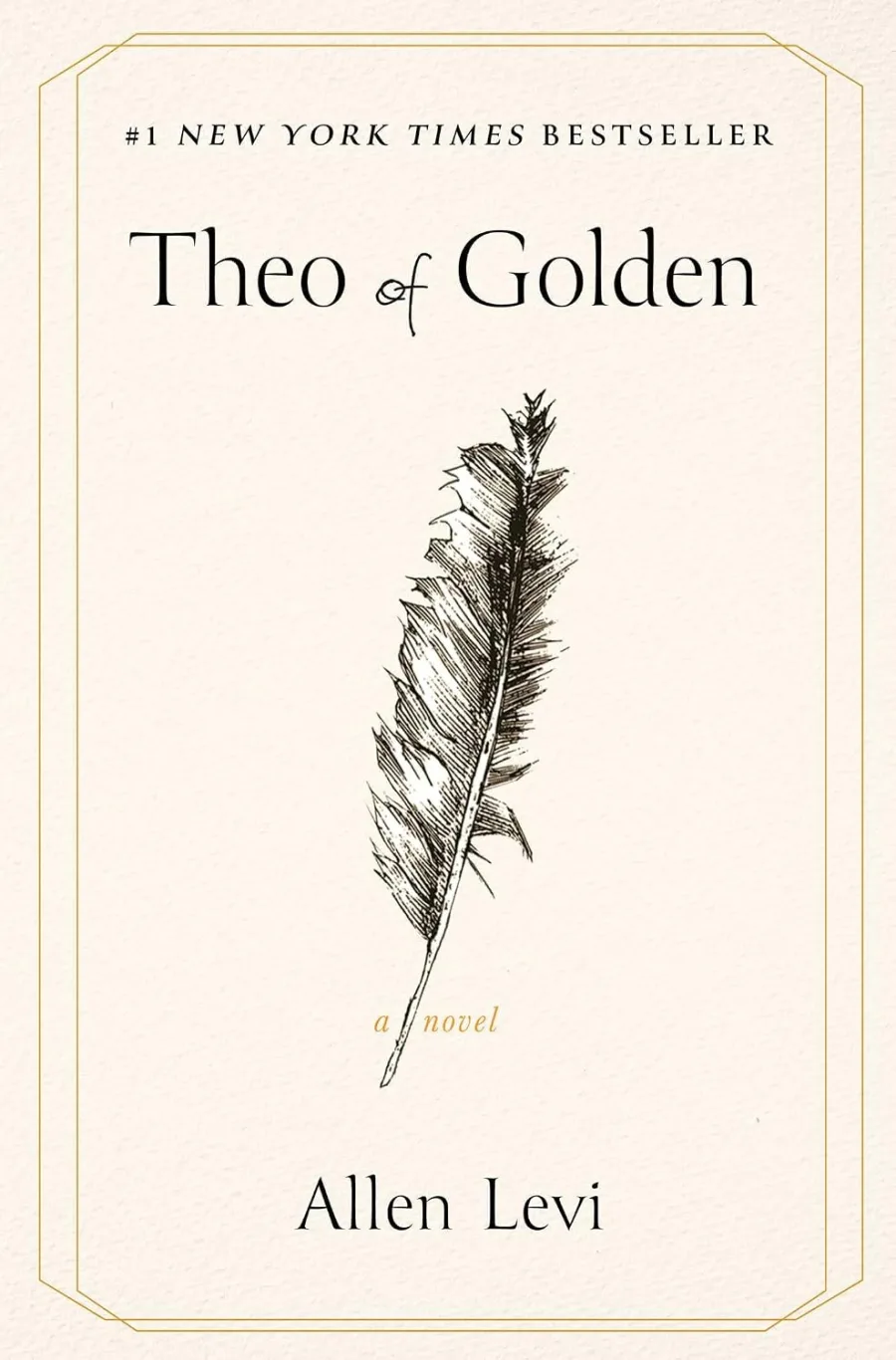
Theo of Golden: A Novel
eBook
• 399 Pages
• USD 20.00
• English
• 9781668236536
No ratings yet
| Publisher | Atria Books |
|---|---|
| ISBN13 | 9781668236536 |
| ASIN/SKU | B0FTT3XSRZ |
| Book Format | eBook |
| Language | English |
| Pages | 399 |
| List Price | USD 20.00 |
| Publishing Date | 03/10/2025 |
| Book Code | BD00070579 |
Buy this Book
Amazon Stores
Ebook Stores
Other Stores
Discover Theo of Golden: A Novel by Allen Levi. This book is published by Atria Books in eBook format, ISBN 9781668236536, ASIN B0FTT3XSRZ, under Literature and Fiction, Literary Fiction, Friendship Fiction.
Book Description
THE #1 NEW YORK TIMES BESTSELLING PHENOMENON
A Katie Couric Book Club Pick • A Jen Hatmaker Book Club Pick
“[A] word-of-mouth smash hit.” —The New York Times
“A treasure.” —Hoda Kotb
“To Kill a Mockingbird for this generation.” —The Dallas Morning News
One spring morning, a stranger named Theo arrives in the small Southern city of Golden. He doesn’t explain much about where he came from or why he’s there—but when he visits the local coffeehouse, where pencil portraits of the people of Golden hang on the walls, he begins purchasing them, one at a time, and giving each portrait to the person depicted. In exchange, he asks only for the person’s story. And so portrait by portrait, person by person, secrets are revealed, regrets are shared, and ordinary lives are profoundly altered.
A story of giving and receiving, of seeing and being seen, Theo of Golden is an unforgettable novel about the power of generosity, the importance of connection, and the quiet miracles that happen when we choose kindness and wonder.
A Katie Couric Book Club Pick • A Jen Hatmaker Book Club Pick
“[A] word-of-mouth smash hit.” —The New York Times
“A treasure.” —Hoda Kotb
“To Kill a Mockingbird for this generation.” —The Dallas Morning News
One spring morning, a stranger named Theo arrives in the small Southern city of Golden. He doesn’t explain much about where he came from or why he’s there—but when he visits the local coffeehouse, where pencil portraits of the people of Golden hang on the walls, he begins purchasing them, one at a time, and giving each portrait to the person depicted. In exchange, he asks only for the person’s story. And so portrait by portrait, person by person, secrets are revealed, regrets are shared, and ordinary lives are profoundly altered.
A story of giving and receiving, of seeing and being seen, Theo of Golden is an unforgettable novel about the power of generosity, the importance of connection, and the quiet miracles that happen when we choose kindness and wonder.
Author Biography
Allen grew up in Columbus, Georgia, attended University of Georgia for degrees in English and Law, and worked as an attorney from 1980 to 1990. He left law practice for two years in 1990, moved to Scotland, and, while there, received a degree in Scottish fiction from the University of Edinburgh. He returned home, resumed law practice for three years, and finally ventured into vocational music in 1996.
Since then, he has worked as a traveling musician, sharing his whimsical, thought-provoking brand of songwriting and storytelling to audiences across the U.S. He has over twenty albums to his credit, as well as hundreds of other unpublished songs.
In 2014, he published The Last Sweet Mile, a memoir of the close friendship he shared with his brother, Gary, who died in 2012. He also wrote and published a children’s book, Oliviatown, adapted from a song of the same title.
Allen published his first novel, Theo of Golden, in 2023 and is currently working on its sequel, Ellen of Golden.
When not reading or writing, Allen, cares for family acreage where he lives with his father, spends time with family nearby, keeps a full schedule of involvement in the small community around him, and dreams of being an artist someday.
Since then, he has worked as a traveling musician, sharing his whimsical, thought-provoking brand of songwriting and storytelling to audiences across the U.S. He has over twenty albums to his credit, as well as hundreds of other unpublished songs.
In 2014, he published The Last Sweet Mile, a memoir of the close friendship he shared with his brother, Gary, who died in 2012. He also wrote and published a children’s book, Oliviatown, adapted from a song of the same title.
Allen published his first novel, Theo of Golden, in 2023 and is currently working on its sequel, Ellen of Golden.
When not reading or writing, Allen, cares for family acreage where he lives with his father, spends time with family nearby, keeps a full schedule of involvement in the small community around him, and dreams of being an artist someday.
Editorial Reviews
JEN HATMAKER BOOK CLUB: March 2026 Book Club Pick
KATIE COURIC BOOK CLUB: February 2026 Book Club Pick
NEW YORK TIMES: Surprising Hits of 2025
“[A] word-of-mouth smash hit.” —The New York Times
“A treasure” —Hoda Kotb
"An emotional and heartwarming tale" —USA Today
“It has a soft-lit, allegorical quality.” —Washington Post
"I'm in awe of Theo - and of his creator Allen Levi. Levi's debut novel is one you'll want to buy so you can travel to Golden again and again." —WKLB-FM (Waltham, MA)
KATIE COURIC BOOK CLUB: February 2026 Book Club Pick
NEW YORK TIMES: Surprising Hits of 2025
“[A] word-of-mouth smash hit.” —The New York Times
“A treasure” —Hoda Kotb
"An emotional and heartwarming tale" —USA Today
“It has a soft-lit, allegorical quality.” —Washington Post
"I'm in awe of Theo - and of his creator Allen Levi. Levi's debut novel is one you'll want to buy so you can travel to Golden again and again." —WKLB-FM (Waltham, MA)
Book Summary
Theo of Golden by Allen Levi is a gentle, deeply human novel about kindness, grief, art, faith, generosity, and the extraordinary effect one person can have on the lives of strangers. Rather than relying on a fast-moving mystery or dramatic plot twists, Levi builds the story around a simple but moving idea: what might happen if someone took the time to truly see other people? The novel follows Theo, an enigmatic eighty-six-year-old Portuguese man who arrives unexpectedly in the small Southern city of Golden, Georgia. He does not explain why he has come, where he intends to stay, or even what his surname is. Instead, he quietly settles into the community and begins an unusual project involving ninety-two pencil portraits created by a talented but largely unknown local artist. Theo buys the portraits and personally gives them to the people depicted in them. In return, he asks for nothing except their stories. Through these encounters, Theo of Golden becomes a moving meditation on what it means to be noticed, understood, forgiven, and loved.
Theo arrives in Golden shortly after Easter, having traveled from New York. He is an unusual newcomer: cultured, multilingual, wealthy, private, and clearly carrying a complicated past. He spends his first days exploring the town, walking near the river, visiting local businesses, and observing the people around him. At the coffee shop known as The Chalice, he discovers a collection of ninety-two pencil portraits hanging on the walls. The portraits were drawn by Asher Glissen, a local artist whose remarkable talent has not yet brought him much commercial success. Theo is immediately fascinated by the faces. He senses that each portrait contains more than a likeness; he sees sadness, strength, kindness, uncertainty, and history in the people Asher has drawn. When he learns that the portraits have remained largely unsold, Theo decides to purchase them one by one and return them to their subjects.
Theo's first “bestowal” establishes the pattern that shapes the entire novel. He purchases the portrait of Minnette Prentiss, a young accountant, and sends her a handwritten letter inviting her to meet him at a fountain called the Fedder. He tells her that he believes the portrait belongs to her. Minnette is puzzled by the gesture and initially wonders whether her husband, Derrick, has secretly bought it for her. When she finally meets Theo, however, she realizes that his interest is not romantic or transactional. He simply believes she should possess the image of herself that another person has seen. Theo studies Minnette's face and tells her that he sees strength, bravery, kindness, and sadness in her eyes. For a woman who has spent much of her life under pressure to succeed, those words have a profound effect.
To make his unusual mission possible, Theo establishes a quiet relationship with James Ponder, a respected consultant and broker who owns Ponder House. Theo rents an apartment there and provides Ponder with substantial funds to cover the costs of purchasing portraits and helping people anonymously. Ponder's secretary, Mrs. Gidley, becomes part of the operation, helping Theo locate the people in Asher's drawings and deliver his handwritten invitations. Theo remains deliberately mysterious. He answers questions about himself only when he chooses and never explains the true reason he has come to Golden. This secrecy creates the novel's central question: who is Theo, and why has an elderly stranger devoted the final chapter of his life to giving things away?
As the portrait bestowals continue, the book expands into a series of intimate human stories. One of the most memorable is Kendrick Whitaker, a night custodian whose young daughter, Lamisha, has been seriously injured in a car accident that killed Kendrick's wife. Kendrick works nights so he can remain with Lamisha during the day, while his mother takes care of the girl at night. He is exhausted, grieving, and skeptical of Theo's generosity. Yet Theo does not simply hand him a portrait and walk away. After learning about Lamisha's situation, he quietly arranges medical assistance and financial support for the family. He even sends flowers, cake, and art supplies to the hospital for Lamisha's birthday. Later, he continues visiting her after she returns home, bringing her a handmade storybook and illustrations. Theo's kindness is never presented as charity for its own sake; he wants people to understand that their lives matter.
Another important character is Ellen, an unhoused woman struggling with mental illness. When Theo gives her portrait to her, she initially has difficulty trusting him. She carries enormous pain from the past. Years earlier, authorities took her infant daughter, Willa Francesca, away after deciding that Ellen was not mentally capable of caring for her. Ellen was barely allowed to see the baby before the child was taken from her. Theo does not attempt to solve Ellen's life with easy advice. Instead, he listens. His willingness to hear her story without judgment gradually restores a sense of dignity that Ellen has almost lost. She begins spending time with Theo, attends church with him, takes him bicycle riding, introduces him to birdwatching, and eventually begins developing her own creative work. Theo recognizes abilities in Ellen that others have overlooked.
Theo's friendships also reveal that he is not simply a saintly figure without wounds. His own past is marked by devastating grief. He tells Kendrick about the death of his ten-year-old daughter, Tita, who died in a car accident in France along with Theo's wife. Theo had been immensely successful, but he came to understand too late that his professional ambitions had damaged his relationship with his family. After their deaths, he fell into profound depression and withdrew from ordinary life. Eventually, walking beside the River Marne and watching a sunset helped him begin the slow process of healing. His grief never completely disappears. Rivers and sunsets remain connected to his daughter, and his understanding of sadness becomes central to how he relates to other wounded people.
Theo's relationship with Tony, the owner of the local bookstore, becomes another important friendship. Tony initially wants to know everything about the mysterious newcomer, but over time the two men develop genuine trust. Tony eventually shares the traumatic experiences he carries from his service in Vietnam, including the memory of accidentally killing a young boy. Like Theo, Tony has spent years living with guilt and an inability to forgive himself. Theo does not tell him to forget what happened. Instead, he gives Tony the kind of attention that allows him to speak about it. The novel repeatedly suggests that healing often begins not when someone provides an answer, but when someone is finally willing to listen without turning away.
Theo's kindness also reaches Basil Cannonfield, a former teacher who became a street musician after leaving his job to care for his dying sister. When she died, her husband took the insurance money and many of her possessions, leaving Basil devastated and unable to return to his old life. Theo sees wisdom and faithfulness in Basil's portrait. Similarly, he helps Kendrick confront a painful question involving the man responsible for the accident that killed his wife and injured Lamisha. Theo encourages Kendrick to distinguish between justice and mercy. This does not mean ignoring wrongdoing; rather, it means recognizing that the person who caused terrible harm may also be suffering. Theo's compassion repeatedly challenges Golden's residents to look beyond easy categories such as guilty and innocent, successful and unsuccessful, deserving and undeserving.
The central artistic relationship in the novel is between Theo and Asher Glissen, the creator of the portraits. When the two men finally meet, they discover a shared understanding of art. Asher believes good art should make people feel something, while Theo believes good art must contain love. Their friendship gradually becomes one of the story's most meaningful relationships. Theo studies Asher's paintings and photographs and becomes especially interested in a painting connected to Asher's mother. He senses that there is a history behind the artwork that Asher himself does not fully understand. Meanwhile, Asher has no idea that Theo's interest in his work is connected to a secret that reaches back decades.
As the year progresses, Theo becomes increasingly woven into the life of Golden. He attends dinners, celebrates birthdays, supports young artists, listens to veterans, encourages musicians, helps families in crisis, and gives thoughtful Christmas presents to his new friends. His actions are intentionally private. He does not want publicity, and even when journalist Katherine Lasker becomes curious about him, he refuses to explain himself before he is ready. His portrait project gradually changes the town because each bestowal becomes a moment of recognition. People who have felt invisible suddenly see themselves through someone else's eyes. The portraits become symbols of human worth: proof that every person carries a story worth noticing.
The story takes a tragic turn after Theo returns to Golden following Christmas. He attends Simone Lavoie's graduate cello recital, surrounded by many of the people whose lives he has touched. The performance becomes a celebration of community, friendship, and art. But later that night, Ellen is attacked by three men near the fountain. Simone attempts to intervene and is badly injured. Theo sees what is happening from the balcony of his apartment. He leans over the railing in an attempt to help, loses his balance, and falls to his death. The tragedy is especially painful because Theo dies while trying to protect others—the same instinct that has defined his entire year in Golden.
Theo's death finally reveals the mystery of his identity. The people of Golden discover that he was actually Gamez Theophilus Zilavez, known professionally as Zila, a world-renowned Portuguese-American artist whose work hangs in major museums. His wealth, artistic reputation, and privacy suddenly make sense. But the greatest revelation is personal rather than professional. Theo did not come to Golden merely to escape his past or perform acts of kindness. He came because he wanted to meet Asher. Decades earlier, Theo had fallen deeply in love with Asher's mother, Gammy, while they were both studying art in Madrid. Their relationship ended when Theo's growing fame and ambition damaged their life together. Gammy returned to Golden, married another man, and eventually gave birth to Asher.
Theo eventually learned that Asher was his son. Gammy had written to him, telling him about the child while also asking Theo not to pursue her or disrupt the life she had created. Theo respected her wishes for decades. Yet he never stopped wondering about his son. His arrival in Golden was therefore both a final act of generosity toward strangers and a quiet attempt to come close to the son he had never known. After Theo's death, Asher receives letters explaining the truth. He learns that the mysterious old man who befriended him was his biological father and that Theo had come to Golden partly because of him. Theo also leaves behind a portrait of Asher, painted by his own hand.
The epilogue shows that Theo's influence does not disappear with his death. The people he helped continue to change. Lamisha's health improves, her education is supported, Simone receives a new cello after the town comes together to replace the one destroyed during the attack, Basil moves forward with his academic ambitions, and Ellen receives professional help while developing her creative work. Minette builds a new life and even names her son Theo. Katherine Lasker eventually publishes a collection of stories about the people who received Theo's portraits. Tony continues visiting the church and drinks only a small glass of port each evening as a private toast to his friend. A plaque is eventually placed on Theo's bench at the Fedder, ensuring that his presence remains part of Golden.
At its deepest level, Theo of Golden is a novel about the transformative power of being seen. Theo does not change people by giving grand speeches or solving every problem. He changes them by paying attention. He notices the sadness behind a face, the courage behind a difficult life, and the potential hidden inside someone who has stopped believing in themselves. The portraits make this idea visible. A drawing captures a person's face, but Theo looks beyond the face to the story underneath it. This is why the novel's central question—“Tell me about yourself”—is so important. Theo gives people something increasingly rare: his full attention.
The novel also explores the complicated relationship between sadness and joy. Theo's generosity does not come from a life untouched by suffering. Quite the opposite: he understands grief because he has lived through it. His daughter's death, his failed relationship with Gammy, and his regrets about his ambition shape the compassion he shows others. The book suggests that happiness does not require us to erase sadness. Instead, the two can exist together. This idea gives the novel its emotional warmth without pretending that life is always easy.
Overall, Theo of Golden is best understood as a character-driven literary novel about kindness, community, art, grief, faith, and human connection. Readers searching for a heartfelt book about a mysterious stranger, a novel about the power of generosity, or an uplifting story about ordinary people whose lives are transformed by one remarkable person will find its central appeal immediately. The story deliberately moves at a reflective pace, choosing intimate conversations and individual lives over conventional suspense.
The most moving idea in Theo of Golden is ultimately very simple: people want to be seen. They want someone to notice the parts of themselves that the world has overlooked—their courage, their grief, their creativity, their mistakes, and their capacity to begin again. Theo spends his final year doing exactly that. By giving away portraits, he gives people back an image of themselves. By listening to their stories, he gives them dignity. And by sharing his own hidden pain, he shows that kindness does not require perfection. Theo's greatest gift to Golden is therefore not money or art. It is attention. His legacy is the realization that a stranger can become a friend, a wounded person can become hopeful, and a small act of seeing can quietly change an entire community.
Theo arrives in Golden shortly after Easter, having traveled from New York. He is an unusual newcomer: cultured, multilingual, wealthy, private, and clearly carrying a complicated past. He spends his first days exploring the town, walking near the river, visiting local businesses, and observing the people around him. At the coffee shop known as The Chalice, he discovers a collection of ninety-two pencil portraits hanging on the walls. The portraits were drawn by Asher Glissen, a local artist whose remarkable talent has not yet brought him much commercial success. Theo is immediately fascinated by the faces. He senses that each portrait contains more than a likeness; he sees sadness, strength, kindness, uncertainty, and history in the people Asher has drawn. When he learns that the portraits have remained largely unsold, Theo decides to purchase them one by one and return them to their subjects.
Theo's first “bestowal” establishes the pattern that shapes the entire novel. He purchases the portrait of Minnette Prentiss, a young accountant, and sends her a handwritten letter inviting her to meet him at a fountain called the Fedder. He tells her that he believes the portrait belongs to her. Minnette is puzzled by the gesture and initially wonders whether her husband, Derrick, has secretly bought it for her. When she finally meets Theo, however, she realizes that his interest is not romantic or transactional. He simply believes she should possess the image of herself that another person has seen. Theo studies Minnette's face and tells her that he sees strength, bravery, kindness, and sadness in her eyes. For a woman who has spent much of her life under pressure to succeed, those words have a profound effect.
To make his unusual mission possible, Theo establishes a quiet relationship with James Ponder, a respected consultant and broker who owns Ponder House. Theo rents an apartment there and provides Ponder with substantial funds to cover the costs of purchasing portraits and helping people anonymously. Ponder's secretary, Mrs. Gidley, becomes part of the operation, helping Theo locate the people in Asher's drawings and deliver his handwritten invitations. Theo remains deliberately mysterious. He answers questions about himself only when he chooses and never explains the true reason he has come to Golden. This secrecy creates the novel's central question: who is Theo, and why has an elderly stranger devoted the final chapter of his life to giving things away?
As the portrait bestowals continue, the book expands into a series of intimate human stories. One of the most memorable is Kendrick Whitaker, a night custodian whose young daughter, Lamisha, has been seriously injured in a car accident that killed Kendrick's wife. Kendrick works nights so he can remain with Lamisha during the day, while his mother takes care of the girl at night. He is exhausted, grieving, and skeptical of Theo's generosity. Yet Theo does not simply hand him a portrait and walk away. After learning about Lamisha's situation, he quietly arranges medical assistance and financial support for the family. He even sends flowers, cake, and art supplies to the hospital for Lamisha's birthday. Later, he continues visiting her after she returns home, bringing her a handmade storybook and illustrations. Theo's kindness is never presented as charity for its own sake; he wants people to understand that their lives matter.
Another important character is Ellen, an unhoused woman struggling with mental illness. When Theo gives her portrait to her, she initially has difficulty trusting him. She carries enormous pain from the past. Years earlier, authorities took her infant daughter, Willa Francesca, away after deciding that Ellen was not mentally capable of caring for her. Ellen was barely allowed to see the baby before the child was taken from her. Theo does not attempt to solve Ellen's life with easy advice. Instead, he listens. His willingness to hear her story without judgment gradually restores a sense of dignity that Ellen has almost lost. She begins spending time with Theo, attends church with him, takes him bicycle riding, introduces him to birdwatching, and eventually begins developing her own creative work. Theo recognizes abilities in Ellen that others have overlooked.
Theo's friendships also reveal that he is not simply a saintly figure without wounds. His own past is marked by devastating grief. He tells Kendrick about the death of his ten-year-old daughter, Tita, who died in a car accident in France along with Theo's wife. Theo had been immensely successful, but he came to understand too late that his professional ambitions had damaged his relationship with his family. After their deaths, he fell into profound depression and withdrew from ordinary life. Eventually, walking beside the River Marne and watching a sunset helped him begin the slow process of healing. His grief never completely disappears. Rivers and sunsets remain connected to his daughter, and his understanding of sadness becomes central to how he relates to other wounded people.
Theo's relationship with Tony, the owner of the local bookstore, becomes another important friendship. Tony initially wants to know everything about the mysterious newcomer, but over time the two men develop genuine trust. Tony eventually shares the traumatic experiences he carries from his service in Vietnam, including the memory of accidentally killing a young boy. Like Theo, Tony has spent years living with guilt and an inability to forgive himself. Theo does not tell him to forget what happened. Instead, he gives Tony the kind of attention that allows him to speak about it. The novel repeatedly suggests that healing often begins not when someone provides an answer, but when someone is finally willing to listen without turning away.
Theo's kindness also reaches Basil Cannonfield, a former teacher who became a street musician after leaving his job to care for his dying sister. When she died, her husband took the insurance money and many of her possessions, leaving Basil devastated and unable to return to his old life. Theo sees wisdom and faithfulness in Basil's portrait. Similarly, he helps Kendrick confront a painful question involving the man responsible for the accident that killed his wife and injured Lamisha. Theo encourages Kendrick to distinguish between justice and mercy. This does not mean ignoring wrongdoing; rather, it means recognizing that the person who caused terrible harm may also be suffering. Theo's compassion repeatedly challenges Golden's residents to look beyond easy categories such as guilty and innocent, successful and unsuccessful, deserving and undeserving.
The central artistic relationship in the novel is between Theo and Asher Glissen, the creator of the portraits. When the two men finally meet, they discover a shared understanding of art. Asher believes good art should make people feel something, while Theo believes good art must contain love. Their friendship gradually becomes one of the story's most meaningful relationships. Theo studies Asher's paintings and photographs and becomes especially interested in a painting connected to Asher's mother. He senses that there is a history behind the artwork that Asher himself does not fully understand. Meanwhile, Asher has no idea that Theo's interest in his work is connected to a secret that reaches back decades.
As the year progresses, Theo becomes increasingly woven into the life of Golden. He attends dinners, celebrates birthdays, supports young artists, listens to veterans, encourages musicians, helps families in crisis, and gives thoughtful Christmas presents to his new friends. His actions are intentionally private. He does not want publicity, and even when journalist Katherine Lasker becomes curious about him, he refuses to explain himself before he is ready. His portrait project gradually changes the town because each bestowal becomes a moment of recognition. People who have felt invisible suddenly see themselves through someone else's eyes. The portraits become symbols of human worth: proof that every person carries a story worth noticing.
The story takes a tragic turn after Theo returns to Golden following Christmas. He attends Simone Lavoie's graduate cello recital, surrounded by many of the people whose lives he has touched. The performance becomes a celebration of community, friendship, and art. But later that night, Ellen is attacked by three men near the fountain. Simone attempts to intervene and is badly injured. Theo sees what is happening from the balcony of his apartment. He leans over the railing in an attempt to help, loses his balance, and falls to his death. The tragedy is especially painful because Theo dies while trying to protect others—the same instinct that has defined his entire year in Golden.
Theo's death finally reveals the mystery of his identity. The people of Golden discover that he was actually Gamez Theophilus Zilavez, known professionally as Zila, a world-renowned Portuguese-American artist whose work hangs in major museums. His wealth, artistic reputation, and privacy suddenly make sense. But the greatest revelation is personal rather than professional. Theo did not come to Golden merely to escape his past or perform acts of kindness. He came because he wanted to meet Asher. Decades earlier, Theo had fallen deeply in love with Asher's mother, Gammy, while they were both studying art in Madrid. Their relationship ended when Theo's growing fame and ambition damaged their life together. Gammy returned to Golden, married another man, and eventually gave birth to Asher.
Theo eventually learned that Asher was his son. Gammy had written to him, telling him about the child while also asking Theo not to pursue her or disrupt the life she had created. Theo respected her wishes for decades. Yet he never stopped wondering about his son. His arrival in Golden was therefore both a final act of generosity toward strangers and a quiet attempt to come close to the son he had never known. After Theo's death, Asher receives letters explaining the truth. He learns that the mysterious old man who befriended him was his biological father and that Theo had come to Golden partly because of him. Theo also leaves behind a portrait of Asher, painted by his own hand.
The epilogue shows that Theo's influence does not disappear with his death. The people he helped continue to change. Lamisha's health improves, her education is supported, Simone receives a new cello after the town comes together to replace the one destroyed during the attack, Basil moves forward with his academic ambitions, and Ellen receives professional help while developing her creative work. Minette builds a new life and even names her son Theo. Katherine Lasker eventually publishes a collection of stories about the people who received Theo's portraits. Tony continues visiting the church and drinks only a small glass of port each evening as a private toast to his friend. A plaque is eventually placed on Theo's bench at the Fedder, ensuring that his presence remains part of Golden.
At its deepest level, Theo of Golden is a novel about the transformative power of being seen. Theo does not change people by giving grand speeches or solving every problem. He changes them by paying attention. He notices the sadness behind a face, the courage behind a difficult life, and the potential hidden inside someone who has stopped believing in themselves. The portraits make this idea visible. A drawing captures a person's face, but Theo looks beyond the face to the story underneath it. This is why the novel's central question—“Tell me about yourself”—is so important. Theo gives people something increasingly rare: his full attention.
The novel also explores the complicated relationship between sadness and joy. Theo's generosity does not come from a life untouched by suffering. Quite the opposite: he understands grief because he has lived through it. His daughter's death, his failed relationship with Gammy, and his regrets about his ambition shape the compassion he shows others. The book suggests that happiness does not require us to erase sadness. Instead, the two can exist together. This idea gives the novel its emotional warmth without pretending that life is always easy.
Overall, Theo of Golden is best understood as a character-driven literary novel about kindness, community, art, grief, faith, and human connection. Readers searching for a heartfelt book about a mysterious stranger, a novel about the power of generosity, or an uplifting story about ordinary people whose lives are transformed by one remarkable person will find its central appeal immediately. The story deliberately moves at a reflective pace, choosing intimate conversations and individual lives over conventional suspense.
The most moving idea in Theo of Golden is ultimately very simple: people want to be seen. They want someone to notice the parts of themselves that the world has overlooked—their courage, their grief, their creativity, their mistakes, and their capacity to begin again. Theo spends his final year doing exactly that. By giving away portraits, he gives people back an image of themselves. By listening to their stories, he gives them dignity. And by sharing his own hidden pain, he shows that kindness does not require perfection. Theo's greatest gift to Golden is therefore not money or art. It is attention. His legacy is the realization that a stranger can become a friend, a wounded person can become hopeful, and a small act of seeing can quietly change an entire community.
Sample Chapters
Sample Chapters will be added soon…
Reader Reviews
No reviews yet.
Theo of Golden: A Novel
Download Cover Image
Do you want to download the full cover image for Theo of Golden: A Novel?