
Yesteryear: A GMA Book Club Pick: A Novel
eBook
• 391 Pages
• USD 14.99
• English
• 9780593804223
No ratings yet
| Publisher | Knopf |
|---|---|
| ISBN13 | 9780593804223 |
| ASIN/SKU | B0FH1V3D9M |
| Book Format | eBook |
| Language | English |
| Pages | 391 |
| List Price | USD 14.99 |
| Publishing Date | 07/04/2026 |
| Book Code | BD00070584 |
Buy this Book
Amazon Stores
Ebook Stores
Other Stores
Discover Yesteryear: A GMA Book Club Pick: A Novel by Caro Claire Burke. This book is published by Knopf in eBook format, ISBN 9780593804223, ASIN B0FH1V3D9M, under Literature and Fiction, Psychological Fiction, Suspense Thrillers.
Book Description
#1 NEW YORK TIMES BESTSELLER • A GMA BOOK CLUB PICK • A NEW YORK TIMES BEST BOOK OF THE YEAR (SO FAR) • A traditional American woman, a “tradwife” influencer, suddenly awakens in the brutal reality of 1855—where she must unravel whether this living nightmare is an elaborate hoax, a twisted reality show, or something far more sinister in this sensational debut novel.
"A bold and biting satire, Yesteryear…will have you cackling and gasping right to the final page."
—Nita Prose, #1 New York Times bestselling author of The Maid series
My name was Natalie Heller Mills, and I was perfect at being alive.
Natalie lives a traditional lifestyle. Her charming farmhouse is rustic, her husband a handsome cowboy, her six children each more delightful than the last. So what if there are nannies and producers behind the scenes, her kitchen hiding industrial-grade fridges and ovens, her husband the heir to a political dynasty? What Natalie’s followers—all 8 million of them—don’t know won’t hurt them. And The Angry Women? The privileged, Ivy League, coastal elite haters who call her an antifeminist iconoclast? They’re sick with jealousy. Because Natalie isn’t simply living the good life, she’s living the ideal—and just so happens to be building an empire from it.
Until one morning she wakes up in a life that isn’t hers. Her home, her husband, her children—they’re all familiar, but something’s off. Her kitchen is warmed by a sputtering fire rather than electricity, her children are dirty and strange, and her soft-handed husband is suddenly a competent farmer. Just yesterday Natalie was curating photos of homemade jam for her Instagram, and now she’s expected to haul firewood and handwash clothes until her fingers bleed. Has she become the unwitting star of a ruthless reality show? Could it really be time travel? Is she being tested by God? By Satan? When Natalie suffers a brutal injury in the woods, she realizes two things: This is not her beautiful life, and she must escape by any means possible.
A gripping, electrifying novel that is as darkly funny as it is frightening, Yesteryear is a gimlet-eyed look at tradition, fame, faith, and the grand performance of womanhood.
"A bold and biting satire, Yesteryear…will have you cackling and gasping right to the final page."
—Nita Prose, #1 New York Times bestselling author of The Maid series
My name was Natalie Heller Mills, and I was perfect at being alive.
Natalie lives a traditional lifestyle. Her charming farmhouse is rustic, her husband a handsome cowboy, her six children each more delightful than the last. So what if there are nannies and producers behind the scenes, her kitchen hiding industrial-grade fridges and ovens, her husband the heir to a political dynasty? What Natalie’s followers—all 8 million of them—don’t know won’t hurt them. And The Angry Women? The privileged, Ivy League, coastal elite haters who call her an antifeminist iconoclast? They’re sick with jealousy. Because Natalie isn’t simply living the good life, she’s living the ideal—and just so happens to be building an empire from it.
Until one morning she wakes up in a life that isn’t hers. Her home, her husband, her children—they’re all familiar, but something’s off. Her kitchen is warmed by a sputtering fire rather than electricity, her children are dirty and strange, and her soft-handed husband is suddenly a competent farmer. Just yesterday Natalie was curating photos of homemade jam for her Instagram, and now she’s expected to haul firewood and handwash clothes until her fingers bleed. Has she become the unwitting star of a ruthless reality show? Could it really be time travel? Is she being tested by God? By Satan? When Natalie suffers a brutal injury in the woods, she realizes two things: This is not her beautiful life, and she must escape by any means possible.
A gripping, electrifying novel that is as darkly funny as it is frightening, Yesteryear is a gimlet-eyed look at tradition, fame, faith, and the grand performance of womanhood.
Author Biography
CARO CLAIRE BURKE received her Master’s in Fine Arts from the Bennington Writing Seminars. She is the co-host of Diabolical Lies, a politics and culture podcast. Yesteryear is her first novel.
Editorial Reviews
“Mesmerizing… An ingenious, exquisite, be-careful-what-you-wish-for… In Burke’s biting prose, Natalie is an electric antiheroine… Revelatory… Yesteryear draws to a dizzying conclusion.”
–Michelle Ruiz, The New York Times Book Review
“One of the year’s most relentlessly fast-paced and satisfying novels, a sharp and witty social satire that also works as a taut thriller and a vexing work of speculation… Unusually ambitious for a debut novel and also uncannily astute about the complicated, contradictory times in which we live.”
--Kate Tuttle, Boston Globe
“The closest we’ll get inside a tradwife’s real and imperfect mind… Burke doesn’t hold back… The humor is delightful… I laughed out loud… Burke’s writing is honest and accessible. She’s not trying to slander Natalie; she’s trying to show us the unvarnished version. At the end of the day, that’s the paradox of Yesteryear — and one that makes it worth reading.”
–Ginny Hogan, The Cut
“Bitingly funny and occasionally heartbreaking… Burke deftly paints a portrait of a woman whose sharp edges and supreme capability put her at odds with everyone in her life… More than a giddy, gory tale of a tradwife’s comeuppance… Emotionally resonant.”
–Aiden Arata, Los Angeles Times
“Bracing… There are more than a few satisfying twists that kept me reading late into the night… Juicy, vindictive and loads of fun.”
–Maddie Oatman, Mother Jones
“Burke keeps the reader guessing… I had no idea where the story was going—and found myself genuinely surprised at the end.”
–Véronique Hyland, Elle
"Caro’s writing grabbed me by the throat and wouldn’t let go.”
–Anne Hathaway
“An absolutely unhinged (in a good way) novel about a lifestyle influencer. . . . When I tell you the ending is off the rails, I am telling you the ending is off the rails.”
—Roxane Gay, New York Times bestselling author of Bad Feminist
"The canniest fictional dissection of femininity and the panopticon of social media....A rollicking satirical debut."
—Vogue, "The Best Books of 2026"
"Perfect wife, perfect life? Think again. A bold and biting satire, Yesteryear examines the power of social media to spin a lie so deep, it turns 'home sweet home' into a prison. Page-turning and illuminating, this caustic look at the tradwife will have you cackling and gasping right to the final page."
—Nita Prose, #1 New York Times bestselling author of The Maid series
“Yesteryear is the novel I didn’t know I needed. Inventive, addictive, and perfectly funny, this is a dark, biting social commentary on the many performances of modern womanhood and the cultural age we’re living in. A wild, thought-provoking ride, sure to be one of my favorite books of the year.”
—Ashley Audrain, New York Times bestselling author of The Push
“Wickedly funny, beautifully written, and frighteningly perceptive. Caro Claire Burke doesn't just expose the underbelly of a tradwife's immaculate Instagram, but ideals of motherhood, marriage, and America. It's unforgettable. (How the hell could you forget Natalie?)”
—Abigail Dean, New York Times bestselling author of Girl A
"Shot through with humour and yet laced with darkness, Yesteryear had me turning the pages late into the night."
—Clare Mackintosh, New York Times bestselling author of I Let You Go
"This debut novel blends satire and psychological thriller as it follows Natalie, a modern influencer alternately loved and hated for her so-called tradwife lifestyle, as she’s suddenly thrust back into the actual life of a tradwife: that is, a farm in 1855. . . . You'll want to read this one ASAP."
—Marie Claire
"Everyone is going to be talking about this book."
—Bella Mackie, bestselling author of How to Kill Your Family
–Michelle Ruiz, The New York Times Book Review
“One of the year’s most relentlessly fast-paced and satisfying novels, a sharp and witty social satire that also works as a taut thriller and a vexing work of speculation… Unusually ambitious for a debut novel and also uncannily astute about the complicated, contradictory times in which we live.”
--Kate Tuttle, Boston Globe
“The closest we’ll get inside a tradwife’s real and imperfect mind… Burke doesn’t hold back… The humor is delightful… I laughed out loud… Burke’s writing is honest and accessible. She’s not trying to slander Natalie; she’s trying to show us the unvarnished version. At the end of the day, that’s the paradox of Yesteryear — and one that makes it worth reading.”
–Ginny Hogan, The Cut
“Bitingly funny and occasionally heartbreaking… Burke deftly paints a portrait of a woman whose sharp edges and supreme capability put her at odds with everyone in her life… More than a giddy, gory tale of a tradwife’s comeuppance… Emotionally resonant.”
–Aiden Arata, Los Angeles Times
“Bracing… There are more than a few satisfying twists that kept me reading late into the night… Juicy, vindictive and loads of fun.”
–Maddie Oatman, Mother Jones
“Burke keeps the reader guessing… I had no idea where the story was going—and found myself genuinely surprised at the end.”
–Véronique Hyland, Elle
"Caro’s writing grabbed me by the throat and wouldn’t let go.”
–Anne Hathaway
“An absolutely unhinged (in a good way) novel about a lifestyle influencer. . . . When I tell you the ending is off the rails, I am telling you the ending is off the rails.”
—Roxane Gay, New York Times bestselling author of Bad Feminist
"The canniest fictional dissection of femininity and the panopticon of social media....A rollicking satirical debut."
—Vogue, "The Best Books of 2026"
"Perfect wife, perfect life? Think again. A bold and biting satire, Yesteryear examines the power of social media to spin a lie so deep, it turns 'home sweet home' into a prison. Page-turning and illuminating, this caustic look at the tradwife will have you cackling and gasping right to the final page."
—Nita Prose, #1 New York Times bestselling author of The Maid series
“Yesteryear is the novel I didn’t know I needed. Inventive, addictive, and perfectly funny, this is a dark, biting social commentary on the many performances of modern womanhood and the cultural age we’re living in. A wild, thought-provoking ride, sure to be one of my favorite books of the year.”
—Ashley Audrain, New York Times bestselling author of The Push
“Wickedly funny, beautifully written, and frighteningly perceptive. Caro Claire Burke doesn't just expose the underbelly of a tradwife's immaculate Instagram, but ideals of motherhood, marriage, and America. It's unforgettable. (How the hell could you forget Natalie?)”
—Abigail Dean, New York Times bestselling author of Girl A
"Shot through with humour and yet laced with darkness, Yesteryear had me turning the pages late into the night."
—Clare Mackintosh, New York Times bestselling author of I Let You Go
"This debut novel blends satire and psychological thriller as it follows Natalie, a modern influencer alternately loved and hated for her so-called tradwife lifestyle, as she’s suddenly thrust back into the actual life of a tradwife: that is, a farm in 1855. . . . You'll want to read this one ASAP."
—Marie Claire
"Everyone is going to be talking about this book."
—Bella Mackie, bestselling author of How to Kill Your Family
Book Summary
Caro Claire Burke’s Yesteryear is a darkly funny psychological thriller and social satire about motherhood, marriage, influencer culture, religious identity, and the dangerous temptation to romanticize the past. The novel follows Natalie Heller Mills, a wealthy Christian “tradwife” influencer who has built an enormous online following by presenting her life as a picture-perfect return to traditional American womanhood. She lives on a sprawling Idaho ranch, raises children, makes sourdough, collects eggs, and celebrates obedience, homemaking, motherhood, and submission to her husband. But almost everything about that image is carefully manufactured. Behind the camera are nannies, employees, producers, hidden appliances, financial problems, marital resentment, and a deeply unhappy woman. When Natalie suddenly wakes up in what appears to be the year 1855, she is forced to experience the supposedly beautiful traditional life she has spent years selling to millions of followers.
At the beginning of Yesteryear, Natalie believes she has mastered the art of being alive. She is thirty-two, pregnant with her sixth child, married to Caleb Mills, and living on Yesteryear Ranch. Her social-media accounts portray her as the perfect Christian wife and mother. She photographs chickens, homemade food, children, farm work, and family life, carefully constructing an image of effortless domestic happiness. In reality, Natalie is much more complicated and much less loving than her online persona suggests. She privately resents her followers, judges other women, dislikes aspects of motherhood, and depends heavily on other people to maintain the lifestyle she claims to manage herself. Even her children are treated partly as elements of the brand. Burke deliberately makes Natalie an uncomfortable character because the gap between the woman she performs online and the woman she actually is becomes the foundation of the novel's satire.
Natalie's marriage to Caleb is similarly deceptive. Caleb comes from a powerful political family, and his father, Doug, is a senator with presidential ambitions. Caleb is handsome and privileged, but he is also immature, unmotivated, and increasingly absorbed in conspiracy theories and internet culture. Natalie has gradually taken responsibility for creating the life they present to the public. When she decides that Caleb should become a cowboy and that their family should live on a remote Idaho ranch, she persuades Doug to finance the project. Doug agrees on the condition that Natalie have more children, turning even her reproductive life into a transaction. The ranch, which Natalie calls Yesteryear, initially becomes a financial disaster. Animals die, the property requires expensive repairs, and the family depends on hired help. The supposedly self-sufficient lifestyle is therefore an illusion almost from the beginning.
Natalie's path toward becoming an influencer begins partly as a response to her dissatisfaction. She creates a carefully controlled online identity centered on traditional femininity and Christian values. Her audience grows rapidly after a prominent men's-rights personality praises her lifestyle. Eventually, hundreds of thousands of followers—and later millions—watch Natalie's carefully edited version of motherhood. She hires nannies and a producer named Shannon to make the operation more professional. Natalie even secretly saves some of the money from her social-media business because she knows she has little financial security of her own. The irony is obvious: the woman preaching domestic simplicity is running a sophisticated commercial enterprise. Her “natural” life is actually a production.
The first major disruption comes when Shannon resigns. Natalie already knows that Shannon has become involved with Caleb, but the affair is only one part of a much larger problem. Shannon has secretly been collecting evidence about the conditions behind Natalie's wholesome online image. She gives Clementine, Natalie's eldest daughter, an old phone, and Clementine begins recording what life is really like behind the scenes. Meanwhile, Caleb tells Natalie that his father wants him to run for political office. Natalie has been quietly manipulating events to push Caleb toward a political career, but Shannon's departure threatens to expose the entire family. When Shannon eventually appears on television and reveals behind-the-scenes footage, the carefully constructed image of the Mills family begins to collapse. The public sees the difference between Instagram Natalie and real Natalie.
Then the novel takes its strangest turn. Natalie wakes up one morning in a dark, freezing house. Her phone is gone. The electricity is gone. The appliances are gone. The children around her look familiar but are not quite the children she knows. A man who resembles Caleb is there, but he is older, harsher, and frightening. When Natalie tries to escape, he catches her and hits her unconscious. As she examines her surroundings, she discovers clues suggesting that she has somehow been transported to 1855. There are primitive furnishings, an outhouse instead of a bathroom, no modern conveniences, and children who appear to belong to another version of her family.
Natalie initially refuses to believe what is happening. She considers several possibilities. Perhaps she has been kidnapped. Perhaps she is participating in an elaborate reality television experiment. Perhaps someone has created a historical simulation specifically for her. When she discovers what looks like a fragment of a microphone, the reality-show theory seems convincing. Later, when that explanation becomes less credible, Natalie interprets her situation as a test from God. Her desperate attempts to make sense of the experience reveal how dependent she has become on familiar explanations. She has spent years telling her followers what life should mean, yet when her own life becomes incomprehensible, she cannot find an easy answer.
The historical world quickly destroys Natalie's romantic vision of pioneer life. She struggles with basic sanitation, cooking, childbirth, injuries, illness, and physical labor. She attempts to escape and steps into a steel trap, badly injuring her leg. The girl named Mary, who appears to be part of this strange family, helps treat the wound. Mary is particularly unsettling because she behaves more like an adult than a child. She understands household responsibilities and repeatedly criticizes Natalie for failing to behave like a proper mother. Natalie gradually realizes that the traditional household she admired online is actually exhausting, dangerous, and brutally unequal. The work that looked charming in photographs is physically punishing when there is no electricity, no medical care, and no convenient way to escape.
The novel alternates these 1855 chapters with Natalie's past. Readers learn about her strict Christian upbringing, her relationship with her mother and sister Abigail, her years at Harvard, and her meeting with Caleb. Natalie becomes increasingly attracted to a worldview that rejects modern feminism and celebrates traditional gender roles. She and Caleb marry quickly, and after the birth of their daughter Clementine, Natalie discovers how different the reality of motherhood is from the fantasy she had imagined. She experiences severe postpartum distress, feels alienated from her baby, and becomes overwhelmed by the demands placed on her. Rather than resolving these feelings, she gradually learns to suppress them and perform the role expected of her.
This history makes Natalie's influencer career more understandable. Her mother once advised her to imagine that she was always being watched. Natalie transforms that idea into an entire profession. She learns to behave as though every moment is part of a performance. Eventually, however, the performance consumes her. Shannon's exposé exposes the abuse, hypocrisy, and exploitation beneath the family's public image. Caleb tells Natalie that his father may even want her killed to contain the scandal. Her world has become so unstable that she cannot tell where performance ends and reality begins.
The biggest revelation comes near the end. The strange 1855 world is not actually a supernatural journey through time. After the scandal, Natalie and Caleb voluntarily retreated into an extreme version of the pioneer lifestyle they had once marketed. They deliberately recreated an isolated nineteenth-century existence and raised their children within it. Natalie has lost track of reality so completely that she interprets this constructed life as literal time travel. The children around her are actually her own children, but the family has manipulated their environment and education to preserve the illusion. Mary, whom Natalie thinks belongs to the past, is actually the daughter Natalie was pregnant with at the beginning of the story.
The truth becomes even more disturbing when Clementine returns as an adult. She escaped the ranch years earlier with several of her siblings, leaving Mary behind. Other children were born and raised entirely within the isolated environment. Caleb secretly maintains connections to modern life through a hidden cabin where he watches television and obtains store-bought food, meaning that even his commitment to the primitive lifestyle is another deception. Natalie has been living inside a manufactured fantasy, while the children have paid the real price for it.
Clementine eventually uses legal authority to remove the younger children from the ranch. Natalie is not allowed to leave with them. She is finally forced to confront the consequences of her choices. She is fifty years old, not thirty-two, and the pregnancy she believes she is experiencing is impossible because she is going through menopause. Her entire understanding of time, motherhood, and identity has collapsed. Left alone with Caleb, she finally admits what the reader has long suspected: they do not love each other. They have built their entire relationship around appearances, expectations, control, and resentment. Together, they decide to leave the ranch behind.
The epilogue takes place five years later. Natalie is serving a thirty-year prison sentence for aggravated child abuse. She returns to Yesteryear Ranch for a televised interview with Reena, an old college friend who has become a news anchor. During the interview, Natalie is given a copy of The Book of Mary, a memoir written by the daughter whose childhood was stolen by the isolated life Natalie and Caleb created. Mary's memoir tells the story from her perspective and describes Clementine's eventual arrival to rescue her. The novel ends not with Natalie receiving forgiveness but with Mary beginning a life of her own, holding Clementine's hand and looking toward a future outside the world her parents constructed.
At its heart, Yesteryear is a novel about the difference between performing a life and actually living one. Burke uses Natalie's obsession with the “traditional wife” ideal to question how easily nostalgia can erase the unpleasant realities of the past. The book does not simply argue that traditional domestic life is inherently wrong; instead, it examines what happens when an aesthetic version of womanhood is turned into a commercial product and then treated as reality. Natalie's online followers see bread, babies, farms, faith, and family. They do not see exhaustion, resentment, financial dependence, marital dysfunction, hidden labor, or the children whose lives are being shaped for content.
The title Yesteryear therefore becomes deeply ironic. Natalie spends her career selling an imagined past, only to become trapped inside an extreme version of it. Her journey from influencer to prisoner shows the danger of confusing nostalgia with truth. The novel also asks difficult questions about motherhood, especially the pressure placed on women to present motherhood as endlessly beautiful and fulfilling. Natalie is hardly an innocent victim, but Burke gives her enough vulnerability and psychological complexity to show how someone can simultaneously be harmed by a system and become harmful to others.
Overall, Yesteryear is a provocative choice for readers searching for a GMA Book Club pick about tradwife culture, a psychological thriller about an influencer, a dark satire about motherhood, or a novel about social media and traditional gender roles. Its unusual premise—an influencer who wakes up apparently trapped in 1855—provides the hook, but the deeper story is about performance, control, family, and the consequences of turning an imagined ideal into an obsession. The ending is especially powerful because the person who ultimately breaks free is not Natalie but her daughter. Mary gets the future Natalie spent years pretending she had: a life in which identity is no longer something performed for an audience, but something a person is finally allowed to choose for herself.
At the beginning of Yesteryear, Natalie believes she has mastered the art of being alive. She is thirty-two, pregnant with her sixth child, married to Caleb Mills, and living on Yesteryear Ranch. Her social-media accounts portray her as the perfect Christian wife and mother. She photographs chickens, homemade food, children, farm work, and family life, carefully constructing an image of effortless domestic happiness. In reality, Natalie is much more complicated and much less loving than her online persona suggests. She privately resents her followers, judges other women, dislikes aspects of motherhood, and depends heavily on other people to maintain the lifestyle she claims to manage herself. Even her children are treated partly as elements of the brand. Burke deliberately makes Natalie an uncomfortable character because the gap between the woman she performs online and the woman she actually is becomes the foundation of the novel's satire.
Natalie's marriage to Caleb is similarly deceptive. Caleb comes from a powerful political family, and his father, Doug, is a senator with presidential ambitions. Caleb is handsome and privileged, but he is also immature, unmotivated, and increasingly absorbed in conspiracy theories and internet culture. Natalie has gradually taken responsibility for creating the life they present to the public. When she decides that Caleb should become a cowboy and that their family should live on a remote Idaho ranch, she persuades Doug to finance the project. Doug agrees on the condition that Natalie have more children, turning even her reproductive life into a transaction. The ranch, which Natalie calls Yesteryear, initially becomes a financial disaster. Animals die, the property requires expensive repairs, and the family depends on hired help. The supposedly self-sufficient lifestyle is therefore an illusion almost from the beginning.
Natalie's path toward becoming an influencer begins partly as a response to her dissatisfaction. She creates a carefully controlled online identity centered on traditional femininity and Christian values. Her audience grows rapidly after a prominent men's-rights personality praises her lifestyle. Eventually, hundreds of thousands of followers—and later millions—watch Natalie's carefully edited version of motherhood. She hires nannies and a producer named Shannon to make the operation more professional. Natalie even secretly saves some of the money from her social-media business because she knows she has little financial security of her own. The irony is obvious: the woman preaching domestic simplicity is running a sophisticated commercial enterprise. Her “natural” life is actually a production.
The first major disruption comes when Shannon resigns. Natalie already knows that Shannon has become involved with Caleb, but the affair is only one part of a much larger problem. Shannon has secretly been collecting evidence about the conditions behind Natalie's wholesome online image. She gives Clementine, Natalie's eldest daughter, an old phone, and Clementine begins recording what life is really like behind the scenes. Meanwhile, Caleb tells Natalie that his father wants him to run for political office. Natalie has been quietly manipulating events to push Caleb toward a political career, but Shannon's departure threatens to expose the entire family. When Shannon eventually appears on television and reveals behind-the-scenes footage, the carefully constructed image of the Mills family begins to collapse. The public sees the difference between Instagram Natalie and real Natalie.
Then the novel takes its strangest turn. Natalie wakes up one morning in a dark, freezing house. Her phone is gone. The electricity is gone. The appliances are gone. The children around her look familiar but are not quite the children she knows. A man who resembles Caleb is there, but he is older, harsher, and frightening. When Natalie tries to escape, he catches her and hits her unconscious. As she examines her surroundings, she discovers clues suggesting that she has somehow been transported to 1855. There are primitive furnishings, an outhouse instead of a bathroom, no modern conveniences, and children who appear to belong to another version of her family.
Natalie initially refuses to believe what is happening. She considers several possibilities. Perhaps she has been kidnapped. Perhaps she is participating in an elaborate reality television experiment. Perhaps someone has created a historical simulation specifically for her. When she discovers what looks like a fragment of a microphone, the reality-show theory seems convincing. Later, when that explanation becomes less credible, Natalie interprets her situation as a test from God. Her desperate attempts to make sense of the experience reveal how dependent she has become on familiar explanations. She has spent years telling her followers what life should mean, yet when her own life becomes incomprehensible, she cannot find an easy answer.
The historical world quickly destroys Natalie's romantic vision of pioneer life. She struggles with basic sanitation, cooking, childbirth, injuries, illness, and physical labor. She attempts to escape and steps into a steel trap, badly injuring her leg. The girl named Mary, who appears to be part of this strange family, helps treat the wound. Mary is particularly unsettling because she behaves more like an adult than a child. She understands household responsibilities and repeatedly criticizes Natalie for failing to behave like a proper mother. Natalie gradually realizes that the traditional household she admired online is actually exhausting, dangerous, and brutally unequal. The work that looked charming in photographs is physically punishing when there is no electricity, no medical care, and no convenient way to escape.
The novel alternates these 1855 chapters with Natalie's past. Readers learn about her strict Christian upbringing, her relationship with her mother and sister Abigail, her years at Harvard, and her meeting with Caleb. Natalie becomes increasingly attracted to a worldview that rejects modern feminism and celebrates traditional gender roles. She and Caleb marry quickly, and after the birth of their daughter Clementine, Natalie discovers how different the reality of motherhood is from the fantasy she had imagined. She experiences severe postpartum distress, feels alienated from her baby, and becomes overwhelmed by the demands placed on her. Rather than resolving these feelings, she gradually learns to suppress them and perform the role expected of her.
This history makes Natalie's influencer career more understandable. Her mother once advised her to imagine that she was always being watched. Natalie transforms that idea into an entire profession. She learns to behave as though every moment is part of a performance. Eventually, however, the performance consumes her. Shannon's exposé exposes the abuse, hypocrisy, and exploitation beneath the family's public image. Caleb tells Natalie that his father may even want her killed to contain the scandal. Her world has become so unstable that she cannot tell where performance ends and reality begins.
The biggest revelation comes near the end. The strange 1855 world is not actually a supernatural journey through time. After the scandal, Natalie and Caleb voluntarily retreated into an extreme version of the pioneer lifestyle they had once marketed. They deliberately recreated an isolated nineteenth-century existence and raised their children within it. Natalie has lost track of reality so completely that she interprets this constructed life as literal time travel. The children around her are actually her own children, but the family has manipulated their environment and education to preserve the illusion. Mary, whom Natalie thinks belongs to the past, is actually the daughter Natalie was pregnant with at the beginning of the story.
The truth becomes even more disturbing when Clementine returns as an adult. She escaped the ranch years earlier with several of her siblings, leaving Mary behind. Other children were born and raised entirely within the isolated environment. Caleb secretly maintains connections to modern life through a hidden cabin where he watches television and obtains store-bought food, meaning that even his commitment to the primitive lifestyle is another deception. Natalie has been living inside a manufactured fantasy, while the children have paid the real price for it.
Clementine eventually uses legal authority to remove the younger children from the ranch. Natalie is not allowed to leave with them. She is finally forced to confront the consequences of her choices. She is fifty years old, not thirty-two, and the pregnancy she believes she is experiencing is impossible because she is going through menopause. Her entire understanding of time, motherhood, and identity has collapsed. Left alone with Caleb, she finally admits what the reader has long suspected: they do not love each other. They have built their entire relationship around appearances, expectations, control, and resentment. Together, they decide to leave the ranch behind.
The epilogue takes place five years later. Natalie is serving a thirty-year prison sentence for aggravated child abuse. She returns to Yesteryear Ranch for a televised interview with Reena, an old college friend who has become a news anchor. During the interview, Natalie is given a copy of The Book of Mary, a memoir written by the daughter whose childhood was stolen by the isolated life Natalie and Caleb created. Mary's memoir tells the story from her perspective and describes Clementine's eventual arrival to rescue her. The novel ends not with Natalie receiving forgiveness but with Mary beginning a life of her own, holding Clementine's hand and looking toward a future outside the world her parents constructed.
At its heart, Yesteryear is a novel about the difference between performing a life and actually living one. Burke uses Natalie's obsession with the “traditional wife” ideal to question how easily nostalgia can erase the unpleasant realities of the past. The book does not simply argue that traditional domestic life is inherently wrong; instead, it examines what happens when an aesthetic version of womanhood is turned into a commercial product and then treated as reality. Natalie's online followers see bread, babies, farms, faith, and family. They do not see exhaustion, resentment, financial dependence, marital dysfunction, hidden labor, or the children whose lives are being shaped for content.
The title Yesteryear therefore becomes deeply ironic. Natalie spends her career selling an imagined past, only to become trapped inside an extreme version of it. Her journey from influencer to prisoner shows the danger of confusing nostalgia with truth. The novel also asks difficult questions about motherhood, especially the pressure placed on women to present motherhood as endlessly beautiful and fulfilling. Natalie is hardly an innocent victim, but Burke gives her enough vulnerability and psychological complexity to show how someone can simultaneously be harmed by a system and become harmful to others.
Overall, Yesteryear is a provocative choice for readers searching for a GMA Book Club pick about tradwife culture, a psychological thriller about an influencer, a dark satire about motherhood, or a novel about social media and traditional gender roles. Its unusual premise—an influencer who wakes up apparently trapped in 1855—provides the hook, but the deeper story is about performance, control, family, and the consequences of turning an imagined ideal into an obsession. The ending is especially powerful because the person who ultimately breaks free is not Natalie but her daughter. Mary gets the future Natalie spent years pretending she had: a life in which identity is no longer something performed for an audience, but something a person is finally allowed to choose for herself.
Sample Chapters
Sample Chapters will be added soon…
Reader Reviews
No reviews yet.
Yesteryear: A GMA Book Club Pick: A Novel
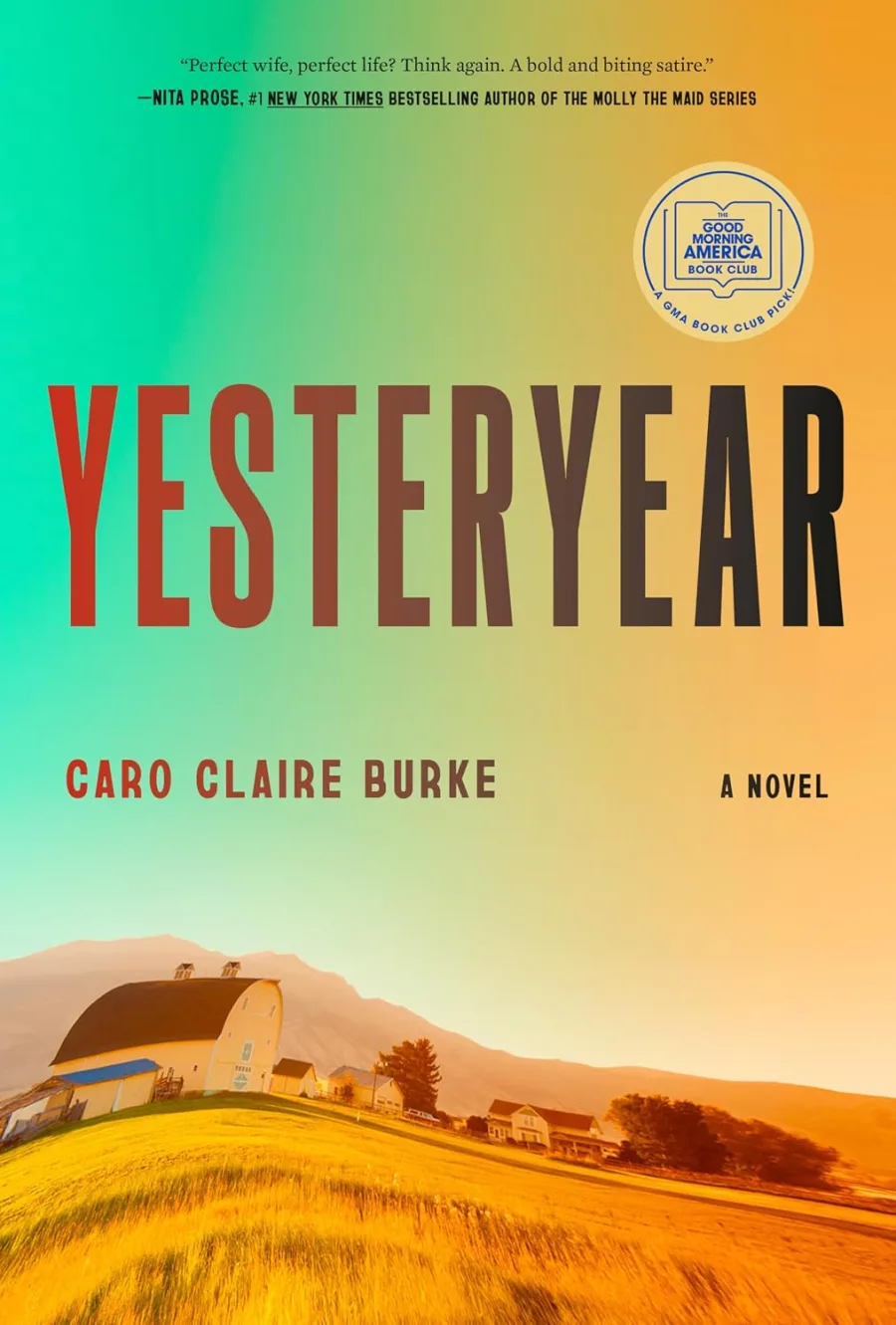
Download Cover Image
Do you want to download the full cover image for Yesteryear: A GMA Book Club Pick: A Novel?