
Thunder Dog: The True Story of a Blind Man, His Guide Dog, and the Triumph of Trust
Paperback
• 256 Pages
• USD 19.99
• English
• 9781400204724
No ratings yet
| Publisher | Thomas Nelson |
|---|---|
| ISBN13 | 9781400204724 |
| ASIN/SKU | 1400204720 |
| Book Format | Paperback |
| Language | English |
| Pages | 256 |
| List Price | USD 19.99 |
| Publishing Date | 06/08/2012 |
| Dimensions | 5.5 x 0.58 x 8.32 inches |
| Weight | 2.31 pounds |
| Book Code | BD00070672 |
Buy this Book
Amazon Stores
Ebook Stores
Other Stores
Discover Thunder Dog: The True Story of a Blind Man, His Guide Dog, and the Triumph of Trust by Michael Hingson. This book is published by Thomas Nelson in Paperback format, ISBN 9781400204724, ASIN 1400204720, under Biographies and Memoirs, Religious Leader Biographies, Disability Biographies.
Book Description
#1 NEW YORK TIMES BESTSELLER
An instant New York Times bestseller, Thunder Dog tells the true story of a blind man, his guide dog, and the life-changing power of faith and trust in the face of terror.
When one of four hijacked planes flew into the World Trade Center's North Tower on September 11, 2001, Michael Hingson, a district sales manager for a data protection and network security systems company, was sitting down for a meeting. His guide dog, Roselle, was at his feet.
Blind from birth, Michael could hear the sounds of shattering glass, falling debris, and terrified people flooding all around him. But Roselle sat calmly beside him. In that moment, Michael chose to trust Roselle's judgment and not to panic. They were a team.
As you relive that fateful day in September 2001 alongside Michael and Roselle, you'll learn:
The ways that grief and loss can lead the way for change
How the rare trust between a man and his guide dog can inspire your own unshakeable faith
The healing power of telling your own story
Praise for Thunder Dog:
"Chapter by chapter of this intriguing work will keep you spellbound. Thunder Dog celebrates the power of the human and animal bond. We all can learn life lessons from this incredible story."
--Larry King, Emmy award-winning broadcaster and longtime host of Larry King Live
An instant New York Times bestseller, Thunder Dog tells the true story of a blind man, his guide dog, and the life-changing power of faith and trust in the face of terror.
When one of four hijacked planes flew into the World Trade Center's North Tower on September 11, 2001, Michael Hingson, a district sales manager for a data protection and network security systems company, was sitting down for a meeting. His guide dog, Roselle, was at his feet.
Blind from birth, Michael could hear the sounds of shattering glass, falling debris, and terrified people flooding all around him. But Roselle sat calmly beside him. In that moment, Michael chose to trust Roselle's judgment and not to panic. They were a team.
As you relive that fateful day in September 2001 alongside Michael and Roselle, you'll learn:
The ways that grief and loss can lead the way for change
How the rare trust between a man and his guide dog can inspire your own unshakeable faith
The healing power of telling your own story
Praise for Thunder Dog:
"Chapter by chapter of this intriguing work will keep you spellbound. Thunder Dog celebrates the power of the human and animal bond. We all can learn life lessons from this incredible story."
--Larry King, Emmy award-winning broadcaster and longtime host of Larry King Live
Author Biography
Michael Hingson is a #1 New York Times best-selling author, technologist and motivational speaker. Michael, blind since birth, survived the 9/11 terrorist attacks with the help of his guide dog, Roselle. This story of teamwork and his indomitable will to live and thrive is the subject of his best-selling book, Thunder Dog and the major motion picture currently in production, coming in September 2013.
Michael Hingson and his guide dog, Roselle, saved dozens of lives by guiding him and his co-workers down 78 floors and out of Tower One just before it collapsed on 9/11. In Thunder Dog, Michael leads us through his moment-by-moment account from inside the tower. The book is also an inspiring look at Michael’s accomplishments in life. Sadly, Roselle passed away in July 2011 but posthumously won the American Humane Association Hero Dog Award for 2012 in a star-studded gala in Beverly Hills, and televised in a special feature presentation on Hallmark Channel.
Despite being blind all his life, Michael has a master’s degree in physics from University of California Irvine and is an accomplished technologist. Michael has worked with inventor, futurist, Ray Kurzweil for more than 30 years and was instrumental in the development of the first reading machine for the blind. Today, the Kurzweil brand is the preeminent name in educational software and technology for students with disabilities for which Michael is a national sales manager—improving the lives of children, students and adults with physical and learning disabilities through assistive technologies. Michael Hingson has a deep commitment to education and is Ambassador for the National Braille Literacy Campaign and also serves as Ambassador for the American Humane Association’s Hero Dog Awards. Innovative Speaker’s Network named Michael Hingson “one of America’s top 10 educational speakers”. Michael is a member of NACA and a member of the National Speaker’s Association.
In countless TV and radio appearances, newspaper features and magazine articles, Michael Hingson does much more than recount his 9-11 story; he continuously explores the broader lessons of his life and experiences as a blind person in today’s world and shares these lessons to educate, inspire and empower audiences world-wide. Michael has appeared on Larry King five times, and other major national broadcasts such as the Today Show, Fox and Friends, the 700 Club, Joy Behar, Discovery Channel, Animal Planet, and the Hallmark Channel.
Michael Hingson and his guide dog, Roselle, saved dozens of lives by guiding him and his co-workers down 78 floors and out of Tower One just before it collapsed on 9/11. In Thunder Dog, Michael leads us through his moment-by-moment account from inside the tower. The book is also an inspiring look at Michael’s accomplishments in life. Sadly, Roselle passed away in July 2011 but posthumously won the American Humane Association Hero Dog Award for 2012 in a star-studded gala in Beverly Hills, and televised in a special feature presentation on Hallmark Channel.
Despite being blind all his life, Michael has a master’s degree in physics from University of California Irvine and is an accomplished technologist. Michael has worked with inventor, futurist, Ray Kurzweil for more than 30 years and was instrumental in the development of the first reading machine for the blind. Today, the Kurzweil brand is the preeminent name in educational software and technology for students with disabilities for which Michael is a national sales manager—improving the lives of children, students and adults with physical and learning disabilities through assistive technologies. Michael Hingson has a deep commitment to education and is Ambassador for the National Braille Literacy Campaign and also serves as Ambassador for the American Humane Association’s Hero Dog Awards. Innovative Speaker’s Network named Michael Hingson “one of America’s top 10 educational speakers”. Michael is a member of NACA and a member of the National Speaker’s Association.
In countless TV and radio appearances, newspaper features and magazine articles, Michael Hingson does much more than recount his 9-11 story; he continuously explores the broader lessons of his life and experiences as a blind person in today’s world and shares these lessons to educate, inspire and empower audiences world-wide. Michael has appeared on Larry King five times, and other major national broadcasts such as the Today Show, Fox and Friends, the 700 Club, Joy Behar, Discovery Channel, Animal Planet, and the Hallmark Channel.
Editorial Reviews
Editorial Reviews will be added soon…
Book Summary
Thunder Dog: The True Story of a Blind Man, His Guide Dog, and the Triumph of Trust by Michael Hingson, written with Susy Flory, is a powerful memoir about survival, blindness, independence, courage, faith, and the extraordinary relationship between a man and his guide dog. Published in 2011, the book became a New York Times bestseller and tells two closely connected stories: Hingson's lifelong journey as a man who was blind from birth and the remarkable experience that unfolded on September 11, 2001, when he and his guide dog, Roselle, escaped from the 78th floor of the World Trade Center's North Tower. Although the 9/11 evacuation is the book's most dramatic episode, Thunder Dog is much more than a 9/11 survival story. At its heart, it is a book about learning to trust, refusing to be defined by other people's assumptions, and discovering that genuine partnership can make people stronger than they could be alone.
Hingson's story begins long before the attacks. Born blind, he grew up in a world where other people often assumed that blindness meant helplessness. His parents, however, refused to accept those limitations as a definition of their son's future. Instead of treating him as someone who needed to be protected from ordinary life, they encouraged independence and problem-solving. This upbringing becomes one of the most important foundations of the memoir. Hingson learned that blindness was a practical challenge, not a reason to surrender his ambitions. His life demonstrates the difference between a physical limitation and the social expectations that other people may attach to that limitation. The book repeatedly challenges the idea that blind people are incapable of living independently, making decisions, working, traveling, learning, and contributing meaningfully to society.
One of the book's strongest themes is therefore independence without isolation. Hingson is independent, but he does not pretend that independence means doing everything alone. His relationship with guide dogs illustrates a healthier understanding of partnership. A guide dog is not simply an animal that performs tasks for a blind person. The relationship depends on communication, training, responsibility, and mutual trust. The dog must make decisions within its training, while the handler must give appropriate commands and understand when to rely on the dog's judgment. Hingson describes this relationship as a genuine partnership, and that idea becomes crucial when the World Trade Center is attacked.
The book introduces readers to Roselle, the yellow Labrador who became Hingson's guide and eventually one of the most famous canine figures associated with the September 11 attacks. Interestingly, the title Thunder Dog comes from Roselle's fear of thunderstorms. Hingson explains that during the early hours of September 11, Roselle was frightened by a thunderstorm and stayed close to him. Several hours later, the sounds of thunder were replaced by something unimaginably more serious: the explosions and destruction surrounding the World Trade Center. This contrast gives the title an emotional dimension. The dog that was afraid of ordinary thunder would soon remain remarkably focused while surrounded by the much greater “thunder” of a collapsing skyscraper.
The central episode begins on the morning of September 11, 2001. Hingson was working on the 78th floor of the North Tower of the World Trade Center when American Airlines Flight 11 struck the building. He could not see the plane or the visual devastation that unfolded outside, but he immediately understood that something was seriously wrong. There was a tremendous explosion, debris was falling, and the building seemed to move. Because he could not rely on sight, Hingson had to interpret the crisis through sound, touch, smell, physical movement, and the reactions of the people around him. The official 9/11 Memorial account confirms that Hingson was in his office on the 78th floor with Roselle when the hijacked aircraft struck the tower.
What follows is the book's most gripping section: the evacuation of the North Tower. Hingson did not know exactly what had happened, but he knew that remaining in the building was dangerous. He and Roselle began making their way toward the stairwell. A coworker, David Frank, joined them, and together they started the long descent. Hingson and Roselle eventually navigated approximately 1,463 stairs from the 78th floor. The physical scale of this journey is difficult to comprehend. The stairwell was crowded, dark, noisy, and filled with people moving downward while firefighters and emergency workers were heading upward.
For Hingson, the descent was also an extraordinary demonstration of trust. He could not see the obstacles around him, but he knew Roselle's training and temperament. Roselle had to navigate through a chaotic environment while maintaining her focus on Hingson's safety. Hingson, in turn, had to resist the instinct to panic and allow the partnership they had developed over time to function. The situation was not simply one in which a dog “rescued” a helpless man. Instead, it was a sophisticated partnership between two beings who had learned how to depend on each other. Hingson trusted Roselle to guide him, while Roselle depended on Hingson for direction, reassurance, and leadership.
The stairwell scenes also reveal Hingson's ability to remain calm under extraordinary pressure. As people descended, panic could easily have spread. Injured people needed assistance, smoke and debris created additional danger, and firefighters were moving in the opposite direction toward the burning floors. Hingson recalls encounters with firefighters who offered to help him, but he was reluctant to accept assistance that might interfere with their urgent work. His attitude illustrates another recurring theme: competence should not be confused with helplessness. He knew what he and Roselle were capable of doing, and he wanted the emergency responders to focus on those who needed immediate assistance.
Eventually, Hingson and Roselle reached the outside. Their escape, however, was not the end of the danger. The South Tower collapsed, creating an enormous cloud of dust and debris. Hingson and those around him had to move quickly and find protection. The scene demonstrates one of the memoir's most important contrasts: Hingson's inability to see did not prevent him from making rational decisions. His other senses, his experience, his knowledge of the environment, and his trust in Roselle all became essential tools for survival.
Yet Thunder Dog does not end with the escape. One of its greatest strengths is the way Hingson places his 9/11 experience within the larger story of his life. The attack becomes a dramatic test of lessons he had learned for decades: remain calm, understand your capabilities, solve problems, trust people who have earned your trust, and do not allow fear to take control. In this sense, September 11 did not suddenly make Hingson courageous. Rather, the crisis revealed qualities that had already been developed through years of adapting to a world designed largely for sighted people.
The memoir consequently spends substantial time challenging misconceptions about blindness. Hingson describes situations in which strangers assume that blind people require assistance even when they have not asked for it. He argues that such behavior, although sometimes motivated by kindness, can become patronizing when it is based on the assumption that blindness automatically means incompetence. His own life offers a powerful counterexample. He pursued education, developed a professional career, used technology to work independently, traveled, and made his own decisions. The book's larger message is that society should focus on accessibility and opportunity rather than imposing artificial limits on people with disabilities.
Technology also plays an important role in Hingson's story. Because he cannot rely on sight, technology becomes an important means of accessing information and participating independently in professional and everyday life. This reinforces one of the book's broader arguments: limitations can often be addressed through adaptation and innovation. Hingson's approach is not to pretend that blindness creates no challenges but to ask how those challenges can be solved. His philosophy is essentially one of adaptive living rather than defeat.
Faith is another important dimension of the memoir. Hingson interprets his survival as more than an extraordinary coincidence and reflects on why he was spared when so many others died. He does not claim to possess a complete answer to the question of why some people survived September 11 while others did not. Instead, the experience leads him toward a stronger sense of responsibility and purpose. Survival, in his view, creates an obligation to use the additional life he has been given constructively. His story consequently becomes one of healing rather than bitterness.
The book's deepest lesson is found in its title: trust. Hingson trusted Roselle, but the memoir ultimately asks readers to consider trust more broadly. Families depend on trust. Teams depend on trust. Communities depend on trust. In a crisis, people must trust one another's skills and intentions. Hingson's relationship with Roselle demonstrates that trust is not blind faith in the careless sense; it is built through training, experience, communication, consistency, and mutual responsibility. The stronger the foundation, the more valuable trust becomes when circumstances become unpredictable. Hingson himself describes teamwork and trust as essential elements of survival.
Ultimately, Thunder Dog: The True Story of a Blind Man, His Guide Dog, and the Triumph of Trust is a remarkable memoir because it refuses to reduce its author to either his blindness or his survival story. It is a 9/11 memoir, guide-dog story, disability memoir, inspirational true story, and reflection on trust and resilience all at once. The escape from the World Trade Center is unforgettable, but the deeper story is the life that prepared Hingson for that moment. Roselle's courage matters, but so does the relationship that allowed her training and Hingson's judgment to work together. The book asks readers to reconsider what disability means, what genuine independence looks like, and how people can respond when fear threatens to overwhelm reason.
The final message of Thunder Dog is ultimately hopeful. Hingson's survival does not erase the tragedy of September 11, nor does the story attempt to turn that tragedy into a simple inspirational lesson. Instead, it shows how courage can emerge from preparation, how independence can coexist with interdependence, and how trust can become a source of strength when the world becomes chaotic. Michael Hingson's journey with Roselle reminds readers that true vision is not always about seeing with the eyes. Sometimes it means understanding what matters, remaining calm when circumstances are frightening, trusting the right partner, and continuing forward even when the path ahead cannot be clearly seen.
Hingson's story begins long before the attacks. Born blind, he grew up in a world where other people often assumed that blindness meant helplessness. His parents, however, refused to accept those limitations as a definition of their son's future. Instead of treating him as someone who needed to be protected from ordinary life, they encouraged independence and problem-solving. This upbringing becomes one of the most important foundations of the memoir. Hingson learned that blindness was a practical challenge, not a reason to surrender his ambitions. His life demonstrates the difference between a physical limitation and the social expectations that other people may attach to that limitation. The book repeatedly challenges the idea that blind people are incapable of living independently, making decisions, working, traveling, learning, and contributing meaningfully to society.
One of the book's strongest themes is therefore independence without isolation. Hingson is independent, but he does not pretend that independence means doing everything alone. His relationship with guide dogs illustrates a healthier understanding of partnership. A guide dog is not simply an animal that performs tasks for a blind person. The relationship depends on communication, training, responsibility, and mutual trust. The dog must make decisions within its training, while the handler must give appropriate commands and understand when to rely on the dog's judgment. Hingson describes this relationship as a genuine partnership, and that idea becomes crucial when the World Trade Center is attacked.
The book introduces readers to Roselle, the yellow Labrador who became Hingson's guide and eventually one of the most famous canine figures associated with the September 11 attacks. Interestingly, the title Thunder Dog comes from Roselle's fear of thunderstorms. Hingson explains that during the early hours of September 11, Roselle was frightened by a thunderstorm and stayed close to him. Several hours later, the sounds of thunder were replaced by something unimaginably more serious: the explosions and destruction surrounding the World Trade Center. This contrast gives the title an emotional dimension. The dog that was afraid of ordinary thunder would soon remain remarkably focused while surrounded by the much greater “thunder” of a collapsing skyscraper.
The central episode begins on the morning of September 11, 2001. Hingson was working on the 78th floor of the North Tower of the World Trade Center when American Airlines Flight 11 struck the building. He could not see the plane or the visual devastation that unfolded outside, but he immediately understood that something was seriously wrong. There was a tremendous explosion, debris was falling, and the building seemed to move. Because he could not rely on sight, Hingson had to interpret the crisis through sound, touch, smell, physical movement, and the reactions of the people around him. The official 9/11 Memorial account confirms that Hingson was in his office on the 78th floor with Roselle when the hijacked aircraft struck the tower.
What follows is the book's most gripping section: the evacuation of the North Tower. Hingson did not know exactly what had happened, but he knew that remaining in the building was dangerous. He and Roselle began making their way toward the stairwell. A coworker, David Frank, joined them, and together they started the long descent. Hingson and Roselle eventually navigated approximately 1,463 stairs from the 78th floor. The physical scale of this journey is difficult to comprehend. The stairwell was crowded, dark, noisy, and filled with people moving downward while firefighters and emergency workers were heading upward.
For Hingson, the descent was also an extraordinary demonstration of trust. He could not see the obstacles around him, but he knew Roselle's training and temperament. Roselle had to navigate through a chaotic environment while maintaining her focus on Hingson's safety. Hingson, in turn, had to resist the instinct to panic and allow the partnership they had developed over time to function. The situation was not simply one in which a dog “rescued” a helpless man. Instead, it was a sophisticated partnership between two beings who had learned how to depend on each other. Hingson trusted Roselle to guide him, while Roselle depended on Hingson for direction, reassurance, and leadership.
The stairwell scenes also reveal Hingson's ability to remain calm under extraordinary pressure. As people descended, panic could easily have spread. Injured people needed assistance, smoke and debris created additional danger, and firefighters were moving in the opposite direction toward the burning floors. Hingson recalls encounters with firefighters who offered to help him, but he was reluctant to accept assistance that might interfere with their urgent work. His attitude illustrates another recurring theme: competence should not be confused with helplessness. He knew what he and Roselle were capable of doing, and he wanted the emergency responders to focus on those who needed immediate assistance.
Eventually, Hingson and Roselle reached the outside. Their escape, however, was not the end of the danger. The South Tower collapsed, creating an enormous cloud of dust and debris. Hingson and those around him had to move quickly and find protection. The scene demonstrates one of the memoir's most important contrasts: Hingson's inability to see did not prevent him from making rational decisions. His other senses, his experience, his knowledge of the environment, and his trust in Roselle all became essential tools for survival.
Yet Thunder Dog does not end with the escape. One of its greatest strengths is the way Hingson places his 9/11 experience within the larger story of his life. The attack becomes a dramatic test of lessons he had learned for decades: remain calm, understand your capabilities, solve problems, trust people who have earned your trust, and do not allow fear to take control. In this sense, September 11 did not suddenly make Hingson courageous. Rather, the crisis revealed qualities that had already been developed through years of adapting to a world designed largely for sighted people.
The memoir consequently spends substantial time challenging misconceptions about blindness. Hingson describes situations in which strangers assume that blind people require assistance even when they have not asked for it. He argues that such behavior, although sometimes motivated by kindness, can become patronizing when it is based on the assumption that blindness automatically means incompetence. His own life offers a powerful counterexample. He pursued education, developed a professional career, used technology to work independently, traveled, and made his own decisions. The book's larger message is that society should focus on accessibility and opportunity rather than imposing artificial limits on people with disabilities.
Technology also plays an important role in Hingson's story. Because he cannot rely on sight, technology becomes an important means of accessing information and participating independently in professional and everyday life. This reinforces one of the book's broader arguments: limitations can often be addressed through adaptation and innovation. Hingson's approach is not to pretend that blindness creates no challenges but to ask how those challenges can be solved. His philosophy is essentially one of adaptive living rather than defeat.
Faith is another important dimension of the memoir. Hingson interprets his survival as more than an extraordinary coincidence and reflects on why he was spared when so many others died. He does not claim to possess a complete answer to the question of why some people survived September 11 while others did not. Instead, the experience leads him toward a stronger sense of responsibility and purpose. Survival, in his view, creates an obligation to use the additional life he has been given constructively. His story consequently becomes one of healing rather than bitterness.
The book's deepest lesson is found in its title: trust. Hingson trusted Roselle, but the memoir ultimately asks readers to consider trust more broadly. Families depend on trust. Teams depend on trust. Communities depend on trust. In a crisis, people must trust one another's skills and intentions. Hingson's relationship with Roselle demonstrates that trust is not blind faith in the careless sense; it is built through training, experience, communication, consistency, and mutual responsibility. The stronger the foundation, the more valuable trust becomes when circumstances become unpredictable. Hingson himself describes teamwork and trust as essential elements of survival.
Ultimately, Thunder Dog: The True Story of a Blind Man, His Guide Dog, and the Triumph of Trust is a remarkable memoir because it refuses to reduce its author to either his blindness or his survival story. It is a 9/11 memoir, guide-dog story, disability memoir, inspirational true story, and reflection on trust and resilience all at once. The escape from the World Trade Center is unforgettable, but the deeper story is the life that prepared Hingson for that moment. Roselle's courage matters, but so does the relationship that allowed her training and Hingson's judgment to work together. The book asks readers to reconsider what disability means, what genuine independence looks like, and how people can respond when fear threatens to overwhelm reason.
The final message of Thunder Dog is ultimately hopeful. Hingson's survival does not erase the tragedy of September 11, nor does the story attempt to turn that tragedy into a simple inspirational lesson. Instead, it shows how courage can emerge from preparation, how independence can coexist with interdependence, and how trust can become a source of strength when the world becomes chaotic. Michael Hingson's journey with Roselle reminds readers that true vision is not always about seeing with the eyes. Sometimes it means understanding what matters, remaining calm when circumstances are frightening, trusting the right partner, and continuing forward even when the path ahead cannot be clearly seen.
Sample Chapters
Sample Chapters will be added soon…
Reader Reviews
No reviews yet.
Thunder Dog: The True Story of a Blind Man, His Guide Dog, and the Triumph of Trust
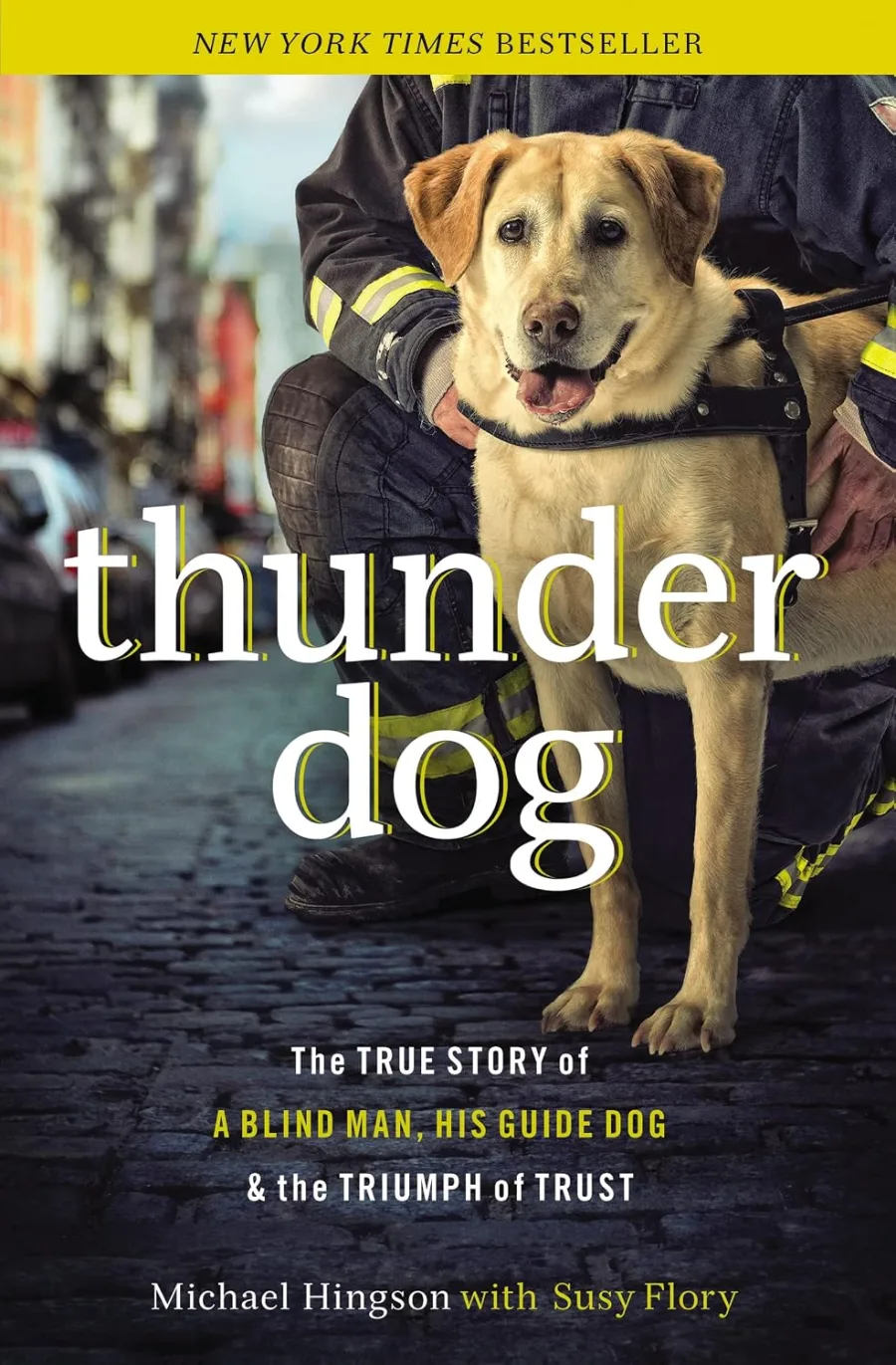
Download Cover Image
Do you want to download the full cover image for Thunder Dog: The True Story of a Blind Man, His Guide Dog, and the Triumph of Trust?