
Winning the War in Your Mind: Change Your Thinking, Change Your Life
Hardcover
• 256 Pages
• USD 29.99
• English
• 9780310362722
No ratings yet
| Publisher | Zondervan |
|---|---|
| ISBN13 | 9780310362722 |
| ASIN/SKU | 0310362725 |
| Book Format | Hardcover |
| Language | English |
| Pages | 256 |
| List Price | USD 29.99 |
| Publishing Date | 16/02/2021 |
| Dimensions | 6.24 x 0.97 x 9.29 inches |
| Weight | 2.31 pounds |
| Book Code | BD00070673 |
Buy this Book
Amazon Stores
Ebook Stores
Other Stores
Discover Winning the War in Your Mind: Change Your Thinking, Change Your Life by Craig Groeschel. This book is published by Zondervan in Hardcover format, ISBN 9780310362722, ASIN 0310362725, under Self-Help, Anxieties and Phobias, Stress Management Self-Help.
Book Description
MORE THAN 500,000 COPIES SOLD!
Are your thoughts out of control--just like your life? Do you long to break free from the spiral of destructive thinking? Let God's truth become your battle plan to win the war in your mind!
We've all tried to think our way out of bad habits and unhealthy thought patterns, only to find ourselves stuck with an out-of-control mind and off-track daily life. Pastor and New York Times bestselling author Craig Groeschel understands deeply this daily battle against self-doubt and negative thinking, and in this powerful new book he reveals the strategies he's discovered to change your mind and your life for the long-term.
Drawing upon Scripture and the latest findings of brain science, Groeschel lays out practical strategies that will free you from the grip of harmful, destructive thinking and enable you to live the life of joy and peace that God intends you to live. Winning the War in Your Mind will help you:
Learn how your brain works and see how to rewire it
Identify the lies your enemy wants you to believe
Recognize and short-circuit your mental triggers for destructive thinking
See how prayer and praise will transform your mind
Develop practices that allow God's thoughts to become your thoughts
God has something better for your life than your old ways of thinking. It's time to change your mind so God can change your life.
Are your thoughts out of control--just like your life? Do you long to break free from the spiral of destructive thinking? Let God's truth become your battle plan to win the war in your mind!
We've all tried to think our way out of bad habits and unhealthy thought patterns, only to find ourselves stuck with an out-of-control mind and off-track daily life. Pastor and New York Times bestselling author Craig Groeschel understands deeply this daily battle against self-doubt and negative thinking, and in this powerful new book he reveals the strategies he's discovered to change your mind and your life for the long-term.
Drawing upon Scripture and the latest findings of brain science, Groeschel lays out practical strategies that will free you from the grip of harmful, destructive thinking and enable you to live the life of joy and peace that God intends you to live. Winning the War in Your Mind will help you:
Learn how your brain works and see how to rewire it
Identify the lies your enemy wants you to believe
Recognize and short-circuit your mental triggers for destructive thinking
See how prayer and praise will transform your mind
Develop practices that allow God's thoughts to become your thoughts
God has something better for your life than your old ways of thinking. It's time to change your mind so God can change your life.
Author Biography
Craig Groeschel is the founding and senior pastor of Life.Church, a multisite church with attenders at locations around the United States and globally at Life.Church Online.
Craig and Amy started Life.Church in a two-car garage in Edmond, Oklahoma in January 1996. While Life.Church has grown over the years, its mission remains the same: to lead people to become fully devoted followers of Christ. Today, the church is known for its innovative use of technology to spread the Gospel, launching the first fully digital church experience in 2006 and the most downloaded mobile Bible app in history, YouVersion, in 2008.
As one of the most respected leaders in the Church, Craig speaks frequently at leadership events and conferences worldwide. He is a New York Times best-selling author with books about topics like dating and marriage, social media, purpose, direction, church leadership, and more. He also hosts the Craig Groeschel Leadership Podcast as a practical tool to spark new ideas and prompt innovative thinking in leaders at every level within any organization.
Craig and Amy married in 1991 and have six children. They live in the Edmond, Oklahoma area where Life.Church began.
Be the first to hear about new podcast episodes, books, speaking appearances, and more by visiting www.craiggroeschel.com.
Craig and Amy started Life.Church in a two-car garage in Edmond, Oklahoma in January 1996. While Life.Church has grown over the years, its mission remains the same: to lead people to become fully devoted followers of Christ. Today, the church is known for its innovative use of technology to spread the Gospel, launching the first fully digital church experience in 2006 and the most downloaded mobile Bible app in history, YouVersion, in 2008.
As one of the most respected leaders in the Church, Craig speaks frequently at leadership events and conferences worldwide. He is a New York Times best-selling author with books about topics like dating and marriage, social media, purpose, direction, church leadership, and more. He also hosts the Craig Groeschel Leadership Podcast as a practical tool to spark new ideas and prompt innovative thinking in leaders at every level within any organization.
Craig and Amy married in 1991 and have six children. They live in the Edmond, Oklahoma area where Life.Church began.
Be the first to hear about new podcast episodes, books, speaking appearances, and more by visiting www.craiggroeschel.com.
Editorial Reviews
Editorial Reviews will be added soon…
Book Summary
Winning the War in Your Mind: Change Your Thinking, Change Your Life by Craig Groeschel is a practical Christian book about something many people struggle with every day: the constant battle taking place inside their own minds. Groeschel explores how thoughts influence emotions, decisions, habits, relationships, faith, and ultimately the direction of a person's life. Fear, anxiety, insecurity, resentment, comparison, discouragement, and self-doubt can become deeply rooted when the same negative thoughts are repeated again and again. His central argument is straightforward but powerful: if you want to change your life, you have to learn to change the way you think. Drawing on biblical teaching, personal experiences, psychological observations, and practical exercises, Groeschel shows readers how to recognize destructive thought patterns and replace them with thoughts grounded in truth, faith, gratitude, and hope. For anyone searching for a Winning the War in Your Mind summary, Craig Groeschel book summary, how to stop negative thinking, how to overcome anxiety and self-doubt, Christian mind renewal, or how to change your thoughts and change your life, the book offers a practical framework for beginning that transformation.
Groeschel opens by describing the human mind as a battlefield. Every day, countless thoughts pass through our minds, and many of them appear so naturally that we don't stop to question them. You might wake up thinking, “Something is going to go wrong today,” “I'm not good enough,” “Nobody understands me,” or “I'll never be able to change.” When a thought has been repeated for years, it can begin to feel like an unquestionable fact. Groeschel asks readers to make an important distinction: a thought can feel true without actually being true. If you never examine your thoughts, you can end up building your choices and your entire outlook around assumptions that are inaccurate, fearful, or destructive.
One of Groeschel's most important ideas is that thoughts influence feelings, feelings influence actions, and repeated actions create habits that eventually shape our lives. Consider someone who constantly thinks other people are judging them. That thought may produce anxiety, which can lead them to avoid social situations, which in turn reinforces their belief that they don't belong. Someone who repeatedly thinks they are destined to fail may stop taking healthy risks, while someone who expects rejection may become defensive even in relationships that are safe. A single thought might last only seconds, but when the same pattern is repeated, it can become a powerful force. Groeschel's goal is to help readers notice that process before the thought automatically becomes a behavior.
He describes these deeply established patterns as mental strongholds. A stronghold is a way of thinking that has become so familiar and deeply reinforced that it can be difficult to challenge. These patterns can grow out of painful experiences, family influences, past failures, cultural expectations, insecurity, disappointment, or years of negative self-talk. Sometimes you may no longer remember exactly when a particular belief began, yet it can continue influencing your decisions. Someone who experienced rejection, for example, might eventually conclude, “I'm not worthy of love.” That conclusion can then influence friendships, marriage, work, and even the way the person understands God.
The answer, Groeschel emphasizes, isn't simply to “think positive.” He makes an important distinction between positive thinking and biblical thinking. Positive thinking can encourage people to repeat reassuring statements that may have little connection with reality. Biblical mind renewal is different. It involves replacing false and destructive beliefs with what is actually true. The aim isn't to convince yourself that everything will always work out exactly as you want. Instead, it's to develop a perspective rooted in God's character and the truths of Scripture. You can acknowledge that something is difficult without concluding that the difficulty means your life is hopeless.
This leads to one of the book's central practices: identify the lie and replace it with truth. Groeschel encourages readers to pay attention to recurring thoughts and ask whether they are genuinely true. “I'm a failure” may need to be challenged by separating one failure from your entire identity. “Nobody cares about me” may be an emotional conclusion rather than an objective fact. “I can never change” may ignore the possibility of growth, healing, and transformation. The process involves recognizing the thought, examining it honestly, identifying what is false or distorted about it, and deliberately replacing it with a healthier and more truthful way of thinking.
For Groeschel, Scripture plays a central role in renewing the mind. Biblical truth isn't presented merely as information to memorize or religious language to repeat. It becomes a standard against which destructive internal narratives can be tested. When you repeatedly expose your mind to Scripture and consciously apply its truth, those ideas can gradually become stronger than the negative patterns that have dominated your thinking. Mind renewal is therefore an ongoing process. It requires repetition because deeply established ways of thinking weren't usually created overnight.
The book also explores the connection between thoughts and imagination. Human beings can experience genuine emotional distress over things that haven't happened. You might imagine losing your job, being rejected, failing publicly, disappointing someone you love, or facing some future disaster. Your body can respond to these imagined scenarios almost as though the danger were already happening. Groeschel encourages readers to distinguish responsible preparation from destructive mental rehearsal. Thinking through a problem can be useful, but repeatedly imagining the worst possible outcome doesn't necessarily prepare you for it. Often, it simply steals peace from the present.
This becomes especially important in Groeschel's discussion of anxiety and worry. He doesn't suggest that a person can simply command anxiety to disappear. Instead, he encourages readers to bring anxious thoughts into awareness and deliberately redirect them toward truth and trust in God. Prayer becomes part of that process because it shifts attention away from the belief that everything depends upon personal control. Instead of endlessly asking, “What if everything goes wrong?” you can ask, “What is true right now, and what can I entrust to God?” Difficult circumstances may remain, but your relationship to those circumstances can change.
Groeschel also addresses rumination, the tendency to replay painful events and conversations over and over. You may repeatedly think about something you said, something someone else said, an opportunity you missed, or a mistake you wish you could undo. Reflection can help you learn from the past, but there is a point where reflection becomes mental captivity. The past cannot be changed by endlessly replaying it. Groeschel encourages readers to recognize when their thinking has stopped producing useful insight and has become a cycle of regret. The healthier response is to learn what can be learned, seek forgiveness where necessary, and return attention to what can actually be done in the present.
Another significant theme is self-talk and identity. The way you speak to yourself matters because repeated internal language can shape the way you see yourself. Statements such as “I'm stupid,” “I'm weak,” “I always ruin everything,” or “I'll never succeed” can gradually become part of your identity. Groeschel challenges readers to stop allowing their worst moments to define them. Christian identity, in his framework, begins with one's relationship with God rather than achievements, failures, appearance, status, or the opinions of other people. Recognizing weaknesses remains important, but weaknesses don't have to become the final definition of who you are.
The book also examines comparison, a problem that has become especially difficult in an age of social media. People can see carefully selected images of other people's careers, relationships, families, possessions, travels, and accomplishments and compare those highlights with the private reality of their own lives. Comparison can produce insecurity when you believe you're falling behind, or pride when you believe you're doing better than someone else. Neither response produces genuine contentment. Groeschel encourages readers to focus less on competing with other people's lives and more on faithfully living according to their own calling and responsibilities.
One practical response to negative thinking is gratitude. The human mind naturally pays attention to problems, threats, disappointments, and things that are missing. Deliberately identifying reasons to be grateful can redirect attention. Gratitude doesn't require pretending that painful circumstances don't exist. You can acknowledge what is difficult while also recognizing what is good. Regularly practicing gratitude helps create a different mental habit, one that notices God's provision and the positive realities that can easily disappear beneath constant worry.
Groeschel also emphasizes that meaningful change requires consistent spiritual practices, not occasional bursts of motivation. Prayer, Scripture, worship, reflection, community, and intentional thought patterns work together to reshape the inner life. You shouldn't expect one inspirational moment to undo years of negative thinking. Just as destructive thoughts become powerful through repetition, healthier patterns become stronger through repeated practice. The process may be gradual, but the direction matters.
A broader concept running through the book is spiritual formation. Groeschel encourages Christians to understand following Jesus as more than agreeing with Christian beliefs. Faith should affect the way a person thinks, responds, speaks, chooses, and lives. The transformation of the mind is therefore part of becoming more like Christ. When your thinking becomes more aligned with biblical truth, your emotions and behavior can increasingly reflect that truth as well.
Ultimately, the main message of Winning the War in Your Mind is that you don't have to believe every thought that enters your mind. Thoughts can be examined, challenged, and replaced. You can learn to recognize recurring patterns instead of automatically obeying them. Groeschel isn't promising a life without difficult thoughts or painful emotions. Rather, he argues that you can become more intentional about which thoughts you accept, which ones you reject, and which truths you repeatedly reinforce.
For readers searching for a Craig Groeschel Winning the War in Your Mind summary, how to overcome negative thoughts, Christian strategies for anxiety, how to renew your mind, how to stop overthinking, or how thoughts affect behavior, the practical framework is clear: recognize destructive thinking, identify the underlying lie, replace it with truth, and practice that new pattern consistently. The process can be challenging because some beliefs may have been reinforced for years, but recognizing the pattern is an important first step toward changing it.
The deepest lesson of the book is captured in its subtitle: “Change Your Thinking, Change Your Life.” Groeschel argues that you cannot always control your circumstances, other people's choices, or everything that happens around you. You can, however, become more intentional about how you interpret and respond to those circumstances. A renewed mind can lead to healthier decisions, stronger relationships, greater emotional resilience, deeper faith, and a more hopeful perspective.
In the end, Winning the War in Your Mind invites readers to stop living on mental autopilot. Instead of accepting every internal message as reality, you're encouraged to slow down, examine what you're thinking, bring those thoughts before God, and choose truth over fear. The battle in the mind may never disappear completely, but you can become better equipped to recognize destructive patterns and refuse to let them determine your future. For Groeschel, meaningful transformation begins when your thinking starts moving away from fear, lies, comparison, and despair and toward truth, faith, gratitude, hope, and trust in God.
Groeschel opens by describing the human mind as a battlefield. Every day, countless thoughts pass through our minds, and many of them appear so naturally that we don't stop to question them. You might wake up thinking, “Something is going to go wrong today,” “I'm not good enough,” “Nobody understands me,” or “I'll never be able to change.” When a thought has been repeated for years, it can begin to feel like an unquestionable fact. Groeschel asks readers to make an important distinction: a thought can feel true without actually being true. If you never examine your thoughts, you can end up building your choices and your entire outlook around assumptions that are inaccurate, fearful, or destructive.
One of Groeschel's most important ideas is that thoughts influence feelings, feelings influence actions, and repeated actions create habits that eventually shape our lives. Consider someone who constantly thinks other people are judging them. That thought may produce anxiety, which can lead them to avoid social situations, which in turn reinforces their belief that they don't belong. Someone who repeatedly thinks they are destined to fail may stop taking healthy risks, while someone who expects rejection may become defensive even in relationships that are safe. A single thought might last only seconds, but when the same pattern is repeated, it can become a powerful force. Groeschel's goal is to help readers notice that process before the thought automatically becomes a behavior.
He describes these deeply established patterns as mental strongholds. A stronghold is a way of thinking that has become so familiar and deeply reinforced that it can be difficult to challenge. These patterns can grow out of painful experiences, family influences, past failures, cultural expectations, insecurity, disappointment, or years of negative self-talk. Sometimes you may no longer remember exactly when a particular belief began, yet it can continue influencing your decisions. Someone who experienced rejection, for example, might eventually conclude, “I'm not worthy of love.” That conclusion can then influence friendships, marriage, work, and even the way the person understands God.
The answer, Groeschel emphasizes, isn't simply to “think positive.” He makes an important distinction between positive thinking and biblical thinking. Positive thinking can encourage people to repeat reassuring statements that may have little connection with reality. Biblical mind renewal is different. It involves replacing false and destructive beliefs with what is actually true. The aim isn't to convince yourself that everything will always work out exactly as you want. Instead, it's to develop a perspective rooted in God's character and the truths of Scripture. You can acknowledge that something is difficult without concluding that the difficulty means your life is hopeless.
This leads to one of the book's central practices: identify the lie and replace it with truth. Groeschel encourages readers to pay attention to recurring thoughts and ask whether they are genuinely true. “I'm a failure” may need to be challenged by separating one failure from your entire identity. “Nobody cares about me” may be an emotional conclusion rather than an objective fact. “I can never change” may ignore the possibility of growth, healing, and transformation. The process involves recognizing the thought, examining it honestly, identifying what is false or distorted about it, and deliberately replacing it with a healthier and more truthful way of thinking.
For Groeschel, Scripture plays a central role in renewing the mind. Biblical truth isn't presented merely as information to memorize or religious language to repeat. It becomes a standard against which destructive internal narratives can be tested. When you repeatedly expose your mind to Scripture and consciously apply its truth, those ideas can gradually become stronger than the negative patterns that have dominated your thinking. Mind renewal is therefore an ongoing process. It requires repetition because deeply established ways of thinking weren't usually created overnight.
The book also explores the connection between thoughts and imagination. Human beings can experience genuine emotional distress over things that haven't happened. You might imagine losing your job, being rejected, failing publicly, disappointing someone you love, or facing some future disaster. Your body can respond to these imagined scenarios almost as though the danger were already happening. Groeschel encourages readers to distinguish responsible preparation from destructive mental rehearsal. Thinking through a problem can be useful, but repeatedly imagining the worst possible outcome doesn't necessarily prepare you for it. Often, it simply steals peace from the present.
This becomes especially important in Groeschel's discussion of anxiety and worry. He doesn't suggest that a person can simply command anxiety to disappear. Instead, he encourages readers to bring anxious thoughts into awareness and deliberately redirect them toward truth and trust in God. Prayer becomes part of that process because it shifts attention away from the belief that everything depends upon personal control. Instead of endlessly asking, “What if everything goes wrong?” you can ask, “What is true right now, and what can I entrust to God?” Difficult circumstances may remain, but your relationship to those circumstances can change.
Groeschel also addresses rumination, the tendency to replay painful events and conversations over and over. You may repeatedly think about something you said, something someone else said, an opportunity you missed, or a mistake you wish you could undo. Reflection can help you learn from the past, but there is a point where reflection becomes mental captivity. The past cannot be changed by endlessly replaying it. Groeschel encourages readers to recognize when their thinking has stopped producing useful insight and has become a cycle of regret. The healthier response is to learn what can be learned, seek forgiveness where necessary, and return attention to what can actually be done in the present.
Another significant theme is self-talk and identity. The way you speak to yourself matters because repeated internal language can shape the way you see yourself. Statements such as “I'm stupid,” “I'm weak,” “I always ruin everything,” or “I'll never succeed” can gradually become part of your identity. Groeschel challenges readers to stop allowing their worst moments to define them. Christian identity, in his framework, begins with one's relationship with God rather than achievements, failures, appearance, status, or the opinions of other people. Recognizing weaknesses remains important, but weaknesses don't have to become the final definition of who you are.
The book also examines comparison, a problem that has become especially difficult in an age of social media. People can see carefully selected images of other people's careers, relationships, families, possessions, travels, and accomplishments and compare those highlights with the private reality of their own lives. Comparison can produce insecurity when you believe you're falling behind, or pride when you believe you're doing better than someone else. Neither response produces genuine contentment. Groeschel encourages readers to focus less on competing with other people's lives and more on faithfully living according to their own calling and responsibilities.
One practical response to negative thinking is gratitude. The human mind naturally pays attention to problems, threats, disappointments, and things that are missing. Deliberately identifying reasons to be grateful can redirect attention. Gratitude doesn't require pretending that painful circumstances don't exist. You can acknowledge what is difficult while also recognizing what is good. Regularly practicing gratitude helps create a different mental habit, one that notices God's provision and the positive realities that can easily disappear beneath constant worry.
Groeschel also emphasizes that meaningful change requires consistent spiritual practices, not occasional bursts of motivation. Prayer, Scripture, worship, reflection, community, and intentional thought patterns work together to reshape the inner life. You shouldn't expect one inspirational moment to undo years of negative thinking. Just as destructive thoughts become powerful through repetition, healthier patterns become stronger through repeated practice. The process may be gradual, but the direction matters.
A broader concept running through the book is spiritual formation. Groeschel encourages Christians to understand following Jesus as more than agreeing with Christian beliefs. Faith should affect the way a person thinks, responds, speaks, chooses, and lives. The transformation of the mind is therefore part of becoming more like Christ. When your thinking becomes more aligned with biblical truth, your emotions and behavior can increasingly reflect that truth as well.
Ultimately, the main message of Winning the War in Your Mind is that you don't have to believe every thought that enters your mind. Thoughts can be examined, challenged, and replaced. You can learn to recognize recurring patterns instead of automatically obeying them. Groeschel isn't promising a life without difficult thoughts or painful emotions. Rather, he argues that you can become more intentional about which thoughts you accept, which ones you reject, and which truths you repeatedly reinforce.
For readers searching for a Craig Groeschel Winning the War in Your Mind summary, how to overcome negative thoughts, Christian strategies for anxiety, how to renew your mind, how to stop overthinking, or how thoughts affect behavior, the practical framework is clear: recognize destructive thinking, identify the underlying lie, replace it with truth, and practice that new pattern consistently. The process can be challenging because some beliefs may have been reinforced for years, but recognizing the pattern is an important first step toward changing it.
The deepest lesson of the book is captured in its subtitle: “Change Your Thinking, Change Your Life.” Groeschel argues that you cannot always control your circumstances, other people's choices, or everything that happens around you. You can, however, become more intentional about how you interpret and respond to those circumstances. A renewed mind can lead to healthier decisions, stronger relationships, greater emotional resilience, deeper faith, and a more hopeful perspective.
In the end, Winning the War in Your Mind invites readers to stop living on mental autopilot. Instead of accepting every internal message as reality, you're encouraged to slow down, examine what you're thinking, bring those thoughts before God, and choose truth over fear. The battle in the mind may never disappear completely, but you can become better equipped to recognize destructive patterns and refuse to let them determine your future. For Groeschel, meaningful transformation begins when your thinking starts moving away from fear, lies, comparison, and despair and toward truth, faith, gratitude, hope, and trust in God.
Sample Chapters
Sample Chapters will be added soon…
Reader Reviews
No reviews yet.
Winning the War in Your Mind: Change Your Thinking, Change Your Life
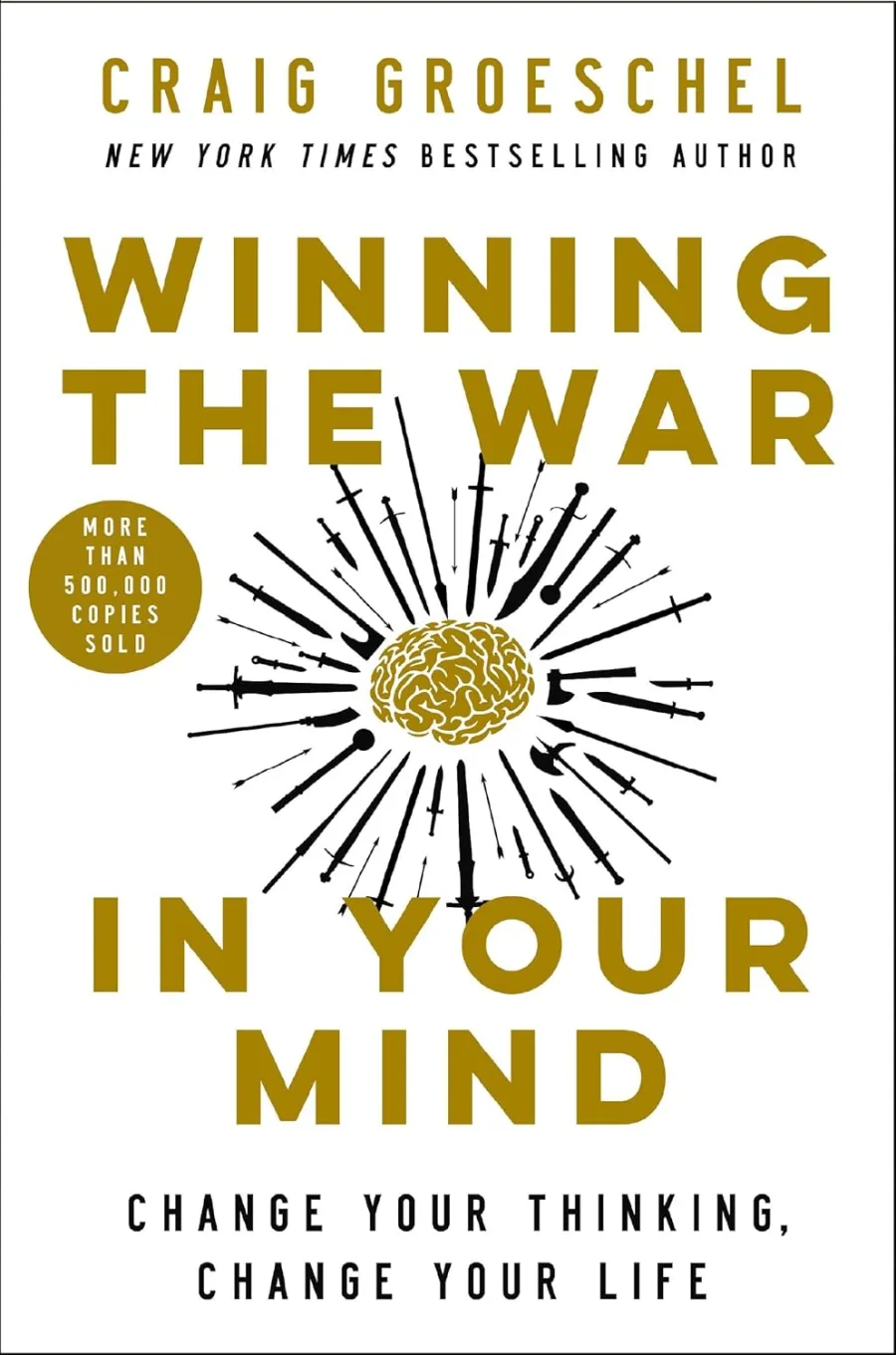
Download Cover Image
Do you want to download the full cover image for Winning the War in Your Mind: Change Your Thinking, Change Your Life?