
Profiles in Cowardice: A Study of Collaboration in the Trump Era
Hardcover
• 288 Pages
• USD 31.00
• English
• 9798217062591
No ratings yet
| Publisher | Penguin Press |
|---|---|
| ISBN13 | 9798217062591 |
| ASIN/SKU | B0GZTB2BPR |
| Book Format | Hardcover |
| Language | English |
| Pages | 288 |
| List Price | USD 31.00 |
| Publishing Date | 15/09/2026 |
| Dimensions | 5.78 x 0.98 x 8.6 inches |
| Weight | 12.8 ounces |
| Book Code | BD00070685 |
Buy this Book
Amazon Stores
Ebook Stores
Other Stores
Discover Profiles in Cowardice: A Study of Collaboration in the Trump Era by Jacob Weisberg. This book is published by Penguin Press in Hardcover format, ISBN 9798217062591, ASIN B0GZTB2BPR, under Politics and Social Sciences, Political Corruption and Misconduct, U.S. Political Science.
Book Description
“Valuable and dauntless.” —The New York Times
"We badly need [this] book.” —Tina Brown
A devastating reckoning with the people and institutions whose failure to stand up to Trump’s brazen grab for authoritarian power has been particularly shocking and consequential
It may be scant solace, but history will be particularly harsh to a subset of Trump enablers with a few key things in common: They have money and power. They represent intuitions that are central in determining whether America remains a free, functioning democracy or not. And they absolutely know better. History starts now.
In Profiles in Cowardice, Jacob Weisberg has written one of the first defining books of the Trump Era—how this pitch-black political moment happened, why so few resisted, and what it reveals about the character of American leadership.
Jeff Bezos, Amazon, and Big Tech. Stephen Schwarzman, Blackstone, and Wall Street. Brad Karp, Paul, Weiss, and Big Law. Mitch McConnell and the United States Senate. Eight individuals in all, together forming an entwined network of power in America, and a new way to understand how authoritarianism can take root in an open society—not by overthrowing institutions, but by bending and bullying them into submission.
The book is a masterful study of the ways people create rationalizations to justify basic human instincts such as greed, vanity and fear—above all fear. Fear is the great enemy of democracy, and the book illuminates how it operates, how it disguises itself, and how it spreads. The book is timeless: its profiles are case studies, but they are also mirrors. They ask readers to examine their own instincts, their own silences, their own thresholds for action. This is not a morality tale with easy villains. It is an attempt to describe the moral mechanics of democratic failure. By studying that failure up close, we may better understand what courage truly requires—and why it is so rarely summoned when it matters most.
"We badly need [this] book.” —Tina Brown
A devastating reckoning with the people and institutions whose failure to stand up to Trump’s brazen grab for authoritarian power has been particularly shocking and consequential
It may be scant solace, but history will be particularly harsh to a subset of Trump enablers with a few key things in common: They have money and power. They represent intuitions that are central in determining whether America remains a free, functioning democracy or not. And they absolutely know better. History starts now.
In Profiles in Cowardice, Jacob Weisberg has written one of the first defining books of the Trump Era—how this pitch-black political moment happened, why so few resisted, and what it reveals about the character of American leadership.
Jeff Bezos, Amazon, and Big Tech. Stephen Schwarzman, Blackstone, and Wall Street. Brad Karp, Paul, Weiss, and Big Law. Mitch McConnell and the United States Senate. Eight individuals in all, together forming an entwined network of power in America, and a new way to understand how authoritarianism can take root in an open society—not by overthrowing institutions, but by bending and bullying them into submission.
The book is a masterful study of the ways people create rationalizations to justify basic human instincts such as greed, vanity and fear—above all fear. Fear is the great enemy of democracy, and the book illuminates how it operates, how it disguises itself, and how it spreads. The book is timeless: its profiles are case studies, but they are also mirrors. They ask readers to examine their own instincts, their own silences, their own thresholds for action. This is not a morality tale with easy villains. It is an attempt to describe the moral mechanics of democratic failure. By studying that failure up close, we may better understand what courage truly requires—and why it is so rarely summoned when it matters most.
Author Biography
Jacob Weisberg is the author of books including Ronald Reagan (2016), The Bush Tragedy (2008), and In an Uncertain World (2003), co-written with former Treasury Secretary Robert E. Rubin. A native of Chicago, he is the former longtime editor of Slate and the co-founder of the podcast company Pushkin Industries. He serves as Chair of The Committee to Protect Journalists and is a regular contributor to the New York Review of Books.
Editorial Reviews
“A cutting compendium of collusion.” —Publishers Weekly
“A highly readable study of the politics and price of capitulation.” —Kirkus Reviews
“We badly need Weisberg’s book . . . In the last few years we’ve expounded so much emotion and despair over Trump’s crass contempt for the rule of law and democratic norms, but not enough on the key people who let it happen. Weisberg, the former editor of Slate and co-founder of podcast company Pushkin Industries, looks at a sample of power-wielding poobahs who failed the test when called to stand up, from people-pleasing former Paul, Weiss chairman Brad Karp to billionaire Benedict Arnold Jeff Bezos to academic Slytherin Sian Beilock, president of Dartmouth College. It’s fascinating, and instructive, to see the multiple ways supposedly upstanding titans of the establishment give themselves permission to become creatures of expedience.” —Tina Brown
“In this perilous moment in American history, much political courage is required; understanding where it went is essential to bringing it back. In Profiles in Cowardice, the extraordinary Jacob Weisberg examines how, when, and why so many Americans and American institutions capitulated to monstrous abuses of the office of the American presidency. The appeasement of Donald Trump is a sordid story. It is also, in Weisberg’s hands, a gripping one.” —Jill Lepore
“Why do some people collaborate? Why do others resist? The answers lie in individual biographies, which is exactly why Jacob Weisberg's book, Profiles in Cowardice, is so useful, timely and important: These are all people who could have helped preserve America's democratic institutions, but they chose not to do so. Each portrait adds to our understanding of what complicity means.” —Anne Applebaum
“A stinging indictment of vice and weakness, all the more so for being careful and fair-minded. Jacob Weisberg delivers history's judgment with devastating clarity." —John Ganz
“We’ve heard variations on this question for years now: ‘How has Donald Trump been allowed to get away with this?’ In Profiles in Cowardice, Jacob Weisberg has written the most essential—and merciless—account yet of how the most allegedly powerful ‘leaders’ in America cowered before a bully and earned the scorn of history. Weisberg has done the impossible: he’s written a thoroughly entertaining book about dereliction of the highest order." —Mark Leibovich
“A highly readable study of the politics and price of capitulation.” —Kirkus Reviews
“We badly need Weisberg’s book . . . In the last few years we’ve expounded so much emotion and despair over Trump’s crass contempt for the rule of law and democratic norms, but not enough on the key people who let it happen. Weisberg, the former editor of Slate and co-founder of podcast company Pushkin Industries, looks at a sample of power-wielding poobahs who failed the test when called to stand up, from people-pleasing former Paul, Weiss chairman Brad Karp to billionaire Benedict Arnold Jeff Bezos to academic Slytherin Sian Beilock, president of Dartmouth College. It’s fascinating, and instructive, to see the multiple ways supposedly upstanding titans of the establishment give themselves permission to become creatures of expedience.” —Tina Brown
“In this perilous moment in American history, much political courage is required; understanding where it went is essential to bringing it back. In Profiles in Cowardice, the extraordinary Jacob Weisberg examines how, when, and why so many Americans and American institutions capitulated to monstrous abuses of the office of the American presidency. The appeasement of Donald Trump is a sordid story. It is also, in Weisberg’s hands, a gripping one.” —Jill Lepore
“Why do some people collaborate? Why do others resist? The answers lie in individual biographies, which is exactly why Jacob Weisberg's book, Profiles in Cowardice, is so useful, timely and important: These are all people who could have helped preserve America's democratic institutions, but they chose not to do so. Each portrait adds to our understanding of what complicity means.” —Anne Applebaum
“A stinging indictment of vice and weakness, all the more so for being careful and fair-minded. Jacob Weisberg delivers history's judgment with devastating clarity." —John Ganz
“We’ve heard variations on this question for years now: ‘How has Donald Trump been allowed to get away with this?’ In Profiles in Cowardice, Jacob Weisberg has written the most essential—and merciless—account yet of how the most allegedly powerful ‘leaders’ in America cowered before a bully and earned the scorn of history. Weisberg has done the impossible: he’s written a thoroughly entertaining book about dereliction of the highest order." —Mark Leibovich
Book Summary
Book Summary will be added soon…
Sample Chapters
Sample Chapters will be added soon…
Reader Reviews
No reviews yet.
Profiles in Cowardice: A Study of Collaboration in the Trump Era
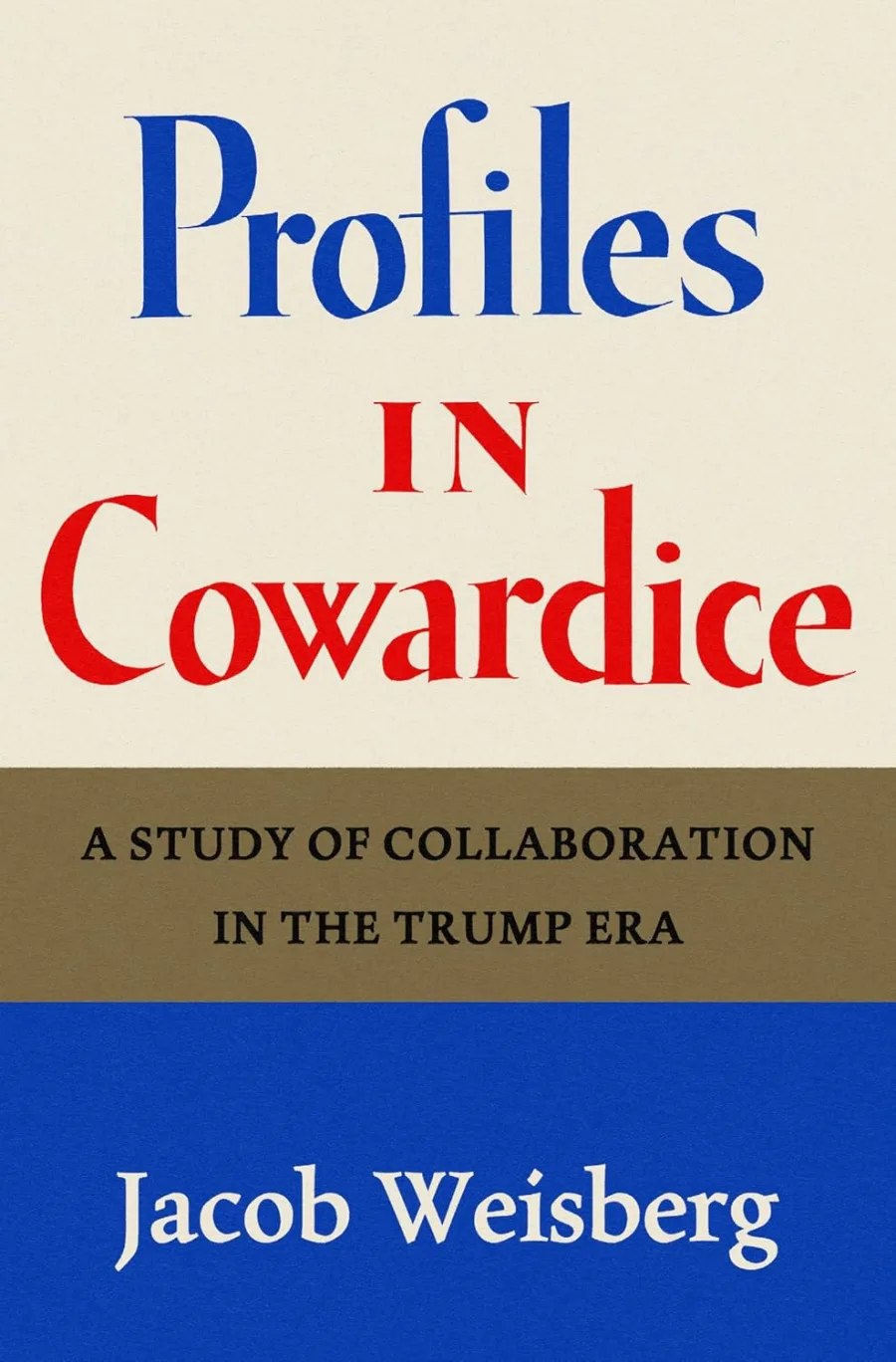
Download Cover Image
Do you want to download the full cover image for Profiles in Cowardice: A Study of Collaboration in the Trump Era?